
Why the right partner matters more than the right technology
Most companies spend weeks debating which tech stack to use — React vs Vue, AWS vs Azure, microservices vs monolith. That's understandable. But research consistently shows that project failures are almost never caused by technology choices. They're caused by misaligned expectations, poor communication, unclear ownership, and partners who overpromise and underdeliver.
Choosing the right software development partner is arguably the most important decision you'll make for your project. A mediocre tech stack with an excellent team will outperform a cutting-edge architecture run by a disorganized firm every single time.
The technology is the easy part. The humans are the hard part. Pick your team first, then build your stack around their strengths.
This guide exists because the questions buyers actually ask — "how do I know they'll deliver?" "who owns the code?" "what happens after launch?" — rarely get answered directly. We'll address every one of them.
7 criteria for evaluating any development partner
Not all criteria carry equal weight. The seven below, ranked in order of importance, will help you move from a long list of vendors to a shortlist of two or three genuinely capable partners.
Proven delivery track record
Can they show you completed projects in your industry or of similar complexity? Case studies, GitHub history, and verifiable client references matter far more than a polished website.
Communication & responsiveness
How quickly do they respond before you're a paying client? That speed is a direct preview of how they'll behave when you have a production incident at 2am.
Technical depth, not just breadth
Any firm can claim ‘full-stack’ expertise. Ask them to whiteboard your specific architectural challenge. The quality of their questions tells you everything.
Transparent processes
Do they work in sprints? How do they handle scope changes? What does their QA process look like? Vague answers here predict expensive surprises later.
IP & code ownership clarity
You should own 100% of everything built for you. Any ambiguity in the contract about intellectual property is a dealbreaker, full stop.
Post-launch support model
The project doesn't end at launch. Understand their SLAs, maintenance retainer options, and how they handle bugs found after handover.
Cultural & timezone fit
Overlap of even 4 working hours dramatically reduces friction. A firm that asks smart questions about your business — not just requirements — is a true partner.
Pro tip: Run a paid discovery sprint first
Before committing to a full project, ask your shortlisted partners to complete a 2-week paid discovery phase. You'll see their documentation quality, communication style, and thinking process — all before the real money is on the table.
10 red flags that reveal an unreliable firm
Due diligence isn't just about what a firm has — it's about what they don't say, don't ask, and don't show. These are the warning signs that experienced technology buyers have learned to watch for.
Warning signs experienced buyers don't ignore
- 01
They send a quote before understanding your requirements
Any firm that quotes a price in the first conversation is either guessing or using a template. Neither is a good start.
- 02
No verifiable client references
A Clutch.co profile with generic reviews isn't a reference. Ask for two clients you can actually call.
- 03
They agree with everything you say
A good partner will push back on bad ideas. ‘Yes, we can build that’ to every request means they're not thinking critically about your problem.
- 04
Vague or non-existent contract terms
If the contract doesn't clearly define deliverables, timelines, IP ownership, and exit clauses — walk away.
- 05
High staff turnover or undisclosed subcontracting
Ask directly: ‘Will the team that pitches us be the team that builds our product?’ Bait-and-switch staffing is rampant.
- 06
No security or compliance conversation
If you're in healthcare, finance, or handling user data, a partner that doesn't proactively raise security isn't the right fit.
- 07
Unrealistically low pricing
If their quote is 40% cheaper than everyone else's, ask why. The answer will reveal either a misunderstanding of scope or corners being cut.
- 08
No dedicated project manager or point of contact
Talking to a different developer every week is a sign of poor organization. You need one accountable person at all times.
- 09
Portfolio doesn't match your project type
An agency that's built 15 marketing websites isn't automatically qualified to build your enterprise SaaS platform.
- 10
Pressure to sign quickly
Artificial urgency — ‘this rate is only valid for 48 hours’ — is a manipulation tactic. A confident firm doesn't need to rush you.
Agency vs. development company vs. freelancer
This is one of the most common questions in early procurement, and the answer depends heavily on your project's size, timeline, and ongoing support needs.
Freelancer
Solo or small team, project-based
Best for small projects
- Lower hourly cost
- High flexibility
- Direct communication
- Single point of failure
- Limited capacity to scale
- No structured process
- Post-launch risk
Software Dev Company
Dedicated team, full lifecycle
Best for serious products
- Full team: devs, QA, PM
- Structured delivery process
- Scalable capacity
- Long-term partnership
- Post-launch support SLAs
- Higher cost (but predictable)
Digital Agency
Broad services, marketing-led
Best for brand + web
- Design + dev under one roof
- Strong UI/UX focus
- Brand consistency
- Weaker on complex logic
- May subcontract dev work
- Not built for enterprise
The “near me” question
Local doesn't automatically mean better. Many excellent software companies operate fully remote with clients across multiple time zones. What matters is communication overlap, not geography. That said, for regulated industries like healthcare or finance, local legal jurisdiction can matter for contracts and compliance.
Questions to ask before signing anything
These 12 questions will reveal more about a potential partner than any proposal document ever will. Use them in your final evaluation calls.
| Question to ask | What you're really testing | Category |
|---|---|---|
| “Can you walk me through a project that went wrong and how you handled it?” Honesty, crisis management, accountability | Honesty, crisis management, accountability | Trust |
| “Who will be our primary point of contact, and what is their availability?” Team structure, communication reliability | Team structure, communication reliability | Process |
| “How do you handle scope changes mid-project?” Change management maturity and flexibility | Change management maturity and flexibility | Process |
| “Can we see code from a past project (with NDA if needed)?” Code quality standards, documentation habits | Code quality standards, documentation habits | Technical |
| “What does your QA process look like?” Quality standards, bug detection before delivery | Quality standards, bug detection before delivery | Technical |
| “Who owns the IP and code once built?” Legal clarity, long-term asset control | Legal clarity, long-term asset control | Legal |
| “What is your post-launch support model?” Long-term reliability, maintenance capability | Long-term reliability, maintenance capability | Support |
| “Have you worked with companies in our industry before?” Domain expertise, compliance awareness | Domain expertise, compliance awareness | Experience |
| “How do you manage data security and access controls?” Security culture and awareness | Security culture and awareness | Security |
| “What would cause this project to fail, and how would we prevent it?” Self-awareness, risk planning, candor | Self-awareness, risk planning, candor | Trust |
| “Can we speak directly to two of your past clients?” Confidence, reference quality | Confidence, reference quality | Trust |
| “What's your exit clause if the relationship doesn't work out?” Contract fairness, professionalism | Contract fairness, professionalism | Legal |
Cost vs. quality trade-offs in outsourcing
Price is almost always the wrong primary selection criterion for software development. Here's why: a $50/hr developer who takes 3× as long and produces buggy code that requires a rewrite will cost you far more than a $120/hr developer who delivers clean, maintainable code on schedule.
The right question isn't “How much does it cost?” — it's “What is the total cost of ownership over three years, including maintenance and future feature development?”
A useful pricing framework
For a mid-complexity web application, expect $80,000–$250,000+ for initial build, depending on complexity. Monthly retainer for ongoing support typically runs $3,000–$12,000. If you receive a quote significantly below this, clarify what has been excluded before comparing numbers.
The hidden costs buyers forget
Knowledge transfer: Onboarding a new partner after a bad experience can cost 30–40% of the original project budget in lost time and documentation work.
Technical debt: Poor architecture decisions made early cascade into maintenance costs for years. A $10,000 saving at build time can cost $80,000 to unwind later.
Integration maintenance: Third-party APIs change. Who handles the maintenance when Stripe updates their payment flow or Twilio changes an endpoint?
Security patching: Libraries go stale. A partner with no ongoing maintenance plan is leaving you exposed.
Offshore, nearshore, or onshore?
Each model has genuine trade-offs. Offshore (e.g., India, Eastern Europe) offers significant cost savings — often 50–70% lower hourly rates — but requires more structured communication and longer async cycles. Nearshore (similar timezone, different country) balances cost and collaboration. Onshore is highest cost but easiest to manage for complex, regulated, or high-stakes projects. The best firms offer hybrid models that let you optimize.
Your evaluation checklist before signing
Use this before signing any development contract
Print this out or copy it into your procurement doc. Every unchecked item should prompt a direct conversation before you proceed.
- Verified at least 2 references who have spoken to us directly
- Reviewed live examples of completed work (not just mockups)
- Confirmed the core team (not just the sales team) who will work on our project
- Contract clearly defines deliverables, milestones, and acceptance criteria
- IP and source code ownership is explicitly assigned to us
- Scope change process is defined (how and at what cost)
- Post-launch support terms and SLAs are in writing
- Security and data handling obligations are stated in the contract
- Exit/termination clause is fair and workable
- Payment schedule is milestone-based, not time-based
- We have repository access and deployment credentials, not just the vendor
- NDA signed before sharing sensitive business requirements
The goal isn't to find the cheapest vendor or the most prestigious one. It's to find a team that will still be a great partner 18 months after launch, when the excitement has worn off and the real maintenance work begins.
Related infographic
The Strategic Guide to Evaluating and Selecting the Right Custom Software Partner
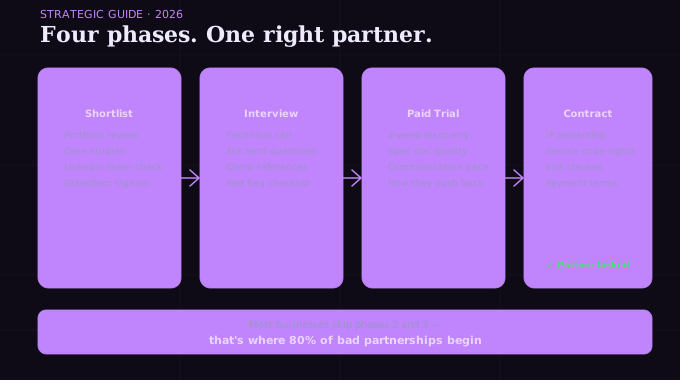
A four-phase vendor evaluation funnel — see the full visual summary.
Get our Partner Evaluation Scorecard
A one-page scoring template used by technology leaders to compare vendors side-by-side. Includes weighted criteria, red flag tracker, and a reference-check script.
🔒 No spam. Unsubscribe any time. Sent to 4,200+ technology buyers.