
Stop Guessing.Compare Software Vendors Like an Enterprise Buyer.
Download the professional Vendor Evaluation Toolkit used by technology leaders to compare software development companies, identify risks, evaluate technical capabilities, and make confident technology decisions.
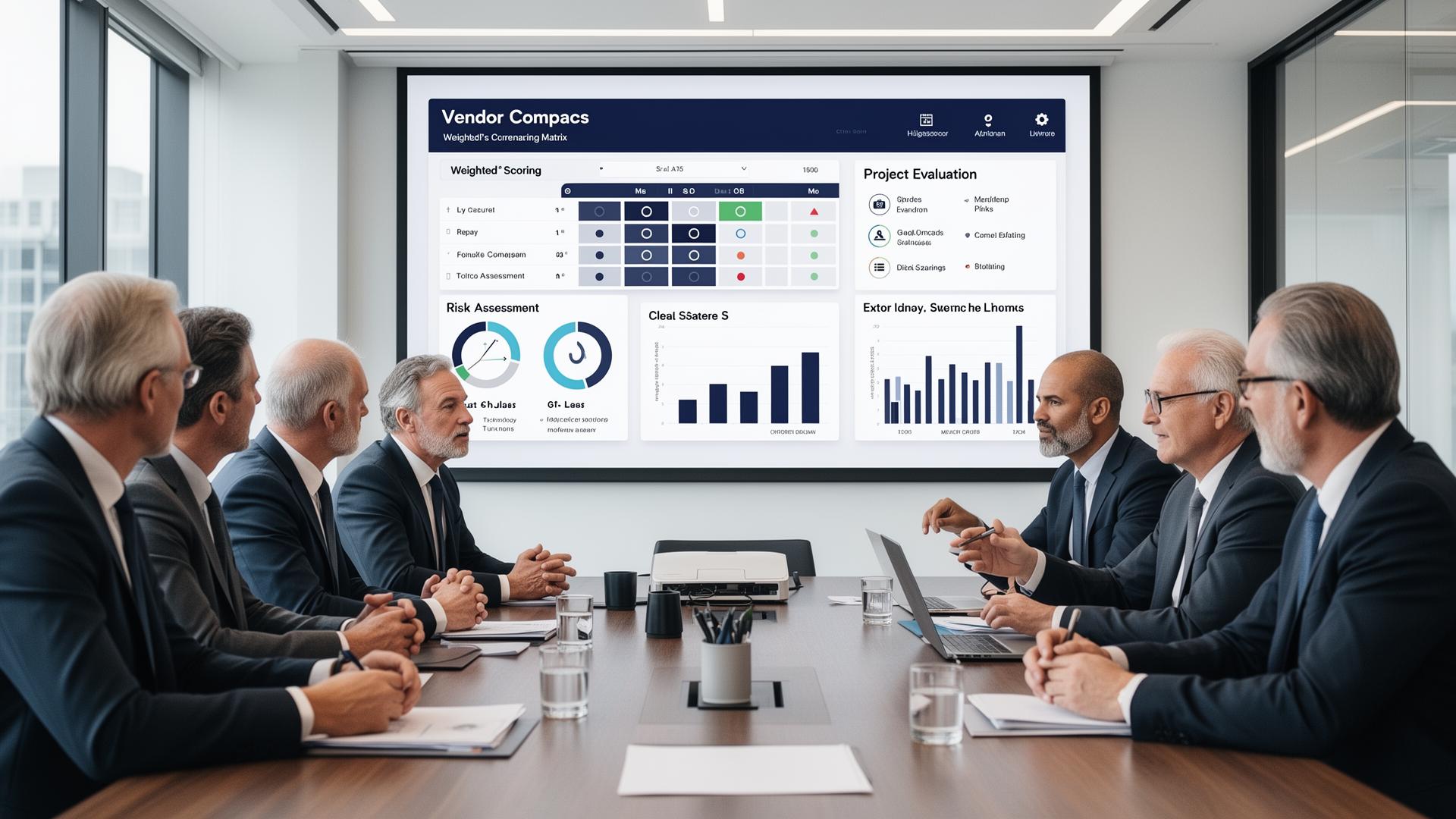
- Vendor Scoring Matrix
- Weighted Evaluation Framework
- Risk Assessment Matrix
- Reference Check Script
- Technical Due Diligence Checklist
- Executive Recommendation Dashboard
Download Your Free Vendor Evaluation Toolkit
Fill in the form below — we'll email you the toolkit instantly.
Everything You Need to Evaluate Vendors with Confidence
Vendor Scoring Matrix
Compare vendors objectively using weighted criteria.
Risk Assessment Framework
Identify project risks before signing contracts.
Technical Due Diligence Checklist
Verify technical capabilities and expertise.
Reference Check Script
Ask the right questions before making a decision.
Executive Dashboard
Summarize vendor evaluations quickly.
Budget & Value Assessment
Compare cost versus long-term business value.
Built for Businesses Making Technology Decisions
Businesses hiring software development companies
Organizations replacing legacy systems
Companies evaluating multiple vendors
Teams planning digital transformation
Businesses exploring AI automation
Companies selecting CRM partners
Avoid These Costly Vendor Selection Mistakes
Choosing based only on price
Not validating technical expertise
Ignoring code ownership
Weak security reviews
Poor support agreements
No discovery process
Unrealistic timelines
No client references
Why Businesses Choose ZANISS SOFTWARES
ZANISS SOFTWARES helps organizations build custom software solutions, CRM systems, AI automation platforms, cloud applications, and digital transformation initiatives.
Our approach focuses on business outcomes, technical excellence, transparency, and long-term partnership success.
Trusted by Growing Businesses
“The scoring matrix forced us to be objective. We narrowed 11 vendors down to 3 in a single afternoon and avoided a six-figure mistake.”
“The risk assessment template surfaced two contractual red flags our procurement team had completely missed. Worth its weight in legal fees.”
“Plug-and-play. We sent the reference check script to three vendor finalists and the responses made the decision obvious.”
Continue Your Research
How to Choose a Software Development Company in 2026
How to Evaluate a Custom Software Development Partner
Discovery Sprint Saves 6 Months of Wasted Code
Custom Software Development Services
AI Automation & IT Consulting Services
Browse the Infographics Library
Need Help Evaluating Software Vendors?
Let our experts help you compare vendors, evaluate risks, estimate costs, and create a successful project roadmap.
Frequently Asked Questions
How do I choose a software development company?+
Evaluate vendors on technical expertise, relevant case studies, communication, delivery process, security practices, code ownership, and total cost of ownership. Use a weighted scoring matrix (like the one in our toolkit) so the decision is objective rather than gut-feel.
What questions should I ask software vendors?+
Ask about their delivery methodology, team composition, code & IP ownership, security/compliance posture, deployment & DevOps practices, post-launch support SLAs, and references from clients in your industry. Our Reference Check Script gives you 25+ vetted questions.
How do I compare software development companies?+
Use a weighted evaluation framework: assign weights to each criterion (technical fit, cost, risk, support, references) based on what matters most for your project, then score each vendor. The toolkit ships with a ready-to-use scoring matrix.
What are red flags when hiring developers?+
Vague proposals, no discovery process, refusing to share past code samples or references, unclear IP ownership terms, weak security practices, unrealistic timelines, lowball pricing, and lack of post-launch support agreements.
How much does custom software development cost?+
Typical ranges in 2026: simple MVPs $10K–$25K, mid-complexity SaaS $25K–$80K, enterprise platforms $80K–$300K+. Cost depends on scope, integrations, compliance, and team location. Always compare total cost of ownership — not just upfront price.
What should be included in a vendor evaluation?+
Capability fit, technical due diligence, security review, references, financial stability, cultural fit, contract & IP terms, support SLAs, and a risk matrix. The toolkit includes templates for all of these.
How do I verify technical expertise?+
Request code samples or live demos, review GitHub/case studies, run a paid discovery sprint or technical interview, and ask scenario-based questions. Validate certifications (cloud, security) and check references from technically literate clients.
Should I choose a local or remote development company?+
Both work in 2026. Remote partners offer wider talent pools and often better economics; local partners offer easier in-person collaboration. What matters more is process maturity, communication cadence, and timezone overlap with your team.
How do I reduce software project risks?+
Run a paid discovery sprint, lock scope and acceptance criteria upfront, demand weekly demos, use milestone-based payments, secure code ownership in the contract, and bake security/QA reviews into the delivery process.
What happens after project launch?+
Strong vendors provide a defined support SLA, a maintenance plan, monitoring and observability, security patching, and a roadmap for iteration. Confirm post-launch terms before signing — the toolkit has a checklist.