Infographic 12 · ZANISS SOFTWARES

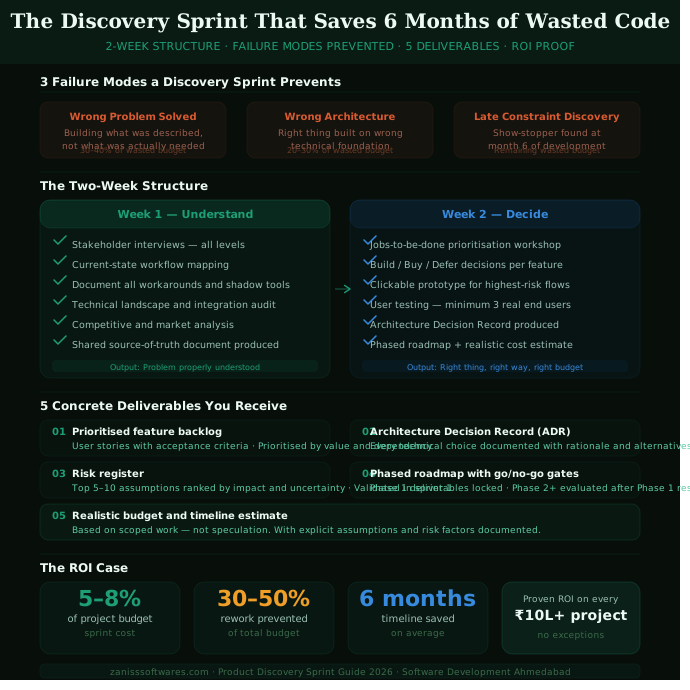
The Discovery Sprint That Saves 6 Months of Wasted Code

A discovery sprint costs ₹3–6L. Skipping it costs ₹15–30L in rebuilds and four to six months of delay — a 3–5× return before production is even deployed. This page walks through what actually happens in a 10-day discovery sprint, the integration-validation step nobody does, and the deliverables you walk away with.

The Discovery Sprint That Saves 6 Months of Wasted Code — infographic by ZANISS SOFTWARES
The Discovery Sprint That Saves 6 Months of Wasted Code · Source: ZANISS SOFTWARES — free to share with credit and a link back to this page.

Key takeaways

  • 70% of software project failures are caused by poor requirements — a discovery sprint resolves them before money is committed
  • Sprint cost ₹3–6L vs typical rebuild cost ₹15–30L plus 4–6 months delay — a 3–5× return before deployment
  • Five deliverables: validated problem statement, prioritised feature list, architecture decision record, clickable prototype, 6–12 month roadmap with budget
  • Most valuable when stakeholders have different definitions of success, third-party integrations are involved, or a fixed price is needed before build
  • The prototype is a tool for stakeholder alignment and risk validation — designed to surface disagreements when they cost a conversation, not a sprint

What Happens in a 10-Day Discovery Sprint

Days 1–3 are stakeholder interviews and business-model mapping. Every stakeholder's definition of success is documented and reconciled. The single most common cause of software project failure is that product, engineering and business leadership had different assumptions about what was being built from day one. This phase eliminates that ambiguity. Days 4–6 cover user journey and workflow documentation. The current state of every relevant workflow is mapped in detail — including manual steps, workarounds and undocumented tribal knowledge. The future state is then defined in terms of measurable user outcomes, not feature lists. A feature list describes what to build; a user outcome describes what the build must achieve.
Technical Audit and Architecture — The Integration Validation Nobody Does

Days 7–9 are the technical audit and architecture options phase. Every third-party integration is validated — not assumed. Every technology choice is evaluated against the specific constraints of the project: data volume, compliance, team expertise, long-term maintenance cost and scalability ceiling. Two or three architecture options are documented with explicit trade-offs. A recommendation is made with a written rationale. The integration-validation step is the most commonly skipped and most commonly regretted. An API assumed to support a feature but in practice requiring a premium tier, or one that is deprecated with insufficient notice, is among the most common causes of mid-project scope changes. Discovering this in day eight of discovery costs a design revision; discovering it in week twelve of engineering costs a rebuild.

Day 10 — Prototype, Roadmap, and Stakeholder Sign-Off

The final day is a presentation to all stakeholders. A clickable prototype of the highest-risk or most complex screens is reviewed together — the first time most teams see a concrete representation of what they agreed to build. A phased 6–12 month roadmap with realistic cost ranges per phase is presented. Every risk identified during the audit is mapped to a mitigation strategy. Every stakeholder signs off before engineering begins. A discovery sprint that costs ₹5L and prevents one major architectural rework — which typically costs ₹15–25L in engineering time plus three to five months of delay — delivers a 3–5× return before the first production deployment.

Frequently asked questions

What is a discovery sprint in software development?
A discovery sprint is a structured pre-development phase focused on defining exactly what will be built, how it will be built, and what it will cost — before any production code is written. It produces wireframes, a technical specification, a development roadmap, and an accurate cost estimate. The goal is to eliminate ambiguity before it becomes expensive to resolve.
How long does a discovery sprint take?
Most discovery sprints run for 2–4 weeks depending on project complexity and the number of stakeholders involved. Simple applications with well-defined requirements can be scoped in 2 weeks. Complex platforms with multiple user roles, integrations, and data requirements typically need 3–4 weeks to cover thoroughly. The output should be detailed enough to hand directly to a development team.
Is a discovery sprint necessary for small software projects?
For simple projects with fully defined, unchanging requirements, a discovery sprint may not be needed. However, for most real-world projects — where requirements are partially defined, integrations exist, or stakeholders have different expectations — even a 1–2 week requirements and wireframing phase pays for itself by preventing misaligned builds and mid-project scope changes.

Want this applied to your business?

Book a free consultation and we'll map this framework to your project — no fluff, no sales pressure.