Infographic 3 · ZANISS SOFTWARES

Why Your Business Needs Digital Marketing in 2026

India crossed 900 million internet users in 2025. Your customers — procurement managers, retail consumers, SME founders — are conducting online research before they ever speak to sales. Businesses that are not visible in those moments are not losing to a competitor's product; they are losing to a competitor's visibility. This page covers the structural shift, the compounding advantage of organic investment, and where to start.

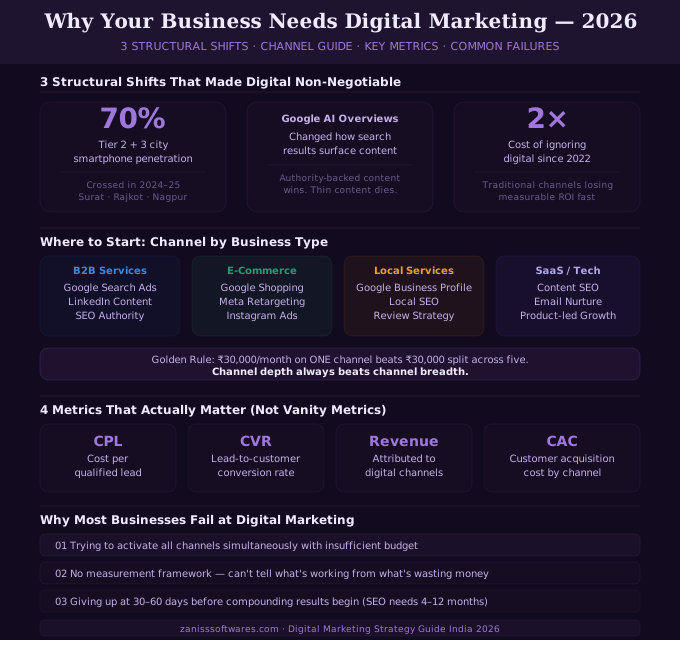
Why Your Business Needs Digital Marketing in 2026 — infographic by ZANISS SOFTWARES
Why Your Business Needs Digital Marketing in 2026 · Source: ZANISS SOFTWARES — free to share with credit and a link back to this page.

Key takeaways

  • 93% of Indian purchase decisions now involve online research — higher still for B2B
  • Consistent 24+ month investment delivers CAC 3–5× lower than start-and-stop competitors
  • Digital marketing provides attribution traditional marketing cannot — every lead, channel, and cost is measurable
  • The cost of not investing is invisible but compounding — competitors are building authority you cannot match later
  • Treat digital marketing as a system, not a campaign — consistent investment outperforms burst campaigns over any 12-month period

The Audience Is Already Online — The Question Is Whether You Are Visible

Buyers in 2026 read reviews, compare providers and form opinions about your brand before they ever speak to a salesperson. The question is not whether to invest, but how to invest in a way that compounds rather than disappears when the budget runs out. Businesses that began investing in organic digital assets three years ago now have structural cost advantages their competitors cannot replicate overnight.
The Compounding Advantage of Organic Digital Investment

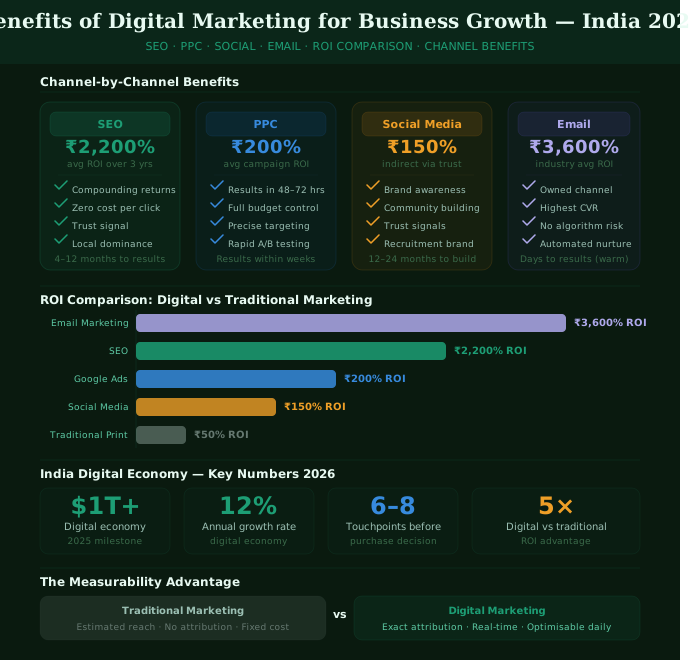
A television advertisement generates impact for exactly as long as it runs. An SEO-optimised article, a well-produced YouTube video, or a systematically grown email list generates impact indefinitely — and reach grows over time as domain authority, subscriber count and social proof accumulate. SEO compounds in a specific way: each page that reaches page one generates qualified leads at zero incremental cost per visit. A blog post ranking for 'custom software development company in Ahmedabad' continues generating enquiries for years after the initial investment.

The Precision of Paid Channels and Why They Need Organic to Work

Google Ads captures demand that already exists — people searching for exactly what you sell — which makes it one of the highest-ROI paid channels for businesses with a clear offer and a defined customer. But paid acquisition without organic authority is expensive and fragile. Google's Quality Score algorithm rewards landing pages with strong organic signals, meaning businesses with established domain authority pay less per click for the same keywords. The most efficient model combines Google Ads for immediate pipeline with SEO for long-term cost reduction — lowering blended cost per lead by 50–70% over 18–24 months. The highest-ROI starting point: optimise your Google Business Profile, launch targeted Google Ads on your highest-intent keywords, and publish two to four long-form articles per month.

Frequently asked questions

Why is digital marketing important for small businesses in 2026?
Small businesses in 2026 compete in markets where the majority of discovery happens online. Without a digital presence — through SEO, paid ads, or social media — a small business is invisible to the majority of potential customers who are actively searching for what it offers. Digital marketing levels the playing field, letting smaller businesses compete directly with larger ones.
How much should a business spend on digital marketing?
A common benchmark is 7–12% of revenue for established businesses and 12–20% for businesses in growth mode or entering new markets. In India, a meaningful digital marketing programme — covering SEO, content, and Google Ads — can be started effectively from ₹30,000–₹80,000 per month depending on industry competition and goals.
What digital marketing channels give the best ROI?
For most B2B businesses, SEO and Google Ads deliver the highest ROI because they capture active purchase intent. For e-commerce and B2C brands, paid social and email marketing typically outperform. The highest-ROI approach combines SEO for long-term organic growth with Google Ads for immediate pipeline — with performance tracked at the lead and conversion level.

Want this applied to your business?

Book a free consultation and we'll map this framework to your project — no fluff, no sales pressure.