Infographic 5 · ZANISS SOFTWARES

Custom Software vs Ready-Made Software — How to Choose in 2026

Build vs buy is one of the most expensive decisions a growing company makes — and most teams get it wrong in both directions. This page gives you the decision framework, the scenarios where each path wins clearly, and the three questions that almost always settle the debate before you spend a rupee on the wrong path.

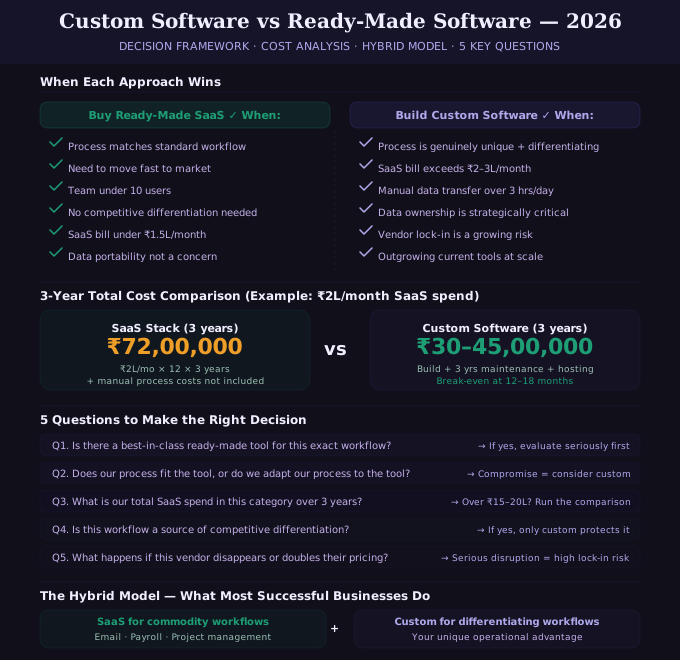
Custom Software vs Ready-Made Software — How to Choose in 2026 — infographic by ZANISS SOFTWARES
Custom Software vs Ready-Made Software — How to Choose in 2026 · Source: ZANISS SOFTWARES — free to share with credit and a link back to this page.

Key takeaways

  • Off-the-shelf wins on speed and initial cost — custom wins on fit, scalability and 3-year TCO; break-even is typically 18–24 months
  • The right question is not 'custom or off-the-shelf?' but 'how much of our competitive advantage depends on technology nobody else has access to?'
  • Hybrid — custom core with best-in-class SaaS integrations around it — often delivers the best mid-market outcome
  • A discovery sprint identifies which parts of your workflow genuinely require custom logic and which can use existing tools
  • SaaS per-user pricing that is manageable at 20 users often becomes the dominant line item on your tech budget at 200 users

When Off-the-Shelf Software Wins

Commodity workflows should almost always be served by commodity software. If you are managing standard HR processes, basic accounting or a generic CRM pipeline, purpose-built SaaS handles these better than a custom build would — at a fraction of the cost and timeline. Salesforce, QuickBooks and Zoho exist precisely because these workflows are universal and do not confer competitive advantage. Building custom versions is an investment that generates no return. Speed to market is the second clear scenario: if you need a solution running in 30 days, SaaS is faster than building in almost every case.
When Custom Software Wins

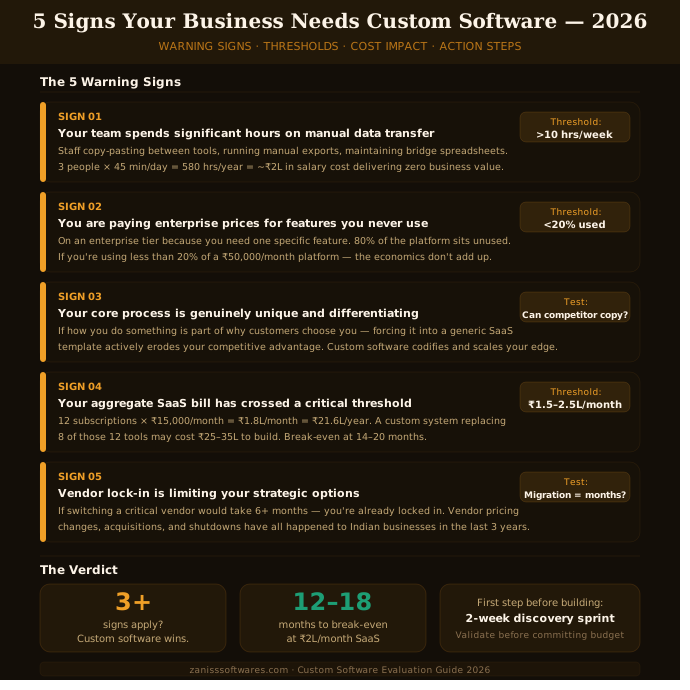
Custom software earns its investment when the workflow being automated is genuinely unique to your business model. If your pricing logic, operational process, customer experience or data structure is meaningfully different from competitors, that differentiation needs to be encoded in software only you have access to. Buying an off-the-shelf tool and configuring it to approximate your process means permanently compromising your differentiation to fit a system designed for someone else. Integration complexity is the second scenario: when four or more systems need to share data in real time and no off-the-shelf tool handles all of them, the cost of manual bridges typically exceeds the cost of a purpose-built integration layer within 12–18 months. Scale is the third driver — per-user pricing that is reasonable at 20 users becomes the dominant cost on a technology budget at 200 users.

The Three Questions That Decide Build vs Buy

Before committing to either path, answer three questions honestly. First: is this workflow genuinely unique to our business model, or are we doing what every business of our type does? Second: will we still be using this in three years, and will it need to scale significantly? Third: does owning this process as a proprietary system give us a competitive advantage that would be visible to our customers or inaccessible to our competitors? If the answer to all three is yes, custom software is the right investment. If the answer to any is no, the honest answer is probably a SaaS tool, a targeted integration or a hybrid approach.

Frequently asked questions

What is the difference between custom and ready-made software?
Ready-made software is a pre-built product sold to many businesses, while custom software is developed specifically for one organisation's unique requirements. Ready-made is faster and cheaper to start; custom is more flexible, scalable, and strategically valuable long-term.
Is custom software worth the investment for small businesses?
It depends on how unique your operations are. For small businesses with standard workflows, ready-made tools often suffice. However, if your business has processes that no off-the-shelf tool handles well, custom software can pay for itself quickly by eliminating workarounds, reducing errors, and improving team efficiency.
How long does it take to build custom software in India?
A basic custom web application typically takes 6–12 weeks. A full CRM, ERP, or multi-module business platform can take 3–6 months depending on complexity. ZANISS SOFTWARES runs a discovery sprint before every project to define scope accurately and give you a realistic timeline before development begins.

Want this applied to your business?

Book a free consultation and we'll map this framework to your project — no fluff, no sales pressure.