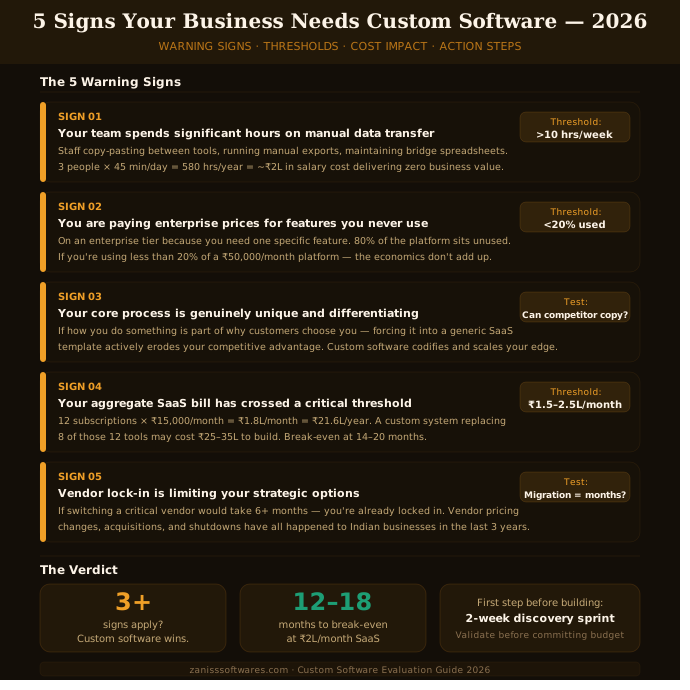
Signs 1 & 2 — Spreadsheets as a System, and Tools That Don't Talk
Spreadsheets are not a system — they are a symptom. When a business of more than five people coordinates critical operations through shared Excel or Google Sheets files, it signals that no purpose-built system exists for that workflow. Common manifestations: a 'master tracker' only one person fully understands, weekly reconciliation meetings whose primary purpose is determining whose version is correct, and data one accidental deletion from being permanently lost. Sign 2: every time an employee copies data from one system to another, you are paying for a manual integration that should not exist. A five-minute data-transfer task done twice a day by three people is 250+ hours per year; a 2% error rate on 10,000 manual entries a month means 200 incorrect records per month each requiring identification, investigation and correction.
Signs 3 & 4 — Paying for Features You Don't Use and a Stack That Can't Scale
SaaS platforms are built for the median customer. If your business model, pricing or workflow is non-standard — and most growing businesses are — you find yourself constantly requesting features on a 'roadmap', paying for a tier that includes things you will never touch, or building manual workarounds for the 20% of your process the tool does not cover. Custom software is scoped exactly to what you need. Sign 4: a system that handles 100 transactions a day often breaks at 1,000; a workflow manageable at eight users becomes a bottleneck at 80. Performance ceilings, permission-model limitations and pricing structures that scale badly are early signs of technology debt that becomes significantly more expensive to solve the longer it is deferred.
Sign 5 — Losing Competitive Advantage Because Competitors Move Faster
When a competitor can offer a feature, a service model or a customer experience you cannot replicate because your systems do not support it, your technology has become a strategic constraint. Custom software converts technology from a cost centre into a competitive differentiator — a system that encodes your specific advantage in a way no off-the-shelf tool can replicate or sell to your competitor next quarter. Hit two of these five signs and the ROI of a custom build is usually 6–9 months. ZANISS SOFTWARES offers a free 30-minute consultation where we review your current systems, identify your highest-priority constraint, and give you an honest assessment of whether custom software, a targeted integration or a different off-the-shelf configuration is the right next step.
Frequently asked questions
- How do I know if my business needs custom software?
- The clearest indicators are: your team maintains manual workarounds daily, your tools don't integrate and require manual data reconciliation, your off-the-shelf software is approaching its scaling limits, or you have compliance requirements your current platform doesn't meet. If two or more of these are true, a custom solution will almost certainly deliver positive ROI within 12–18 months.
- Is custom software development worth the cost for SMEs?
- For SMEs with complex or unique operations, yes — often significantly so. The calculation is straightforward: add up the hours per week your team spends on workarounds, manual data entry, and processes your software doesn't handle. Multiply by hourly labour cost and annualise it. That number often equals or exceeds the cost of custom development within the first year.
- How long does it take to build custom business software?
- Most custom business applications — CRMs, operations platforms, client portals, workflow tools — take 8–20 weeks to design, build, and deploy depending on complexity. ZANISS SOFTWARES runs a discovery sprint before every project to define requirements, resolve architectural decisions, and produce a timeline and budget estimate before development begins.