In this article
Quick Summary
- 1SaaS is built for the average user; if your operation is the differentiator, the average tool is actively diluting it.
- 2Per-seat pricing scales linearly with headcount. At 100 users on ₹2,000/month, you're spending ₹24L/year before any custom work begins.
- 3If three people on your team spend their day moving rows between tools in spreadsheets, you've already paid for half a custom build.
- 4The right time to build is usually 18 months earlier than you think — once SaaS costs are obviously broken, you're already overdue.
Most teams don't choose to build custom software — they back into the decision after their SaaS stack has quietly grown into something nobody fully understands. The CRM was added in 2022, the inventory tool in 2023, the WhatsApp integration in early 2024, the analytics dashboard last quarter. By the time someone runs the numbers, the monthly SaaS spend has crossed ₹3 lakh and three people on the team are essentially being paid to copy data between systems.
That's the moment. Not the marketing-flavoured "scale your business" version — the much more boring version where the spreadsheet glue between your tools has become a full-time job that nobody put in the org chart.
Why this happens to almost every growing business
SaaS tools are built for the median customer. That's their economic model — solve the 80% case beautifully and ignore the rest. When you're small, you're close enough to the median that it doesn't matter. As you grow, the gap between "how the SaaS thinks the workflow should run" and "how your business actually wins customers" widens. Eventually the workarounds outweigh the convenience.
Five signals it's time to build, with the math behind each
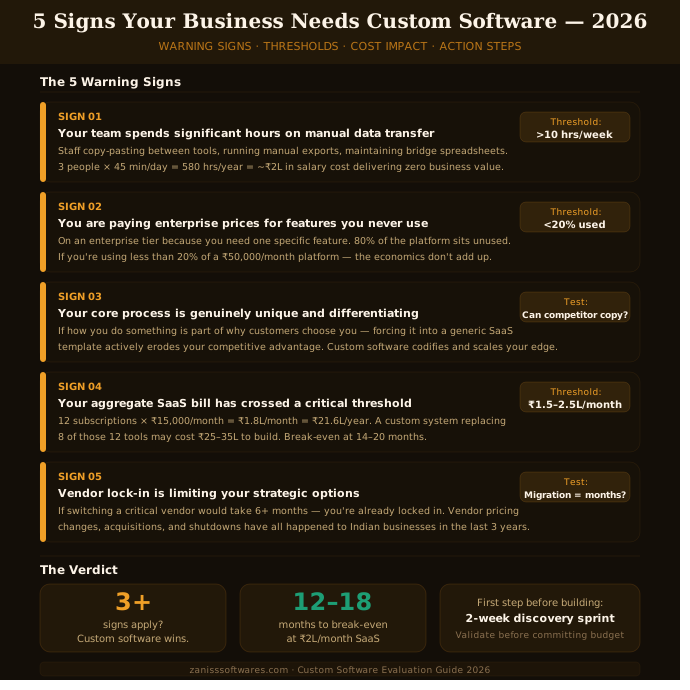
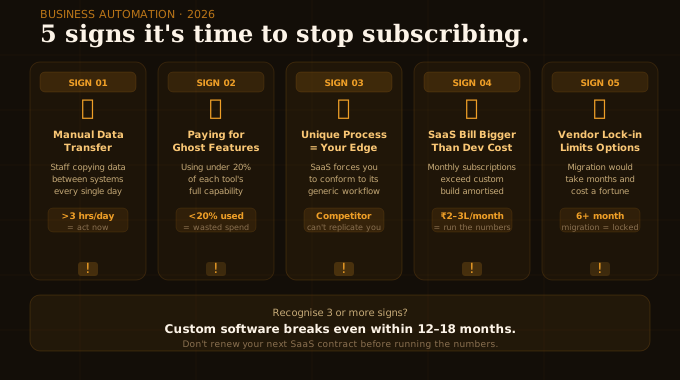
1. You're paying for 100% of the platform and using maybe 25%
Audit your last quarter's logins. The typical mid-market SaaS deployment uses about 20–30% of available features but pays the full enterprise tier. The seat licence, the extra storage, the "advanced" reporting module nobody touches — it's all in there. Migrating only the features you use to a focused custom tool can compress license spend by 60–80%, sometimes more.
2. The "spreadsheet bridge" has become a job description
Look at how data actually moves between your CRM, your billing system, and your fulfilment tool. If the answer involves a Google Sheet, a Zapier flow that breaks weekly, or a person whose calendar has a recurring "data sync" block — that's manual integration cost the budget never sees. We routinely find ops teams reclaim 15–30% of their week by collapsing the bridge into one purpose-built system. At ₹50K/month per person, the payback math is brutal.
3. SaaS spend is growing faster than headcount or revenue
Plot two lines for the last 24 months: monthly SaaS spend, and revenue. If the SaaS line slopes up faster, you're being squeezed by per-seat pricing and renewal increases compounding. A typical ₹2,000/user/month tool at 100 users costs ₹24 lakh in year one and usually ₹28–30 lakh by year two as renewals tick up 8–15%. Multiply that across four tools and the slope becomes the problem.
4. You've started saying "we'd do it that way, but the software won't let us"
This is the cultural signal that matters most. The moment your team starts shaping process around tool limitations rather than customer needs, you've handed your competitive edge to a vendor product manager in another country. If the workflow is genuinely your moat — the way you onboard, fulfil, or service customers — the right answer is to build it the way you actually do it, not the way HubSpot's wizard expects.
5. Compliance, residency, or audit requirements have changed the conversation
Healthcare PHI under HIPAA-equivalent norms, RBI-regulated payment data, government contracts with data-residency clauses, or any industry where an auditor wants to know exactly where data sits and who can read it — these turn SaaS from "convenient" into "the harder answer." A custom system on your own AWS or Azure account, with documented IAM policies and tested backups, is the cleaner audit story and often the cheaper one over a 3-year horizon.
The hidden one: integrations that never quite work
If your CRM, ERP, and marketing tools all "have integrations" but your team still copies data between them on Mondays — the integrations don't work. Usually because each tool's idea of a "customer" is slightly different (different fields, different IDs, different update windows) and the SaaS connectors don't reconcile the differences. A custom orchestration layer that owns the canonical customer record and syncs to each SaaS via webhook fixes this once instead of being patched forever.
Planning a Website? Don't Overpay or Underbuild
Most businesses overspend on features they don't need — or underspend and rebuild within a year. We help you scope it right from day one.
SaaS vs custom — the reality table
| Dimension | SaaS | Custom |
|---|---|---|
| 3-year TCO at 100 users | ₹70–90 lakh, growing | ₹35–55 lakh, flat |
| Time to first value | Days–weeks | 3–6 months |
| Workflow fit | Bend your process to the tool | Tool fits the process |
| Data ownership | Vendor's database | Your cloud account |
| Vendor risk | Pricing, pivots, shutdowns | Maintenance and on-call you control |
When NOT to build custom (the honest counter-argument)
Don't build custom if you're under 12 months old, if your process is genuinely standard (payroll, accounting, helpdesk), if your team is under 15 people, or if you don't yet have a stable workflow worth codifying. SaaS is the faster and cheaper answer for those cases — and a healthy company should still leave 30–50% of its software stack on SaaS even at scale.
Signals you're actually ready
- Revenue is growing 30%+ year-on-year and likely to keep doing so.
- Operations involve at least one workflow that doesn't fit the SaaS template cleanly.
- Total SaaS spend has crossed ₹2–3 lakh/month and renewals are biting.
- Your operations lead can describe the ideal workflow in detail — that's the foundation a discovery sprint will turn into specs.
Related reading
For the deeper framework: custom vs ready-made software (the 3-year math), how to choose a development partner, and the India website cost guide.
Ready to explore your options? Start by reading how to identify the right software development company in Ahmedabad for your specific needs.
Want the build-vs-buy math run on your stack?
We do this for free in a 60-minute working session — pull up your invoices, your ops workflow, and we'll model the 3-year TCO of staying on SaaS vs replacing the operational core with custom software development. contact us when you're ready to see the real number.
Pro Insight
Planning a cloud-native platform? Let's review your architecture for free.
At ZANISS SOFTWARES, we don't just build websites — we build growth systems.
- ✓SEO-first architecture
- ✓Conversion-focused design
- ✓High-speed performance
- ✓Scalable, future-proof code
📩 Response within 24 hours
Frequently Asked Questions
When should a business switch to custom software?
When SaaS costs are scaling faster than revenue, when the team is using spreadsheets to bridge tools, when compliance forces data control, or when the workflow you're contorting is the one that wins customers.
Can custom software replace multiple SaaS tools?
Often yes — particularly for the operational core (orders, inventory, customer ops). Generic functions like email, payroll, and accounting are usually still cheaper to leave on SaaS and integrate via API.