In this article
Quick Summary
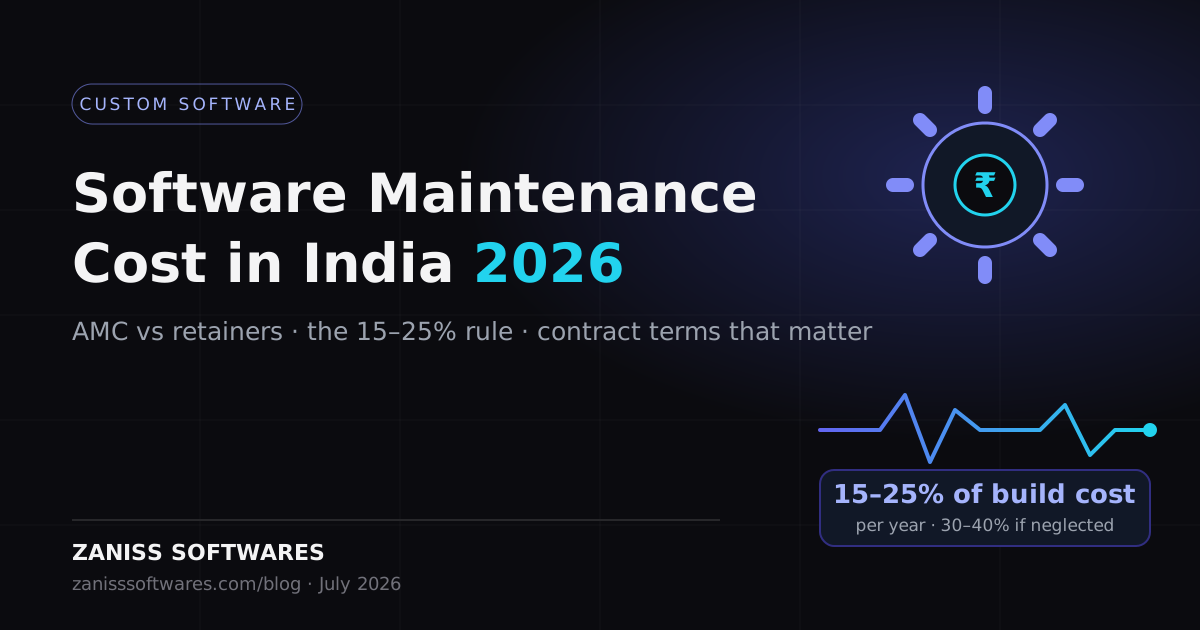
- 1Plan for 15–25% of your original build cost per year — neglected legacy systems push it to 30–40%.
- 2Business website ₹15K–₹75K/year; web app ₹1.2–₹4.8L/year; mobile app ₹1.8–₹6L/year; custom ERP/CRM ₹3–₹12L/year.
- 3The engagement model matters as much as the number: ad-hoc hourly work looks cheapest and usually costs the most.
- 4A serious contract has a response-time SLA, proactive monitoring, defined scope, monthly reporting, hour rollover, and a clean-exit clause.
Every pricing conversation we have starts with build cost. Almost none start with run cost — and yet the system you launch will spend far more years being maintained than being built. We've inherited enough neglected codebases from other vendors to know exactly what skipping maintenance costs: the ₹5 lakh platform that needed a ₹9 lakh rescue because nobody applied a security patch for two years is not a hypothetical for us. It's a Tuesday.
So this guide covers the question that should be asked at every kickoff and rarely is: what does it actually cost to keep software healthy in India in 2026 — and which engagement model (AMC, monthly retainer, or ad-hoc) fits which kind of system?
What "maintenance" actually includes
Maintenance is not "fixing bugs when someone complains." Proper support covers four distinct types of work, and a contract that only covers the first one is a liability dressed up as a line item:
| Type | What it covers | If you skip it |
|---|---|---|
| Corrective | Bug fixes, error handling, broken flows | Users find your bugs before you do |
| Adaptive | OS/browser updates, dependency upgrades, API changes | The app breaks when something else changes |
| Preventive | Security patches, monitoring, backups, performance tuning | Small issues compound silently into outages |
| Perfective | Small improvements, UX tweaks, minor features | The product stagnates while competitors iterate |
The invisible half of this list — adaptive and preventive — is where most of the real risk lives. Frameworks ship breaking releases, payment gateways deprecate APIs, app stores change submission rules, and vulnerability disclosures don't wait for your convenience. None of that work is triggered by a user complaint, which is exactly why unmanaged systems rot quietly.
The 15–25% rule — and when it breaks
The industry benchmark has held steady for years: annual maintenance costs 15–25% of the original development cost. Build for ₹10 lakh, budget ₹1.5–₹2.5 lakh a year to keep it healthy. The number lands at the lower end for modern, well-documented stacks with few integrations, and at the higher end for systems with heavy third-party surface area, compliance requirements, or real traffic.
The rule breaks in one predictable direction: legacy systems with accumulated technical debt run 30–40% of build cost per year. Every year of deferred upgrades makes the next patch more expensive — the compounding problem we mapped in The Tech Debt Iceberg. Past a certain point, maintenance spend on a legacy system exceeds the amortised cost of modernising it, which is when the conversation changes to the strangler-fig playbook.
What maintenance costs by system type (India, 2026)
See the cost table above for the by-system breakdown. Mobile deserves its own caveat: app maintenance is structurally more expensive per rupee of build cost because two OS vendors force your hand annually — iOS and Android releases, new device sizes, and store policy changes each generate mandatory adaptive work whether or not you want new features.
The four engagement models — and which one quietly overcharges you
Ad-hoc hourly. ₹1,200–₹2,500/hour for senior Indian engineering time, no commitment, no SLA. Looks cheapest; usually isn't. You pay a context-switching premium on every incident, nobody is monitoring anything between calls, and emergencies bill at emergency rates — 2–3x standard. Acceptable only for systems you could afford to lose for a week.
Annual Maintenance Contract (AMC). A fixed annual fee — typically that 15–25% band — for a defined scope: patches, backups, uptime monitoring, a fixed bug-fix allowance, and scheduled updates. Predictable and budgetable. The catch is scope: an AMC that excludes dependency upgrades or caps "incidents" at a token number is an ad-hoc contract in disguise. Read what's excluded before what's included.
Monthly retainer. A bank of hours (usually 10–40/month) with a response-time SLA, covering everything from patches to small feature work. ₹25,000–₹1 lakh/month covers most SME systems. This is the model most of our clients land on, because it flexes: quiet months go to preventive work and small improvements instead of expiring unused — if your contract includes rollover, which it should.
Dedicated support engineer. ₹1.2–₹2.5 lakh/month for a named engineer embedded on your systems. Justified when you're running multiple production applications or an enterprise platform where four business hours of downtime is a board-level event.
What maintenance costs by system type (India, 2026)
| System type | Price Range | Best For |
|---|---|---|
| Business website (CMS/marketing site) | ₹15,000 – ₹75,000 / yr | Build cost ₹50K–₹3L · ₹1,250–₹6,250/month equivalent |
| Web application / customer portal | ₹1.2L – ₹4.8L / yr | Build cost ₹8–₹25L · ₹10,000–₹40,000/month equivalent |
| Mobile app (iOS + Android) | ₹1.8L – ₹6L / yr | Build cost ₹10–₹30L · ₹15,000–₹50,000/month equivalent |
| Custom ERP / CRM | ₹3L – ₹12L / yr | Build cost ₹15–₹60L · ₹25,000–₹1L/month equivalent |
| Enterprise platform (integrations, compliance) | ₹15L+ / yr | Build cost ₹1 Cr+ · ₹1.25L+/month equivalent |
Planning a Website? Don't Overpay or Underbuild
Most businesses overspend on features they don't need — or underspend and rebuild within a year. We help you scope it right from day one.
What actually drives your number
Six factors move you within (or out of) the 15–25% band: stack age (a 2019-era framework costs more to keep patched than a current LTS); dependency surface (every third-party API is someone else's breaking change waiting for you); compliance load (fintech and health platforms carry audit and patching obligations others don't); traffic and data volume (performance tuning is a real workload at scale); integration count (ERP-connected systems break when the ERP sneezes); and documentation quality (undocumented systems bill discovery time on every single ticket — one reason we hand over full documentation and repository access as standard).
The cost of not maintaining
The failure pattern is boringly consistent. Months 1–6: nothing visible happens, and the budget line looks like waste. Months 6–18: dependencies drift out of support, a payment or WhatsApp or maps API deprecates, and the first "urgent" invoice arrives at emergency rates. Months 18–36: unpatched vulnerabilities accumulate, performance degrades, and the vendor who built it has reassigned the team — so a new vendor bills discovery time on a codebase nobody remembers. By year three, you're holding quotes for a rescue project that costs more than disciplined maintenance would have cost over the entire period.
If you're already in that third act, start with a software audit before signing anything — rescue quotes without an audit are guesses.
What a serious maintenance contract includes
Six things to demand in writing: a response-time SLA by severity (critical issues acknowledged within 4 business hours, not "as soon as possible"); proactive monitoring with alerts the vendor sees before you do; a defined scope listing patches, backups, dependency updates and bug-fix allowances explicitly; a monthly written report of work done, incidents handled and risks flagged; rollover or reallocation of unused retainer hours toward preventive work; and an exit clause with handover — documentation, credentials and repository access returned without ransom.
That last one tells you everything about a vendor. Anyone who resists a clean-exit clause is planning to charge you for captivity, a pattern we warned about in our buyer's guide to choosing a software development company.
Red flags, briefly: "unlimited support" with no SLA (unlimited and unenforceable are the same thing), pay-per-incident-only pricing (the vendor profits from your outages), no staging environment (they're testing in production), and no monitoring (support that starts when you call is not support — it's billing).
AMC, retainer, or ad-hoc: the decision in three questions
How much does an hour of downtime cost you? If the answer is "real money" — orders lost, operations stalled — you need an SLA, which rules out ad-hoc. Does the system change often? Frequently-evolving products fit retainers (fixes and improvements share one hours bank); stable systems fit AMCs. Is it revenue-critical or compliance-bound? Then budget the top of the band and include preventive work explicitly — this is exactly the category where the 30–40% legacy trap forms if you underspend for three years straight.
Working with us
Every ZANISS build includes a 30-day post-launch support window as standard, with full documentation and repository access handed over on day one — because support you can't leave isn't support. Beyond that window, our maintenance retainers cover patches, monitoring, dependency updates and small improvements with under-4-business-hour response on critical issues. If you're budgeting run cost for a new build, or holding a rescue quote for a system another vendor left behind, book a free consultation — we'll give you an honest read on what your system should cost to keep healthy, whether you hire us or not.
Pro Insight
Working with us
Every ZANISS build includes a 30-day post-launch support window as standard, with full documentation and repository access handed over on day one. Beyond that, our maintenance retainers cover patches, monitoring, dependency updates and small improvements with under-4-business-hour response on critical issues.
- ✓SEO-first architecture
- ✓Conversion-focused design
- ✓High-speed performance
- ✓Scalable, future-proof code
📩 Response within 24 hours
Frequently Asked Questions
How much does software maintenance cost per year in India?
Typically 15–25% of the original development cost per year. A ₹10 lakh application costs roughly ₹1.5–₹2.5 lakh annually to maintain. Poorly maintained legacy systems run 30–40%. Websites start around ₹15,000/year; custom ERP/CRM systems run ₹3–₹12 lakh/year.
What is included in a software AMC?
A standard AMC covers security patches, dependency updates, backups, uptime monitoring, a defined bug-fix allowance, and scheduled maintenance windows for a fixed annual fee. Feature development is usually excluded. Always check the exclusions list — weak AMCs quietly exclude dependency upgrades, the costliest recurring item.
What's the difference between an AMC and a monthly retainer?
An AMC is a fixed annual fee for a defined maintenance scope — predictable, but rigid. A retainer is a monthly bank of hours with a response SLA that covers fixes, updates and small improvements interchangeably. Stable systems fit AMCs; actively evolving products fit retainers.
How much does website maintenance cost in India?
A standard business website costs ₹15,000–₹75,000 per year to maintain in 2026, covering CMS and plugin updates, security patches, backups, uptime monitoring and minor content changes. E-commerce sites run higher because payment integrations and traffic add adaptive and performance work.
Why do mobile apps cost more to maintain than web apps?
Because two OS vendors force annual work regardless of your roadmap: iOS and Android version releases, new devices, and app store policy changes all require updates just to keep the app functioning and listed. Budget ₹1.8–₹6 lakh/year for a production app on both platforms.
Can I skip maintenance for a year to save money?
You can, the way you can skip servicing a car. Nothing visible happens for months — then dependencies drift out of support, an API deprecates, or a vulnerability lands, and the fix bills at emergency rates that usually exceed the maintenance you skipped. Deferred maintenance is a loan at a bad interest rate.