Quick Summary
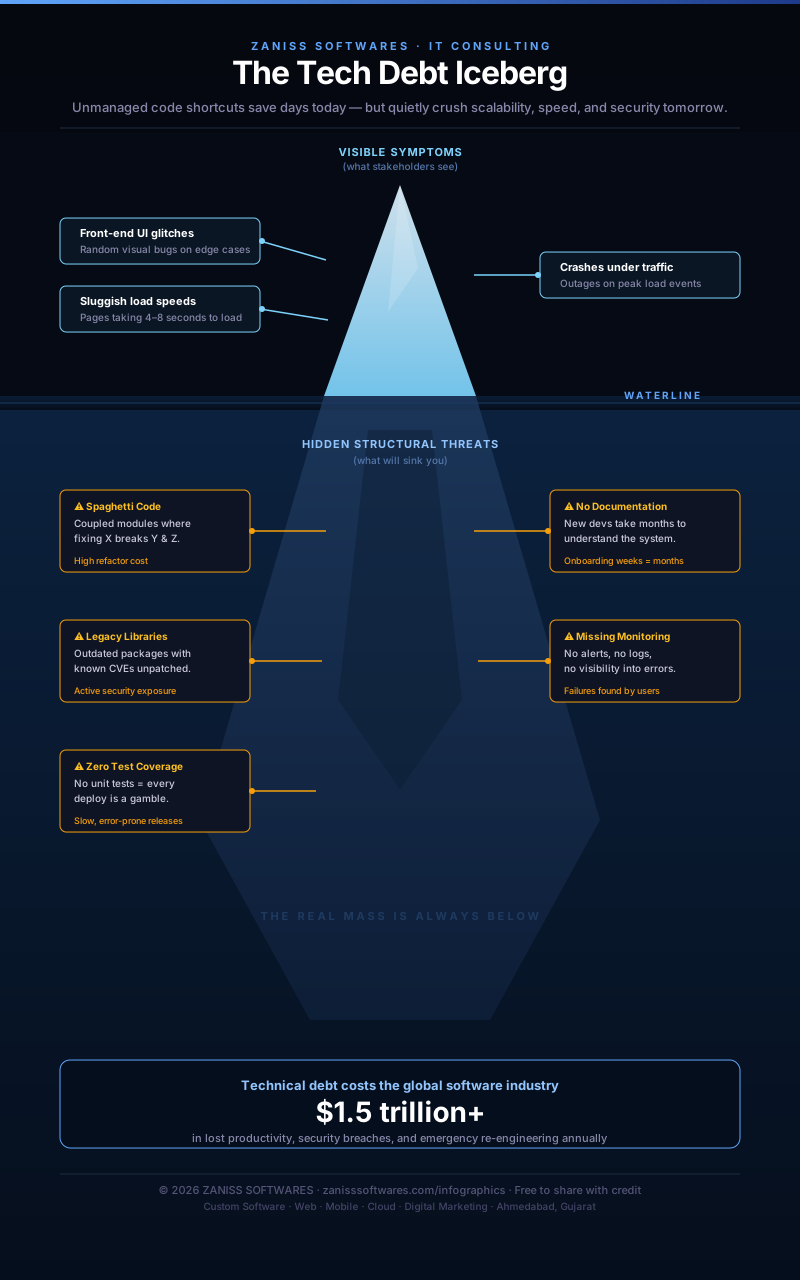
- 1Visible debt (slow code, slow CI) is the tip — the real cost is in the seven hidden categories below.
- 2Security exposure, hiring difficulty, and onboarding time are the under-counted compounders.
- 3Fix security risks first, then anything that directly slows feature delivery, then hiring blockers.
- 4A structured software audit is the cheapest way to size your exposure before deciding what to fix.
The visible tip: slow code and missed deadlines
When engineering teams talk about tech debt, they usually mean the obvious stuff — functions that take three times as long as they should, database queries with missing indexes, a CI pipeline that takes 45 minutes to run, copy-pasted logic spread across twelve files. These are real and painful, and they slow feature delivery in ways that are easy to measure.
But they're the tip of the iceberg. The real damage from accumulated tech debt is mostly invisible until something breaks, and by then it's expensive to fix.
Planning a Website? Don't Overpay or Underbuild
Most businesses overspend on features they don't need — or underspend and rebuild within a year. We help you scope it right from day one.
Below the surface: the seven hidden costs
Security exposure. Unpatched dependencies, insecure authentication patterns, and hardcoded credentials are common in codebases that haven't been maintained. Every dependency with a known CVE that's still in production is a potential breach waiting for an adversary to notice.
Hiring difficulty. Strong engineers interview companies as much as companies interview them. A codebase that lacks tests, uses outdated frameworks, or has no documentation actively repels senior hires. We've had candidates turn down offers specifically because of the state of the existing code.
Onboarding time. The worse the codebase, the longer it takes new engineers to become productive. We've seen onboarding times range from one week on well-maintained codebases to three months on deeply tangled ones. That's a real cost: three months of senior engineer time to get one new person up to speed.
Feature velocity slowdown. Tech debt compounds. A codebase that was 80% clean two years ago is often 40% clean today if maintenance hasn't kept pace with feature additions. The slowdown is gradual enough that teams often don't notice until they're spending more time on hotfixes than new features.
Testing absence risk. No tests means every deployment is a roll of the dice. The absence of automated testing isn't just a quality problem — it's a psychological one. Teams that can't verify their changes confidently ship less, take fewer risks, and move slower than teams with strong test coverage.
Vendor lock-in brittleness. Undocumented dependencies on specific providers, hardcoded configuration, and architecture built around a specific cloud service mean that changing any external dependency is a project in itself, not a configuration change.
Regulatory and audit exposure. Especially relevant for fintech, healthtech, and enterprise SaaS — auditors and enterprise customers increasingly require documented security practices, dependency management, and change control. A codebase with uncontrolled tech debt often can't pass these audits, which blocks enterprise sales.
How to measure your tech debt exposure
The simplest starting point is a structured software audit (we cover what this costs and includes in our Software Audit Services India 2026 post). A quality audit typically surfaces: dependency vulnerability count, test coverage percentage, cyclomatic complexity hotspots, documentation gaps, and architectural risk areas. This gives you a prioritised list of what to fix and what to leave.
The rule we apply: fix anything that is a security risk first, then anything that directly slows feature delivery, then anything that would make it hard to hire. We deliver this through IT consulting and custom software development.
Not sure how deep your tech debt iceberg goes? contact us for a free consultation.
Pro Insight
Planning a cloud-native platform? Let's review your architecture for free.
At ZANISS SOFTWARES, we don't just build websites — we build growth systems.
- ✓SEO-first architecture
- ✓Conversion-focused design
- ✓High-speed performance
- ✓Scalable, future-proof code
📩 Response within 24 hours
Frequently Asked Questions
How do we know if our tech debt is bad enough to act on?
If feature delivery is consistently 2× slower than your estimates, if you've had security incidents tied to unpatched dependencies, or if senior engineers are leaving citing the codebase — those are the three actionable triggers.
Is a full rewrite ever the right answer?
Rarely. Incremental modernisation almost always wins on risk and total cost. Full rewrites work when the existing system fundamentally can't support a required business change, and even then we recommend strangler-fig patterns over big-bang rewrites.
How long does a software audit take?
Two to four weeks for a typical SMB codebase, longer for enterprise systems with many services. The output is a prioritised remediation backlog you can budget against.