In this article
Quick Summary
- 1EDA is not a microservices upgrade — it is a different consistency model. Adopt it when workflows are async, fan-out heavy, or cross-team by nature.
- 2In India 2026, a production-grade Kafka or managed-broker rollout costs INR 25 L–1.5 Cr in year one depending on volume, HA and team maturity.
- 3Managed brokers (MSK, Confluent Cloud, EventBridge, SQS/SNS) beat self-hosted Kafka for 80% of Indian teams under 200 engineers.
- 4The failure mode is never the broker — it is schema drift, poison messages and missing idempotency. Fix those first, or EDA becomes a distributed debugger.
Event-driven architecture (EDA) is the pattern every Indian engineering team asks about once they cross a few dozen services — and the one most teams adopt for the wrong reasons. In 2026, EDA is no longer exotic: managed brokers are cheap, tooling is mature, and the pattern is well understood. What has not changed is the truth that EDA is a consistency model, not a scaling trick, and adopting it without that mindset creates more incidents than it prevents.
This guide is the honest 2026 view from the EDA rollouts we have shipped and operated across Indian SaaS, fintech and logistics platforms — when it pays back, what it actually costs in INR, which broker to pick, and the operational patterns that separate a working event backbone from a distributed debugger.
When event-driven architecture actually earns its keep
The three signals that make EDA a genuine fit — not a resume-driven rewrite:
- Workflows are naturally async — order placed → payment → inventory → notification → fulfilment. Every step can retry independently and none of them should block the user's HTTP request.
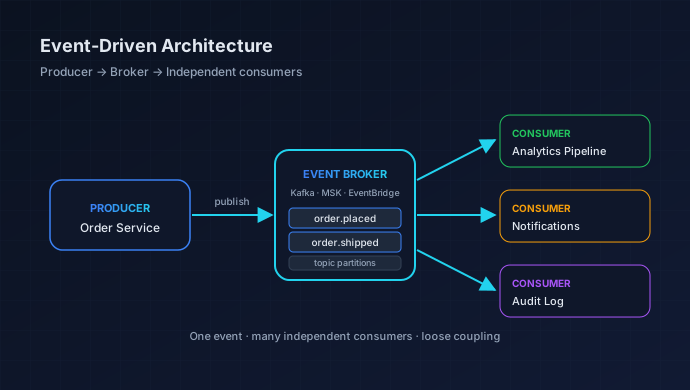
- Fan-out is real — one business event needs to reach 3+ consumers (analytics, search index, notifications, audit) and those consumers evolve independently.
- Teams are decoupled and want to stay that way — publishing an event lets downstream teams subscribe without a synchronous API contract every time you ship a change.
If none of those apply, a well-designed REST or RPC API with background jobs (see our microservices vs monolith and API development guides) is cheaper, faster and easier to debug.
Broker choice for Indian teams in 2026
Broker selection dominates the cost curve, and because MSK, Confluent Cloud and EventBridge are all cloud-infra decisions with real networking, IAM and cost-model implications, treat it as part of your cloud solutions strategy — not just an app-layer choice. The 2026 landscape has consolidated — pick from four defensible options:
- AWS SQS + SNS — the boring, correct choice for most teams under 10K events/sec. No ordering across partitions, no replay, but effectively zero ops and INR 8–20 L / year at typical Indian SaaS volumes.
- AWS EventBridge — best when you want schema-registry-backed events and rule-based routing without running Kafka. Excellent for cross-team fan-out under 1K events/sec per rule.
- MSK or Confluent Cloud (Managed Kafka) — the default for anything needing ordered streams, replay, or 10K+ events/sec. Confluent Cloud in Mumbai/Singapore regions costs INR 40 L–1.2 Cr / year at typical mid-size volumes and removes the Kafka ops burden entirely.
- Self-managed Kafka + Schema Registry — only defensible above 500K events/sec, when regulatory data residency forces on-prem, or when you already have a platform team (see our platform engineering guide). Below that, the ops cost eats the licence savings.
What it actually costs in India, 2026
Real numbers from EDA rollouts we have run in the last 18 months. All-in cost includes broker + infra + engineering time to design, ship and operate the platform.
- Small (SQS/SNS or EventBridge) — INR 8–25 L / year. One senior engineer part-time, single team, async job replacement for a monolith background queue. Ships in 4–8 weeks.
- Mid (Managed Kafka) — INR 40 L–1.2 Cr / year. Two engineers to design topics, schemas and consumer groups; INR 20–60 L in broker costs; schema registry, DLQs and monitoring baked in. Ships in 3–6 months.
- Large (Self-managed Kafka) — INR 1.5–4 Cr / year. A dedicated 3–5 person streaming team, multi-cluster HA, ZooKeeper-free KRaft mode, tiered storage, and internal SLAs on broker availability.
Indicative event-driven architecture investment (India, 2026)
| Scope | Price Range | Best For |
|---|---|---|
| Small (SQS/SNS or EventBridge) | INR 8–25 L / year | Low-volume async workflows, single team, no ordering guarantees needed |
| Mid (Managed Kafka / MSK / Confluent) | INR 40 L–1.2 Cr / year | Multi-team fan-out, ordered streams, 10K–500K events/sec |
| Large (Self-managed Kafka + Schema Registry) | INR 1.5–4 Cr / year | 500K+ events/sec, strict cost control, dedicated platform team |
Planning a Website? Don't Overpay or Underbuild
Most businesses overspend on features they don't need — or underspend and rebuild within a year. We help you scope it right from day one.
Sagas vs choreography vs orchestration
Once events are flowing, the next question is how you coordinate multi-step business processes. Three patterns, each with a real cost:
- Pure choreography — every service listens for events and reacts. Cheapest to build, hardest to reason about at 20+ event types. Great for genuinely independent flows.
- Saga with an orchestrator (Temporal, AWS Step Functions) — one workflow engine owns the state machine, services stay dumb. Adds INR 5–20 L / year in tooling but cuts debugging time by 60–80% for anything with more than 4 steps. Our default recommendation for payments, onboarding and fulfilment flows.
- Command-driven with events for notifications only — keep the write path synchronous, publish events for downstream consumers. The best migration path from a monolith and often the last stop for teams that thought they needed full EDA.
The five operational patterns that decide success
The broker is never the problem. Every failed EDA rollout we have audited failed on one of these five:
- Schema registry from day one — Avro or Protobuf with a schema registry (Confluent, AWS Glue Schema Registry) is non-negotiable. JSON with no schema is how you learn what "poison message" means in production.
- Idempotent consumers, always — every consumer must handle at-least-once delivery. Deduplication keys, upserts, or idempotency tables — pick one, enforce it in code review.
- Dead-letter queues with humans attached — a DLQ nobody watches is a silent data-loss pipeline. Alert on DLQ depth, assign an owner per topic, and run a weekly triage.
- Consumer lag as a first-class SLO — treat lag like latency. Alert at 30s, page at 5min, publish it on every service's dashboard.
- Event versioning strategy before the second producer ships — additive-only changes, deprecation windows, and a registry of who consumes what. Retrofit this and you will freeze the platform for a quarter.
Common mistakes we still see in 2026
- Adopting Kafka because "microservices need Kafka" — SQS + a schema convention handles 80% of workloads for a fraction of the cost.
- Publishing CRUD events (
UserUpdated) instead of business events (SubscriptionUpgraded) — consumers end up rebuilding your write model and coupling gets worse, not better. - No replay strategy — the day a downstream consumer needs to rebuild from history, teams discover their retention is 24 hours.
- Skipping the orchestrator for a 7-step payment saga — six months later the team is drawing the state machine on a whiteboard to debug a single failed transaction.
- Treating the broker as infra owned by DevOps — topics, schemas and consumer contracts are a product surface. Own them like an API (see our software audit guide for how we surface these issues).
Working with us
We design, ship and operate event-driven platforms for Indian product teams — from a first SQS-based async workflow to full Kafka backbones with Temporal orchestration. Pair this with our multi-tenant SaaS architecture, microservices vs monolith and IT consulting guides, then contact us for an EDA readiness assessment.
Pro Insight
Planning a cloud-native platform? Let's review your architecture for free.
At ZANISS SOFTWARES, we don't just build websites — we build growth systems.
- ✓SEO-first architecture
- ✓Conversion-focused design
- ✓High-speed performance
- ✓Scalable, future-proof code
📩 Response within 24 hours
Frequently Asked Questions
Do we need Kafka, or is SQS enough?
For most Indian teams under 10K events/sec with no strict ordering or replay requirements, SQS + SNS (or EventBridge for schema-backed routing) is enough and costs a fraction of Kafka. Move to managed Kafka (MSK or Confluent Cloud) when you need ordered streams per key, replay from history, or fan-out to more than a handful of independent consumers. Self-managed Kafka only makes sense above 500K events/sec or under strict data-residency rules.
How long does an event-driven rollout take?
A first async-workflow replacement on SQS or EventBridge ships in 4–8 weeks. A production-grade managed Kafka backbone with schema registry, DLQs, monitoring and 2–3 real producers/consumers takes 3–6 months for a mid-size team. Full org-wide adoption — with schemas, versioning discipline and every team publishing business events — is a 12–18 month cultural change, not a project.
What is the single most common EDA mistake?
Publishing CRUD-shaped events (UserUpdated, OrderRowChanged) instead of business events (SubscriptionUpgraded, OrderShipped). CRUD events leak your write model, force consumers to rebuild business logic, and increase coupling. Business events describe an intent that already happened and let consumers evolve independently. Fixing this after the fact usually requires re-emitting history through a translator layer — much cheaper to get right on day one.