Quick Summary
- 1Tech DD in 2026 is deeper than 2022 — code scan, cloud audit, security posture, and founder interviews are standard.
- 2Typical India DD engagement: INR 3–15 L over 2–4 weeks, paid by the investor or acquirer.
- 3Top deal-killers: no code ownership, unpatched CVEs, single-founder key-person risk, and messy IP assignment.
- 4Preparing 6–8 weeks ahead of a round can lift valuation 10–25% or unblock a stalled term sheet.
Technical due diligence has changed. In 2022 most Indian seed and Series A deals closed on a founder call and a look at the GitHub repo. In 2026 — with cheaper capital gone and every fund burnt at least once by a "great team, terrible codebase" — proper tech DD is table stakes above INR 20 Cr rounds and standard on almost every acquisition.
Having run DD for both sides of the table on Indian SaaS, fintech and healthtech deals, here is what actually gets checked in 2026, what it costs, and how founders can prepare so DD is a formality instead of a re-negotiation event.
What investors actually look at in 2026
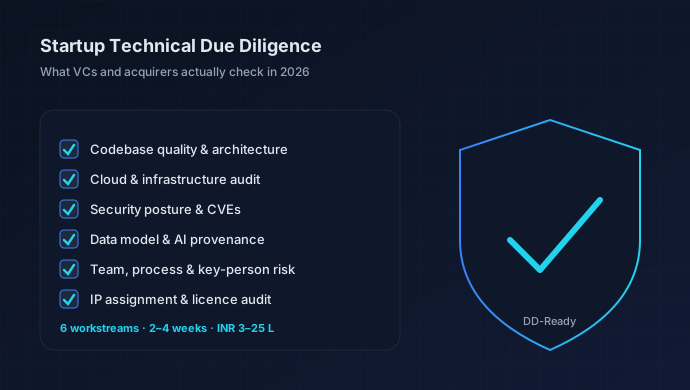
A modern tech DD is not one artefact — it is six overlapping workstreams that run in parallel over 2–4 weeks. Every serious DD firm we cross paths with covers these six, and they map cleanly to the risk categories in our enterprise software risk framework.
- Codebase quality — architecture, test coverage, static analysis, hotspot files, bus-factor per service.
- Cloud & infrastructure — cost efficiency, IaC coverage, backup / DR posture, environment parity.
- Security & compliance — CVEs, secrets in git, IAM hygiene, SOC 2 / ISO / DPDP readiness.
- Data & AI — data model sanity, PII handling, model provenance, licensing of training data.
- Team & process — org chart, key-person risk, hiring pipeline, PR review culture, on-call maturity.
- IP & legal — assignment agreements, open-source licences, third-party SDK terms, patent exposure.
The red flags that kill deals
Most tech DD reports do not "fail" a company — they surface risks that get priced into the term sheet. But a handful of findings will pull a term sheet entirely, and we see the same ones every quarter:
- No IP assignment — a founder or ex-contractor never signed over their code. Fixable, but slows a round by 4–8 weeks.
- Secrets in git history — AWS keys, Stripe keys, or customer PII committed and never rotated. Signals a security culture problem.
- Single-engineer key-person risk — one person understands 60%+ of the system with no documentation. Common at seed, unacceptable at Series B.
- Unpatched critical CVEs — especially in exposed frameworks (old Next.js, Spring, Log4j-era libs).
- Fabricated metrics — MRR, NPS, or user counts that do not reconcile with database queries. Instantly fatal.
Our software audit playbook covers the technical remediation path for the first four; the fifth is a governance problem no auditor can solve.
Indicative tech DD engagement cost (India, 2026)
| Engagement Type | Price Range | Best For |
|---|---|---|
| Light-touch review | INR 3–5 L / 5–8 days | Seed / pre-Series A rounds under INR 25 Cr |
| Standard DD | INR 6–10 L / 2–3 weeks | Series A–B, INR 25–150 Cr rounds |
| Acquisition-grade DD | INR 12–25 L / 3–5 weeks | M&A, strategic exits, growth-stage rounds |
Planning a Website? Don't Overpay or Underbuild
Most businesses overspend on features they don't need — or underspend and rebuild within a year. We help you scope it right from day one.
What tech DD costs in India (2026)
Fees are almost always paid by the investor or acquirer, not the target — but founders should still understand the shape of the engagement because it dictates how much time your team loses to interviews and data-room requests.
A light-touch review (INR 3–5 L) is usually enough for seed and small pre-Series A cheques and takes 5–8 working days. Standard DD (INR 6–10 L) runs 2–3 weeks and includes deep code review, cloud audit, and 4–8 hours of founder / CTO interviews. Acquisition-grade DD (INR 12–25 L) adds a formal security assessment, licence audit and 360° reference calls with customers and ex-employees.
How founders can prepare — a 6-week checklist
The single highest-leverage thing a founder can do before a round is a self-inflicted DD dry run. Six weeks out from term sheet, spend two weekends on this and you will avoid 80% of the last-minute chaos:
- Week 1 — Run a git-history secret scan (Gitleaks, TruffleHog). Rotate anything found. Get every current and past contributor to sign an IP assignment.
- Week 2 — Snyk / Dependabot on every repo. Patch every critical / high CVE. Document the ones you consciously accept.
- Week 3 — Cloud audit: enable AWS Config / Azure Policy, close public S3 buckets, enforce MFA on the root account, review IAM permissions.
- Week 4 — Write a 6-page architecture overview and a 2-page security posture doc. These get read by every DD firm.
- Week 5 — Reconcile every metric in your pitch deck against production data. If a number cannot be regenerated from the DB, do not use it.
- Week 6 — Prep the data room: org chart, PR review policy, incident log, backup / DR runbook, third-party contract list.
Working with us
We run pre-round tech DD prep for founders and buy-side DD for VCs and acquirers across SaaS development, fintech and healthcare portfolios. Pair this with IT consulting and our fractional CTO practice, then contact us for a confidential pre-round assessment.
Pro Insight
Planning a cloud-native platform? Let's review your architecture for free.
At ZANISS SOFTWARES, we don't just build websites — we build growth systems.
- ✓SEO-first architecture
- ✓Conversion-focused design
- ✓High-speed performance
- ✓Scalable, future-proof code
📩 Response within 24 hours
Frequently Asked Questions
Who pays for tech due diligence — the startup or the investor?
Almost always the investor or acquirer. Founders are expected to make the team, code and data room available, but the DD fee itself is a deal cost the fund absorbs. The exception is an acquisition where the target commissions a vendor-side DD to accelerate the sale — in that case the seller pays.
How long does a typical Series A tech DD take in India?
Two to three weeks of elapsed time for standard DD, with 8–15 hours of live time from the founding team spread across interviews, code walkthroughs and follow-up questions. Acquisition-grade DD runs 3–5 weeks. Preparation work by the target before DD kicks off usually saves at least a week.
Can a bad DD report kill a round?
Rarely on its own — most findings get priced into valuation, escrow or milestone conditions. But findings that indicate fraud, unassigned IP or founder-hostile employment contracts will pull a term sheet, and those are the four categories worth spending real time on before the round opens.