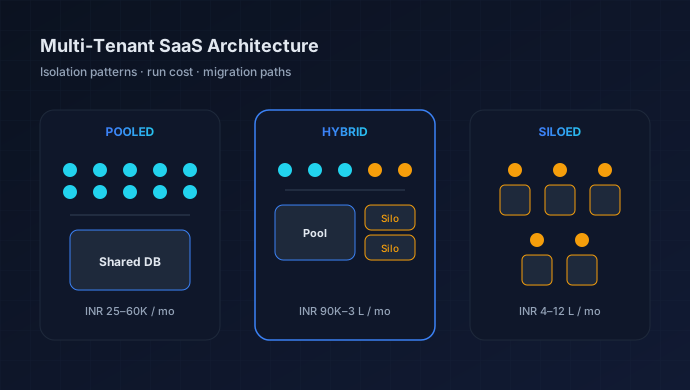
Quick Summary
- 1Four patterns dominate 2026: pooled DB, siloed DB per tenant, hybrid pool-and-silo, and full silo per tenant.
- 2Pooled is 4–8× cheaper to run but the hardest to secure and migrate off later.
- 3Enterprise deals above INR 10 L ACV increasingly demand dedicated infra — plan the migration path from day one.
- 4Row-level security in Postgres, plus a strict tenant_id in every table, catches 90% of leaks before code review.
Multi-tenancy is the architecture decision that quietly decides whether your SaaS margins hit 78% or 42% — and whether you can sell into a regulated enterprise buyer in year three or spend six months re-platforming when the first serious contract lands. It is also the decision founders defer longest, because the pain shows up 18 months after launch when the code is hardest to change.
We have architected multi-tenant systems for Indian SaaS teams across fintech, healthcare and B2B horizontal products. Here is the 2026 view of the four patterns that actually work, what each costs to run, and the migration paths between them.
The four patterns you will actually pick between
Ignore the taxonomy from vendor whitepapers — in practice Indian SaaS teams ship one of four patterns. The trade-offs are stable across clouds; only the specific service names change.
- Pooled (shared DB, shared schema) — one Postgres, one schema, a
tenant_idcolumn on every table, row-level security. Cheapest to run, hardest to isolate. Great for SMB SaaS under INR 2 L ACV. - Schema-per-tenant — one Postgres, one schema per tenant. Middle ground; useful when tenants demand logical separation but you cannot yet afford dedicated databases.
- Hybrid (pool + premium silos) — pooled DB for SMBs, dedicated DB (or schema) per enterprise. The pattern most successful Indian SaaS teams land on by Series B.
- Silo (DB per tenant, sometimes VPC per tenant) — dedicated infra per customer. Highest cost, easiest sell into regulated buyers, hardest to keep in sync as the product evolves.
What each pattern really costs in India, 2026
Concrete numbers for 100 tenants at moderate load, on AWS Mumbai with managed Postgres, load balancer, background workers and observability. Storage and egress not included:
- Pooled — INR 25–60K / month. One db.r6g.large Aurora writer, a couple of replicas, a shared ECS Fargate cluster. Adds INR 200–800 / month per net-new tenant.
- Schema-per-tenant — INR 60K–1.2 L / month. Same DB instance, but connection-pool tuning and per-schema migrations start eating engineering time.
- Hybrid — INR 90K–3 L / month. Pooled tier as above plus 5–15 dedicated small DB instances for enterprise tenants. This is where 70% of our Series B clients land.
- Full silo — INR 4–12 L / month. 100 dedicated DB instances, per-tenant secrets, per-tenant deploy pipelines. Only justified when the buyer contract explicitly demands it — usually regulated fintech, healthtech or govtech.
The run-cost gap between pooled and silo is 8–20×. That gap is the entire reason multi-tenancy strategy matters — it directly sets your gross margin and how far each rupee of raised capital goes. Our SaaS MVP cost breakdown and cloud-native guide cover the underlying infra sizing in more detail.
Indicative run-cost per 100 tenants (India, 2026)
| Isolation Pattern | Price Range | Best For |
|---|---|---|
| Pooled (shared DB, shared schema) | INR 25–60K / mo | SMB SaaS, high tenant count, low ACV |
| Hybrid (pool + premium silos) | INR 90K–3 L / mo | Mixed SMB + enterprise |
| Siloed DB per tenant | INR 4–12 L / mo | Regulated buyers, enterprise-only |
Planning a Website? Don't Overpay or Underbuild
Most businesses overspend on features they don't need — or underspend and rebuild within a year. We help you scope it right from day one.
Tenant isolation — the four rules that stop leaks
Every tenant-leak incident we have investigated in India comes back to one of the same four missing controls. Ship these before the first paying customer and you will avoid the class of bug that ends careers:
- tenant_id on every table, no exceptions — including audit logs, background jobs, and analytics tables. Enforce with a linter or migration hook, not vibes.
- Row-level security in Postgres — set a
SET LOCAL app.tenant_idat the start of every transaction and let the DB enforce filtering. Catches the bugs your ORM misses. - Signed tenant claims in every JWT — never trust
tenant_idfrom the request body or URL. Extract it from the verified token and re-check it on the backend. - Cross-tenant tests in CI — write tests that log in as tenant A and try to read tenant B's data via every endpoint. Automate the run on every PR.
When to migrate between patterns
Almost every successful SaaS moves patterns at least once. The two most common paths:
Pooled to hybrid — trigger: your first enterprise buyer above INR 10 L ACV asks for a dedicated database, a signed DPA and an infra diagram. Do not fight it; carve out a "premium tier" and migrate that tenant to a dedicated DB using logical replication over a weekend. Budget 3–6 engineer-weeks per enterprise migration.
Silo back to hybrid — trigger: you shipped silo-first for regulated buyers, added 40 tenants, and now spend more on infra than on engineering. Pool the SMB slice, keep the regulated tenants siloed. Painful, 3–6 months, but recovers 40–70% of run-cost. We have run this migration for several SaaS development teams and cover it under IT consulting.
Common mistakes we still see in 2026
- Shipping full silo because it "feels safer" — then discovering you cannot roll out a schema migration to 200 databases inside a sprint.
- Bolting tenant_id into an existing single-tenant codebase without RLS — leaks are near-inevitable within 12 months.
- Storing tenant secrets in a shared KMS key — one leaked key gives access to every tenant's data.
- Using tenant subdomain for isolation only, not authentication — attackers guess subdomains and probe the auth layer.
Working with us
We design and migrate multi-tenant SaaS platforms end-to-end — architecture, tenant isolation reviews, cost modelling and cutover engineering. Pair this with SaaS development, our microservices vs monolith guide and IT consulting, then contact us for a free architecture review.
Pro Insight
Planning a cloud-native platform? Let's review your architecture for free.
At ZANISS SOFTWARES, we don't just build websites — we build growth systems.
- ✓SEO-first architecture
- ✓Conversion-focused design
- ✓High-speed performance
- ✓Scalable, future-proof code
📩 Response within 24 hours
Frequently Asked Questions
Should a new SaaS start with pooled or siloed multi-tenancy?
Pooled with strict row-level security and a well-designed tenant_id contract, unless your first buyer is regulated (banking, health, defence) and contractually requires dedicated infra. Pooled is cheaper, faster to ship, and easier to migrate out of than to migrate into. Add silos for enterprise tiers as they arrive.
How risky is row-level security in Postgres for real production loads?
Not risky in 2026 — it is a mature Postgres feature and used by many Indian SaaS teams at scale. The common mistake is forgetting to SET LOCAL app.tenant_id at the start of every transaction, or bypassing RLS with a superuser role in background jobs. Fix those two and RLS handles most tenant-isolation bugs before they leave code review.
What is the biggest hidden cost of multi-tenant silos?
Not the extra DB instances — it is the engineering time to keep 100+ databases on the same schema version, run 100+ background workers, and diagnose 100+ separate performance profiles. Once you go silo, you own a lifetime tax on every product change. Only take it on when the buyer contract demands it.