Quick Summary
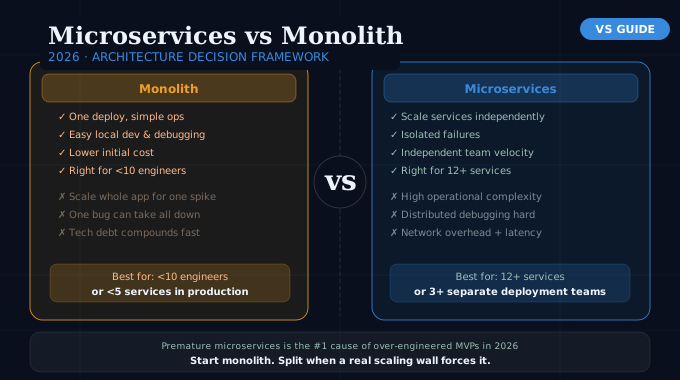
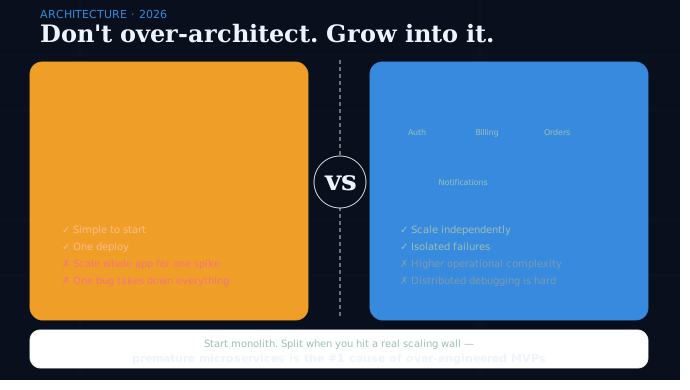
- 1Modular monolith is the right default below ~15 engineers — almost without exception
- 2Microservices pay off when teams genuinely need independent deploy cadence
- 3Microservices add 25–45% to infra and ops cost vs an equivalent monolith
- 4Decompose by team boundary, not by tech taste — Conway's Law wins
The microservices vs monolith debate refuses to die because the honest answer ("it depends on your team size and deploy cadence") is less fun than picking a tribe. Here is a decision framework that has held up across the last decade and is even more true in 2026.
Start with a modular monolith — almost always
Below ~15 engineers, a well-modularised monolith ships faster, costs less to run, and is easier to refactor. The mistake is treating "monolith" as a slur — a modular monolith with clean domain boundaries, internal contracts, and good test coverage is a perfectly grown-up architecture for most products.
The three real reasons to go microservices
- Independent deploy cadence — different teams need to ship on different rhythms without blocking each other.
- Independent scaling — one part of the system has 10x the load of the rest and you can't justify scaling everything.
- Different runtime needs — one component genuinely needs a different language, runtime, or stateful primitive.
Notice what's not on the list: "it's the modern way", "the team wants to try Go", or "we might scale one day".
Indicative architecture decision (2026)
| Website Type | Price Range | Best For |
|---|---|---|
| Modular monolith | Lowest infra + ops cost | 1–3 teams, < 15 engineers, fast iteration |
| Selective extraction | +15–25% ops cost | 1–2 services pulled out for scale or independent deploy |
| Full microservices | +25–45% infra + ops cost | 5+ teams, distinct domains, mature platform team |
Planning a Website? Don't Overpay or Underbuild
Most businesses overspend on features they don't need — or underspend and rebuild within a year. We help you scope it right from day one.
The cost no one priced in
- Service discovery, mesh, gateway — ops complexity scales non-linearly with service count.
- Distributed tracing and correlated logging become mandatory, not nice-to-have.
- Schema evolution across services requires a discipline most teams underestimate.
- Local dev experience degrades — without docker-compose / devcontainer investment, productivity drops 20–30%.
Expect 25–45% higher infra + ops cost vs an equivalent monolith. Read our take on controlling that bill if you go this route.
The middle path most teams actually want
Selective extraction: keep a modular monolith as the core, extract 1–2 services for genuine scale or deploy-cadence reasons, and stop there. This is where most successful 2026 teams land — not pure monolith, not full microservices.
Decompose by team, not by entity
Conway's Law (systems mirror the org that builds them) is still undefeated. If you split services by entity (users-service, orders-service) but your teams are organised around customer journeys, the seams will fight you forever. Decompose by team boundary first.
The migration playbook
- Identify the one service that has the strongest business case (independent scale, deploy cadence).
- Carve a clean module inside the monolith first; only then extract.
- Strangler-fig the traffic over weeks, not in one cut.
- Stop. Reassess. Most teams should not extract a second service for at least 6 months.
See IT consulting for architecture reviews or contact us for a fixed-fee decomposition assessment on an existing codebase.
Pro Insight
Planning a cloud-native platform? Let's review your architecture for free.
At ZANISS SOFTWARES, we don't just build websites — we build growth systems.
- ✓SEO-first architecture
- ✓Conversion-focused design
- ✓High-speed performance
- ✓Scalable, future-proof code
📩 Response within 24 hours