Quick Summary
- 1Platform engineering is the 2026 evolution of DevOps — treat internal tooling as a product with real users (your engineers).
- 2A minimal IDP in India costs INR 40–90 L to stand up and 2–4 engineers to run, but pays back in 6–12 months for teams above 30 engineers.
- 3Golden paths, self-serve environments and paved-road templates cut deploy lead time by 40–70% in every rollout we have measured.
- 4Buy the boring parts (Backstage, ArgoCD, Terraform modules) — build only the glue that reflects your org's actual workflow.
Platform engineering is the answer to a problem every scaling Indian tech team hits between 30 and 80 engineers: your best product engineers are spending a third of their week on Terraform, YAML, IAM tickets and CI debugging instead of shipping features. In 2026, the teams solving this are not adding more DevOps engineers — they are building an internal developer platform (IDP) and treating it as a product with real users.
We have helped Indian SaaS, fintech and D2C teams stand up their first IDP and evolve second-generation platforms already in production. Here is the 2026 view — what an IDP actually contains, what it costs, when it pays back, and the mistakes we still see teams make.
What an internal developer platform actually is in 2026
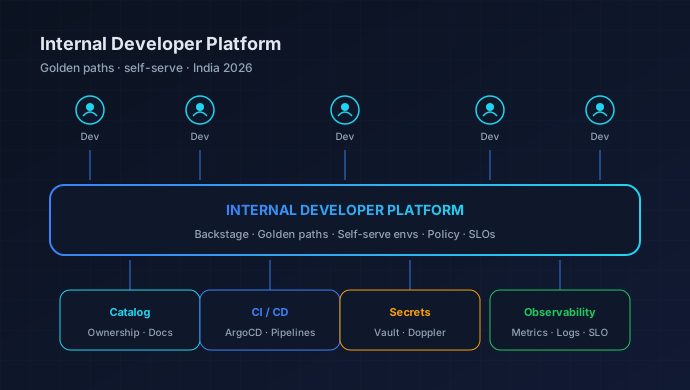
An IDP is the thin, opinionated layer between your engineers and the underlying cloud, CI, secrets, observability and data stack. It is not a Kubernetes cluster and it is not a wiki — it is a self-serve product that answers, in one place, the questions every engineer asks weekly:
- How do I spin up a new service? One command, one PR, or one Backstage form — never a ticket.
- How do I get a preview environment for this PR? Automatic, scoped to the PR, torn down on merge.
- How do I add a database, a queue, a feature flag? A golden-path template with sensible defaults baked in.
- How do I see the SLO, logs and cost of my service? One dashboard, linked from the service's Backstage page.
- Who owns this? A single source of truth tying every service to a team, on-call rotation and SLO.
What to buy vs what to build
The 2020-era "let's build our own platform from scratch" mistake is well documented. In 2026 the split is settled — buy the boring, standardised parts and build only the glue that reflects your organisation's actual workflow.
- Buy — service catalogue (Backstage or Port), GitOps deploys (ArgoCD or Flux), secrets (Doppler, AWS Secrets Manager, Vault), observability (Grafana Cloud, Datadog, New Relic), IaC (Terraform + Terragrunt or Crossplane).
- Build — your golden-path templates, your paved-road service scaffold, your PR-preview environment glue, your policy checks. These encode your engineering culture and cannot be bought.
The teams that get this wrong spend 18 months building a home-grown Backstage clone and then quietly migrate to Backstage anyway. Our DevOps and SRE guide and cloud-native application guide cover the underlying platforms in more depth.
What it costs in India, 2026
Concrete numbers from platforms we have shipped and run in the last 18 months. All-in cost includes salaries, tooling licences and cloud overhead — not the engineering hours saved on the consuming side (which is where the real ROI lives).
- 30–60 engineers — INR 40–90 L / year. A 2-person platform team (senior platform engineer + mid-level), Backstage on a small cluster, ArgoCD, one paved-road template. Tooling licences under INR 8 L / year.
- 60–150 engineers — INR 1.2–2.5 Cr / year. 4–6 platform engineers, 3–5 golden paths (web service, worker, ML job, static site, cron), PR-preview environments, cost dashboards, SLO tooling. Tooling licences INR 15–40 L / year.
- 150+ engineers — INR 3–6 Cr / year. Dedicated platform organisation with sub-teams for observability, developer experience, and infra. Chargeback / showback per team, multi-cluster fleet, formal internal SLAs on the platform itself.
Indicative platform engineering investment (India, 2026)
| Team Size | Price Range | Best For |
|---|---|---|
| 30–60 engineers | INR 40–90 L / year | First IDP, 2-person platform team, Backstage + ArgoCD baseline |
| 60–150 engineers | INR 1.2–2.5 Cr / year | 4–6 platform engineers, golden paths, self-serve envs |
| 150+ engineers | INR 3–6 Cr / year | Dedicated platform org, SLOs, chargeback, multi-cluster fleet |
Planning a Website? Don't Overpay or Underbuild
Most businesses overspend on features they don't need — or underspend and rebuild within a year. We help you scope it right from day one.
The payback maths that convinces the CFO
Platform engineering is a hard sell without numbers. The one calculation that lands every time: how many engineer-hours per week does your average product engineer lose to platform friction today? In the Indian teams we audit before rollout, the honest answer is 6–10 hours per engineer per week — CI failures, environment drift, deploy waits, IAM tickets, one-off Terraform edits.
At INR 25–40 L fully loaded per senior engineer, a 60-person org loses INR 2.5–4.5 Cr / year to platform friction. An INR 1.5 Cr platform team that recovers even half of that time pays back in under 12 months — and the recovered time compounds because it is spent on the product, not on plumbing. This is the same ROI story that makes legacy modernization and software audits land with finance.
How to roll out an IDP without a rebellion
Every failed IDP rollout we have seen shares the same root cause: the platform team built the platform in a vacuum and then mandated migration. The rollouts that succeed treat the platform as a product with paying customers who can defect.
- Pick one pilot team, one paved road — usually a new greenfield service. Do not try to migrate a legacy monolith first.
- Ship a golden path that is genuinely faster than the status quo — if
idp new serviceis slower than the copy-paste approach, adoption dies. - Measure lead time before and after — commit-to-production, PR-to-preview-environment, and time-to-first-log. Publish the numbers monthly.
- Treat platform bugs as P1 — a broken CI template blocking 40 engineers costs more than a customer-facing outage.
- Expand by pull, not push — when teams ask for the platform, onboard them. When they resist, do not force migration until the value gap is undeniable.
Common mistakes we still see in 2026
- Building the platform before agreeing what "done" looks like — no target lead-time metric, no adoption target, no sunset date for the legacy path.
- Staffing the platform team entirely with ex-DevOps engineers and no product manager — the platform becomes an infra project, not a product.
- Shipping Backstage with an empty catalogue and expecting teams to populate it — automate service registration from day one.
- Skipping cost visibility — engineers cannot optimise what they cannot see. Bake per-service cost into every service page.
- Treating the IDP as a one-time project — an unmaintained platform decays faster than the codebase it is meant to serve.
Working with us
We design, ship and operate internal developer platforms for Indian engineering teams — from a first Backstage rollout to a full platform organisation. Pair this with DevOps services, our multi-tenant SaaS architecture guide and IT consulting, then contact us for a platform readiness assessment.
Pro Insight
Planning a cloud-native platform? Let's review your architecture for free.
At ZANISS SOFTWARES, we don't just build websites — we build growth systems.
- ✓SEO-first architecture
- ✓Conversion-focused design
- ✓High-speed performance
- ✓Scalable, future-proof code
📩 Response within 24 hours
Frequently Asked Questions
When is a team too small for platform engineering?
Under 20–25 engineers, a dedicated platform team is almost always overkill — a strong DevOps engineer plus good templates covers the same ground. The economics start working around 30 engineers, and above 60 engineers not having a platform team is usually the more expensive choice once you account for lost product-engineering time.
Do we need Kubernetes to have an IDP?
No. Plenty of successful Indian IDPs run on ECS Fargate, Cloud Run, or Render. Kubernetes is a common substrate because it gives the platform team a uniform API, but the value of the IDP is in the golden paths, service catalogue and self-serve environments — not the orchestrator underneath.
How do we measure whether the platform is working?
Four metrics land with every stakeholder: deploy lead time (commit to production), change failure rate, time to spin up a new service, and platform NPS from consuming engineers. Publish them monthly, on the same dashboard, forever. A platform whose metrics are not visible will lose funding within 18 months.