Quick Summary
- 1Cloud-native isn't 'hosted on AWS' — it's containers, managed services, infra-as-code and observability by default.
- 2Build cost in India 2026 for a production cloud-native MVP: INR 18–45 L; monthly run-rate INR 40K–4 L based on traffic.
- 3Kubernetes pays off above ~12 services or 3 environments; below that, serverless + managed Postgres wins on TCO.
- 4Multi-cloud is almost always a mistake for early-stage teams — pick one cloud, master it, abstract only what you must.
Almost every team we talk to in 2026 says they want to be "cloud-native". Almost no one agrees on what that means. For some clients it's "we run on AWS instead of a Hetzner box". For others it's "we have 47 microservices and a service mesh and nobody can deploy on a Friday". Both miss the point, and both end up paying for it — one in lost agility, the other in a cloud bill that grows faster than revenue.
After shipping cloud-native platforms for Indian SaaS founders, fintech operators and mid-market enterprises across AWS, Azure and GCP, here's the honest 2026 playbook for what cloud-native actually is, what it costs to build and run in India, and where the bodies are buried.
What "cloud-native" actually means in 2026
Strip away the marketing and the working definition is boring: your application is designed around managed cloud services, containers (or serverless), infrastructure-as-code, and built-in observability from day one. Lifting an old monolith onto an EC2 instance is not cloud-native — it's hosting. Cloud-native is when you can rebuild your entire environment from a fresh git clone and a single command, and when failure of a node, region or even a managed service degrades gracefully instead of taking the product down.
The four traits we look for in any genuinely cloud-native system:
- Containerised or serverless workloads — Docker images, Lambda / Cloud Run functions, no snowflake VMs.
- Managed data services — RDS / Aurora, Cloud SQL, Cosmos DB, MSK, EventBridge — instead of self-hosted Postgres, Kafka or Redis on your own instances.
- Infrastructure-as-code — Terraform, Pulumi or CDK, with every change reviewed in a PR.
- Observability by default — structured logs, metrics, traces and SLOs from the first deploy, not bolted on after the first outage.
The three architecture buckets — and what they really cost in India
Most cloud-native builds we scope fall into one of three buckets. Picking the wrong one is the single biggest cost mistake we see, and it usually costs 3–5× more to fix than to get right the first time. The full reference architectures we use live under cloud solutions.
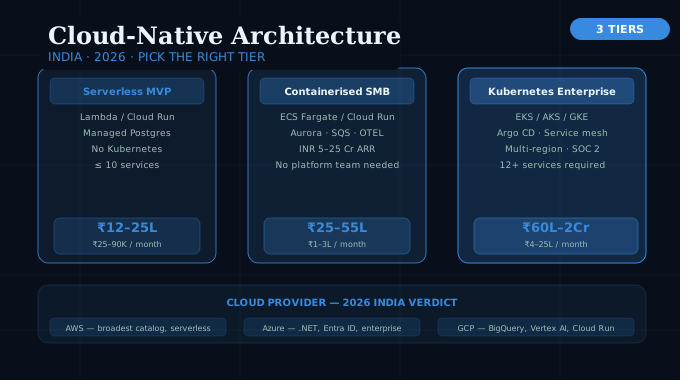
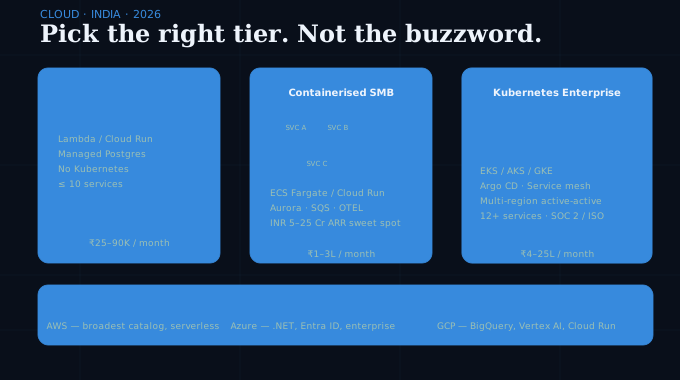
1. Serverless MVP — INR 12–25 L build, INR 25–90K / month
Lambda or Cloud Run for compute, API Gateway, managed Postgres (RDS or Cloud SQL), S3 / GCS for storage, Cognito or Auth0 for auth. No Kubernetes, no service mesh, no Kafka. We default to this for any team under ~25 engineers with fewer than 10 services. Cold starts are mostly a solved problem in 2026 with provisioned concurrency, and you'll spend half what an equivalent containerised setup costs to operate.
2. Containerised SMB — INR 25–55 L build, INR 1–3 L / month
ECS Fargate, Cloud Run or AKS managed pools — containers without the operational tax of full Kubernetes. Add Aurora or Cloud SQL, an API gateway, a queue (SQS / Pub/Sub) and OpenTelemetry-based observability. This is the sweet spot for funded B2B SaaS at INR 5–25 Cr ARR, regulated workloads, or any product where you want portability without a platform team. Most of our SaaS clients (custom software development) sit here.
3. Kubernetes enterprise — INR 60 L–2 Cr build, INR 4–25 L / month
EKS / AKS / GKE, service mesh, GitOps with Argo CD, multi-region active-active, dedicated platform team. Worth it above ~12 services, 3+ environments, regulated multi-tenant workloads or genuine multi-region needs. Below that scale, you'll spend more on the platform than on the product — we routinely audit clients (IT consulting) who could cut infra spend 40–60% by moving off K8s back to managed containers.
AWS vs Azure vs GCP for Indian teams in 2026
The honest 2026 answer is: any of the three will work, and switching later is far more expensive than picking imperfectly today.
- AWS — broadest service catalog, deepest hiring market in India, best for serverless-first builds. Mumbai and Hyderabad regions are mature; data residency is straightforward.
- Azure — default if you're already on Microsoft 365, Entra ID, or .NET. Pairs beautifully with our ASP.NET and .NET practice. Enterprise contracts often beat AWS on list price.
- GCP — the strongest data + AI story for Indian teams in 2026. Cloud Run is the cleanest serverless container runtime available, letting you deploy containers without managing Kubernetes. BigQuery handles analytics at petabyte scale without operational overhead. Vertex AI covers training, tuning and real-time inference for machine learning workloads. The India hiring pool for GCP engineers is still smaller than AWS, but improving fast in 2026 as fintech and data-platform teams adopt GCP.
Multi-cloud sounds prudent and is almost always a strategic mistake for teams under 200 engineers — pick one, master it, abstract only the boundaries that genuinely need to be portable (object storage, auth, your data warehouse).
Indicative cloud-native build & run cost (India, 2026)
| Architecture Type | Price Range | Best For |
|---|---|---|
| Serverless MVP | INR 12–25 L build / INR 25–90K mo | Early SaaS, low-traffic internal tools |
| Containerised SMB | INR 25–55 L build / INR 1–3 L mo | Growing B2B SaaS, regulated workloads |
| Kubernetes enterprise | INR 60 L–2 Cr build / INR 4–25 L mo | Multi-region, 20+ services, SOC 2 / ISO |
Planning a Website? Don't Overpay or Underbuild
Most businesses overspend on features they don't need — or underspend and rebuild within a year. We help you scope it right from day one.
The five hidden costs that wreck cloud-native budgets
Every cloud-native budget we've seen run over has been killed by one of these. None of them show up in the architecture diagram.
- Data egress — the single most under-estimated cost line. Cross-AZ replication, cross-region backups, CDN misses and chatty microservices can easily double your bill.
- Observability tooling — Datadog, New Relic and friends can quietly become your second-largest infra line. Budget 8–18% of compute spend or use OSS (Grafana / Tempo / Loki).
- Always-on non-prod environments — staging and QA running 24×7 routinely cost as much as production. Auto-stop policies recover 30–50% of non-prod spend.
- Premium support tiers — AWS Business / Azure Standard / GCP Enhanced are usually worth it for production; AWS Enterprise rarely is below INR 8 Cr ARR.
- Reserved-instance / Savings Plans drift — every cloud bill we audit has 12–35% of compute running on-demand when it should be on a 1- or 3-year commit.
We cover the specific cost-control playbook in Cutting cloud bills without breaking production, which is required reading before any cloud-native commitment.
Security and compliance as build-time concerns, not afterthoughts
Cloud-native makes security simpler if you bake it in, and brutal if you don't. The non-negotiables for any 2026 build are: SSO via your identity provider, short-lived credentials (no long-lived IAM keys), encryption-at-rest and in-transit on every data store, automated dependency and container scanning in CI, and a documented incident-response runbook before launch. Add SOC 2-aligned controls if you're selling B2B in the US or EU; HIPAA-aligned controls if you're touching health data. Retrofitting these later costs 3–6× more than building them in.
When cloud-native is the wrong answer
It's worth saying out loud: not every project needs cloud-native. A simple marketing site, an internal CRUD tool used by 20 people, or a regulated workload that must run on-prem for legal reasons — all of these are better served by simpler architectures. We've talked plenty of founders out of a Kubernetes cluster they didn't need. The right question isn't "are we cloud-native?" — it's "what's the cheapest, most reliable way to run this workload for the next three years?"
Working with us
We build cloud-native platforms end-to-end on AWS, Azure and GCP — discovery, reference architecture, infra-as-code, application engineering and a 30-day post-launch warranty. Pair this guide with cloud solutions and our DevOps & SRE practice, then contact us for a free 30-minute architecture review.
Pro Insight
Planning a cloud-native platform? Let's review your architecture for free.
At ZANISS SOFTWARES, we don't just build websites — we build growth systems.
- ✓SEO-first architecture
- ✓Conversion-focused design
- ✓High-speed performance
- ✓Scalable, future-proof code
📩 Response within 24 hours