Quick Summary
- 1Lakehouse + dbt + dashboards: $40K–$120K for a 10–14 week build
- 2Real-time streaming (Kafka + Flink): $60K–$180K additional
- 3Managed data engineering retainer: $4K–$12K/month
- 4Indian teams cut data engineering cost by 50–65% vs US/EU baselines
Every serious operator in 2026 has the same problem: data is everywhere, trusted nowhere. Sales lives in HubSpot, billing in Stripe, product events in Segment or Rudderstack, support in Zendesk, ops in five spreadsheets and a Postgres database. A modern data engineering team unifies that mess into a single lakehouse, models it cleanly, and serves it back as dashboards, embedded analytics, and ML features. Here is what that costs in 2026 from an Indian team that does it daily.
The 2026 reference architecture
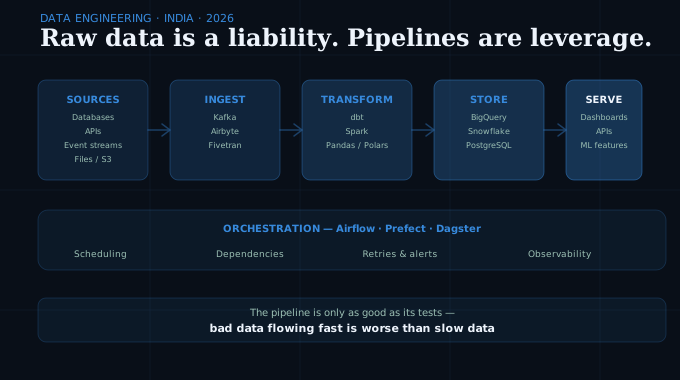
- Ingestion: Fivetran, Airbyte, or custom connectors land raw data in cloud storage.
- Storage: Snowflake, BigQuery, Databricks (Delta Lake), or Redshift Serverless.
- Transformation: dbt for batch SQL models, Spark/PySpark for heavy lifting, Flink/ksqlDB for streaming.
- Orchestration: Airflow, Dagster or Prefect.
- Serving: Looker, Metabase, Superset, Tableau, or embedded analytics via Cube/GoodData.
- Reverse ETL: Hightouch or Census push modelled data back into HubSpot, Salesforce, ad platforms.
What it actually costs to build
Lakehouse MVP ($40K–$120K): 4–6 source systems ingested into Snowflake or Databricks, dbt models with documented tests, an orchestrated daily run, and a starter set of dashboards. 10–14 weeks.
Real-time streaming layer ($60K–$180K): Kafka or Kinesis for event capture, Flink or ksqlDB for streaming transforms, materialised views for sub-second query latency. 8–14 weeks on top of the batch build.
Embedded analytics ($30K–$80K): Cube semantic layer + custom React dashboards inside your SaaS product. Per-tenant row-level security, usage metering, branded white-label.
Planning a Website? Don't Overpay or Underbuild
Most businesses overspend on features they don't need — or underspend and rebuild within a year. We help you scope it right from day one.
The data quality discipline most teams skip
- dbt tests on every model: not_null, unique, accepted_values, foreign-key relationships.
- Great Expectations or Soda: data contract validation at ingest time.
- Freshness SLAs: "Sales table is no more than 15 minutes stale" — monitored and alerted.
- Lineage: dbt docs or OpenLineage so when a number is wrong, you can trace it back.
Where Indian teams add real value
Senior data engineers in India run $30–$75/hour versus $130–$250/hour in the US. A 3-person pod (senior + mid + analytics engineer) typically delivers what a single US senior costs, with full IST/PST overlap of 3–4 hours daily. Most of our clients run a hybrid: their head of data sits in the US or EU; the build pod sits in India.
Common anti-patterns to avoid
- Pushing raw Stripe webhooks straight into BI tools — no modelling, no tests, no lineage.
- One giant 4,000-line SQL view that does everything. Refactor into staged dbt models.
- No environments. Production transformations getting hot-fixed against the live warehouse.
- Ignoring storage and compute cost until the Snowflake bill hits five figures.
If you are scoping a lakehouse build, a streaming pipeline, or you want to take an existing mess and make it trustworthy, contact us for a free architecture review. See related services in our cloud solutions and IT consulting practices.
Pro Insight
Planning a cloud-native platform? Let's review your architecture for free.
At ZANISS SOFTWARES, we don't just build websites — we build growth systems.
- ✓SEO-first architecture
- ✓Conversion-focused design
- ✓High-speed performance
- ✓Scalable, future-proof code
📩 Response within 24 hours