In this article
Quick Summary
- 1GST-compliant billing and inventory for a single-location manufacturing unit typically runs ₹50,000–₹2,00,000 one-time plus ₹10,000–₹25,000/year in AMC; a proper cloud ERP with basic production tracking runs ₹3,00,000–₹12,00,000.
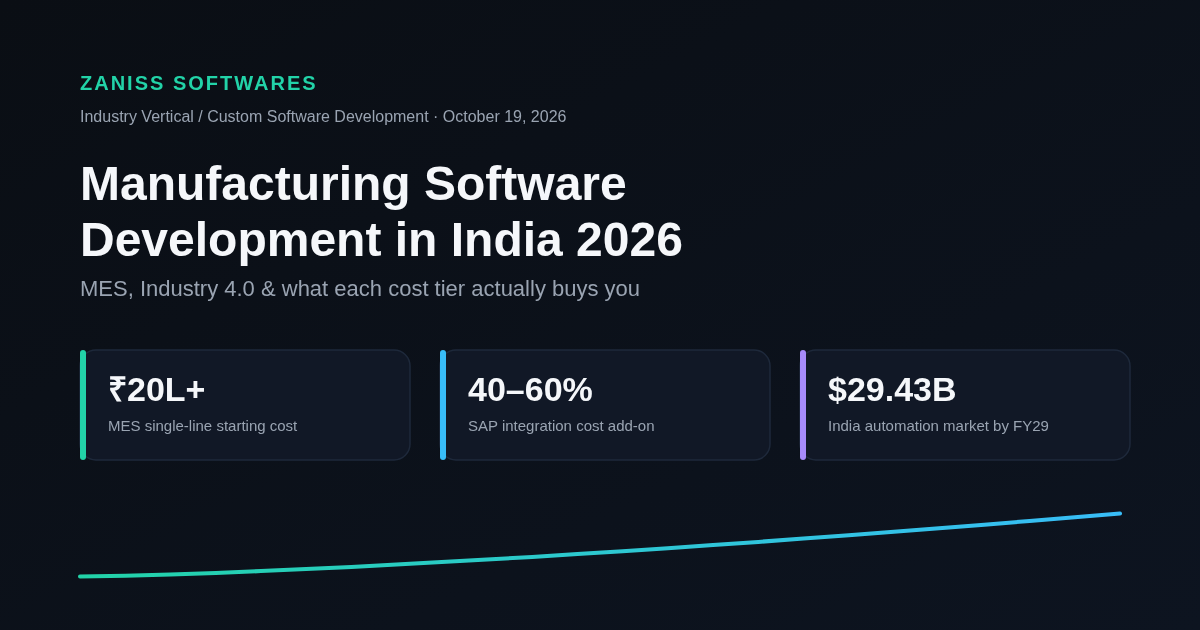
- 2A custom Manufacturing Execution System (MES) for one production line starts around ₹20,00,000, and rises to ₹40,00,000–₹80,00,000 once it has to integrate with SAP S/4HANA or another full ERP.
- 3E-invoicing has been mandatory since August 2023 for any business whose aggregate turnover has crossed ₹5 crore in any year since FY 2017-18 — and once you cross that line, you stay covered even if turnover later dips.
- 4India's industrial automation market is projected to grow at a 14.26% CAGR to roughly $29.43 billion by FY2029, and NASSCOM expects digital technologies to account for 40% of total manufacturing spend — up from 20% in 2021 — which is why the planning conversation is shifting from "should we digitise" to "which tier do we start at."
The Manufacturing Software Gap in Indian Factories
Walk into most mid-sized manufacturing units across Gujarat's industrial belt — Vatva, Sanand, Vapi, Naroda — and you'll typically find one of two setups. Either the shop floor runs almost entirely on paper logbooks and WhatsApp messages between the supervisor and the owner, or there's an ERP system in place — often Tally, sometimes SAP Business One or Zoho — that handles invoicing, GST filing and inventory reasonably well but has no visibility into what's actually happening on the production line in real time. Neither setup is "wrong" for where that business is today. Both become expensive the moment the business grows past a certain size, takes on an export order with traceability requirements, or gets flagged for a GST mismatch that nobody can explain because production data and billing data were never connected.
At ZANISS SOFTWARES, when we talk to manufacturers across Gujarat and the rest of India in 2026, the same gap keeps showing up. Finance systems are usually in reasonable shape. Production — the floor where machines run, operators log output, and quality checks happen — is still disconnected from everything else. That gap is exactly what Manufacturing Execution Systems (MES), Industry 4.0 connectivity, and plant-level ERP integration exist to close, and it's also where the real cost confusion lives. This guide breaks down what each piece actually does, what it costs in INR in 2026, and how to decide what your factory genuinely needs rather than what a vendor wants to sell you.
What "Manufacturing Software" Actually Covers in 2026
The term gets used loosely, so it helps to separate it into the layers manufacturers actually buy:
GST-compliant billing and inventory is the floor. Tools like Tally Prime, Vyapar or a lightly customised cloud accounting package handle invoicing, e-invoice generation, GST returns and basic stock counts. Almost every registered manufacturer in India needs this layer regardless of size.
Enterprise Resource Planning (ERP) sits above billing and ties together purchasing, inventory, finance, HR and sales into one system of record. For manufacturers, the useful ERPs — SAP Business One, Zoho Books/Inventory, Odoo, or a custom build — add bill-of-materials management, multi-location stock and basic production planning.
Manufacturing Execution Systems (MES) are the layer most Indian SMEs skip, and the one that actually closes the floor-to-finance gap. MES tracks work orders, machine status, operator output, quality checks and scrap in real time, and feeds that data back into the ERP so a finished-goods entry in Tally actually matches what happened on the line.
Industry 4.0 connectivity — IoT sensors on machines, PLC/OPC-UA data capture, predictive maintenance models, and dashboards that roll all of it up for a plant manager or owner — is the layer that turns MES data into decisions instead of just records.
Most manufacturers don't need all four layers on day one. The mistake we see most often is a business buying Industry 4.0-grade dashboards before their billing and inventory data is even clean, or conversely, running five production lines with zero visibility because "we'll add MES later" became permanent.
GST E-Invoicing: The Compliance Floor, Not the Ceiling
E-invoicing has been a live compliance requirement for a growing share of Indian manufacturers for a few years now, and the threshold is worth getting exactly right because it quietly expands every business's compliance obligations once it's crossed. Under Notification No. 10/2023-Central Tax (effective 1 August 2023), e-invoicing is mandatory for any GST-registered business whose aggregate annual turnover (AATO) has exceeded ₹5 crore in any financial year from FY 2017-18 onwards — for B2B invoices, export invoices, and supplies to government departments and PSUs. The important detail most owners miss: once you've crossed ₹5 crore in any year, you stay covered going forward even if your turnover later dips below it. There's no "falling back out" of the mandate.
A second rule that specifically affects larger manufacturers: from 1 April 2025, taxpayers with aggregate turnover of ₹10 crore or more cannot report invoices, credit notes or debit notes to the IRP more than 30 days after the invoice date for IRN generation. That window is tight enough that a manual, end-of-month invoicing process genuinely breaks — which is one of the most common reasons manufacturers come to us asking for billing automation that isn't really about MES or IoT at all, but about not missing the 30-day window.
The practical takeaway: compliant billing isn't optional once you've crossed ₹5 crore in turnover, and it's the cheapest, fastest layer to get right before spending anything on MES or Industry 4.0 work. We treat it as the floor every manufacturing software engagement starts from, not a separate project.
The Real Cost of Manufacturing Software in India (2026)
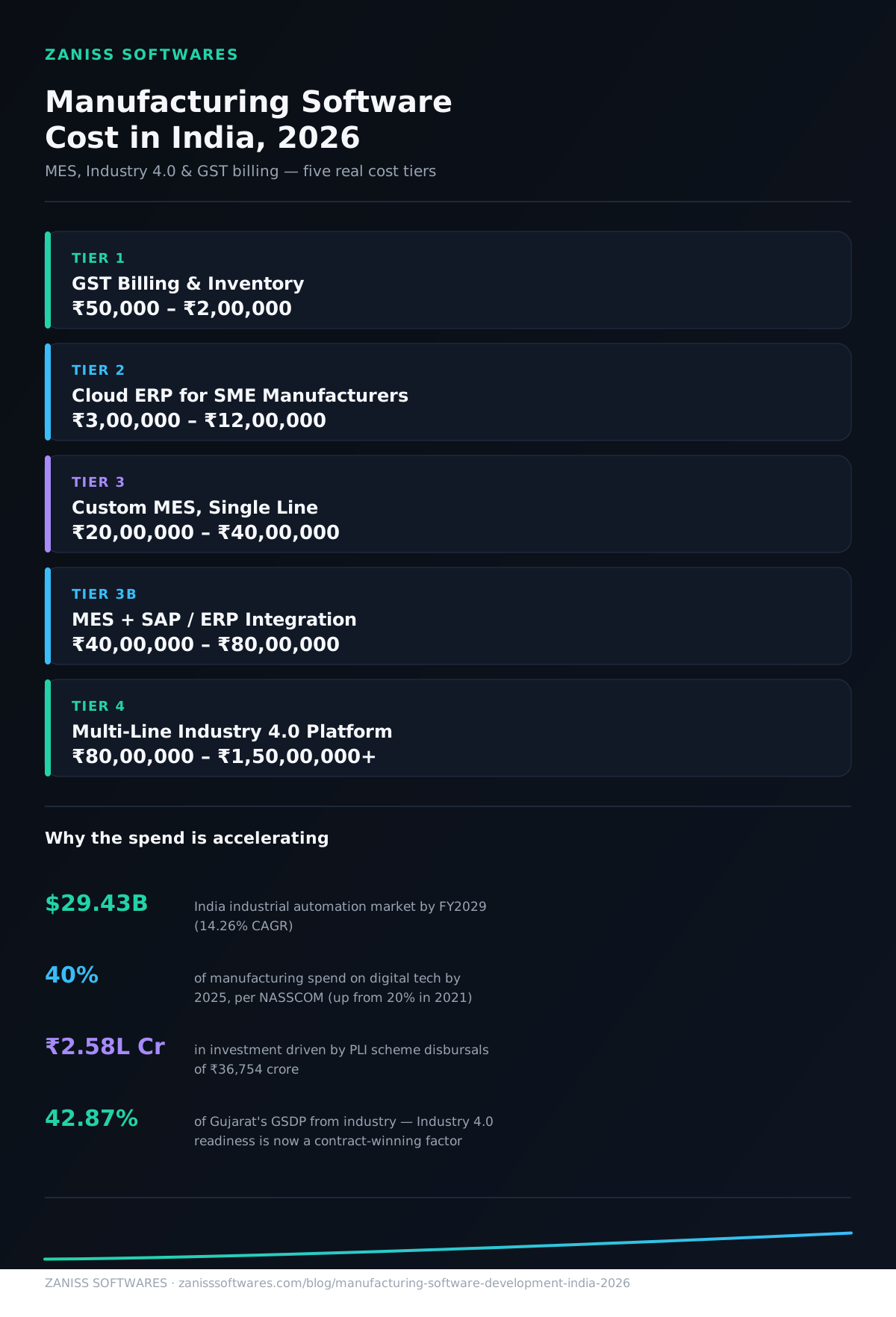
Pricing varies more in manufacturing software than in almost any other category we build, because the cost is driven by line count, existing ERP complexity, and machine connectivity — not just feature count. Based on current India market pricing and our own project data, here's how the tiers typically break down (figures exclude GST and hardware such as PLCs, edge gateways and RFID readers unless noted):
| Tier | What's Included | Typical Cost (INR) | Typical Timeline |
|---|---|---|---|
| TierTier 1 — GST Billing & Inventory | What's IncludedE-invoicing, GST returns, basic stock counts, single location (Tally/Vyapar-based, light customisation) | Typical Cost (INR)₹50,000 – ₹2,00,000 one-time + ₹10,000–₹25,000/year AMC | Typical Timeline2–4 weeks |
| TierTier 2 — Cloud ERP for SME Manufacturers | What's IncludedMulti-module ERP (Zoho/Odoo-based or custom), bill of materials, purchasing, basic production tracking | Typical Cost (INR)₹3,00,000 – ₹12,00,000 | Typical Timeline8–14 weeks |
| TierTier 3 — Custom MES, Single Line | What's IncludedWork-order tracking, operator logging, quality checks on one production line, no existing ERP integration | Typical Cost (INR)₹20,00,000 – ₹40,00,000 | Typical Timeline10–12 weeks |
| TierTier 3B — MES with SAP/ERP Integration | What's IncludedSame as Tier 3, plus production-order-to-confirmation sync with SAP S/4HANA or another full ERP | Typical Cost (INR)₹40,00,000 – ₹80,00,000 | Typical Timeline14–18 weeks |
| TierTier 4 — Multi-Line Industry 4.0 Platform | What's Included10–20 lines, IoT sensors, predictive maintenance, custom dashboards, full ERP integration | Typical Cost (INR)₹80,00,000 – ₹1,50,00,000+ | Typical Timeline18–24 weeks |
A few cost drivers worth flagging before you request quotes. SAP S/4HANA integration alone typically adds 40–60% to a base MES build, since a single production-order-to-confirmation sync can take 4–6 weeks on its own. Each additional line with the same machines and process adds roughly 15–25% to the cost; lines with unique steps, different PLC makes, or extra quality checks cost more. Machine connectivity itself varies sharply by protocol: well-supported protocols like Modbus RTU, OPC-UA and Allen-Bradley Ethernet/IP typically cost ₹50,000–₹1,00,000 per machine to connect, while custom or legacy protocols can run ₹2,00,000–₹5,00,000 per machine. And for multi-plant rollouts, each additional plant after the first typically costs ₹20,00,000–₹50,00,000 and 8–12 weeks, since most of the integration work is repeatable but machine connectivity still has to be redone per site.
Industry 4.0: IoT, Predictive Maintenance and the Gujarat Opportunity
The business case for Industry 4.0 investment in India isn't theoretical anymore. India's industrial automation market is projected to grow at a 14.26% CAGR, reaching roughly $29.43 billion by FY2029, and NASSCOM projects digital technologies will account for 40% of total manufacturing expenditure by 2025 — double the 20% share in 2021. Separately, India's Industry 4.0 market overall is estimated at around $6.3 billion in 2025, projected to reach $11 billion by 2030. Government support is accelerating this shift too: the PLI (Production Linked Incentive) schemes have disbursed roughly ₹36,754 crore to beneficiary companies, driving an estimated ₹2.58 lakh crore in actual investment and supporting employment for over 14.57 lakh people, which means more manufacturers are scaling production capacity and need the visibility to match.
Gujarat sits at the centre of this specifically. The state's secondary sector — industry and manufacturing — made up 42.87% of Gujarat's GSDP at current prices in 2025-26, with the state's total GSDP estimated at ₹33.24 lakh crore for FY27. Gujarat already accounts for a disproportionate share of specific manufacturing categories: around 40% of India's man-made fabric production and roughly 65-70% of national denim output run through Surat alone, and the state draws major new investment in semiconductors (Sanand, Dholera), automobiles (Khoraj) and petrochemicals (Vadodara, Dahej). For manufacturers operating inside or supplying into this ecosystem, Industry 4.0 readiness — real-time production data, predictive maintenance, and integration-ready systems — is increasingly a condition of winning larger contracts and export orders, not a nice-to-have upgrade.
Predictive maintenance specifically tends to have the clearest, fastest ROI story of any Industry 4.0 investment: connecting vibration, temperature or current sensors to a handful of critical machines and feeding that into a basic anomaly-detection model typically costs a fraction of a full MES build, and it directly prevents the unplanned downtime that erodes margins on every other investment in the plant.
How to Decide Which Tier You Actually Need
We run this as a short checklist with manufacturers before quoting anything, because the tiers above only work as a roadmap if you start at the right rung:
- Is your billing GST-compliant today? If you're not confidently inside the ₹5 crore e-invoicing mandate (or approaching it), start at Tier 1. Nothing above it matters until this is solid.
- Do you have one ERP system of record, or several disconnected tools? If purchasing, inventory and finance live in separate spreadsheets or systems that don't talk to each other, Tier 2 comes before any shop-floor investment — an MES feeding into a broken ERP just produces faster-arriving bad data.
- How many production lines, and how similar are they? A single line with standard machines is a very different (and cheaper) project than five lines with mixed-age equipment and different PLC vendors. Get an honest line-by-line audit before budgeting.
- Do you already run SAP, or will you? SAP S/4HANA integration is the single biggest cost multiplier in this entire category. If SAP is already committed, budget for Tier 3B or Tier 4 from the start rather than bolting it on later.
- Is downtime or traceability actually costing you money today? If unplanned downtime, scrap rates, or an inability to trace a batch back to its inputs is a named, quantified problem, Industry 4.0 investment pays for itself faster than the cost tables suggest. If it's a hypothetical "nice to have," start smaller and prove the case on one line first.
Common Mistakes We See Manufacturers Make
The most expensive mistake is sequencing: buying dashboards and predictive maintenance before production data is even flowing reliably into a system of record. The second most common is underestimating integration cost — a vendor quote that looks attractive in isolation often excludes SAP or legacy-protocol connectivity, which can add 40-60% once added back in. The third is treating a multi-plant rollout as "the same project five times," when in practice only the software logic repeats cleanly; machine connectivity, operator training and site-specific quality rules have to be redone at every plant.
What to Ask Before You Sign a Vendor Contract
Because manufacturing software pricing swings so widely on integration complexity, the quote itself is less useful than the questions behind it. Ask every vendor to state, in writing, which machine protocols they've priced for (Modbus RTU and OPC-UA are commodity work; anything proprietary or legacy should be flagged and quoted separately), whether the quote includes SAP or ERP integration or treats it as a change order later, and what a 12-month bug-fix warranty costs if it isn't already built into the number. We also recommend asking for the cost of each additional production line and each additional plant up front, even if you're only starting with one — a vendor who can't answer that quickly usually hasn't actually scoped a multi-line rollout before, which matters if that's where you're headed in year two.
One more question worth asking directly: who owns the code and the data model once the project ships? A system that locks your production data into a vendor's proprietary format is a liability the moment you want to add a dashboard, swap a reporting tool, or bring development in-house. Full code ownership should be a default term, not a premium add-on.
Decision Framework Summary
If you answered "no" to question 1 above, start with GST-compliant billing (Tier 1). If finance and inventory are still siloed, go to Tier 2 before touching the shop floor. Only move to Tier 3 or 3B once you have one clean production line to pilot MES on, and reserve Tier 4 for when you're rolling out across multiple lines or plants with a quantified downtime or traceability problem to solve.
Frequently Asked Questions
What is an MES, and do I need one if I already have an ERP?
An MES (Manufacturing Execution System) tracks what's actually happening on the shop floor in real time — work orders, machine status, operator output, quality checks — and feeds that data into your ERP. An ERP alone tells you what should happen financially and operationally; an MES tells you what did happen on the line. If your finished-goods entries in your ERP are based on estimates rather than real production data, you need an MES regardless of how good your ERP is.
How much does manufacturing software actually cost in India in 2026?
It ranges from roughly ₹50,000 for basic GST-compliant billing on a single-location unit up to ₹1.5 crore or more for a multi-line Industry 4.0 platform with IoT and predictive maintenance. The biggest single driver of cost within that range is whether the system needs to integrate with SAP or another full ERP, which typically adds 40-60% to a base MES build.
Is GST e-invoicing mandatory for my manufacturing business?
Yes, if your aggregate annual turnover has exceeded ₹5 crore in any financial year since FY 2017-18, under Notification No. 10/2023-Central Tax. Once you cross that threshold in any year, the requirement applies going forward even if turnover later falls below ₹5 crore — there's no opting back out.
How long does a manufacturing software or Industry 4.0 project actually take?
A single-line MES without ERP integration typically takes 10-12 weeks. Add SAP integration and that extends to 14-18 weeks. A full multi-line Industry 4.0 rollout (10-20 lines, IoT, predictive maintenance) typically runs 18-24 weeks for the first plant, with each additional plant adding 8-12 weeks.
Can ZANISS integrate manufacturing software with our existing SAP, Tally or Zoho setup?
Yes — most of our manufacturing engagements start from an existing system rather than a blank slate. We scope the integration cost explicitly during discovery rather than estimating it, since SAP integration specifically can add 40-60% to a project versus a greenfield build, and we'd rather you know that number before we start than discover it mid-project.
Related Articles
- IoT Development Services in India 2026: From Firmware to Cloud Dashboards →
- Custom ERP Software Development in India 2026: Cost, Modules & Timeline →
- Cloud-Native Application Development in India 2026: Architecture, Cost & Vendor Choices →
- System Integration Services in India 2026: Connecting CRM, ERP & Disconnected Tools →
Working With Us
ZANISS SOFTWARES builds custom manufacturing software — from GST-compliant billing through full Industry 4.0 platforms — scoped around your actual production lines, not a generic template. See our Custom Software Development services, or book a free consultation to get a line-by-line cost estimate.
📩 Response within 24 hours