Quick Summary
- 1India's logistics costs still run 13–14% of GDP — nearly double the 8–10% global benchmark the National Logistics Policy is chasing. The push to close that gap — AIS-140 vehicle tracking, the Unified Logistics Interface Platform (ULIP), and city-level freight plans like Ahmedabad's ₹12,315 crore logistics master plan — is pulling MSME and mid-market logistics operators into fleet tracking, warehouse management (WMS) and last-mile delivery software faster than any year before. This guide breaks down what these systems actually cost to build in India in 2026, when an off-the-shelf TMS beats custom development, and how to decide which tier your business needs.
Why Indian Logistics Is Digitizing Fast in 2026
India's logistics sector has spent a decade being told it costs too much. The National Logistics Policy's working figure — 13–14% of GDP spent on logistics, against an 8–10% global benchmark — has become the number every state transport department, port authority and freight operator is now measured against. Closing that gap is the explicit goal behind the Unified Logistics Interface Platform (ULIP), the central government's effort to pull EXIM data, railway freight data, highway and toll data, and warehousing data into one digital layer that logistics companies can plug into instead of chasing paperwork across a dozen departments. Digitization in logistics is no longer an efficiency nice-to-have; it is the stated national strategy, and procurement, compliance and customer-tracking expectations are shifting around it in real time.
The shift is visible locally, not just in policy papers. Ahmedabad's city logistics plan, released in mid-2026, commits ₹12,315 crore across three phases running from 2025 to 2047 to deal with roughly 289.5 million tonnes of freight moving through the city annually — 92% of it still by road. The plan leans on a three-tier physical network of Multi Modal Logistics Parks, Urban Consolidation Centers and Micro Delivery Hubs, but every one of those nodes needs software behind it: fleet visibility into the trucks feeding the parks, warehouse systems inside the consolidation centers, and last-mile routing out of the micro hubs. Gujarat's broader industrial base — GIDC corridors, textile and pharma manufacturing clusters, and port-linked freight out of Mundra and Kandla — creates the same pattern for mid-market manufacturers and distributors: more shipments, more compliance paperwork, and a shrinking tolerance for tracking any of it in spreadsheets or on WhatsApp.
The honest caveat, also from the same policy reviews: smaller logistics players are the ones struggling most to adapt. Enterprise TMS platforms are often built — and priced — for large 3PLs and national fleets, not a 40-truck transporter in Ahmedabad or a regional distributor running three warehouses. That gap between what MSMEs need and what enterprise software assumes is exactly where right-sized custom development tends to win.
What "Logistics Software" Actually Means
The category gets used loosely, so it's worth separating the four systems that usually get bundled under "logistics software":
- Fleet Management — GPS/telematics tracking, driver behavior, fuel monitoring, maintenance scheduling, and (in India specifically) AIS-140 compliance reporting.
- Warehouse Management (WMS) — inbound/outbound processing, inventory accuracy, bin/slot management, barcode or RFID scanning, and multi-warehouse stock visibility.
- Transportation Management (TMS) — freight procurement, carrier selection, dispatch planning, route and load optimization, freight billing and e-way bill linkage.
- Last-Mile Delivery — dynamic routing for delivery riders or vans, proof-of-delivery capture, and the customer-facing tracking link that online shoppers now expect by default.
Most real businesses need some combination of these, not all four at once — which is the first thing a scoping conversation should establish before anyone talks about cost.
AIS-140: The GPS Mandate Every Fleet Platform Must Support
Any fleet or logistics software touching commercial vehicles in India has to be built around AIS-140, the Ministry of Road Transport and Highways' vehicle location tracking standard. It's more than "add a GPS chip" — it's a full data and safety specification: dual-constellation positioning using both GPS and India's own NavIC system with 5-meter minimum accuracy, 4G connectivity (falling back to 3G/2G), location updates every 30 seconds while moving, a hard-wired panic button, tamper and SIM-removal detection, at least 6 hours of local data retention, and a standardized data feed into the government's NVLT portal and the Vahan database.
It applies to buses, taxis, school buses, ambulances, corporate shuttles and all commercial freight carriers — private, non-commercial vehicles are exempt, but anything run commercially (including a privately owned car used as a taxi) falls under it. Non-compliance isn't a soft risk: permit cancellation, fines up to ₹20,000, and vehicle detention at checkpoints are all live enforcement outcomes.
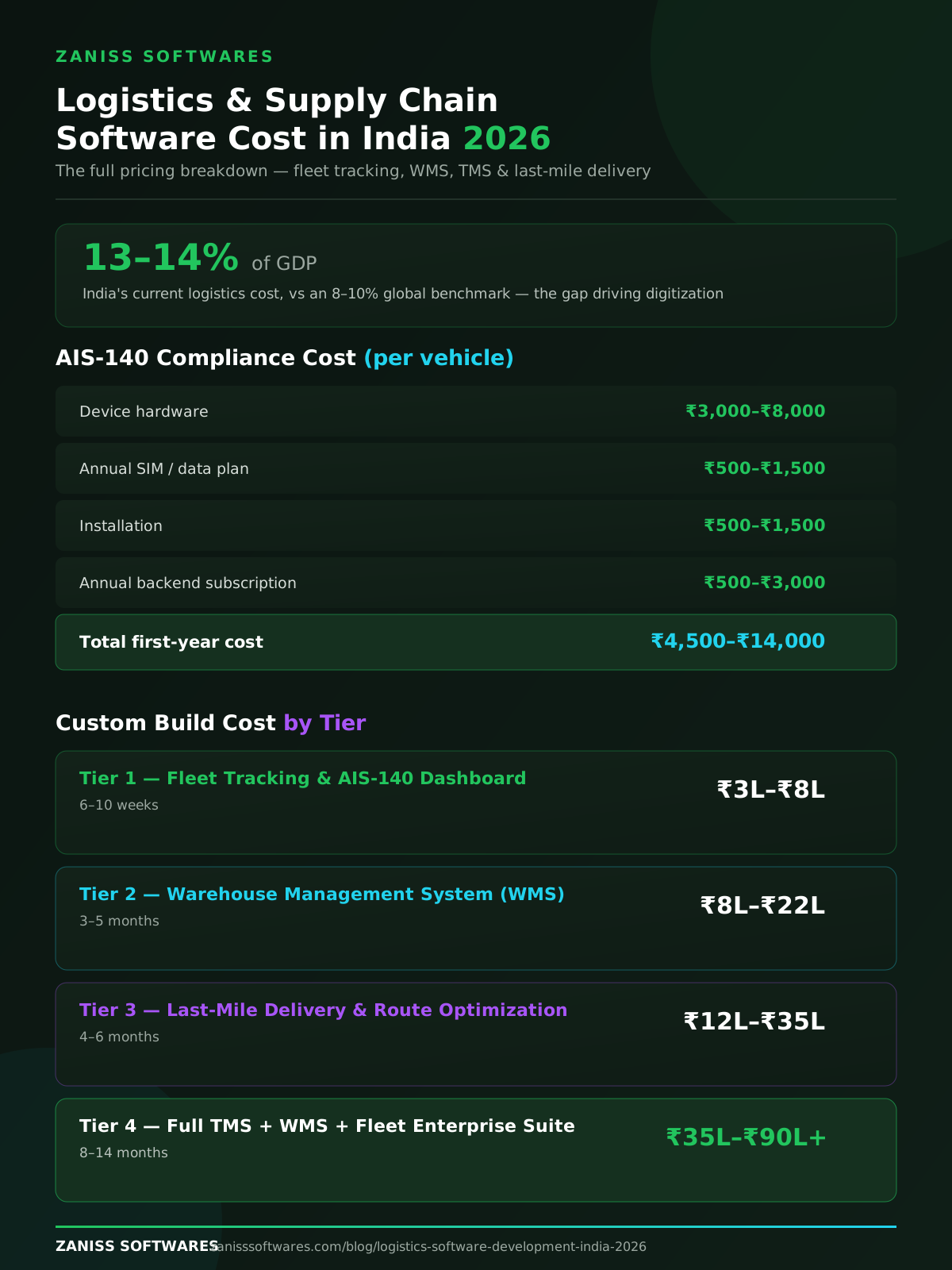
| AIS-140 Cost Component | Typical Range (per vehicle) |
|---|---|
| Device hardware | ₹3,000 – ₹8,000 |
| Annual SIM / data plan | ₹500 – ₹1,500 |
| Installation | ₹500 – ₹1,500 |
| Annual backend subscription | ₹500 – ₹3,000 |
| Total first-year cost | ₹4,500 – ₹14,000 |
Fleet operators running software that was built before — or without reference to — AIS-140 frequently end up retrofitting compliance reporting later at a higher cost than building it in from day one. 2026 is also seeing tighter NavIC accuracy requirements, ANPR integration at toll plazas, early specifications for EV telemetry, and discussion of extending the mandate to commercial two- and three-wheelers used in last-mile delivery — all reasons to design the tracking layer to be extensible rather than hard-coded to today's rules.
Build vs Buy: SaaS TMS Platforms vs Custom Development
Before scoping a custom build, it's worth knowing what's already on the shelf. India's TMS market has matured enough that several platforms are viable for mid-market and enterprise fleets:
| Platform | Indicative Pricing | Best Fit |
|---|---|---|
| Fretron | Contact sales (transaction-based) | Freight procurement, SAP/Tally-linked dispatch |
| Shipsy | Enterprise, modules sold separately | TMS + WMS + EXIM + last-mile in one suite |
| Locus | ≈ ₹17 lakh/year | Route optimization-first, strong last-mile focus |
| FarEye | Enterprise pricing | Route planning, carrier management, returns |
| SuperProcure | Contact sales | Freight sourcing, reverse e-auctions, FASTag/Vahan links |
| Freight Tiger | Enterprise pricing | Digital freight network, settlement, tracking |
| Pando | ≈ ₹1.7 crore/year | AI-driven freight and carrier rate optimization |
| Traqo | Low-cost / free tier | WhatsApp-native basic shipment tracking |
Buying off-the-shelf makes sense when deployment speed matters more than fit, when the carrier network and integrations a platform already has are valuable on their own, or when there's no in-house team to maintain custom software. Custom development starts winning once a business has workflows the off-the-shelf tools don't model well — multi-modal freight specific to Gujarat's port corridors, deep SAP/Tally/ERP integration, a 3PL that wants to white-label the platform for its own customers, or a transport company whose per-shipment SaaS fees are climbing past what a one-time build would have cost at their current volume.
What It Costs to Build Logistics Software in India in 2026
For businesses that land on custom development, here's how ZANISS SOFTWARES typically scopes logistics platform builds, priced for Indian delivery:
| Tier | Scope | Typical Cost (INR) | Timeline |
|---|---|---|---|
| Tier 1 | Fleet Tracking & AIS-140 Compliance Dashboard | ₹3,00,000 – ₹8,00,000 | 6–10 weeks |
| Tier 2 | Warehouse Management System (WMS) | ₹8,00,000 – ₹22,00,000 | 3–5 months |
| Tier 3 | Last-Mile Delivery & Route Optimization Platform | ₹12,00,000 – ₹35,00,000 | 4–6 months |
| Tier 4 | Full TMS + WMS + Fleet Enterprise Suite | ₹35,00,000 – ₹90,00,000+ | 8–14 months |
Budget an additional 20–30% on top of the build cost for SAP/Tally/ERP integration and e-way bill automation if they're in scope, and 15–20% of the build cost annually for maintenance, hosting and support once the platform is live — both are costs quotes commonly leave out of the headline number.
A Decision Framework: Which Tier Does Your Business Need?
- Under 20 vehicles, single warehouse: Tier 1, or evaluate a low-cost off-the-shelf option like Traqo or FleetX before building custom.
- Growing 3PL or distributor running multiple warehouses: Tier 2, with inventory accuracy and multi-location visibility as the priority.
- D2C or e-commerce brand running its own delivery fleet: Tier 3, built around rider apps, proof-of-delivery and a customer-facing tracking experience.
- Manufacturer or large distributor with existing ERP and multiple transport modes: Tier 4, scoped from day one around SAP/Tally integration and e-way bill compliance.
Gujarat & Ahmedabad: Why Local Logistics Tech Demand Is Surging
Gujarat's industrial geography — GIDC corridors, textile and pharmaceutical manufacturing clusters, and the Mundra and Kandla port corridors — generates a steady volume of multi-modal freight that most generic logistics software wasn't designed around. Ahmedabad's ₹12,315 crore city logistics plan is the clearest public signal of where that demand is heading: Multi Modal Logistics Parks and Urban Consolidation Centers that will need fleet visibility and warehouse systems wired into them from the start, and Micro Delivery Hubs that will need last-mile routing software to make the "last few kilometers" of the plan actually work. For manufacturers, distributors and transporters operating in and around Ahmedabad, the practical move is to start scoping software against where this infrastructure is headed, not just against today's operations.
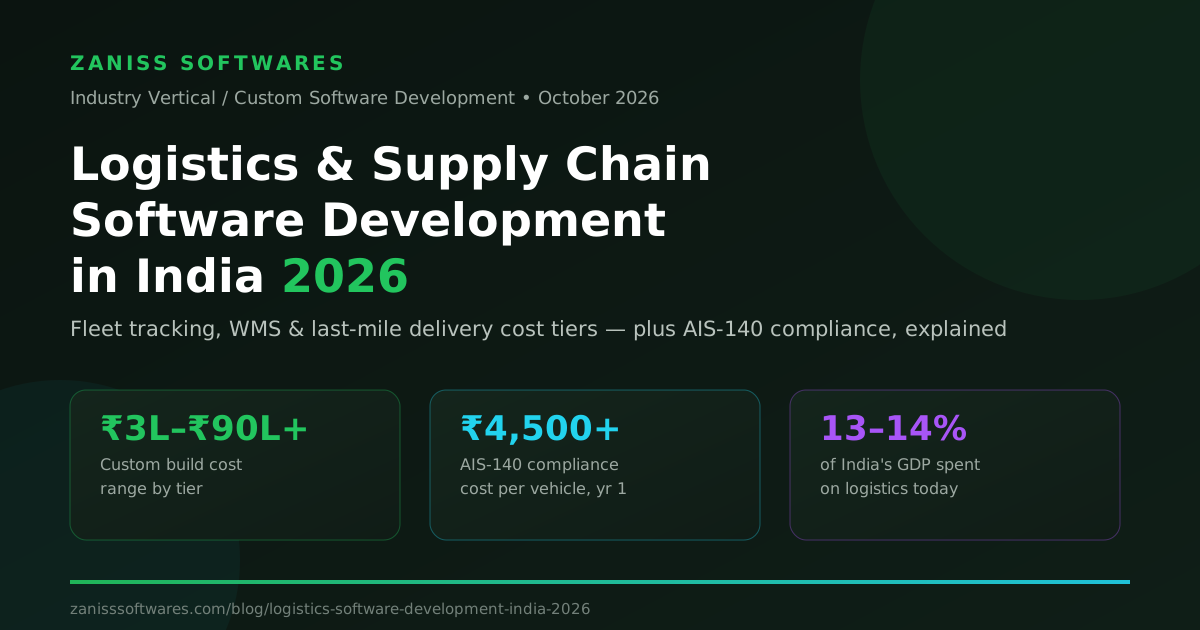
Companion infographic: Logistics & Supply Chain Software Cost in India 2026 →
Related Articles
Planning a Website? Don't Overpay or Underbuild
Most businesses overspend on features they don't need — or underspend and rebuild within a year. We help you scope it right from day one.
Pro Insight
Working With Us
Planning a fleet tracking, WMS or last-mile delivery build? ZANISS SOFTWARES designs and builds custom software scoped to your fleet size, warehouse footprint and compliance needs — not a one-size-fits-all SaaS subscription.
- ✓SEO-first architecture
- ✓Conversion-focused design
- ✓High-speed performance
- ✓Scalable, future-proof code
📩 Response within 24 hours
Frequently Asked Questions
How much does logistics software cost to build in India in 2026?
Custom builds typically range from ₹3 lakh for a focused fleet-tracking and AIS-140 compliance dashboard to ₹90 lakh or more for a full TMS + WMS + fleet enterprise suite, depending on scope, integrations and timeline.
Is AIS-140 GPS tracking mandatory for my business?
Yes, if you operate commercial vehicles — buses, taxis, trucks, school buses, ambulances or shuttles. Private, non-commercial vehicles are exempt, but any vehicle used commercially falls under the mandate, with fines up to ₹20,000 and permit cancellation for non-compliance.
Should I buy a TMS or build custom logistics software?
Buy when you need fast deployment and a platform's existing carrier network or integrations are valuable on their own. Build custom when your workflows, ERP integration needs, or long-term per-shipment SaaS costs don't fit what off-the-shelf platforms assume.
How long does it take to build a WMS or last-mile delivery platform?
A warehouse management system typically takes 3–5 months; a last-mile delivery and route optimization platform typically takes 4–6 months, depending on integration scope.
Does logistics software integrate with SAP/Tally and e-way bill systems?
It can, but that integration is usually scoped and priced separately — budget an additional 20–30% on top of the base build cost when SAP, Tally or e-way bill automation is required.