Quick Summary
- 1Firmware (ESP32/STM32/Nordic) + cloud + dashboard MVP: $30K–$90K
- 2Fleet management with OTA, alerts and analytics: $60K–$180K
- 3Production-grade security (TLS, secure boot, signed OTA) is mandatory, not optional
- 4Indian IoT teams typically save 50–65% vs US/EU equivalents
IoT in 2026 is no longer about hobby boards blinking LEDs. It is about commercial fleets of 1,000–100,000+ devices reporting telemetry every few seconds, receiving signed OTA updates, and feeding ML-driven anomaly detection. Whether you are building a smart energy meter, an industrial vibration sensor, a connected agriculture probe, or a logistics tracker, the cost and complexity break down predictably. Here is the 2026 playbook from an Indian IoT engineering perspective.
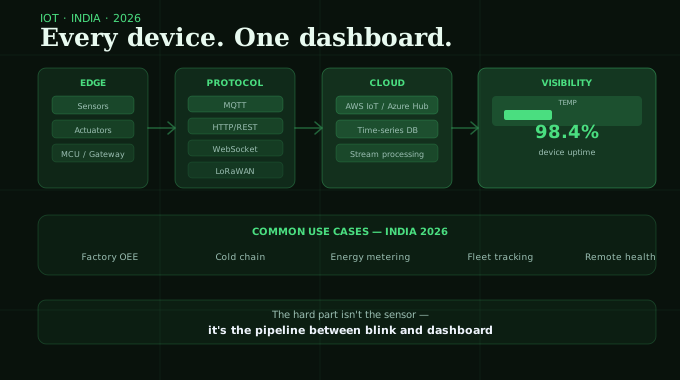
The four layers of any IoT system
- Device / firmware: ESP32, STM32, Nordic nRF52/91, Raspberry Pi CM4. Written in C/C++ or Rust on FreeRTOS, Zephyr or bare metal.
- Connectivity: BLE, Wi-Fi, LoRaWAN, NB-IoT, LTE-M, 4G/5G. Protocol over MQTT or CoAP.
- Cloud ingestion + storage: AWS IoT Core, Azure IoT Hub, Google Cloud IoT, or self-hosted EMQX/HiveMQ. Time-series DB (TimescaleDB, InfluxDB).
- Application + dashboard: Operator dashboard, alert engine, OTA orchestration, customer portal.
What an IoT MVP costs in 2026
For a single device class — say a smart energy meter with Wi-Fi reporting kWh every 30 seconds and a web dashboard — expect $30K–$90K across 10–14 weeks. That covers firmware on ESP32 with TLS-secured MQTT, AWS IoT Core ingestion, TimescaleDB storage, a React dashboard with live charts, and a basic alert rule engine. Hardware certification (BIS, FCC, CE) is a separate $5K–$25K depending on geography.
IoT build pricing (USD)
| Website Type | Price Range | Best For |
|---|---|---|
| IoT MVP | $30K – $90K | Single device class, basic cloud + dashboard |
| Fleet & OTA Platform | $60K – $180K | Multi-device, OTA, analytics, alerts |
| Industrial / OT | $100K – $300K+ | Modbus, OPC-UA, SCADA integration |
| Per-device cloud cost | $0.20 – $2 / month | Depends on telemetry volume |
Planning a Website? Don't Overpay or Underbuild
Most businesses overspend on features they don't need — or underspend and rebuild within a year. We help you scope it right from day one.
Fleet management is where it gets interesting
Once you cross 500 devices in the field, the priorities shift. You need: signed OTA updates (rollback-safe), staged rollouts (10% canary first), device-level secrets (X.509 per-device certs), shadow state sync, geofencing, and operator RBAC. That platform layer alone is $60K–$180K on top of the device firmware. We typically build this in three phases — ingest + storage, then OTA + fleet, then analytics + alerts.
Security is the part vendors love to skip
- Secure boot: Only signed firmware can run. Mandatory for production devices.
- Per-device credentials: Never share a single API key across a fleet. Use X.509 certs or AWS IoT Just-in-Time Provisioning.
- TLS everywhere: MQTT over TLS 1.3. No exceptions.
- Signed OTA: Firmware bundles must be signed; the bootloader verifies before flashing.
- Anomaly detection: Watch for devices reporting impossibly high frequencies (compromised device or replay attack).
Cloud cost per device
For most low-frequency telemetry (1 message/minute, sub-1KB payloads), AWS IoT Core + Timestream + Lambda alerting runs $0.20–$2 per device per month. High-frequency industrial signals (10Hz vibration data) can hit $5–$20/device. Always model this BEFORE you ship 10,000 units, or your unit economics will collapse.
Why Indian IoT teams are competitive
India has a deep bench of embedded engineers, a growing semiconductor ecosystem, and pricing that lets startups iterate fast. Senior firmware engineers run $30–$70/hour vs $120–$250/hour in the US. We routinely deliver complete IoT MVPs at 40–50% of the equivalent US build cost. See our IT consulting and cloud solutions pages for related capability, or contact us to scope your IoT project.
Pro Insight
Planning a cloud-native platform? Let's review your architecture for free.
At ZANISS SOFTWARES, we don't just build websites — we build growth systems.
- ✓SEO-first architecture
- ✓Conversion-focused design
- ✓High-speed performance
- ✓Scalable, future-proof code
📩 Response within 24 hours