Quick Summary
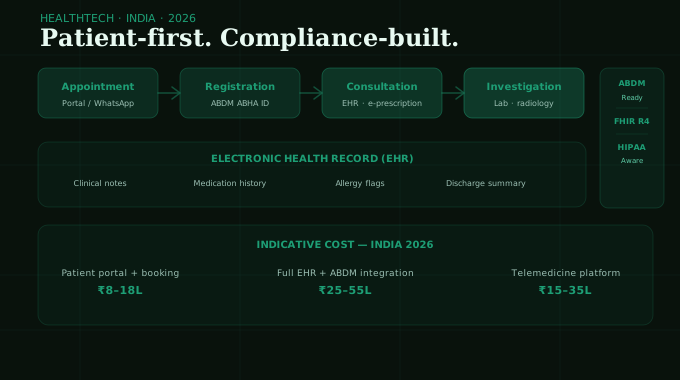
- 1ABDM (Ayushman Bharat Digital Mission) is the integration spine — design for it day one
- 2FHIR R4 is the de-facto data standard; legacy HL7v2 still appears in hospital integrations
- 3Telemedicine MVP: INR 25–60 L; full HMIS or chain-grade EHR: INR 1.2–3.5 Cr
- 4DPDP Act + ABDM consent layer = real consent management, not a checkbox
Healthcare software in India looks like a fragmented market until you zoom in: ABDM is quietly becoming the integration spine, FHIR is the data model that finally stuck, and DPDP Act compliance has teeth. If you are building a clinic SaaS, a telemedicine platform, or an EHR for a small chain in 2026, the playbook is clearer than it has ever been.
The ABDM mental model
Think of ABDM as four interlocking pieces:
- ABHA (Ayushman Bharat Health Account): the patient's unique health ID.
- HPR / HFR: registries for healthcare professionals and facilities.
- UHI: the marketplace layer for discovering and booking services.
- HIE-CM (Consent Manager): how patient health records move between providers, with explicit consent.
If you ignore ABDM, you will integrate piecewise in 2027 anyway, more painfully and at higher cost. Design for ABHA linking and consented record exchange from day one.
FHIR R4 — the standard that stuck
India's HIE-CM speaks FHIR R4 bundles for record exchange. Your internal model does not have to be FHIR, but you must be able to serialise to FHIR (Patient, Encounter, Observation, Condition, MedicationRequest, DiagnosticReport) on demand. Treat FHIR as a wire format; keep your domain model clean.
Indicative healthtech build costs (2026)
| Website Type | Price Range | Best For |
|---|---|---|
| Telemedicine MVP | INR 25–60 L | Video consults, payments, basic EMR, ABDM linking |
| Single-clinic EHR / HMIS | INR 60 L–1.2 Cr | OPD, billing, labs, pharmacy, ABDM v1 |
| Hospital chain EHR | INR 1.2–3.5 Cr | Multi-site, IPD, integrations, audit-grade compliance |
Planning a Website? Don't Overpay or Underbuild
Most businesses overspend on features they don't need — or underspend and rebuild within a year. We help you scope it right from day one.
Telemedicine: a 2026 reference stack
- Video via a reputable WebRTC SaaS (Daily, 100ms, Twilio) — do not build your own stack.
- Pre-consultation intake form, prescription pad with digital signature, e-prescription PDF.
- Payments via a PA + UPI autopay for follow-ups.
- ABHA linking, optional consented record fetch.
- RBI / DPDP localised storage, full audit trail.
EHR / HMIS: the unsexy 80%
Most of the cost in a clinic or hospital EHR is the long tail: pharmacy, labs, radiology, billing, insurance claim flows, IPD orders, ward management, GST-compliant invoices, inventory, and ABDM. Founders consistently under-estimate billing and claims — plan for 25–35% of the build to land there.
DPDP Act in practice
- Explicit consent per purpose, withdrawable, logged.
- Notice in clear language, in the local language where applicable.
- Breach notification SLAs to the DPB and affected patients.
- Data fiduciary obligations even if you are a vendor to a hospital — get the DPA right.
Common 2026 mistakes
- Hard-coding clinic workflows. Every clinic thinks they are unique. Configure, do not bake in.
- Treating ABDM as a "nice to have." Government tenders increasingly require it.
- Skipping offline mode for OPD in low-connectivity areas.
- Storing scanned prescriptions as opaque PDFs with no structured data behind them.
We help healthtech founders ship ABDM-compliant builds through custom software development, mobile app development, and cloud solutions engagements. Need an architecture review against ABDM and DPDP? contact us.
Pro Insight
Planning a cloud-native platform? Let's review your architecture for free.
At ZANISS SOFTWARES, we don't just build websites — we build growth systems.
- ✓SEO-first architecture
- ✓Conversion-focused design
- ✓High-speed performance
- ✓Scalable, future-proof code
📩 Response within 24 hours