Quick Summary
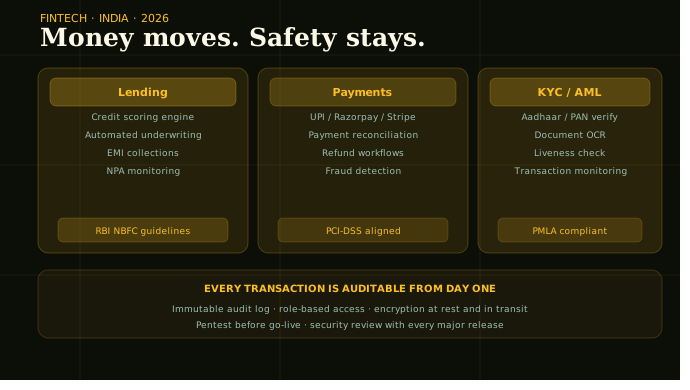
- 1Most India fintechs sit on UPI, Account Aggregator, and a payment aggregator licence chain
- 2MVP cost: INR 35–80 L; production-ready compliant build: INR 1–2.5 Cr
- 3Plan for RBI data localisation, audit logs, and 7-year retention from day one
- 4Outsource UI, ledger, integrations — keep risk, compliance, and customer ops in-house
Fintech in India in 2026 is not a vibe — it is a compliance-heavy distributed system that happens to have a friendly UI. RBI tightened payment aggregator rules, DPDP Act enforcement is live, and the Account Aggregator framework matured into the default data plumbing. Here is a clear-eyed view of what it takes to build.
The licence stack that decides your architecture
- Payment Aggregator (PA): required if you settle merchant funds. Most early fintechs ride a partner PA (Razorpay, Cashfree, PayU) before applying for their own.
- Prepaid Payment Instrument (PPI): needed for wallets and gift cards.
- NBFC or co-lender: for any credit product. Without it you are a DLG / LSP under the digital lending guidelines.
- Account Aggregator consumer: the right way to pull bank statements in 2026 — no scraping, no statement upload friction.
The standard 2026 architecture
- Identity + KYC: Aadhaar e-KYC via a licensed AUA/KUA partner, video KYC, PAN, DigiLocker.
- Core ledger: double-entry, append-only, idempotent. Treat it as the system of record. Postgres + an event log is fine; do not start with microservices.
- Payments layer: UPI (collect, autopay, recurring), cards via your PA, NEFT/IMPS for high-value, settlement reconciliation jobs.
- Compliance plumbing: 7-year audit log, immutable transaction trail, customer consent records, FIU-IND reporting hooks.
- Fraud and risk: device fingerprinting, velocity rules, sanctions screening, transaction monitoring. Buy a platform (Sardine, Bureau, HyperVerge) before building.
Indicative fintech build costs (2026)
| Website Type | Price Range | Best For |
|---|---|---|
| MVP (closed beta) | INR 35–80 L | Validation with sandbox APIs, basic KYC, limited users |
| Production launch | INR 1–2.5 Cr | PA/PPI integration, full KYC/AML, audit-ready logging |
| Scale (Series A+) | INR 3–6 Cr/year | Multi-product, fraud platform, SRE, compliance team |
Planning a Website? Don't Overpay or Underbuild
Most businesses overspend on features they don't need — or underspend and rebuild within a year. We help you scope it right from day one.
Where the money goes
Frontend and onboarding flows are ~25% of build cost. Ledger + payments integrations are ~35%. Compliance, audit logging, observability and security hardening are ~25%. The remaining ~15% is internal ops tooling — reconciliation dashboards, dispute handling, customer support back-office. Founders consistently under-budget internal ops, then drown in support tickets at month four.
What to outsource and what to keep in-house
Outsource: UI engineering, ledger plumbing, third-party integrations, DevOps, design. Keep in-house: risk policy, compliance reporting, customer ops, partner negotiations. The line is not seniority — it is regulatory exposure. We build the technical surface area as a fixed-price custom software development engagement; you keep the regulated decisions.
Common 2026 mistakes
- Treating the ledger as a normal CRUD app. It needs idempotency, double-entry, and reconciliation from day one.
- Logging PII into Datadog or Sentry. Tag and scrub before egress; store regulated logs in India per RBI localisation.
- Skipping a real reconciliation job for the PA. Settlements will silently drift; you will find out from your CA.
- Building fraud rules in spreadsheets. Use a platform from day one; rules will change weekly.
Realistic timeline
Closed beta with sandbox APIs and partner PA: 4–6 months. Production launch with full KYC and reconciliation: 8–12 months. Own PA/PPI licence: add 9–15 months of regulatory work in parallel.
If you are scoping a fintech build, contact us for an architecture and compliance review. See our work in cloud solutions and IT consulting for related context.
Pro Insight
Planning a cloud-native platform? Let's review your architecture for free.
At ZANISS SOFTWARES, we don't just build websites — we build growth systems.
- ✓SEO-first architecture
- ✓Conversion-focused design
- ✓High-speed performance
- ✓Scalable, future-proof code
📩 Response within 24 hours