In this article
Quick Summary
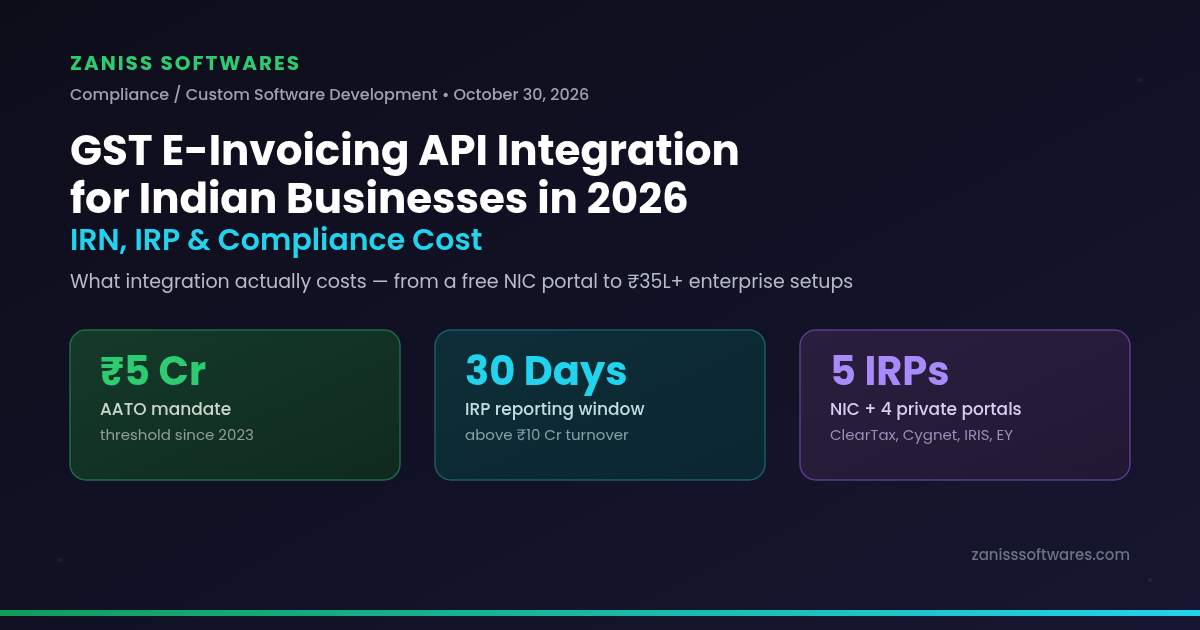
- 1Every business crossing ₹5 crore in aggregate annual turnover must generate an Invoice Reference Number (IRN) through a government-approved Invoice Registration Portal (IRP) before an invoice is legally valid for GST purposes — and if your turnover is ₹10 crore or more, that invoice must reach the IRP within 30 days or it's rejected outright. Manual entry on the free NIC portal works for a handful of invoices a day; it collapses the moment volume, multiple GSTINs, or an ERP enters the picture. This article breaks down what GST e-invoicing API integration actually costs in India in 2026 — from a ₹500/month Tally plugin to a ₹25 lakh+ multi-entity SAP integration — and how to pick the right IRP/GSP combination for your business.
India's ₹5 Crore Rule, and Why It Keeps Catching Businesses Off Guard
India's GST e-invoicing mandate has quietly become one of the most consequential pieces of compliance infrastructure a growing business has to plug into. It started in October 2020 as a rule for companies turning over ₹500 crore or more. By August 2023 the threshold had been cut five times, down to ₹5 crore in Aggregate Annual Turnover (AATO) — and it has stayed there since, pulling tens of thousands of mid-sized Indian businesses into mandatory e-invoicing almost overnight.
If your business crossed ₹5 crore in turnover in any financial year from 2017-18 onward, e-invoicing isn't optional. The invoice your accounts team emails a customer today, without a valid Invoice Reference Number (IRN) and QR code stamped on it by a government-approved portal, is not a valid tax invoice. Buyers can't claim input tax credit against it, and under Section 122 of the CGST Act, the supplier is staring at a penalty of ₹10,000 or the tax amount involved — whichever is higher.
This is where "GST e-invoicing" stops being an accounting function and starts being a software integration problem. The question for most founders and IT leads isn't "should we comply" — it's "how do we wire this into what we already run without turning finance into a full-time IRN-chasing department."
How GST E-Invoicing Actually Works
Despite the name, your business never "sends an e-invoice" to the government. The flow is the same for everyone, just automated to different degrees:
- You generate an invoice in your billing system, ERP, or accounting software (Tally, Zoho Books, SAP, a custom system — doesn't matter).
- That invoice data, in a prescribed JSON schema, is submitted to an Invoice Registration Portal (IRP).
- The IRP validates the invoice, checks for duplicates, generates a unique IRN (a 64-character hash) and a signed QR code, and pushes the registered invoice data onward to the GST and e-way bill systems automatically.
- The IRP returns the signed invoice, IRN, and QR code to you, which you then print or embed on the customer-facing invoice.
There are currently five live IRPs taxpayers can use: the NIC IRP (run by the National Informatics Centre, free, used by the large majority of smaller filers), and four private IRPs approved by GSTN — ClearTax, Cygnet, IRIS Business Services, and EY. The private IRPs don't just register invoices; they layer on ERP connectors (SAP, Oracle, Tally, Zoho, Busy), bulk-upload tools, reconciliation dashboards, and API access that the raw NIC portal doesn't offer. Several businesses also work through a GST Suvidha Provider (GSP) — a GSTN-authorised API intermediary — rather than integrating with an IRP directly, particularly when they need the GSP's existing SAP/Oracle connector instead of building one from scratch.
The Two Numbers Every Finance and Engineering Team Needs to Know
₹5 crore AATO is the compliance trigger. Once your aggregate turnover (across all GSTINs under the same PAN) crosses ₹5 crore in any year since 2017-18, e-invoicing becomes mandatory for all B2B, export, and deemed-export invoices going forward — permanently, even if turnover later drops below the threshold.
30 days is the reporting window that catches teams off guard. Taxpayers with AATO of ₹10 crore or more must report an invoice to the IRP within 30 days of the invoice date. Miss the window and the IRP won't register it at all — the invoice is simply invalid for GST purposes, with no retroactive fix.
Who Can Get Away With the Free NIC Portal — and Who Can't
For a business issuing a dozen or so B2B invoices a month, manually keying each one into the free NIC e-invoice portal is genuinely fine. The cracks appear fast once any of the following is true: you're issuing more than roughly 50-100 invoices a month, you operate across multiple GSTINs or states, your billing already lives inside an ERP or custom system that would otherwise need duplicate manual entry, your sales or field teams raise invoices outside a central finance desk, or you've crossed the ₹10 crore 30-day reporting threshold and can't risk a missed window.
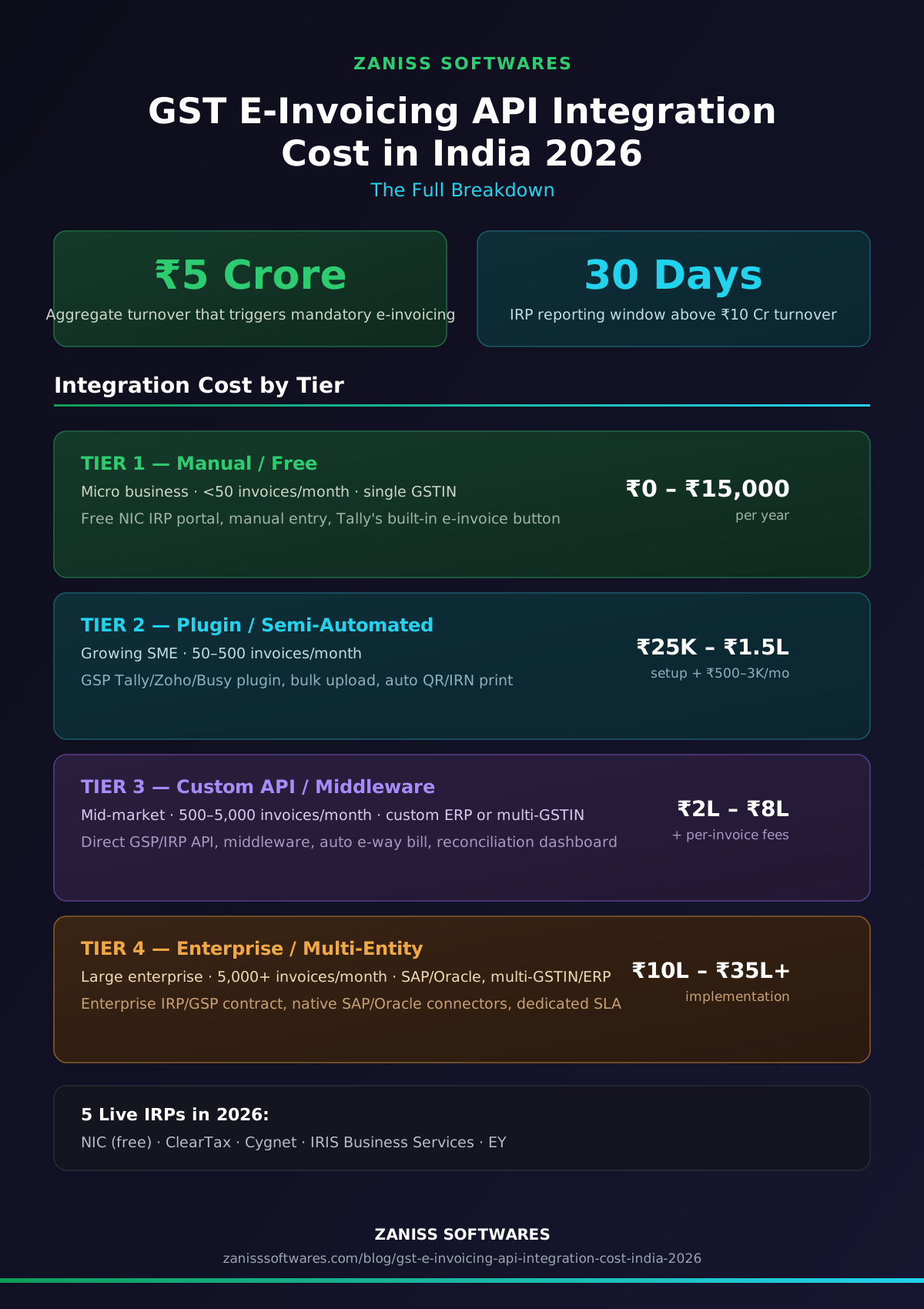
What GST E-Invoicing API Integration Actually Costs in India (2026)
| Tier | Typical Business | What's Included | Indicative Cost (INR) |
|---|---|---|---|
| TierTier 1 — Manual / Free | Typical BusinessMicro business, <50 invoices/month, single GSTIN | What's IncludedFree NIC IRP portal, manual entry, Tally's built-in e-invoice button | Indicative Cost (INR)₹0 – ₹15,000/year (licence only) |
| TierTier 2 — Plugin / Semi-Automated | Typical BusinessGrowing SME, 50–500 invoices/month | What's IncludedGSP-provided Tally/Zoho/Busy plugin, bulk upload, auto QR/IRN print | Indicative Cost (INR)₹25,000 – ₹1,50,000 setup + ₹500 – ₹3,000/month |
| TierTier 3 — Custom API / Middleware | Typical BusinessMid-market, 500–5,000 invoices/month, custom ERP or multiple GSTINs | What's IncludedDirect GSP/IRP API integration, middleware, auto e-way bill, reconciliation dashboard | Indicative Cost (INR)₹2,00,000 – ₹8,00,000 + per-invoice fees |
| TierTier 4 — Enterprise / Multi-Entity | Typical BusinessLarge enterprise, 5,000+ invoices/month, SAP/Oracle, multi-GSTIN/ERP | What's IncludedEnterprise IRP/GSP contract, multi-GSTIN orchestration, native SAP/Oracle connectors, dedicated SLA | Indicative Cost (INR)₹10,00,000 – ₹35,00,000+ implementation |
Two cost drivers consistently surprise businesses scoping this for the first time. First, GSP per-invoice fees are usually small individually (₹1–₹3 per invoice) but compound fast at volume. Second, the real integration cost rarely lives in the IRP connection itself; it lives in reconciliation — matching IRNs back to your ERP records, handling IRP downtime gracefully, retrying failed submissions before the 30-day window closes, and keeping e-way bill generation in sync.
A Decision Framework: Which Tier Is Right for You
- What's your monthly invoice volume? Under 50, Tier 1 is defensible. Between 50 and 500, Tier 2 pays for itself inside a few months in saved staff time. Above 500, manual or plugin-based entry becomes an operational risk.
- Is your AATO at or above ₹10 crore? If yes, you need automated, reliable submission — Tier 3 or above — regardless of volume.
- Do you run more than one GSTIN or more than one ERP/billing system? Multiple entities multiply the reconciliation problem faster than they multiply invoice count.
- Is e-invoicing data feeding anything else — e-way bills, GSTR-1 auto-population, customer ERP integrations, or audit reporting? Budget for middleware and reconciliation accordingly.
What a Proper Integration Should Include
A resilient API layer that retries failed IRP submissions automatically before the 30-day cutoff; validation that catches schema errors (HSN codes, GSTIN format, mandatory fields) before submission; a reconciliation dashboard flagging invoices stuck in a failed or pending state; e-way bill auto-generation where applicable; and a clean audit trail mapping every IRN back to its source invoice.
Choosing Between the Five IRPs: What Actually Differs
The NIC IRP is free and reliable for low-volume use but offers no bulk APIs or ERP connector library. ClearTax and IRIS are generally the strongest picks for businesses needing an out-of-the-box SAP, Oracle, or Tally connector. Cygnet tends to be favoured by mid-size and large manufacturing/distribution businesses already using Cygnet's broader tax compliance suite. EY's IRP suits large enterprises evaluating e-invoicing as part of a broader statutory compliance program. Run a sandbox trial with your actual invoice formats, including credit notes, exports, and SEZ supplies, before committing to a provider.
Common Integration Mistakes We See
Treating the IRP call as a synchronous, blocking step inside invoice creation; skipping schema validation on your side; underestimating credit notes, debit notes, and export invoices during scoping; and failing to build a reconciliation view at all. Budgeting for these from day one is usually the difference between an integration that holds up and one that generates a support ticket every month-end.
Frequently Asked Questions
Is GST e-invoicing mandatory for my business?
If your aggregate turnover across all GSTINs under your PAN crossed ₹5 crore in any financial year from 2017-18 onward, e-invoicing is mandatory for all B2B, export, and deemed-export invoices — permanently.
What happens if an invoice isn't registered with an IRP?
It isn't treated as a valid tax invoice. Your buyer cannot claim input tax credit, and you face a penalty under Section 122 of ₹10,000 or the tax amount involved, whichever is higher.
Can I use the free NIC portal instead of a paid GSP?
Yes — the NIC IRP is free, but manual entry becomes impractical past roughly 50 invoices a month, and it offers no ERP connectors, bulk tools, or reconciliation dashboards.
What is the 30-day rule and does it apply to me?
Businesses with AATO of ₹10 crore or more must submit an invoice to the IRP within 30 days of its invoice date, or it's rejected outright with no retroactive fix.
How long does a custom API integration take to build?
Tier 2: 1–2 weeks. Tier 3: 4–8 weeks including sandbox testing. Tier 4 (enterprise multi-entity): 10–16 weeks.
Related Articles
- System Integration Services in India 2026: Connecting CRM, ERP & Disconnected Tools
- Custom ERP Software Development in India 2026: Cost, Modules & Timeline
- API Development Services in India 2026: REST, GraphQL and gRPC Done Right
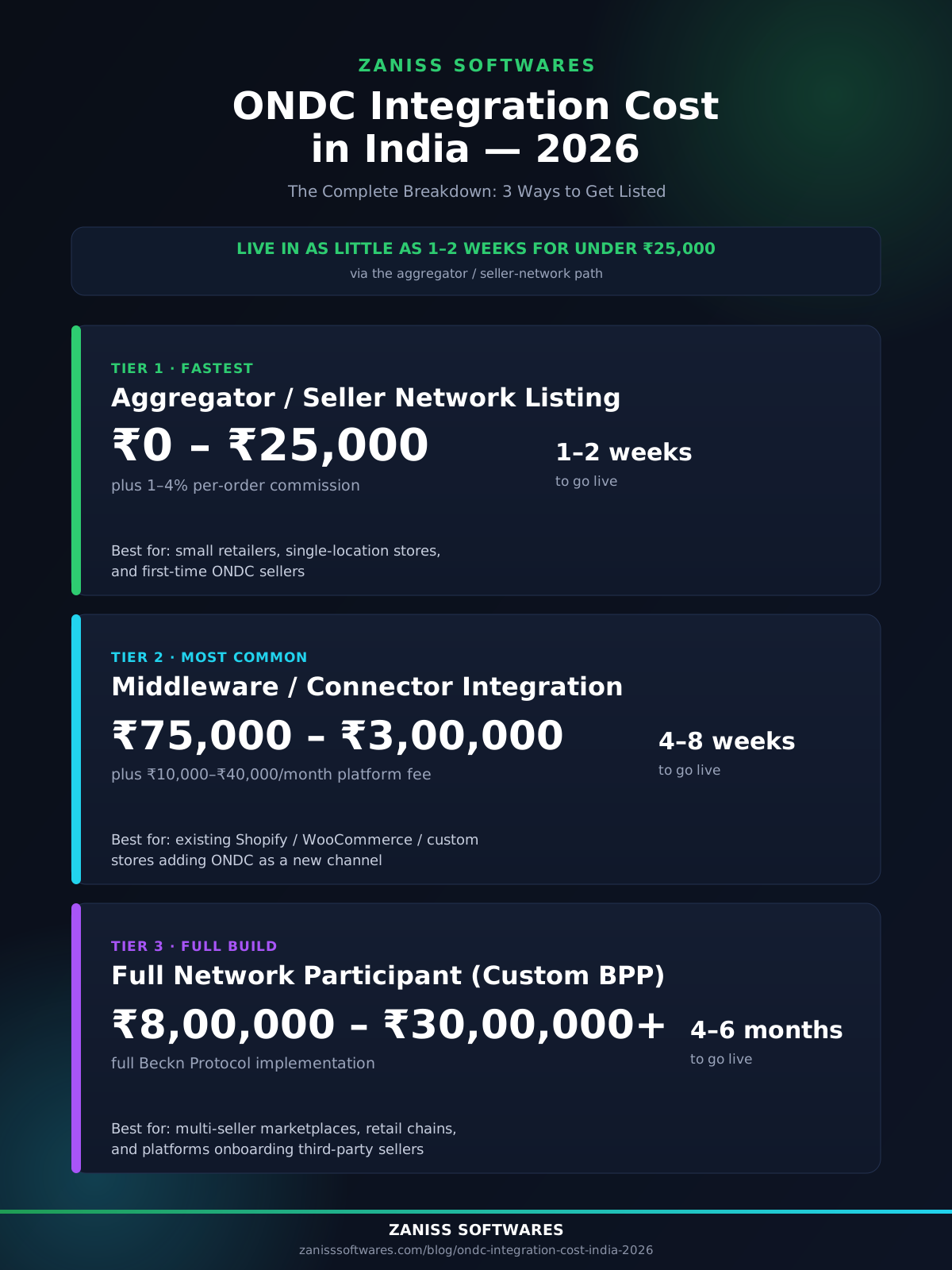
- ONDC Integration for Indian Businesses in 2026
Companion infographic: GST E-Invoicing API Integration Cost in India 2026 — The Full Breakdown →
Working With Us
GST e-invoicing API integration isn't a side project — it's compliance infrastructure your billing, ERP, and finance teams will depend on for years. ZANISS SOFTWARES builds resilient IRP/GSP integrations, reconciliation dashboards, and ERP middleware for Indian businesses crossing the ₹5 crore threshold or scaling past manual entry. Explore our Custom Software Development services, or get a free consultation to scope your integration.
📩 Response within 24 hours