In this article
Quick Summary
- 1Real estate is one of the few verticals where software, legal disclosure, and escrow accounting are now the same design problem — not three separate ones.
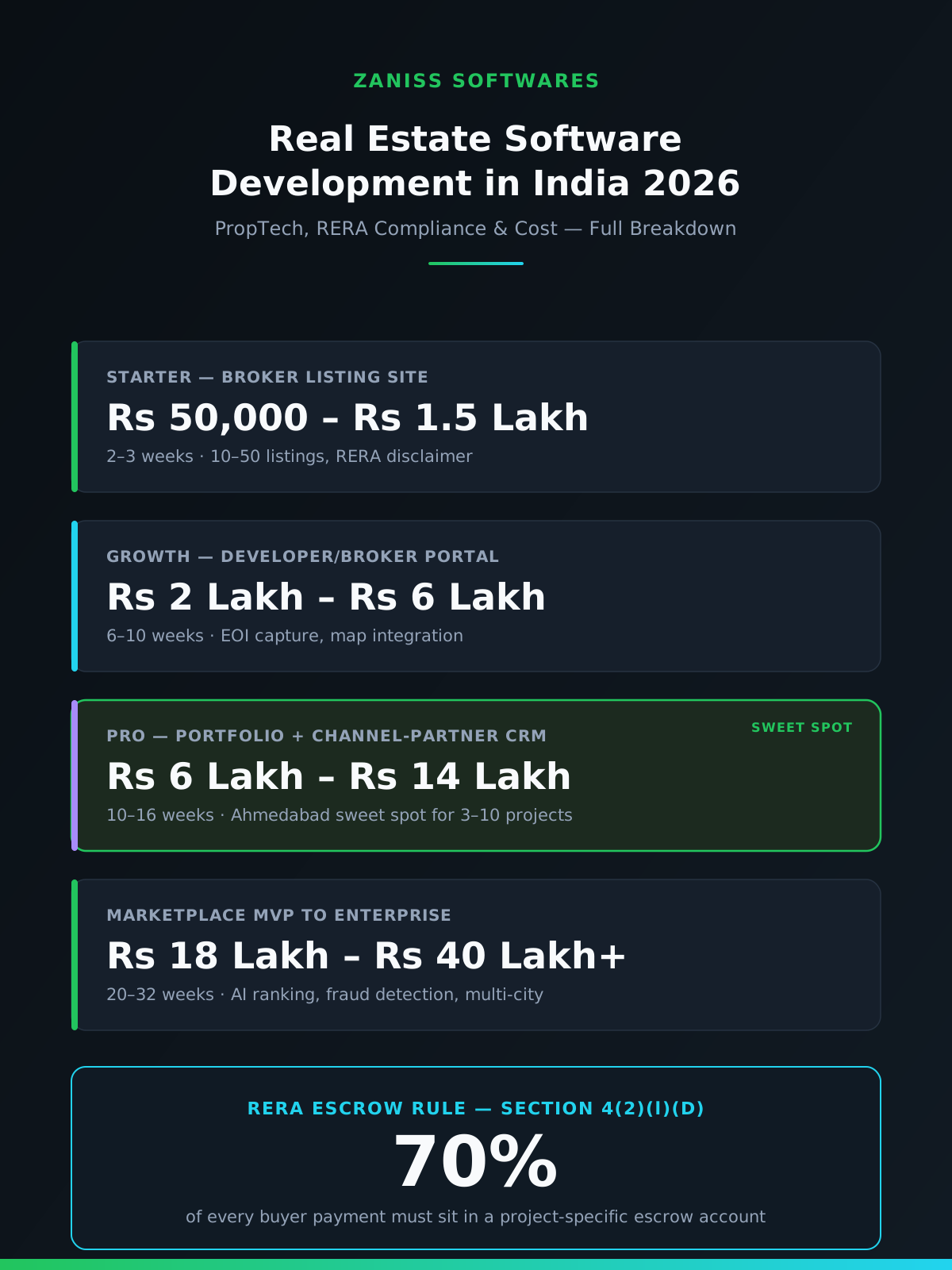
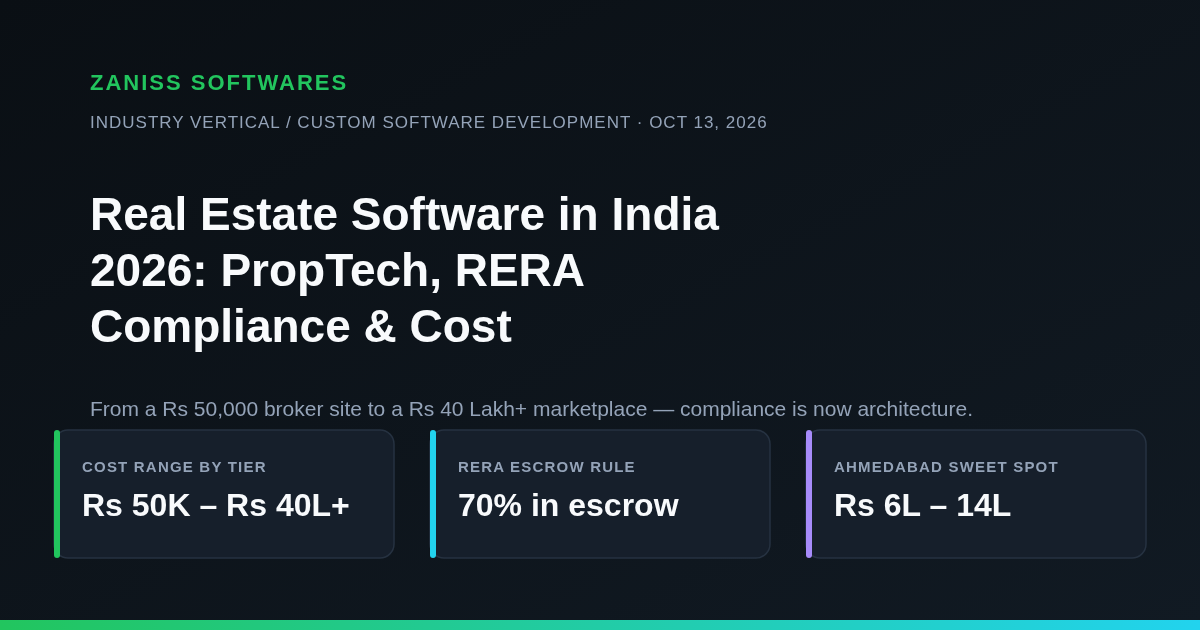
- 2Custom real estate software in India (2026) ranges from roughly ₹50,000 for a RERA-compliant broker listing site to ₹40 Lakh+ for a full multi-city PropTech marketplace.
- 3RERA's 70% escrow rule, MahaRERA's QR-coded ad requirement, and state portals like Gujarat's GRERA are turning compliance into an architecture decision, not just a legal checkbox.
- 4Most Ahmedabad-area developers running 3–10 active projects land in the ₹6–14 Lakh "developer portfolio + channel-partner CRM" tier.
Why Real Estate Software Is Different in 2026
Real estate is one of the few sectors in India where the buyer journey, the seller's legal obligations, and the software product are governed by the same rulebook at the same time. A listings page is not just a listings page — in most states it is also, implicitly, a RERA (Real Estate Regulatory Authority) disclosure surface. A CRM is not just a sales tool — it has to reconcile against an escrow account that regulators can audit on demand. And a "simple" broker website now competes against marketplace-grade PropTech platforms that buyers already expect, complete with virtual tours, EMI calculators, and WhatsApp-first lead capture.
That combination — regulatory exposure plus rising buyer expectations — is why real estate has quietly become one of the more complex verticals we build for, even though the individual features (listings, CRM, payments) look deceptively familiar from other industries.
The Five Shapes Real Estate Software Takes
Most requests we see fall into one of five categories, and the category matters more than the feature list when it comes to cost and architecture:
- Listing & brochure sites — for individual brokers or single-project developers, built mainly to capture leads and satisfy RERA disclosure requirements.
- Developer portfolio platforms — for builders running 3–10 active projects, with virtual tours, EOI (expression of interest) capture, and payment-linked booking.
- Broker / channel-partner CRM — the system that tracks leads, commissions, site visits and conversion across a developer's external sales network.
- Rental & property management platforms — tenant onboarding, rent collection, maintenance tickets, and lease-document workflows for residential or commercial portfolios.
- PropTech marketplaces — multi-developer, multi-city listing platforms with AI-assisted search ranking, fraud detection and paid placement, competing directly with national portals.
Each category carries a different regulatory surface area. A single-project brochure site mainly needs an accurate RERA registration number and disclaimer. A marketplace aggregating listings from multiple developers has to verify registration status, handle escrow disclosures by proxy, and keep an audit trail strong enough to survive a regulator's scrutiny.
RERA Compliance Is Now a Software Requirement, Not Just a Legal One
RERA has existed since 2016, but 2026 is the year it stopped being purely a legal-and-paperwork concern and started showing up directly in system design. Three changes matter most for anyone building or buying real estate software right now.
First, escrow discipline is now something your CRM and accounting integration need to model explicitly. Under Section 4(2)(l)(D) of the RERA Act, developers must deposit 70% of buyer collections into a project-specific escrow account, released only against construction milestones. A booking or payments module that cannot route and tag funds by project — and produce a clean escrow statement on demand — creates compliance risk, not just an accounting headache.
Second, several state RERA authorities are tightening how project advertising connects to the regulator's own systems. MahaRERA (Maharashtra) now requires every new-project advertisement to carry a QR code linking directly to that project's MahaRERA registration page — a pattern other states are expected to follow over time. If your marketing site or portal generates project ad creatives, that QR-linking logic needs to live somewhere in the pipeline, not be bolted on manually before each campaign.
Third, state RERA portals are becoming the system of record your own platform has to reconcile against. Gujarat's RERA authority (GRERA) — directly relevant for any Ahmedabad-based developer or broker — publishes registration status, project timelines and complaint history per project. Software that shows a property as "available" without checking it against current RERA registration status is building on a foundation that can go stale, or misleading, overnight.
None of this means every real estate site needs a custom RERA integration from day one. It does mean the decision to go custom, hybrid, or off-the-shelf should be made with these obligations in view, not discovered after launch.
What Real Estate Software Actually Costs in India (2026)
| Tier | Typical Scope | Cost (INR) | Timeline |
|---|---|---|---|
| TierStarter — Broker Listing Site | Typical Scope10–50 listings, WhatsApp click-to-chat, RERA disclaimer, basic local SEO | Cost (INR)₹50,000 – ₹1.5 Lakh | Timeline2–3 weeks |
| TierGrowth — Developer/Broker Portal | Typical Scope200+ listings, EOI capture, map integration, CRM sync, 1–3 active projects | Cost (INR)₹2 Lakh – ₹6 Lakh | Timeline6–10 weeks |
| TierPro — Developer Portfolio + Channel-Partner CRM | Typical ScopeVirtual tours, channel-partner portal, commissions, 3–10 active projects | Cost (INR)₹6 Lakh – ₹14 Lakh | Timeline10–16 weeks |
| TierMarketplace MVP | Typical ScopeMulti-seller listings, native apps, paid placement, 1–3 cities | Cost (INR)₹18 Lakh – ₹28 Lakh | Timeline20–26 weeks |
| TierEnterprise Marketplace | Typical ScopeAI lead scoring, fraud detection, multi-city, ERP/booking integrations | Cost (INR)₹28 Lakh – ₹40 Lakh+ | Timeline26–32 weeks |
A few things worth noting about these numbers. The jump from the ₹2–6 Lakh "Growth" tier to the ₹6–14 Lakh "Pro" tier is driven almost entirely by the channel-partner CRM and multi-project support — not by visual polish. The leap from ₹14 Lakh to ₹18 Lakh+ is a different kind of project altogether: a marketplace portal has to solve search, trust and multi-seller payments at once, which makes it behave more like a SaaS build than a website.
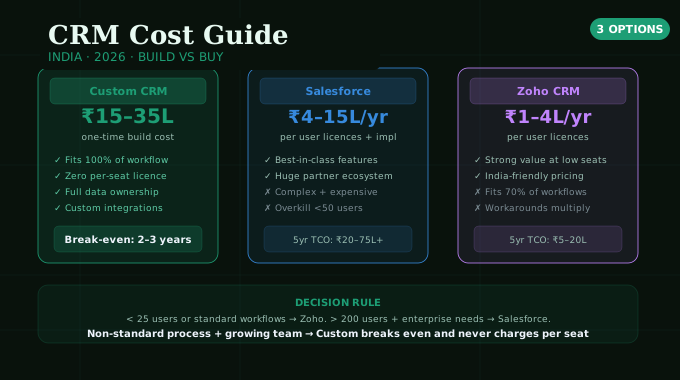
For teams not ready to commit to a custom build, subscription real estate CRMs in India typically run ₹700–₹3,000+ per user per month. A 20-person sales team on a ₹1,200/user plan works out to roughly ₹2.88 Lakh a year — meaningfully cheaper up front than a custom CRM, but it comes with limits on how deeply you can model RERA-specific escrow workflows, custom commission structures, or integrations with your own ERP.
Build vs Buy vs Hybrid: A Decision Framework
We walk every real estate client through the same five questions before recommending a tier:
- Data ownership & RERA audit trail — if you need to reconcile escrow disclosures or GRERA-aligned status checks, you need a system you can modify. A pure subscription tool gets harder to justify past this point.
- Integration depth — if the platform needs to talk to accounting/ERP systems, payment gateways, or the WhatsApp Business API, build or hybrid tends to pay back faster than stitching plugins onto a subscription CRM.
- Project count and pipeline size — a solo broker or single-project developer rarely needs more than a ₹50,000–₹6 Lakh site; 3+ simultaneous projects is where a channel-partner CRM starts paying for itself.
- Three-year total cost of ownership — subscription CRMs look cheaper in year one but compound. A 20-person team can spend ₹8–9 Lakh over three years on a per-seat CRM with no ownership of the underlying data model.
- Timeline pressure — if you need to be live in under six weeks, a hybrid approach (an off-the-shelf CRM paired with a custom-built, RERA-compliant listing front-end) is usually the realistic path, not a full custom build.
Why Ahmedabad and Gujarat Change the Calculus
Gujarat's real estate market — Ahmedabad in particular — has been growing fast enough that "wait and see" is a more expensive strategy than it looks. Developers here increasingly run 5–15 active projects at once across micro-markets with different price points, which pushes them past the brochure-site tier almost immediately. GRERA's own registration and disclosure requirements are also state-specific enough that a generic, out-of-the-box CRM built around a Mumbai or Bengaluru workflow often needs real customization to fit Gujarat's registration formats and timelines cleanly.
For brokers and mid-size developers in Ahmedabad specifically, the practical sweet spot we see most often is the ₹6–14 Lakh "Pro" tier: a developer portfolio platform with channel-partner CRM, built to reconcile against GRERA data directly rather than assuming a one-size-fits-all compliance layer will cover it.
How We Scope a Real Estate Software Project
Before writing a line of code, we map three things: which of the five software shapes above the business actually needs (not which one sounds most impressive), which RERA obligations apply at the state level the projects are registered in, and what the realistic three-year total cost of ownership looks like across build, hosting, and ongoing compliance updates. That scoping conversation is free, and it's usually where the custom-vs-off-the-shelf decision gets made with real numbers instead of guesswork.
Frequently Asked Questions
How much does real estate software development cost in India in 2026?
Costs range from about ₹50,000 for a basic RERA-compliant broker listing site to ₹40 Lakh or more for a full multi-city PropTech marketplace with AI-assisted search and fraud detection. Most developers running 3–10 active projects land in the ₹6–14 Lakh "Pro" tier.
Is RERA compliance a legal requirement or a technical one in 2026?
Both. RERA registration and disclosure are legal obligations, but increasingly they show up as technical requirements too — escrow-aware payment routing (70% of collections under Section 4(2)(l)(D)), QR-coded advertisement links to the regulator's portal, and reconciliation against state RERA databases like GRERA in Gujarat.
What's the difference between a broker CRM and a full PropTech marketplace?
A broker or channel-partner CRM tracks leads, site visits and commissions for one developer's sales network, typically costing ₹6–14 Lakh. A PropTech marketplace aggregates listings from many sellers, handles multi-seller payments and search ranking, and costs ₹18–40 Lakh or more because it has to solve trust and discovery at scale, not just sales-pipeline tracking.
Can I start with an off-the-shelf CRM and migrate to custom software later?
Yes, and for many brokers and single-project developers it's the sensible path — a subscription CRM at ₹700–₹3,000 per user per month gets you moving fast. The migration point usually arrives when you need RERA-specific escrow reporting, custom commission logic, or ERP integration that the subscription tool can't flex to support.
Why does Gujarat or Ahmedabad matter specifically for this decision?
GRERA's registration and disclosure formats are state-specific, and Ahmedabad's fast-growing, multi-project developer base outgrows generic CRM workflows quickly. A platform built to reconcile against GRERA data directly, rather than a one-size-fits-all compliance layer, tends to hold up better as a developer's project count grows.
Related Articles
- CRM Software Development Cost in India 2026: Custom vs Salesforce vs Zoho
- Custom ERP Software Development in India 2026: Cost, Modules & Timeline
- Fintech Software Development in India 2026: Compliance, Cost and Architecture
Companion infographic: Real Estate Software Development in India 2026 →
Working With Us
Whether you're a single-project developer who needs a RERA-compliant listing site or a multi-city operator evaluating a full PropTech marketplace, our custom software development team can scope the right tier for your pipeline — not the biggest one available.
📩 Response within 24 hours