In this article
Quick Summary
- 1Not every tired website needs a full rebuild, and not every slow one can be fixed with a quick optimisation pass. This guide splits the decision into three real paths — Optimise, Redesign, and Rebuild — gives 2026 India cost tiers for each (₹35,000 to ₹30,00,000+), and walks through the concrete signals that tell you which one your site actually needs, so you stop guessing and stop overpaying.
Why "Just Redesign It" Is the Wrong First Question
Almost every business that calls us asking for a "redesign" hasn't actually diagnosed what's broken. A site that converts poorly because of a confusing checkout flow doesn't need the same fix as a site running on an unsupported CMS that gets hacked twice a year. Treating every website problem as a design problem is how companies end up spending ₹3,00,000 on new visuals for a site whose real issue was a 6-second load time, or spending ₹25,00,000 rebuilding a platform that a ₹60,000 optimisation sprint would have fixed.
In 2026, with Core Web Vitals, AI-driven search summaries, and mobile-first buying journeys all competing for the same page load, the cost of guessing wrong is higher than it used to be. This guide gives you a structured way to separate three genuinely different projects — Optimise, Redesign, and Rebuild — before you ask any agency for a quote.
The Three Paths, Defined Properly
Optimise means your platform and your design are fundamentally sound. You keep the CMS, the theme, and most of the content, and you fix specific, measurable problems: page speed, Core Web Vitals, broken conversion funnels, stale copy, accessibility gaps, or technical SEO issues. Nobody touches the visual identity.
Redesign means the platform underneath is fine, but the experience built on top of it no longer serves the business. You keep the CMS and the hosting, but you rebuild the visual design, the information architecture, and often the mobile experience from scratch, then migrate the content across. This is the right call after a rebrand, a shift in target audience, or when the site simply looks and behaves like it was built five-plus years ago.
Rebuild means the problem sits below the design layer entirely. The CMS is end-of-life, a legacy plugin stack makes every update risky, the architecture can't scale with traffic or integrations, or the business needs capabilities — headless delivery, a custom web app, multi-region content — that the current platform was never built to support. A rebuild usually includes a new design as a byproduct, but the design was never the trigger.
Signs You Need to Optimise, Not Redesign
If most of these are true, a redesign would be a wasted budget line:
- The site is under roughly three years old and was built on a current, well-supported platform.
- Traffic is reasonable, but specific pages underperform on load time, Core Web Vitals, or a narrow set of keywords.
- Conversion rate has slipped on particular pages (a pricing page, a contact form) rather than site-wide.
- User feedback (heatmaps, session recordings, support tickets) points to one or two friction points, not a general dislike of the site.
- Budget is constrained and the business needs a fast win now, with a larger project possible later.
We cover the diagnostic side of this in detail in our UX audit framework piece — it's the audit we run before quoting any of the three paths below, because it's the fastest way to tell optimisation and redesign apart. Page-speed and Core Web Vitals specifics are covered separately in our Core Web Vitals optimisation cost guide.
Signs You Need a Full Redesign
- The design is visibly dated: heavy stock imagery, cramped layouts, non-responsive sections, or a mobile experience that feels like an afterthought.
- The business has rebranded, repositioned, expanded into new services, or shifted its target customer since the site was last touched.
- The site technically works but isn't meeting its goals, and an honest audit traces the gap to design and UX, not to content or a single broken funnel.
- Competitors in the same India market now look and function noticeably better.
- The site is roughly four to six years old — old enough that incremental fixes no longer move the needle, but the underlying CMS and hosting are still current and supportable.
Signs You Need a Complete Rebuild
- The CMS or framework is end-of-life, unsupported, or has had repeated security incidents.
- Every content or feature change requires a developer because the platform wasn't built to be self-service, or a plugin stack has made updates fragile.
- The business needs architecture the current platform cannot provide: headless content delivery across web, app, and kiosk; a custom web application rather than a brochure site; multi-region or multi-language structures; or deep API integrations with CRM, ERP, or payment systems.
- The team has already tried one or two redesigns on the same platform and the core problems (speed, scalability, editorial flexibility) persisted anyway.
- Technical debt remediation is consuming a disproportionate share of the IT budget just to keep the current site running.
What Each Path Actually Costs in India (2026)
These are representative INR ranges for Indian SMB-to-enterprise projects in 2026. Final numbers depend on page count, integrations, and content volume — we always put a fixed number in writing after a short discovery call, never a bare range.
| Path | What Changes | Typical Cost (INR) | Typical Timeline | Best Fit |
|---|---|---|---|---|
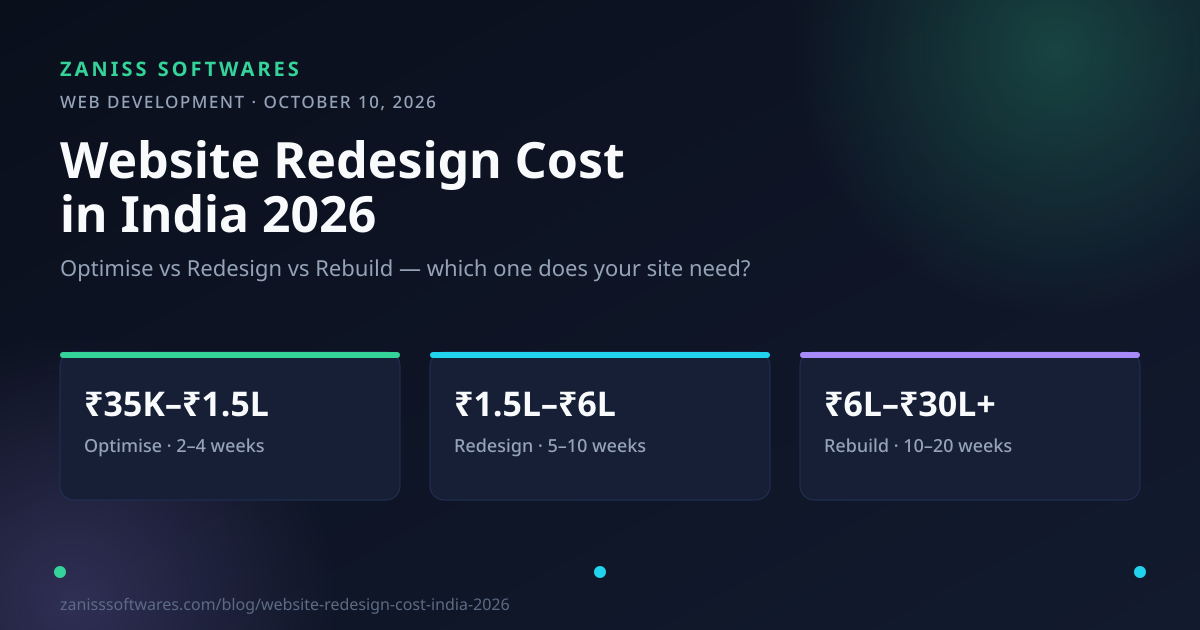
| PathOptimise | What ChangesSame design, same platform — fix speed, Core Web Vitals, SEO, and conversion leaks | Typical Cost (INR)₹35,000 – ₹1,50,000 | Typical Timeline2 – 4 weeks | Best FitSound foundation, specific measurable problems |
| PathRedesign | What ChangesNew visual design and UX, same CMS/platform, content migrated across | Typical Cost (INR)₹1,50,000 – ₹6,00,000 | Typical Timeline5 – 10 weeks | Best FitDated look, weak mobile UX, rebrand, goals missed on design |
| PathRebuild | What ChangesNew platform/architecture — e.g. legacy CMS to a headless stack or custom web app | Typical Cost (INR)₹6,00,000 – ₹30,00,000+ | Typical Timeline10 – 20 weeks | Best FitLegacy tech, security/scaling limits, vendor lock-in, repeated failed redesigns |
A useful budgeting rule: set aside 15–20% contingency on top of whichever tier you land in. Content migration, third-party integrations, and discovered technical debt are the three line items that most often push a project past its initial estimate, on any of the three paths.
Our companion piece on the full cost of building a website in India covers new-build pricing by project type in more depth; this guide is specifically about deciding what to do with a site you already have.
A Simple Decision Framework
Run your site through these three questions, in order, and stop at the first no:
- Is the underlying platform sound? Supported CMS, acceptable security posture, able to scale with your traffic and integration needs. If no — you need a Rebuild.
- Is the design and UX meeting your business goals? Modern, on-brand, mobile-first, and aligned with what the business actually sells today. If no (but the platform passed step 1) — you need a Redesign.
- Is the gap specific and measurable — speed, a particular funnel, technical SEO, stale content? If yes — an Optimise pass is enough, for now.
If you're unsure which bucket your site falls into, an independent audit is cheaper than a wrong guess: a focused UX and technical audit typically runs a fraction of any of the three project costs above and tells you, in writing, which path actually applies before you commit a six- or seven-figure budget.
Timelines You Should Realistically Expect
Optimisation sprints run two to four weeks because the scope is narrow and there's no new design or content migration. Redesigns typically run five to ten weeks: roughly a week of planning and audit, three to five weeks of design and build, and the remainder for content migration, QA, and a staged launch. Rebuilds run longer — ten to twenty weeks for most Indian SMB and mid-market projects — because they involve architecture decisions, data migration, integration rework, and a heavier QA cycle; enterprise-scale replatforming with multiple locales or legacy integrations can run well beyond that.
Across all three paths, the single biggest timeline risk is content migration that was scoped as an afterthought. Manually moving and re-checking a few hundred pages of content can quietly add two to four weeks to any project if it isn't planned for on day one.
Common Mistakes Businesses Make
The most expensive mistake is skipping the diagnosis and going straight to a redesign quote, because "redesign" is the term most business owners default to regardless of the actual problem. The second most common mistake is choosing Optimise on a platform that's genuinely end-of-life — the fixes hold for a few months and then the same problems resurface, and the business ends up paying for optimisation and a rebuild instead of a rebuild alone. The third is under-budgeting content migration and integrations on a Redesign or Rebuild, then treating the inevitable overage as a vendor failure rather than a scoping gap.
What to Ask Any Agency Before Signing
Whichever path you land on, four questions separate a scoped project from an open-ended one. First, ask for the diagnosis in writing before the quote — a vendor who proposes a redesign without first auditing your analytics, Core Web Vitals, and user behaviour is pricing a guess, not a problem. Second, ask exactly what's included in content migration: the number of pages, whether redirects and SEO equity are preserved, and who owns the QA checklist. Third, ask what happens to ownership — you should hold the CMS credentials, the domain, and the source code at handover, on all three paths, not just the rebuild. Fourth, ask for a fixed price in writing, not a range; a credible vendor can commit to a number once the discovery call has scoped the work, because the open-ended "it depends" range is exactly where the 15–20% contingency gets quietly absorbed into margin instead of into your project.
This matters more on Redesign and Rebuild projects than on Optimise sprints, simply because there's more surface area for scope to drift — more pages to migrate, more integrations to re-test, more stakeholders signing off on design. A short, specific scope document, agreed before work starts, is the cheapest insurance either project has.
Frequently Asked Questions
How do I know if my website needs a redesign or just optimisation in 2026?
Start with an audit, not a gut feeling. If the problems are narrow and measurable — page speed, a specific funnel, a handful of underperforming keywords — optimisation is enough. If the issues are broad (dated design, poor mobile experience, a rebrand) but the platform itself is current and secure, you need a redesign. Our UX audit framework is built specifically to answer this question before you spend on either.
What does a website redesign cost in India in 2026?
For most SMB and mid-market Indian businesses, a redesign that keeps the existing CMS and migrates content across typically runs ₹1,50,000 to ₹6,00,000, depending on page count, custom functionality, and integrations. A simple optimisation pass runs ₹35,000 to ₹1,50,000; a full platform rebuild runs ₹6,00,000 to ₹30,00,000 or more.
How is a "rebuild" different from a "redesign"?
A redesign changes what the visitor sees and how they navigate it, while keeping the same CMS and hosting underneath. A rebuild changes the platform itself — moving off an unsupported CMS, moving to a headless architecture, or building a custom web application — and typically includes a new design as a consequence, not as the primary goal.
How long does a website redesign take?
Most Indian business redesigns that keep the existing platform run five to ten weeks from kickoff to launch. Rebuilds run longer, typically ten to twenty weeks, because they involve new architecture, data migration, and heavier QA.
Can I optimise first and redesign later without wasting money?
Yes, if the two projects are scoped as genuinely separate problems. Fixing page speed, Core Web Vitals, and a broken conversion funnel now doesn't conflict with a full visual redesign later — in fact, a faster, better-converting site gives you a cleaner baseline to measure the redesign's impact against. It only becomes wasted money if the "optimisation" is really patching a platform that needs replacing, which is why the diagnosis step matters more than which path you pick first.
Related Articles
- Cost of Website Development in India 2026 — Full Pricing Guide
- Core Web Vitals Optimization Cost in India 2026
- UX Audits in India 2026: The Framework We Run Before Any Redesign
- Conversion Rate Optimization (CRO) for Indian Business Websites in 2026
Companion infographic: Website Redesign Cost in India 2026 — Optimise vs Redesign vs Rebuild →
Working With Us
If you're not sure which of these three paths fits your site, we run a short audit before quoting anything, so you pay for the problem you actually have. Talk to our web development team or book a free consultation to get a written scope, timeline, and fixed price for your site.
📩 Response within 24 hours