Quick Summary
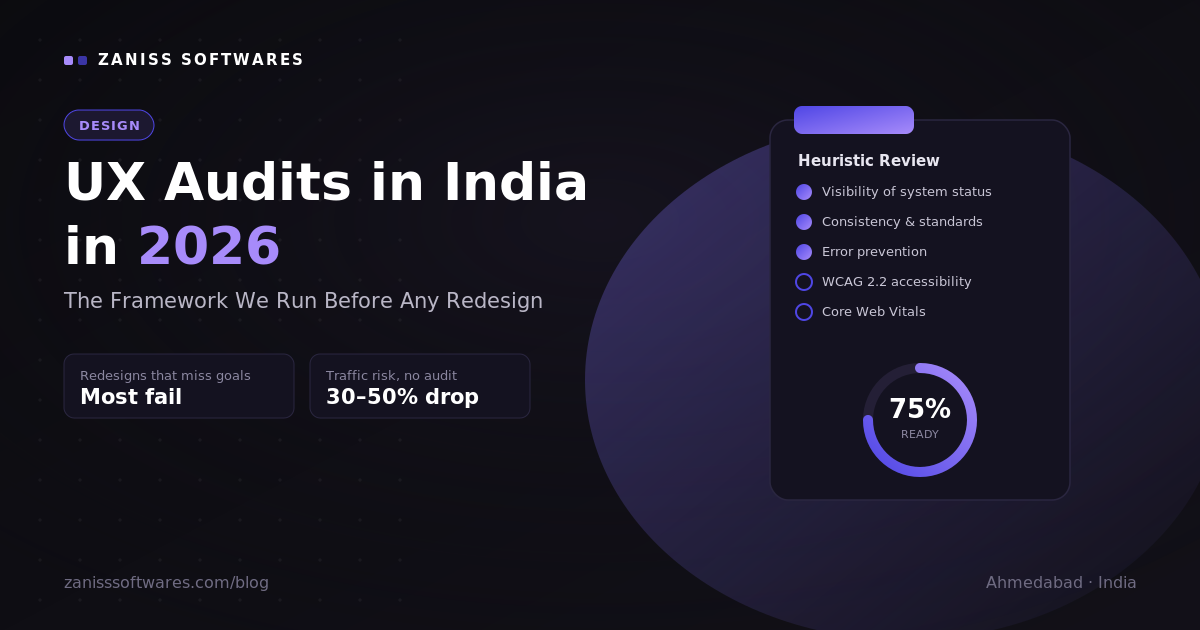
- 1Most website redesigns fail to hit their original business goals, and a full redesign without a structured audit first can cost a site 30–50% of its existing organic traffic and conversions during the transition.
- 2A focused UX audit in India typically runs ₹80,000–₹3,00,000; a full audit of a complex SaaS or ecommerce product can run ₹15–40 lakh+ — a fraction of what a full redesign costs, and it tells you whether you need one at all.
- 3Our framework combines behavior data (session recordings, heatmaps, funnels), a structured heuristic evaluation against Nielsen's 10 usability principles plus 2026 additions like WCAG 2.2 accessibility and dark-pattern checks, and a technical performance pass — before a single wireframe gets drawn.
- 4Most of the friction causing lost conversions surfaces with 3–5 evaluators and a few weeks of behavior data, not a six-month user-research program.
Most website redesigns don't hit the goal they were commissioned for. Teams spend months planning, sign off on a new visual direction, launch — and traffic dips, conversion rates stay flat or fall, and nobody can say exactly why, because nothing was measured before the old site was replaced. Redesigns commonly trigger 30–50% swings in organic traffic and conversion when URL structures, content hierarchy and page speed all change at once, and a large share never fully ship on the original timeline or scope.
This is the framework we run before we let a client commit budget to a redesign. It's not a new idea — it's a UX audit — but most agencies either skip it to get to billable design work faster, or run a version so shallow it's just a subjective walkthrough with a few screenshots. Ours ties directly into UI/UX Design and, where a redesign turns out not to be the answer, into targeted conversion rate optimization instead. If you're budgeting the redesign that follows the audit, our UI/UX design cost in India in 2026 guide breaks down pricing by project type and designer seniority.
Why Redesigns Fail Without One
The pattern behind failed redesigns is consistent across the ones we've been called in to fix. Teams optimize for how the new site looks rather than how it performs — aesthetics and current design trends drive decisions instead of data on where users actually get stuck. Everything changes at once, so even when some changes genuinely help, they're bundled with others that hurt, and the net effect on conversion is impossible to isolate after launch. Scope creep mid-project means a meaningful share of redesigns never fully ship what was originally planned. And performance regressions are common and expensive: every additional second of load time measurably reduces conversion, yet redesigns routinely ship heavier pages than the ones they replaced.
What a UX Audit Actually Is
A UX audit is a structured evaluation of an existing product or site against established usability principles, real user behavior data, and technical constraints — done before any redesign work starts, so decisions are based on evidence rather than opinion.
The baseline method is heuristic evaluation: reviewing the interface against Jakob Nielsen's ten usability heuristics (visibility of system status, match between system and the real world, user control, consistency, error prevention, recognition over recall, flexibility, minimalist design, error recovery, and help documentation), ideally with three to five independent evaluators to reduce individual bias.
A 2026-standard audit goes further than the classic heuristics list — it adds WCAG 2.2 accessibility checks, mobile-first evaluation, dark-pattern detection, and technical performance review, because all four now materially affect both usability and, increasingly, legal and regulatory exposure.
Our Five-Stage Audit Framework
- 1. Behavior data review. Session recordings and heatmaps (Microsoft Clarity or Hotjar) plus funnel and drop-off analysis in GA4 — where users actually click, scroll, hesitate, and abandon, not where we assume they do.
- 2. Heuristic evaluation. Three to five evaluators score every key flow against Nielsen's ten heuristics plus 2026 additions, independently, then reconcile findings to remove individual bias.
- 3. Accessibility pass. A WCAG 2.2 AA baseline check — contrast ratios, keyboard navigation, screen-reader labeling, focus states — both because it's the right thing to do and because accessibility complaints and regulatory attention are rising.
- 4. Technical performance check. Core Web Vitals, mobile load time, and rendering issues that look like "UX problems" but are actually engineering problems — these findings route straight into a Web Development fix, since a slow page is as much a UX problem as a confusing one.
- 5. Prioritized findings report. Every finding ranked by estimated impact versus effort to fix, ending in a clear go/no-go recommendation: incremental fixes, a partial redesign of specific flows, or a full redesign.
Step four is where audit findings connect directly to our Web Development service — page speed and rendering issues get fixed by engineers, not designers.
Planning a Website? Don't Overpay or Underbuild
Most businesses overspend on features they don't need — or underspend and rebuild within a year. We help you scope it right from day one.
UX Audit Cost in India by Scope
| Audit scope | Typical cost (India) | What's included | Turnaround |
|---|---|---|---|
| Focused single-flow audit | ₹80,000 – ₹2,00,000 | One critical journey (e.g., checkout, signup, lead form) — heuristic review + behavior data | 1–2 weeks |
| Full website audit | ₹1,50,000 – ₹3,00,000 | All key flows, accessibility pass, performance check, prioritized report | 2–4 weeks |
| Complex SaaS / product audit | ₹15,00,000 – ₹40,00,000+ | Multi-flow, multi-role product, regulated workflows, user testing, stakeholder workshops | 6–10 weeks |
For scale, a full redesign typically costs several times more than the audit that should precede it — which is the entire point. An audit is the cheapest insurance against spending lakhs rebuilding a site around the wrong assumptions.
Tools We Use
| Tool | Monthly cost | What it's for |
|---|---|---|
| Microsoft Clarity | Free | Heatmaps, session recordings, dead-click and rage-click detection — our default for budget-conscious clients |
| Hotjar | From ~$32/mo (~₹2,700) | Heatmaps, recordings, on-page surveys and feedback widgets when qualitative input is needed alongside behavior data |
| GA4 | Free | Funnel and drop-off analysis, traffic segmentation, conversion tracking |
| Maze / UsabilityHub | ~₹15,000–₹60,000/study | Moderated or unmoderated user testing when the audit calls for direct user feedback, not just behavior data |
Redesign or Fix-in-Place — The Decision Framework
Audit findings should end in a clear recommendation, not just a list of problems. As a rule: if the findings cluster in two or three specific flows and the underlying information architecture is sound, fix those flows in place — it's faster, cheaper, and safer than touching everything at once.
If findings are spread across the entire experience, the technical foundation is genuinely outdated (unsupported framework, no mobile-responsive layer, Core Web Vitals that can't be patched incrementally), or the business itself has outgrown the site's original structure, a full redesign is justified — but scope it around the audit's prioritized findings, not a fresh subjective brief. The riskiest outcome is redesigning everything at once based on opinion; the safest is fixing the ranked list of evidenced problems first and reassessing before committing to more.
Patterns We See Most Often
A handful of issues show up in the majority of audits we run. Primary calls-to-action buried below the fold or competing visually with secondary actions. Forms asking for more information than the business actually needs at that stage of the funnel. Critical actions placed outside the natural thumb reach zone on mobile — a pattern we've written about in detail in the mobile UX thumb-zone heatmap. And pages that look finished but carry enough unused JavaScript and unoptimized images to blow past Core Web Vitals thresholds on a mid-range Android device, which is still the majority of Indian mobile traffic.
Working With Us
We run UX audits as the first step of every UI/UX Design engagement, and hand you the same prioritized findings report whether you build the fix with us or your own team. It's a fixed-scope deliverable with a clear go/no-go recommendation at the end — not a sales pitch dressed up as research. If you're weighing a redesign, book a free 30-minute consultation and we'll tell you honestly whether you need one.
Pro Insight
Thinking about a redesign?
We'll run the audit first and tell you honestly whether you need a full rebuild, a partial fix, or nothing at all.
- ✓SEO-first architecture
- ✓Conversion-focused design
- ✓High-speed performance
- ✓Scalable, future-proof code
📩 Response within 24 hours