Quick Summary
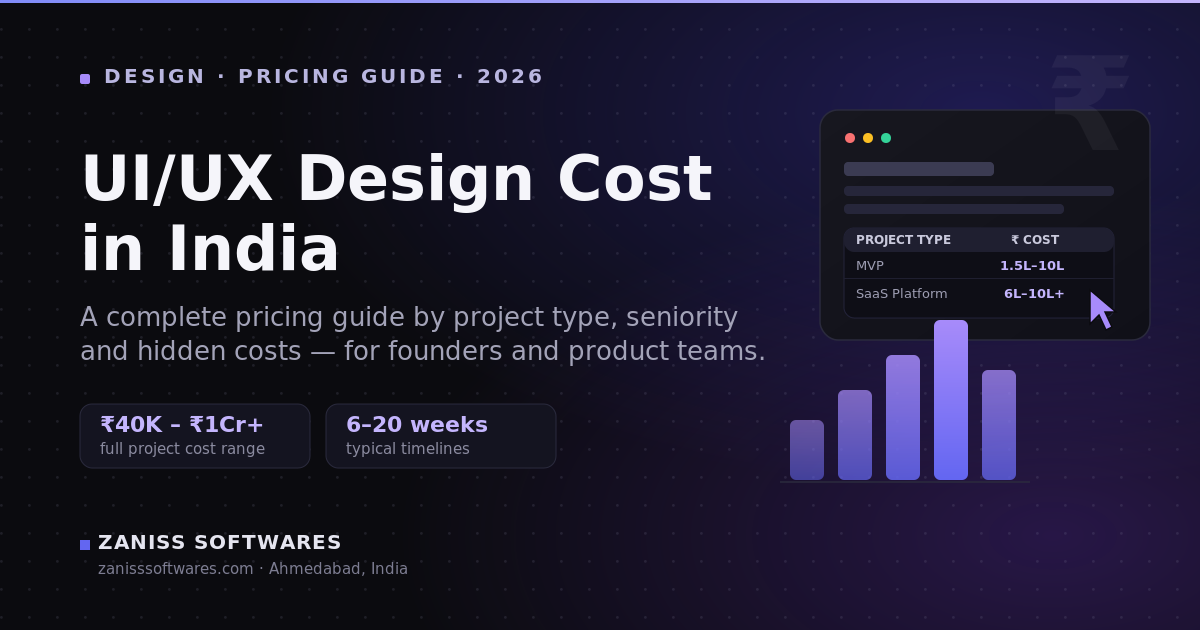
- 1UI/UX design in India in 2026 costs anywhere from ₹40,000 for a single landing page to ₹1 crore+ for a multi-product enterprise design system — the number that matters is cost per finished screen, not the headline quote.
- 2A startup MVP typically runs ₹1.5L–₹10L over 6–12 weeks; a mid-size web app with real user research runs ₹4L–₹12L over 8–14 weeks.
- 3Hourly rates range from ₹2,000–3,500 for junior designers to ₹6,000–8,000+ for senior leads.
- 4The two costs most quotes hide are extra revision rounds (₹1,500–5,000 per screen after the included 2–3 rounds) and tooling (₹5,000–25,000/month for Figma, Maze and Hotjar). This guide breaks pricing down by project type, seniority, and what should — and shouldn't — be in a fixed-price UI/UX proposal.
Why "how much does UI/UX design cost" doesn't have one answer
Every week a founder or product lead asks us for a single number: what does UI/UX design cost? The honest answer is that "UI/UX design" describes at least four different disciplines — user research, information architecture, wireframing, and visual UI design with prototyping and handoff — and a quote that doesn't specify which of these it covers isn't really a quote. In India in 2026, published numbers range from ₹15,000 for a single Figma template to ₹1 crore+ for an enterprise design system, and almost all of them are technically accurate for what they cover. This guide breaks the number down by project type, by seniority, and by what a proposal should actually include, so you can compare quotes on the same basis instead of comparing on price alone.
What actually drives UI/UX design cost
Four variables move the number more than anything else.
Project type and screen count. A five-screen landing page and a forty-screen SaaS dashboard aren't the same job, even if both get called "a website." Cost scales with the number of unique screen states, not pages — a dashboard with five user roles and different empty, loading and error states per screen can have more design surface area than a fifteen-page marketing site.
Research depth. Pure UI design — turning an existing sitemap or feature list into visuals — is the cheapest line item. Add user interviews, competitive analysis, journey mapping and usability testing, and the same project can cost 40–70% more, because research adds calendar time as well as design time: recruiting participants, running sessions, synthesising findings.
Team seniority. A junior designer executing a well-defined brief and a senior designer making architecture-level product decisions are priced very differently, and should be — the senior designer is often the reason a product doesn't need a redesign eighteen months later.
Deliverable format. A static Figma file with no handoff notes costs less than a fully annotated, developer-ready spec with a documented design system and component library your engineering team can implement without back-and-forth. If your team is offshore, distributed, or outsourced, this difference in deliverable quality is usually where projects quietly go over budget — not in the design phase itself.
UI/UX design cost in India by project type (2026)
These are the ranges we see quoted across the Indian market in 2026, checked against agency and freelancer pricing published this year. Treat them as a starting point for a scoping conversation, not a final number — always ask what's included.
| Project Type | What's Typically Included | India Cost Range (₹) | Timeline |
|---|---|---|---|
| Landing page / single product page | 1–3 screens, no research, one revision round | ₹40,000 – ₹1,50,000 | 1–2 weeks |
| Marketing website (5–15 pages) | Wireframes + UI kit, light competitive research | ₹1,50,000 – ₹4,00,000 | 3–6 weeks |
| Startup MVP (web or mobile app) | User research, wireframes, clickable prototype, starter design system | ₹1,50,000 – ₹10,00,000 | 6–12 weeks |
| Mid-size web app / SaaS module | Full UX research, IA, hi-fi UI, dev-ready handoff | ₹4,00,000 – ₹12,00,000 | 8–14 weeks |
| Complex SaaS platform (multi-role) | Multiple dashboards, full design system, usability testing | ₹6,00,000 – ₹10,00,000+ | 12–20 weeks |
| Enterprise product suite | Multiple products, governance, design ops, accessibility audit | ₹35,00,000 – ₹1,00,00,000+ | 6–12 months |
A useful sanity check: divide the quoted price by the realistic screen count (including states, not just pages) for a rough cost-per-screen. Well-scoped Indian projects typically land between ₹8,000 and ₹35,000 per finished, dev-ready screen depending on research depth — quotes far outside that band in either direction are worth a second look.
Hourly and day rates by seniority
If you're staffing a project by the hour rather than by fixed scope, seniority is the biggest lever.
| Level | Experience | India Hourly Rate | Approx. USD Equiv. | Typical US/UK Rate |
|---|---|---|---|---|
| Junior | Under 2 years | ₹2,000 – ₹3,500 | $20 – $40 | $50 – $80 |
| Mid-level | 2–5 years | ₹3,500 – ₹6,000 | $60 – $100 | $90 – $150 |
| Senior / Lead | 5+ years | ₹6,000 – ₹8,000+ | $100 – $200+ | $150 – $250 |
Agencies typically blend these rates across a team rather than billing a single senior rate for every hour, which is why a boutique Indian studio often lands at an effective $25–80/hour even when senior designers are involved — junior and mid-level time absorbs the routine execution work. That blended model is usually better value than a single freelancer at a flat rate, because research, UI polish and handoff are each done by the right level of seniority instead of one person doing all three at one price.
Planning a Website? Don't Overpay or Underbuild
Most businesses overspend on features they don't need — or underspend and rebuild within a year. We help you scope it right from day one.
Freelancer, boutique studio, agency, or in-house — which fits your project?
A freelancer makes sense for a single, well-defined deliverable — a landing page, a UI refresh, a pitch deck's visual design — where you can write a tight brief and don't need ongoing design decisions made without you in the room. Expect to manage scope closely; freelance quotes rarely include revision buffers or research.
A boutique studio or small agency (2–8 designers) is the sweet spot for most startup MVPs and mid-size web or app projects. You get research, UI, and handoff from people who work together daily, at a blended rate that's usually cheaper than a single senior freelancer once you account for revisions and rework.
A full-service agency — where design sits alongside engineering — removes handoff risk entirely, because the same team designs and builds. This is where most of our own UI/UX engagements sit: design decisions get pressure-tested against what's actually buildable in the sprint, instead of arriving as a beautiful file that costs another six weeks to reconcile with the codebase.
In-house only pays back once you have continuous design work — typically once you're shipping new screens or flows every sprint, not every quarter. Below that volume, a fractional or retained external designer usually has better unit economics.
The hidden costs most quotes leave out
Two line items quietly inflate almost every UI/UX budget we've reviewed for clients switching vendors.
Revision rounds. Most proposals include 2–3 rounds of revisions per screen. Every round beyond that is typically billed separately, at ₹1,500–5,000 per screen per round. If your internal approval process runs through more than two stakeholders, budget for at least one extra round — it's cheaper to plan for it than to be surprised by it.
Tooling and research costs. Figma's Professional tier runs $12–15 per editor per month (roughly ₹1,000–1,300), Organization is $45/month, and Enterprise is $90/month — multiplied by every design seat on the project, not just the lead. Add usability-testing and analytics tools like Maze or Hotjar, and tooling alone typically adds ₹5,000–25,000/month depending on team size. If your project includes real user research, budget separately for participant incentives — usually ₹500–2,000 per participant for a moderated session.
Neither of these is a red flag when it's disclosed upfront. It's a red flag when it isn't in the proposal at all.
Does UI/UX design actually pay back?
We covered the ROI math in detail in our UI/UX Design ROI guide — the short version is that well-executed design work reliably moves conversion rate, support ticket volume, and onboarding completion, which is exactly why it belongs in the same budget conversation as web development and conversion rate optimization, not as a line item that gets cut when budgets tighten. A website that doesn't convert is one of the four operational bottlenecks we see most often in client audits, and in most cases the root cause traces back to a design phase that was skipped or under-scoped, not a marketing problem.
How we price UI/UX design engagements
We scope UI/UX work the same way we scope every engagement: a free consultation to understand what you're building and for whom, followed by a fixed-price, milestone-based proposal within a few business days — not an open-ended hourly estimate. Design work runs inside the same two-week sprint cadence as custom software development, with a working prototype at the end of every sprint, so you're reviewing real screens on a real cadence instead of waiting six weeks for a big reveal. When design and development sit under the same roof, handoff isn't a separate cost — it's the same team continuing the same sprint.
Working With Us
If you're scoping a redesign, a new product, or an MVP and want a real number instead of a range, our UI/UX Design team can walk through your screens and return a fixed-price proposal within a few business days. Book a free 30-minute consultation — no obligation, no NDA required to start the conversation.
Pro Insight
Want a real number, not a range?
Our UI/UX Design team will walk through your screens and return a fixed-price proposal within a few business days.
- ✓SEO-first architecture
- ✓Conversion-focused design
- ✓High-speed performance
- ✓Scalable, future-proof code
📩 Response within 24 hours
Frequently Asked Questions
How much does UI/UX design cost in India in 2026?
Most projects fall between ₹40,000 for a single landing page and ₹12,00,000 for a mid-size web app with full user research and dev-ready handoff. Startup MVPs typically run ₹1.5L–₹10L, and enterprise design systems can exceed ₹1 crore. The number depends far more on research depth and screen count than on the vendor's location.
What's the difference between UI design and UX design pricing?
UI design (visual styling of screens you've already defined) is usually the cheaper component. UX design (research, information architecture, user flows, usability testing) adds calendar time and typically increases the total quote by 40–70% over UI-only pricing — but it's also what prevents an expensive redesign a year later.
Should I hire a freelancer or a design agency?
Freelancers work well for single, well-scoped deliverables like a landing page or UI refresh. Agencies and boutique studios suit multi-screen products better because they blend junior, mid, and senior time at a lower effective rate than a single senior freelancer billing every hour at their top rate.
How long does a UI/UX design project take?
A simple marketing website takes 3–6 weeks. A startup MVP typically runs 6–12 weeks. A full SaaS platform with multi-role dashboards runs 12–20 weeks from research through developer handoff.
What should be included in a UI/UX design proposal?
A serious proposal specifies screen count (including states, not just pages), the number of revision rounds included, whether user research is in scope, the tooling and licenses covered, and what the developer handoff deliverable actually is — a static file or an annotated, component-level spec.
Does investing in UI/UX design actually improve conversion and revenue?
Yes — in our experience and across published industry benchmarks, well-executed UI/UX work reliably improves conversion rate, reduces support tickets, and shortens onboarding time. We break down the specific numbers in our UI/UX Design ROI guide.