In this article
Quick Summary
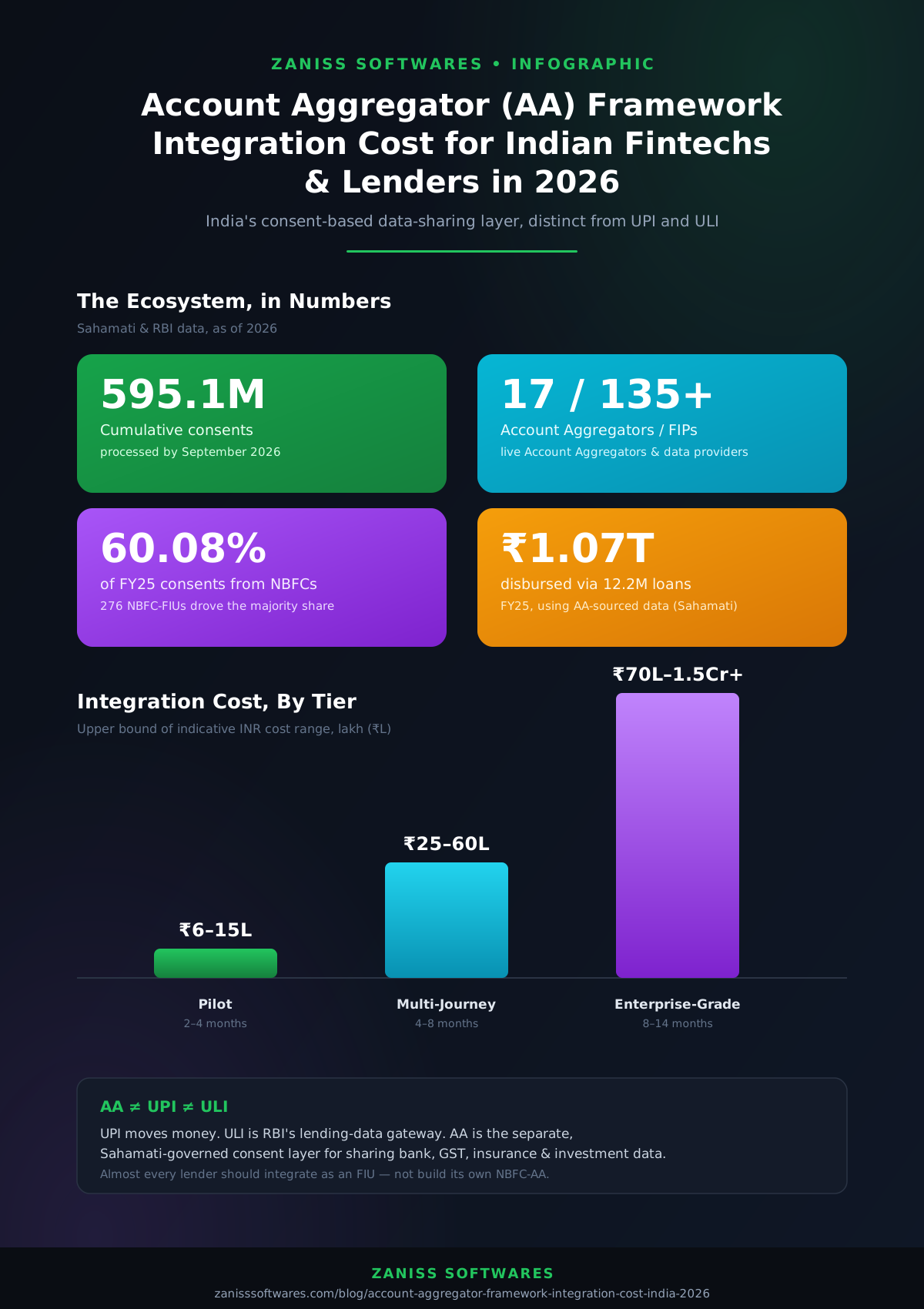
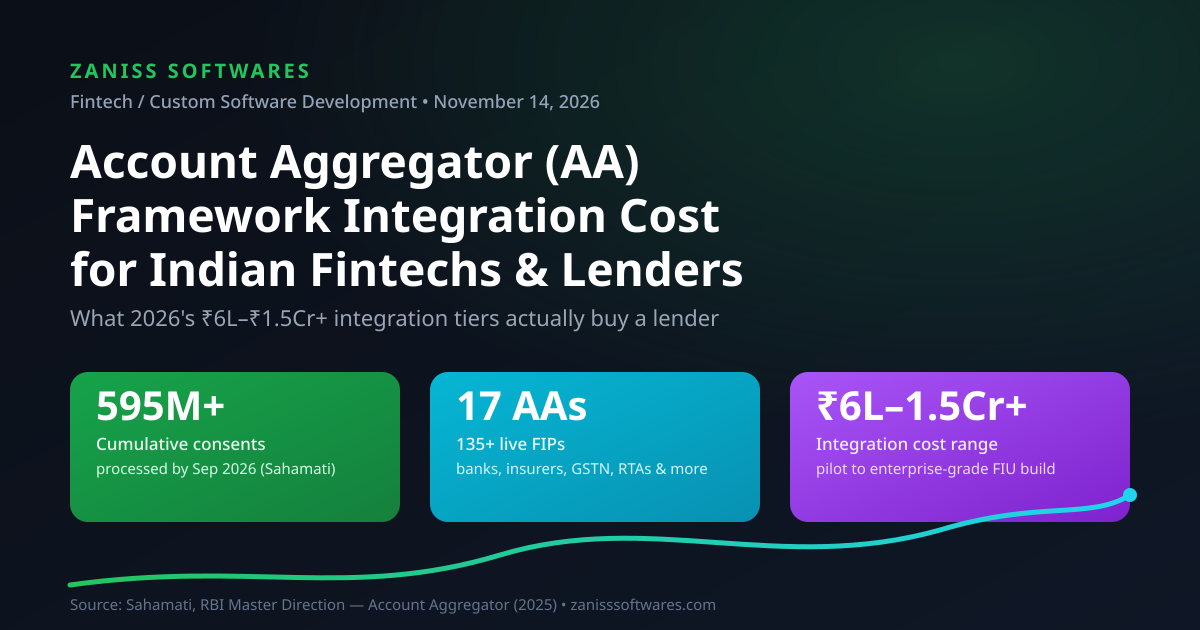
- 1India's Account Aggregator network recorded 595.11 million cumulative consents and 352.19 million linked accounts by September 2026, routed through 17 live Account Aggregators and 135+ Financial Information Providers (Sahamati).
- 2NBFCs drove 60.08% of all FY25 AA-based consents (from 276 NBFC-FIUs) and used consented data to help disburse ₹1.07 trillion across 12.2 million loans — entirely through consent-based data pulls, not bureau checks alone.
- 3A single-use-case pilot FIU integration typically costs ₹6–15 lakh and takes 2–4 months; a multi-journey underwriting stack runs ₹25–60 lakh+ over 4–8 months; enterprise-grade, multi-AA-redundant builds reach ₹70 lakh–₹1.5 crore+.
- 4AA is not UPI (a payments rail for moving money) and not ULI (RBI's separate lending-data gateway) — it is the distinct, Sahamati-governed consent layer for sharing bank, GST, insurance, investment, deposit and pension data between regulated Financial Information Providers (FIPs) and Financial Information Users (FIUs).
Every lender in India now has to answer one question before they can underwrite faster than a bureau pull allows: how does a borrower's bank, GST, insurance and investment data actually move from the institution that holds it to the institution that wants to lend against it — with the borrower's explicit, revocable consent, and without anyone screenshotting a bank statement? The answer, since 2021 and increasingly non-negotiable by 2026, is the Account Aggregator (AA) framework — India's RBI-licensed, Sahamati-governed consent architecture for financial data sharing. For fintechs and lenders planning a 2026 roadmap, the real question is no longer "should we integrate AA" but "which tier of AA integration do we actually need, and what will it cost."
What the Account Aggregator Framework Actually Is (and What It Isn't)
An Account Aggregator is a licensed non-banking entity — an NBFC-AA — regulated under the RBI's Master Direction on Non-Banking Financial Company – Account Aggregator (originally issued September 2, 2016, amended nine times since, with the Account Aggregator Directions, 2025 as the current consolidated version). The AA itself never stores or reads financial data; it is a consent and routing layer that sits between:
- Financial Information Providers (FIPs) — banks, insurers, depositories (CDSL, NSDL), RTAs (CAMS, KFintech), NPS CRAs, GSTN, AMCs and select NBFCs that hold a customer's financial data, and
- Financial Information Users (FIUs) — lenders, fintechs, wealth platforms and insurers that want to consume that data, with consent, to underwrite, verify or advise.
This is the technical core of India's Data Empowerment and Protection Architecture (DEPA): the customer, not the institution, controls who sees what data, for how long, and for what purpose — and can revoke that access at any time from their AA app.
It is critical to disambiguate AA from two frameworks it gets confused with constantly in fintech planning documents:
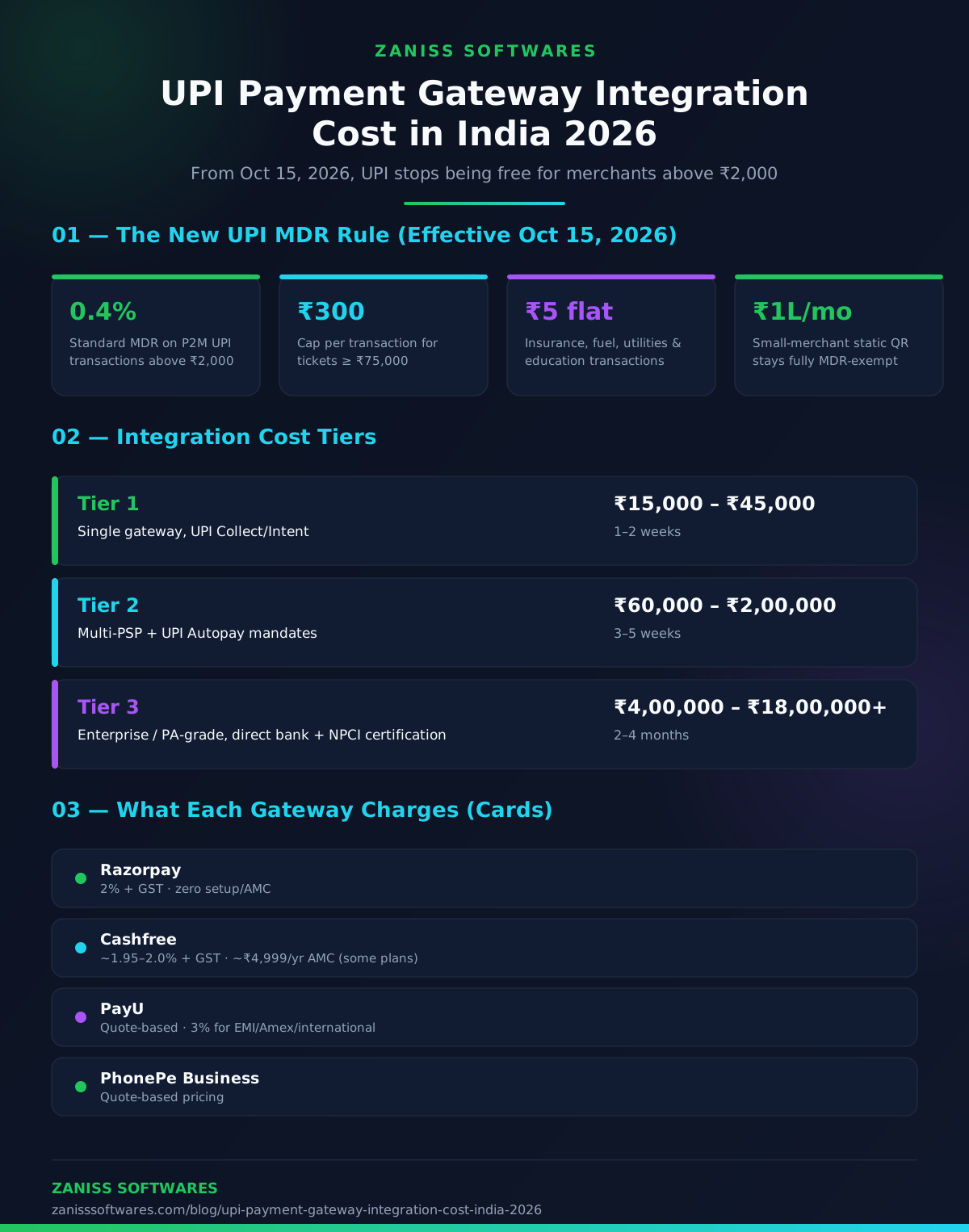
- UPI is a payments rail. It moves money between bank accounts in real time. It has nothing to do with sharing financial history or documents.
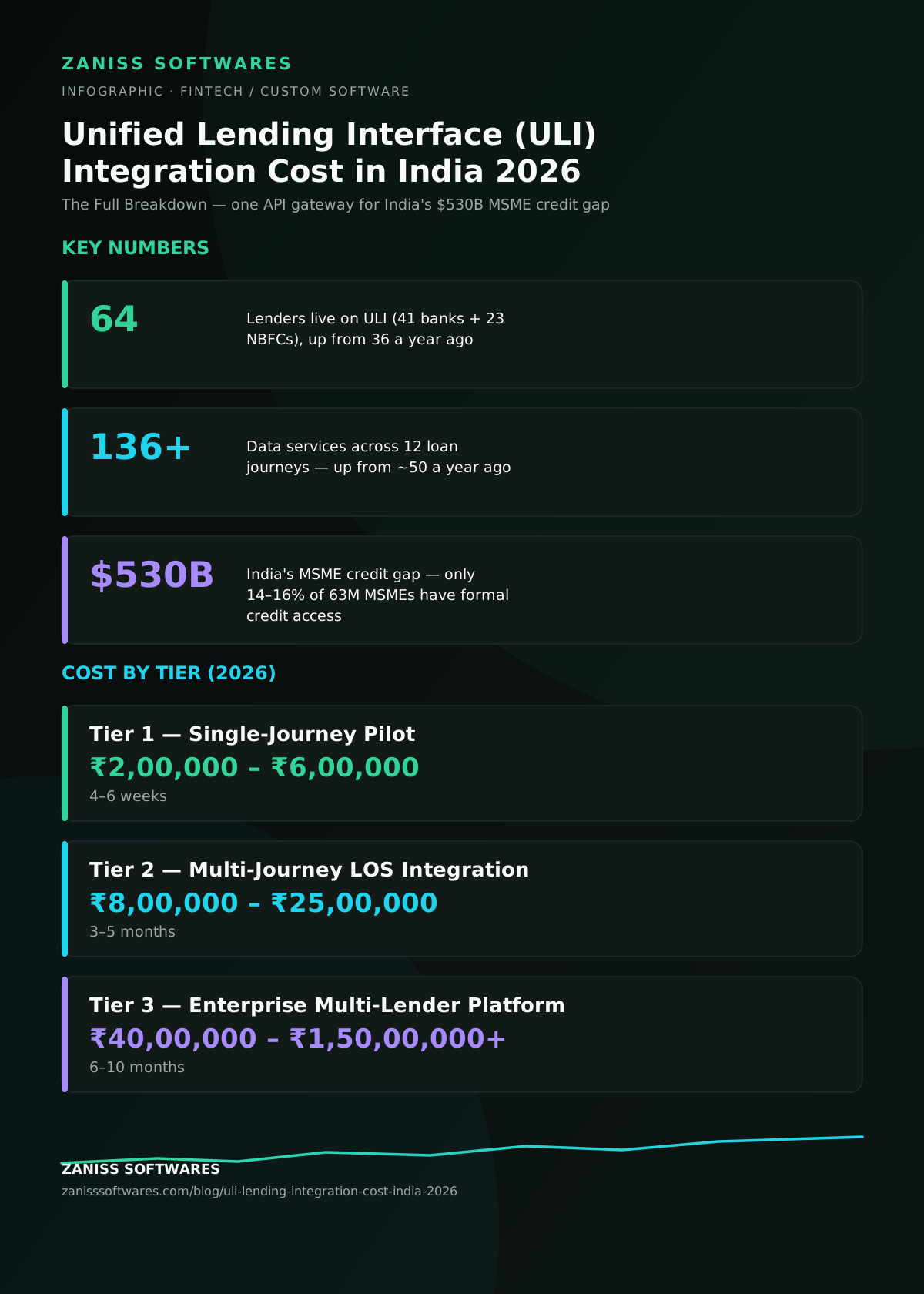
- ULI (Unified Lending Interface) is RBI's newer, separate gateway specifically for lending-journey data — state land records, GST returns formatted for credit decisioning, dairy/MSME cash-flow data — aimed at making loan-specific data retrieval frictionless for lenders. ULI is purpose-built for the lending journey and sits alongside, not inside, the AA framework.
- Account Aggregator is the general-purpose, consent-based data-sharing layer covering a much broader 20+ categories of financial information — deposits, term deposits, recurring deposits, mutual funds, insurance policies, NPS, GST returns, equities — usable for lending, wealth advisory, insurance underwriting and personal finance management, not just credit decisions.
A lender can, and in 2026 increasingly does, use both ULI and AA in the same underwriting stack — ULI for lending-specific alternate data, AA for the borrower's own bank statements, GST filings and investment holdings — but they are built, licensed and priced differently, and this article covers AA integration cost specifically.
How the Consent and Data-Sharing Flow Actually Works
The AA data flow follows a fixed sequence defined by the Sahamati technical specifications and enforced by the Master Direction:
- Consent request: The FIU (the lender) initiates a consent request through its chosen AA, specifying purpose (e.g., "personal loan underwriting"), the FI types needed (deposit accounts, GST returns, mutual fund holdings), the date range, and the "consent life" — how long the FIU may hold or re-pull the data.
- Customer discovery and approval: The borrower logs into the AA's app or web interface, links their accounts (typically via mobile number + OTP against each FIP), and reviews/approves the specific consent artifact — they see exactly what is being shared, with whom, and for how long.
- Consent artifact issuance: The AA issues a cryptographically signed consent artifact that both the FIU and the relevant FIPs can validate.
- Data fetch: The AA requests the data from each FIP on the FIU's behalf. The FIP encrypts the data specifically for the requesting FIU's public key before sending it — the AA routes the encrypted payload but cannot read its contents.
- Delivery and decryption: The FIU receives and decrypts the data, typically delivered as structured JSON against Sahamati's standardized FI data schemas (bank transaction statements, GST data, equity holdings, etc.).
- Consent type and lifecycle: Consents are either one-time (a single pull, common for pilot underwriting checks) or periodic/recurring (e.g., a monthly refresh for the life of a loan, common in working-capital and BNPL monitoring).
- Revocation and deletion: The borrower can view, pause or revoke any consent at any time from the AA interface, which immediately stops future fetches; the FIU is contractually and technically obligated to delete data once the agreed data life expires.
For an engineering team, this means building (or licensing) a consent-request client, a decryption and schema-parsing layer for each FI data type you plan to consume, a consent-lifecycle dashboard for compliance and audit, and — critically — a DPDP-Act-aligned data retention and deletion pipeline, since AA consent artifacts and the Digital Personal Data Protection Act's consent provisions now have to be read together rather than treated as separate compliance tracks.
The Ecosystem a Lender Is Actually Plugging Into, in 2026
By March 2026, Sahamati reported 17 operating Account Aggregators, of which 13 had live FIP integrations, connecting to 135+ live Financial Information Providers — a mix of 72 banks, 57 insurers, 2 depositories (CDSL, NSDL), 2 RTAs (CAMS, KFintech), 3 NPS CRAs, GSTN, 6 NBFCs and roughly 40 AMCs reached indirectly through RTA connections. The largest AAs by live FIP connectivity were Anumati (80+), CAMS AA (70+), OneMoney (65+), Finvu (60+) and NADL (60+), with other licensed entities such as Setu, Perfios-linked AA infrastructure, Upmint, Cygnet, PB Financial and Scoreme at earlier stages of FIP connectivity.
On the demand side, FY25 Sahamati data put the FIU base at 748 registered FIUs, with NBFCs alone accounting for 276 of them and 60.08% of all completed consents — Registered Investment Advisers and stockbrokers together drove another 35%, and private banks and housing finance companies made up the remainder. In that same year, the ecosystem served 24.4 million users, supported ₹1.07 trillion disbursed across 12.2 million loans, verified 4.73 million F&O accounts, issued 28,472 life insurance policies through AA-sourced data, and logged 115.8 million consent-based data transactions in total.
Momentum has only accelerated into late 2026: Sahamati's own dashboard shows cumulative consents climbing from 450.69 million in April 2026 to 595.11 million by September 2026 — roughly 32% growth in six months — with cumulative linked accounts rising from 294.42 million to 352.19 million over the same window. The Department of Financial Services separately reported more than 2.88 billion financial accounts enabled to share data as of March 31, 2026. This is no longer an emerging-tech pilot; it is default underwriting infrastructure for any lender that wants bank-statement-grade data without asking a customer to upload a PDF.
Why Lenders and Fintechs Need This Now, Not Later
Three forces are converging on Indian lenders in 2026:
- Underwriting speed is now a competitive feature. NBFCs and digital lenders using AA-sourced bank/GST/investment data for real-time cash-flow underwriting are closing personal and MSME loans in minutes rather than days, and borrowers increasingly expect it.
- Bureau-only underwriting is losing ground for thin-file and new-to-credit borrowers, where AA-sourced deposit, GST and investment data is often the only reliable signal available — and RBI's regulatory tone increasingly favors consented, verifiable data sources over manual document collection.
- Sahamati's rate card, effective December 1, 2026, formalizes per-pull FIP fees (for example, pulling 20 years of investment history costs up to ₹96 per account) — meaning the economics of AA usage are becoming predictable enough to model into a unit-economics plan, which removes a major planning blocker that held some lenders back through 2024–2025.
What It Actually Costs to Integrate as an FIU in 2026
Integration cost depends almost entirely on scope — how many data categories you need, how many AAs you integrate for redundancy, and whether consent is one-time or recurring. Based on current market-rate engineering effort, TSP/vendor integration fees, security audit requirements and Sahamati per-pull costs, here is how the tiers break down for a lender or fintech building this in 2026:
| Integration Tier | Typical Scope | Indicative Timeline | Indicative Cost (INR) |
|---|---|---|---|
| Integration TierPilot / Single Use Case | Typical ScopeOne lending journey (e.g., personal loan bank-statement check), one AA partner, one-time consent only | Indicative Timeline2–4 months | Indicative Cost (INR)₹6 lakh – ₹15 lakh |
| Integration TierMulti-Journey Underwriting | Typical ScopeMultiple products (personal/MSME/BNPL), 2–3 AA redundancy, bank + GST + investment data types, periodic + one-time consents, scoring layer integration | Indicative Timeline4–8 months | Indicative Cost (INR)₹25 lakh – ₹60 lakh |
| Integration TierEnterprise / Regulatory-Grade | Typical Scope4–6 AA redundancy, 15–20+ FI data categories, in-house analytics/underwriting engine, CISA-aligned audit, real-time monitoring and compliance reporting | Indicative Timeline8–14 months | Indicative Cost (INR)₹70 lakh – ₹1.5 crore+ |
| Integration TierBuild Your Own NBFC-AA (vs. integrating as an FIU) | Typical ScopeFull RBI licensing via PRAVAAH, ₹2 crore minimum Net Owned Funds, leverage ratio ≤7:1, CISA system audit, FIP/FIU onboarding | Indicative Timeline12–18 months licensing + build | Indicative Cost (INR)₹3 crore+ (capital + build; excludes NOF opportunity cost) |
Industry-wide estimates for a first-year AA integration broadly range ₹5–25 lakh, which aligns closely with our Pilot and lower Multi-Journey bands above — the wider enterprise figures reflect the added cost of redundancy, in-house scoring/analytics, and compliance tooling that most serious lending books eventually need. Note that becoming your own NBFC-AA is almost never the right move for a lender — that license is designed for neutral intermediaries, not for the FIUs consuming the data; nearly all lenders should integrate as an FIU through one or more existing licensed AAs instead.
A Decision Framework: How Should a Lender Scope Its AA Integration?
- If you're validating a single new underwriting signal (e.g., does bank-statement cash-flow data improve approval rates for thin-file borrowers), start at the Pilot tier with one AA and one-time consent — don't over-build before you have proof the signal moves your approval/default curve.
- If AA data is becoming core to more than one lending product, or you need recurring/periodic consent for ongoing monitoring (working capital, BNPL), move to the Multi-Journey tier and budget for AA redundancy — a single-AA dependency is an operational risk when FIP coverage differs across AAs.
- If you're processing high loan volumes, operate across multiple lending products, or sit under heightened RBI compliance scrutiny (listed NBFC, scale-based regulation "Upper Layer" classification, or similar), the Enterprise tier is the realistic floor — the cost of a compliance gap or an outage in your consent pipeline outweighs the integration premium.
- Always map your AA scope against DPDP Act obligations from day one — consent life, data minimization and deletion pipelines need to satisfy both the AA consent artifact rules and the DPDP Act's own consent and purpose-limitation requirements; retrofitting this after launch is far more expensive than building it in from the start.
Frequently Asked Questions
What exactly is the Account Aggregator (AA) framework, and how is it different from UPI or ULI?
AA is a Sahamati-governed, RBI-licensed consent layer that lets a customer approve sharing of their bank, GST, insurance, investment and pension data between a Financial Information Provider and a Financial Information User. UPI moves money; it shares nothing but payment instructions. ULI is RBI's separate gateway specifically for lending-journey data like land records and GST-for-credit data. AA, UPI and ULI are three distinct frameworks that a modern lending stack may use together, but they solve different problems and are integrated, licensed and priced separately.
Do we need our own NBFC-AA license, or can we integrate as an FIU through an existing AA?
Almost all lenders and fintechs should integrate as an FIU through one or more of the 17 existing licensed AAs (e.g., Anumati, CAMS AA, OneMoney, Finvu, Setu). Building your own NBFC-AA requires a minimum ₹2 crore Net Owned Funds, RBI approval via the PRAVAAH portal, and 12–18 months of licensing plus build time — it's designed for neutral data intermediaries, not for lenders who are themselves consuming the data.
How long does an AA integration actually take for a mid-size NBFC or fintech lender?
A single-use-case pilot typically takes 2–4 months. A production-grade, multi-journey underwriting integration with AA redundancy and periodic consent support typically takes 4–8 months. Enterprise-grade builds with in-house analytics and full compliance tooling run 8–14 months.
What data can we actually pull through an AA, and how is it priced?
The Master Direction covers 20+ categories of financial information — deposit and term deposit accounts, recurring deposits, mutual fund holdings, insurance policies, NPS accounts, GST returns, equities and more. Sahamati's rate card, effective December 1, 2026, sets per-pull FIP fees; for example, pulling 20 years of investment history can cost up to ₹96 per account. Overall integration cost depends far more on engineering scope than on these per-pull fees.
Is Account Aggregator data sharing DPDP Act compliant out of the box?
AA consent artifacts give you a strong technical foundation — purpose-bound, time-bound, revocable consent — but they don't automatically satisfy every DPDP Act obligation. You still need your own data minimization, retention-and-deletion pipeline, breach-notification process and data-processing-agreement coverage aligned to DPDP. We recommend reading AA and DPDP compliance together rather than treating AA integration as a compliance checkbox on its own — see our dedicated DPDP Act compliance guide below.
Related Articles
- Fintech Software Development in India: 2026 Guide
- UPI Payment Gateway Integration Cost in India (2026)
- ULI Lending Integration Cost in India (2026)
- DPDP Act Compliance for Indian SaaS (2026)
Companion infographic: Account Aggregator (AA) Framework Integration Cost for Indian Fintechs & Lenders in 2026 →
Working With Us
Planning an Account Aggregator integration — pilot, multi-journey underwriting, or a full enterprise-grade build? ZANISS SOFTWARES designs and builds secure, compliant financial software, including AA/FIU integration layers, lending platforms and RegTech dashboards, as part of our Custom Software Development practice for the finance sector.
📩 Response within 24 hours