In this article
Quick Summary
- 1A single AWS Mumbai-region outage can cost a mid-market Indian business an estimated ₹8–25 lakh per hour in lost revenue and SLA penalties — a second region turns that into minutes, not hours.
- 2Architecture decides your Recovery Time Objective (RTO) far more than budget does: backup-and-restore (4–24 hr RTO) typically adds 10–20% over single-region cloud cost; active-active (under 1 minute RTO) typically adds 80–150%+.
- 3RBI rules require payment system data — including its backup and DR copies — to stay inside India. For regulated Indian businesses, an India-only region pair (Mumbai + Hyderabad on AWS, or Central India + South India on Azure) is now the compliant default, not an offshore DR site.
- 4For most Indian SMEs and mid-market companies, a warm-standby design across two India regions is the sweet spot: a 15–60 minute RTO for roughly 40–70% over single-region run cost — far cheaper than active-active, far faster than nightly backups.
Why Multi-Region Resilience Matters for Indian Businesses in 2026
India's digital economy does not tolerate downtime the way it did five years ago. UPI processes over 18 billion transactions a month, e-commerce and fintech apps are expected to be available 24/7, and enterprise SaaS buyers now write multi-region uptime clauses directly into vendor contracts. A single-region deployment — however well engineered — has one unavoidable failure mode: if that region has a bad day, so does your business.
The Real Cost of a Single-Region Outage
Cloud regions do fail, even hyperscaler ones. Historical outages at AWS, Azure and GCP (including India-region incidents) have lasted anywhere from 40 minutes to most of a working day. For an Indian business running ₹50 lakh–₹5 crore a year through a single region, a half-day outage does not just mean lost sales — it means SLA penalty clauses triggering, support tickets flooding in, and in regulated sectors (payments, healthcare, lending), potential reporting obligations to RBI, IRDAI or the relevant regulator. Industry estimates for mid-market digital businesses put the all-in cost of unplanned downtime — lost transactions, idle staff, incident response, reputational drag — in the range of ₹8–25 lakh per hour, scaling well beyond that for larger platforms. Multi-region architecture does not eliminate outages; it changes what happens next, from "wait for AWS to fix the region" to "fail over in minutes."
Customer and Compliance Expectations Have Shifted
Three forces are pushing Indian businesses toward multi-region design in 2026. First, customer expectation: BFSI, healthcare and e-commerce platforms are increasingly measured against 99.95%+ uptime SLAs, and enterprise customers now ask vendors directly about DR posture during procurement. Second, regulatory pressure: RBI's payment-data localisation direction and sector-specific business-continuity expectations make a documented, tested DR plan a compliance artifact, not a nice-to-have. Third, cost of inaction: cyber-insurance premiums and enterprise contracts increasingly price in whether a vendor has a tested, multi-region recovery plan — meaning the "cost" of not building resilience is no longer zero, it is just hidden until the day it is needed.
It's worth being precise about what this article covers, because it's easy to conflate with other cloud decisions. This is not about moving from on-premise to the cloud (that's a migration cost question), and it's not about trimming an existing cloud bill (that's a FinOps question). This article is specifically about what it costs to survive losing an entire cloud region — a distinct, additive cost layer on top of whatever your normal cloud spend already is.
The Four Architecture Patterns: Backup-and-Restore, Pilot-Light, Warm-Standby, Active-Active
Cloud disaster recovery is not a single on/off decision — it is a spectrum of four well-established patterns, each with a different RTO (how fast you recover) and RPO (how much data you can afford to lose), and each with a correspondingly different cost.
Backup-and-Restore
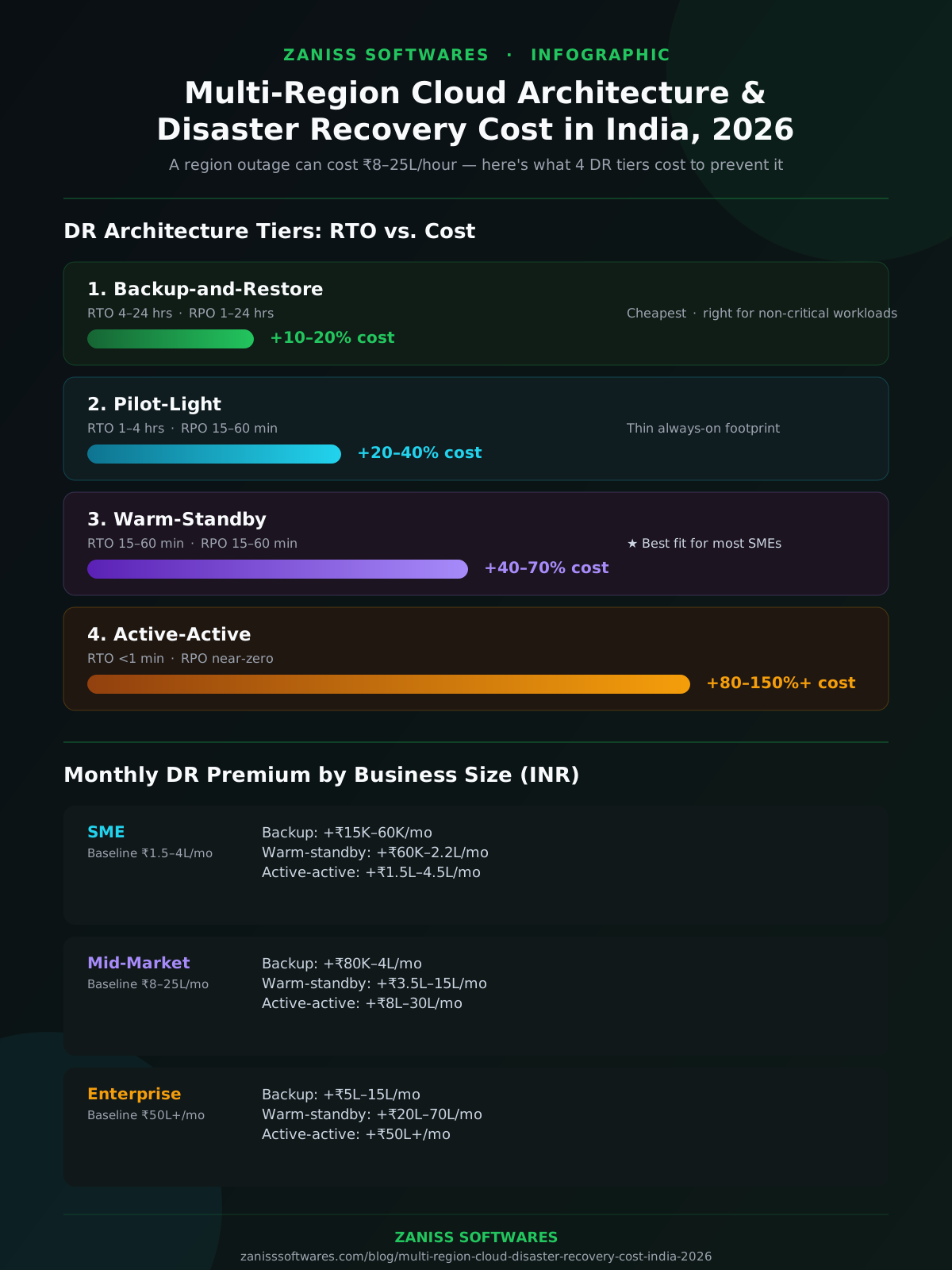
Your production workload runs in one region (say, AWS Mumbai / ap-south-1). You take regular, automated backups — database snapshots, object storage replication, infrastructure-as-code templates — and store copies in a second India region (ap-south-2 Hyderabad, or Azure's paired South India region). Nothing runs in the second region day-to-day; you spin it up only when disaster strikes. RTO: 4–24 hours. RPO: 1–24 hours (depending on backup frequency). This is the cheapest pattern and the right starting point for most small businesses, internal tools, and non-critical workloads — but it means hours of downtime and up to a day of lost data in a real failover.
Pilot-Light
A minimal skeleton of your production environment — core databases kept in sync, networking and security groups pre-configured, but application servers scaled down to near-zero — sits ready in the second region. When disaster strikes, you "light the pilot": scale up compute, point DNS, and you're live. RTO: 1–4 hours. RPO: minutes to 1 hour. This is a meaningful step up from backup-and-restore at a modest cost increase, because the expensive compute layer stays off until needed — you mainly pay for storage replication and a thin always-on footprint.
Warm-Standby
A scaled-down but fully functional copy of your production stack runs continuously in the second region — smaller instance sizes, lower auto-scaling limits, but genuinely live and able to serve real traffic within minutes. Failover means scaling the standby stack up and redirecting traffic, not building anything from scratch. RTO: 15–60 minutes. RPO: 15–60 minutes (often much tighter with continuous database replication). For most Indian SMEs and mid-market companies running customer-facing applications, this is the pattern that best balances cost against risk.
Active-Active (Multi-Site)
Full production capacity runs simultaneously in two (or more) regions, actively serving live traffic behind global load balancing or DNS-based routing, with continuous bidirectional data replication. If one region disappears, the other absorbs 100% of the load with no failover step at all. RTO: under 1 minute. RPO: near-zero. This is the pattern for payment rails, trading platforms, and large-scale consumer apps where even 60 seconds of downtime is unacceptable — but it roughly doubles infrastructure cost and meaningfully increases architectural and data-consistency complexity (conflict resolution, cross-region latency of 80–120ms round-trip between India regions and any international leg, and duplicate licensing).
| Pattern | Typical RTO | Typical RPO | Cost vs. single-region baseline |
|---|---|---|---|
| PatternBackup-and-restore | Typical RTO4–24 hours | Typical RPO1–24 hours | Cost vs. single-region baseline+10–20% |
| PatternPilot-light | Typical RTO1–4 hours | Typical RPO15–60 minutes | Cost vs. single-region baseline+20–40% |
| PatternWarm-standby | Typical RTO15–60 minutes | Typical RPO15–60 minutes | Cost vs. single-region baseline+40–70% |
| PatternActive-active | Typical RTOUnder 1 minute | Typical RPONear-zero | Cost vs. single-region baseline+80–150%+ |
India-Specific Data Residency: RBI, MeitY and the DPDP Act
Multi-region design in India is not just an availability decision — it is a legal one for a large share of businesses, and the two can pull in different directions if you are not careful.
The Reserve Bank of India's payment-data localisation direction (in force since 2018) requires the entire data of a payment system — transaction details, customer identifiers, card and UPI data, and payment credentials — to be stored only in India. Critically, this extends to backup and disaster-recovery copies: an offshore DR region does not satisfy the rule, and even offshore processing requires the data to be deleted abroad and repatriated to India within 24 hours. For any business touching payments — not just banks and PSOs, but merchants, gateways, and SaaS platforms in the payments chain — this makes an India-only region pair (Mumbai + Hyderabad on AWS; Central India + South India on Azure; asia-south1 + asia-south2 on GCP) the only compliant multi-region topology, not a choice of convenience.
The Digital Personal Data Protection (DPDP) Act, 2023 takes a more permissive general stance: cross-border transfer of personal data is allowed by default, with the government reserving the right to restrict transfers to specific countries by notification (none notified as of this writing, with the broader cross-border regime slated to take fuller effect from mid-2027). But DPDP explicitly preserves sector-specific localisation rules — so RBI's payment-data rule, and any equivalent future direction from IRDAI (insurance) or sector regulators, still applies on top of DPDP, not instead of it.
Practical takeaway: before choosing your two regions, classify your data. If you process payments, your DR pair must be two India regions, full stop. If you handle only general personal data with no payments or health-sector overlay, you have more latitude (including, in principle, a region outside India for part of your footprint) — but most Indian businesses doing multi-region DR in 2026 are choosing two India regions anyway, because it simplifies compliance, improves latency for Indian users, and avoids re-litigating the residency question every time a new regulation lands.
What Multi-Region DR Actually Costs in 2026 (INR)
Actual cost depends heavily on your current single-region spend, your chosen pattern, and how much of your stack needs protecting (not everything needs the same tier — a common real-world move is tiering: active-active for the payment path, warm-standby for the core app, backup-and-restore for internal/admin tools). The table below gives realistic monthly DR premium ranges — the extra spend on top of your existing single-region cloud bill — for three common Indian business sizes.
| Business size (typical single-region cloud spend) | Backup-and-restore | Warm-standby | Active-active |
|---|---|---|---|
| Business size (typical single-region cloud spend)SME (₹1.5–4 lakh/month) | Backup-and-restore+₹15,000–60,000/month | Warm-standby+₹60,000–2,20,000/month | Active-active+₹1,50,000–4,50,000/month |
| Business size (typical single-region cloud spend)Mid-market (₹8–25 lakh/month) | Backup-and-restore+₹80,000–4,00,000/month | Warm-standby+₹3,50,000–15,00,000/month | Active-active+₹8,00,000–30,00,000/month |
| Business size (typical single-region cloud spend)Enterprise (₹50 lakh+/month) | Backup-and-restore+₹5,00,000–15,00,000/month | Warm-standby+₹20,00,000–70,00,000/month | Active-active+₹50,00,000+/month |
Three cost drivers consistently surprise first-time DR buyers:
- Cross-region data transfer (egress). Replicating data between India regions typically runs in the ₹1.5–2.5 per GB range; a business pushing several TB of database and object changes per day can see this alone add ₹50,000–3,00,000+ per month, scaling with data volume — this is often the single most under-budgeted line item.
- Duplicate licensing and reserved capacity. Database, monitoring, and security-tooling licenses are frequently charged per-node or per-instance, so a standby environment can mean paying twice for software you hope never to fully use. Reserved-capacity or savings-plan commitments (roughly 25–70% off on-demand pricing, deeper for longer, all-upfront terms) materially reduce this for warm-standby and active-active tiers.
- DR testing and runbook maintenance. A DR plan nobody has tested is a hope, not a plan. Budget for quarterly or half-yearly failover drills — typically ₹50,000–3,00,000 per test cycle in engineering time and any production-adjacent risk — plus the one-time cost of writing and maintaining runbooks (commonly ₹2–10 lakh depending on system complexity).
A Decision Framework: Choosing the Right Tier for Your Business
Rather than picking a DR tier off a feature list, work through four questions in order:
- What does one hour of downtime actually cost you? Calculate lost revenue, SLA penalties, support load, and reputational impact. If that number is under roughly ₹50,000/hour, backup-and-restore or pilot-light is probably proportionate. Above ₹2–5 lakh/hour, warm-standby earns its cost quickly. Above ₹10 lakh/hour (payments, trading, large-scale consumer platforms), active-active stops being a luxury.
- Does regulation set your floor, not your ceiling? If you touch payment data, RBI's localisation rule already forces an India-only region pair regardless of which tier you pick — so the DR conversation becomes "which tier," not "which countries."
- Can your data layer actually support the RTO you want? A warm-standby web tier is worthless if your database can't replicate fast enough to keep RPO inside your target. Validate the data layer's replication lag before committing to an RTO number in a customer-facing SLA.
- Tier by component, not by company. Very few businesses need active-active everywhere. The most cost-efficient real-world architectures run active-active (or warm-standby) only for the revenue-critical path — checkout, payment processing, core API — and backup-and-restore for everything else (admin panels, internal dashboards, batch/reporting jobs).
Frequently Asked Questions
Do I need multi-region DR if I'm already backing up my data daily?
Daily backups protect against data loss, not downtime. If your single region goes down, a backup sitting in the same region (or even a different one with no standby compute ready) still means hours of manual restoration before you're serving traffic again. Multi-region backup-and-restore — backups stored in a second region, with a tested restoration runbook — is the minimum real DR posture; it's a different thing from routine backups.
Which India region pair should I use — AWS, Azure, or GCP?
For AWS, Mumbai (ap-south-1) paired with Hyderabad (ap-south-2) is now the standard India DR pair. For Azure, Central India pairs with South India as Microsoft's designated regional pair. For GCP, asia-south1 (Mumbai) pairs with asia-south2 (Delhi). The right provider depends on where your existing workload already runs — multi-region DR within one provider is materially simpler than spanning providers, and cross-provider DR is rarely worth the added complexity unless you have a specific vendor-lock-in concern.
Is active-active ever overkill?
Yes, frequently. If your realistic downtime cost is a few lakh rupees per hour and your customers would tolerate a 20–30 minute outage without churning, warm-standby delivers most of the resilience benefit at roughly half the cost. Active-active is justified by transaction volume and downtime cost, not by ambition.
How does this interact with RBI's data localisation rules?
If any part of your system touches payment system data, both your primary and your DR region must be inside India, and DR/backup copies cannot be the "live" offshore record even temporarily. This is the single most common compliance mistake we see: businesses build a technically sound DR pair that includes an offshore region, not realising the payments path makes that non-compliant.
How long does it take to actually implement a multi-region DR architecture?
Backup-and-restore can typically be stood up in 2–4 weeks. Pilot-light and warm-standby usually take 6–12 weeks, depending on how many services need to be made region-aware (database replication, DNS failover, stateful session handling). Active-active is a genuine re-architecture project, typically 3–6 months, because it touches data consistency, conflict resolution, and testing depth in ways the other tiers don't.
Related Articles
- Cloud Migration Cost in India (2026) — for businesses still deciding whether and how to move to the cloud in the first place.
- Cutting Cloud Bills Without Breaking Production — FinOps and cost optimization for workloads you're already running.
- Cloud-Native Application Development in India (2026) — general cloud architecture tiers and design patterns.
- Cloud Security Posture Management Cost in India (2026) — hardening and compliance, a close cousin to the data-residency section above.
Working With Us
Multi-region resilience is one of the three pillars of our Cloud Solutions practice, alongside AWS/GCP/Azure deployments and cost optimization audits. If you're not sure whether your business needs backup-and-restore, warm-standby, or something in between, that's exactly the conversation worth having before you commit budget to either direction.
📩 Response within 24 hours