In this article
Quick Summary
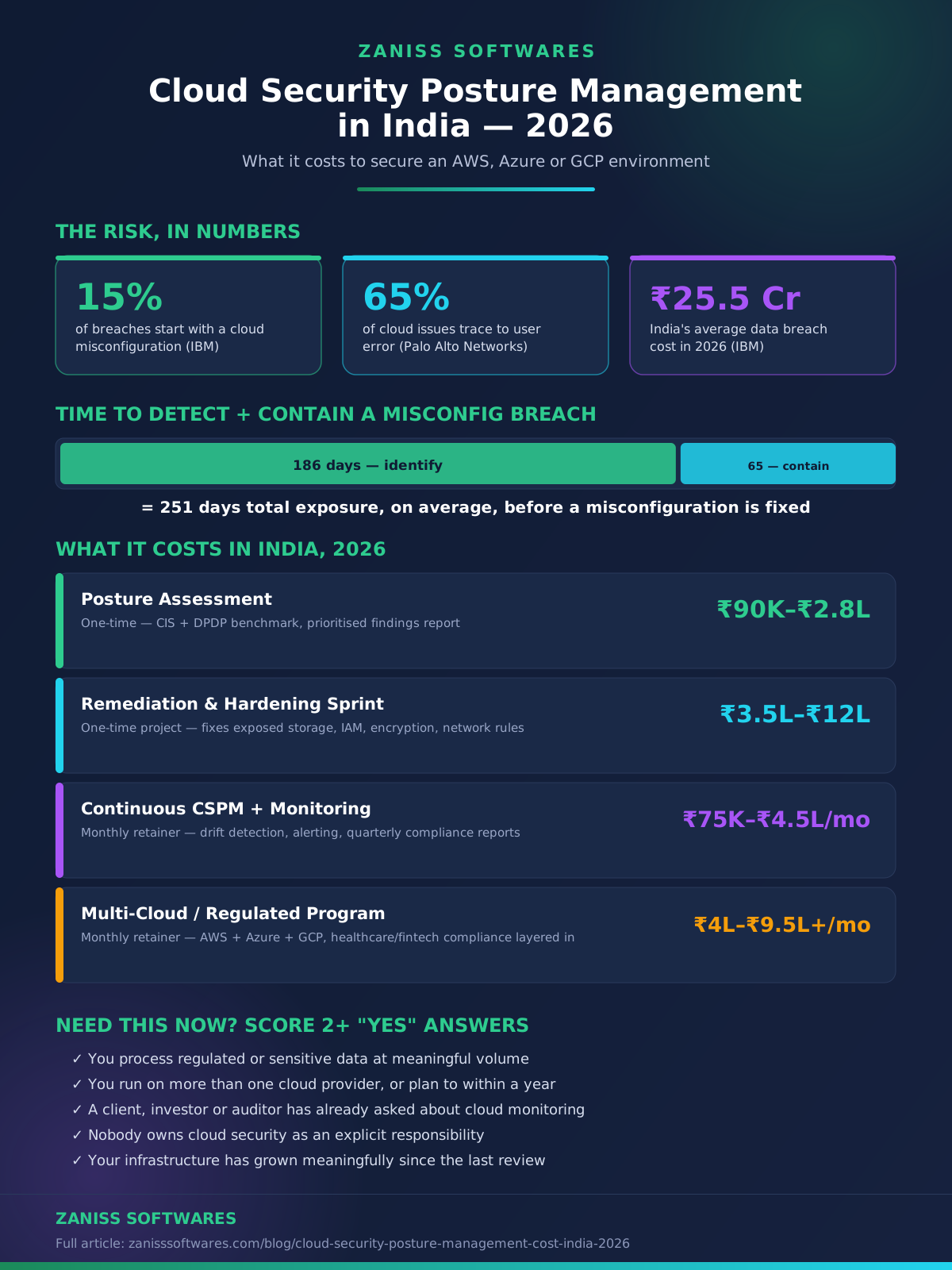
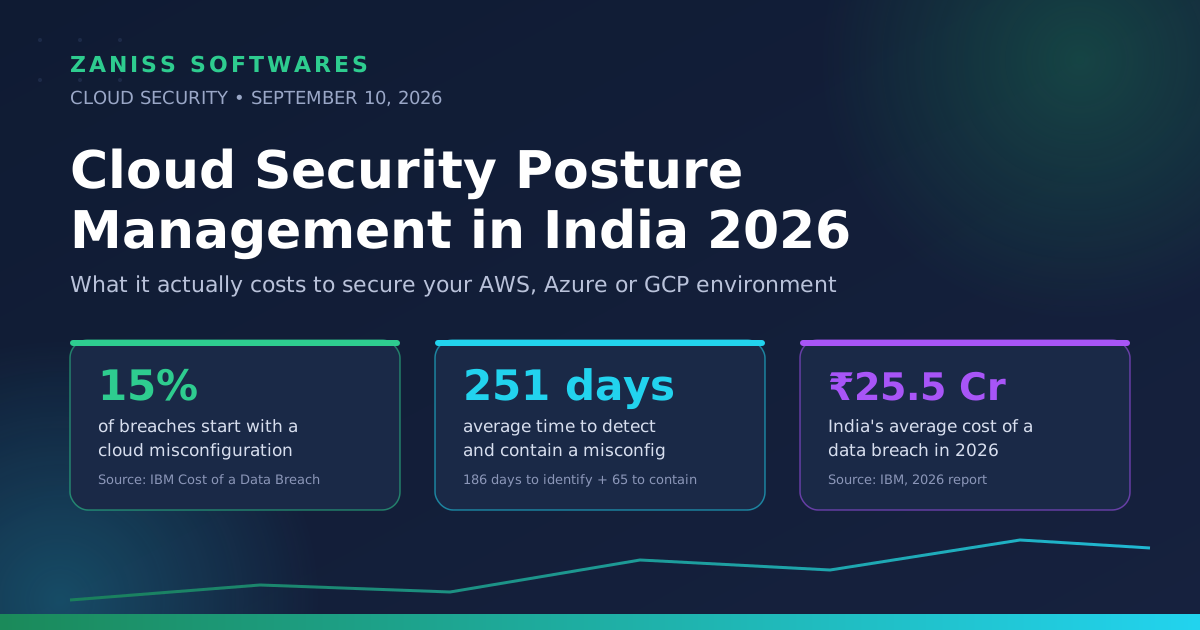
- 1Cloud misconfiguration — not a sophisticated hacker — is the third most common initial attack vector in data breaches, and misconfiguration-driven breaches take an average of 251 days to identify and contain (IBM Cost of a Data Breach Report).
- 2India's average cost of a data breach hit a record ₹25.5 crore in 2026 (IBM), and Gartner has been blunt about where the fault sits: through 2025, 99% of cloud security failures were the customer's, not the cloud provider's.
- 3A realistic Cloud Security Posture Management (CSPM) program in India in 2026 costs ₹90,000–₹2,80,000 for a one-time assessment, ₹3,50,000–₹12,00,000 for a remediation sprint, and ₹75,000–₹4,50,000/month for continuous monitoring — this article breaks down exactly what each tier buys.
- 4CSPM isn't the same thing as a cloud migration audit or a firewall — it's the ongoing discipline of finding and fixing exposed storage, over-permissioned accounts, and drifted configurations across AWS, Azure and GCP before an attacker (or an auditor) finds them first.
Why Cloud Security Posture Suddenly Matters for Indian Businesses in 2026
For most of the last decade, "cloud security" in India meant one conversation: which provider to trust, AWS, Azure or GCP, and whether their data centre was compliant enough for an enterprise client's vendor questionnaire. Once that box was ticked, security was treated as the cloud provider's problem to solve, not the business's problem to manage.
That assumption has become the single most expensive mistake a growing company can make. AWS, Azure and GCP all operate on a shared responsibility model: the provider secures the physical data centre, the network backbone, and the hypervisor. Everything above that line — who can access which storage bucket, whether a database is exposed to the public internet, whether an IAM role has more permissions than it needs, whether encryption is actually turned on — is the customer's job. Gartner's own research has been unambiguous about how that's playing out: through 2025, 99% of cloud security failures were projected to be the customer's fault, not the provider's.
For Indian businesses running production workloads on AWS, Azure or GCP — the exact platforms ZANISS SOFTWARES builds and migrates infrastructure on for clients across healthcare, fintech, logistics, retail and SaaS — this isn't an abstract statistic. It's the difference between a routine security review and a breach notification that lands on a founder's desk on a Monday morning.
What Cloud Security Posture Management Actually Is (It's Not Just a Firewall)
Cloud Security Posture Management, usually shortened to CSPM, is the ongoing practice of continuously discovering, assessing and fixing misconfigurations across a cloud environment — rather than securing it once at launch and assuming it stays that way. It's a discipline, not a single product, though it's usually supported by tooling that scans an AWS, Azure or GCP account against known-good benchmarks (CIS Benchmarks, cloud-provider well-architected frameworks, and India's own DPDP Act requirements) and flags drift the moment something changes.
This is a meaningfully different job from a traditional firewall or endpoint antivirus, and it's different again from a cloud migration audit. A firewall controls traffic at a network boundary. A migration audit is a point-in-time health check performed once, usually before or right after moving workloads to the cloud. CSPM is what happens every day after that: a storage bucket someone made public for a demo and forgot about, an IAM role a departing contractor still has active, a database left unencrypted because a rushed feature launch skipped a checklist item. None of these show up in a one-time audit six months later. All of them show up in an active breach.
The Real Numbers: Why Misconfiguration, Not Hackers, Is the Bigger Risk
It's tempting to picture cloud breaches as sophisticated attacks by skilled adversaries exploiting zero-day vulnerabilities. The data tells a more mundane, and more preventable, story. Cloud misconfigurations account for roughly 15% of initial attack vectors in data breaches, making them the third most common way attackers get in — not through a clever exploit, but through a door someone left open. Separate research from Palo Alto Networks found that 65% of cloud network security issues stem directly from user error and misconfiguration, not external attack sophistication.
The financial consequence compounds because these breaches are slow to notice. Misconfiguration-driven breaches take an average of 186 days to identify and a further 65 days to contain — 251 days total, during which the exposure is live. Organisations experiencing this category of breach face average costs of roughly $3.86 million globally. In India specifically, the average cost of a data breach reached a record ₹25.5 crore in 2026, according to IBM's Cost of a Data Breach Report — and that figure includes detection costs, lost business, regulatory response, and remediation, not just the direct incident response bill.
The pattern that shows up most often in the environments we've audited for clients isn't a single catastrophic error. It's an accumulation of small ones: a storage bucket made public "temporarily" during a migration and never locked back down, an IAM policy copied from a tutorial that grants far more than the task needs, a security group opened to 0.0.0.0/0 to unblock a developer and never scoped back. Individually, none of these look alarming in a code review. Together, across dozens of services and multiple cloud accounts, they're exactly the kind of drift CSPM is built to catch continuously rather than once a year.
What a CSPM Program Actually Costs in India in 2026
Pricing for cloud security work in India varies more by scope and cloud footprint than by vendor brand name, so the honest answer is a set of ranges tied to what's actually being delivered, not a single number. The table above reflects what a realistic engagement costs across the three stages most Indian businesses go through: assessment, remediation, and ongoing monitoring. For context on what the migration itself costs, see our breakdown of cloud migration cost in India 2026.
What's Included at Each Tier — And Why the Range Is So Wide
The width of each range isn't padding — it reflects three variables that actually move the cost: the number of cloud accounts and services in scope, whether the environment is single-cloud or multi-cloud, and whether a formal compliance framework (DPDP, SOC 2, ISO 27001, HIPAA-equivalent for healthcare) needs to be mapped against the findings, not just a generic best-practices checklist.
A single-product startup on one AWS account with a handful of services sits at the low end of every tier. A logistics or fintech platform running production across AWS and Azure, with a compliance obligation attached to investor due diligence or an enterprise client's security questionnaire, sits at the top of the range almost automatically — not because the work is being marked up, but because there are genuinely more services, more IAM roles, and more regulatory boxes to check.
The assessment stage is the one businesses most often try to skip, moving straight to buying a monitoring tool. That's usually a mistake: a monitoring tool without a baseline assessment just generates a wall of alerts with no sense of which findings are actually urgent. The assessment is what turns "200 flagged issues" into "here are the 6 that expose customer data, ranked by how bad it would be if each one were exploited today."
Cloud Security Posture Management pricing in India, 2026 (typical ranges)
| Engagement Type | Price Range | Best For |
|---|---|---|
| Cloud Security Posture Assessment (one-time) | ₹90,000 – ₹2,80,000 | Automated + manual configuration review across one cloud account, benchmarked against CIS Controls and DPDP Act requirements; prioritised findings report. |
| Remediation & Hardening Sprint (one-time project) | ₹3,50,000 – ₹12,00,000 | Fixing exposed storage, over-permissioned IAM roles, unencrypted data stores, open security groups, and secrets management, scoped to the assessment's findings. |
| Continuous CSPM + Managed Monitoring (monthly retainer) | ₹75,000 – ₹4,50,000 / month | Ongoing automated scanning, drift detection, alerting, and quarterly compliance reporting; scales with number of cloud accounts and services in scope. |
| Multi-Cloud / Regulated Industry Program (monthly retainer) | ₹4,00,000 – ₹9,50,000+ / month | Everything above extended across AWS + Azure + GCP simultaneously, with healthcare (ABDM), fintech (RBI) or DPDP-specific compliance reporting layered in. |
Planning a Website? Don't Overpay or Underbuild
Most businesses overspend on features they don't need — or underspend and rebuild within a year. We help you scope it right from day one.
CSPM and India's DPDP Act: Why Compliance Now Has Real Teeth
India's Digital Personal Data Protection Act (DPDP Act, 2023) has moved from "a law we should look at eventually" to an active compliance obligation for any business processing personal data of Indian users, and its rules assume "reasonable security safeguards" are already in place — which regulators and enterprise auditors increasingly interpret to mean a documented, continuously monitored cloud security posture, not a one-time checklist signed off at launch.
For businesses that already work with regulated data — healthcare records, financial transactions, or any customer PII at meaningful scale — a CSPM program isn't really optional anymore; it's the evidence a business produces when a client's security team, an investor's technical due diligence process, or a regulator asks how personal data is actually protected in the cloud. Having that evidence ready, rather than assembled under pressure after an incident, is most of what the continuous-monitoring tier of pricing above is actually buying. Our guide to DPDP Act compliance for Indian SaaS covers what engineering teams must build alongside this.
Decision Framework: Do You Need CSPM Now, or Can It Wait?
Not every business needs the top tier of this pricing table today, and a business with a single low-traffic marketing site on one cloud account genuinely can defer this. The framework we use with clients comes down to five questions:
- Do you process regulated or sensitive data — health records, financial information, or customer PII at meaningful volume? If yes, treat this as urgent, not optional.
- Are you running on more than one cloud provider, or planning to within the next year? Multi-cloud sprawl is where configuration drift compounds fastest and is hardest to track manually.
- Has your business ever had a security review requested by an enterprise client, an investor, or a compliance audit? If a questionnaire has already asked "how do you monitor cloud configuration continuously," that's a signal the answer needs to exist before it's asked again.
- Do you have a dedicated security engineer, or is cloud security currently everyone's part-time responsibility? If it's the latter, an assessment at minimum is overdue — most misconfigurations we find were nobody's explicit job to prevent.
- Has your infrastructure grown meaningfully since it was last reviewed — new services, new team members with cloud access, or a recent migration? Growth is exactly when drift accumulates fastest.
Two or more "yes" answers is a reasonable trigger for at least a one-time assessment; a regulated-data business with multi-cloud infrastructure should be planning for the continuous-monitoring tier, not just the assessment.
Common Mistakes Indian Businesses Make With Cloud Security
The single most common mistake isn't a technical one — it's assuming cloud security was "handled" during the original migration or initial build, and never revisiting it as the environment grows. A configuration that was correct on launch day drifts constantly: new services get added, new team members get access, and nobody circles back to check whether permissions still match what's actually needed.
The second most common mistake is treating a security tool purchase as equivalent to a security program. Buying a CSPM scanning tool without a prioritised remediation plan behind it produces a dashboard full of red flags that nobody has the bandwidth to work through — which, in practice, is barely better than having no visibility at all, and can create a false sense of coverage that's worse than knowing you have a blind spot.
The third mistake, and the quietest one, is scoping security reviews around the primary production account while ignoring staging, sandbox, and "temporary" test environments that quietly accumulate real customer data over time. We've found production-grade PII sitting in a staging database more than once during an assessment — a system nobody thought to include in the security conversation because, on paper, it was never supposed to hold real data in the first place.
How ZANISS SOFTWARES Approaches Cloud Security Hardening
Our cloud solutions practice runs cloud security hardening and compliance as a core service line, not a bolt-on to a migration project — it sits alongside the infrastructure audits, cost analysis, and 24/7 managed cloud support we already run for clients on AWS, Azure and GCP. We start with a vendor-neutral posture assessment, prioritise findings by actual exploitability and data sensitivity rather than raw alert count, and hand over a remediation plan a client's own engineers can execute — or that our senior engineers execute directly, with documentation, as a scoped sprint.
The goal isn't to sell the largest possible monthly retainer. It's to give a business an honest, evidence-based answer to "how exposed are we right now, and what does fixing that actually cost" — and then to make continuous monitoring make sense on its own merits once the baseline is fixed, not as a default upsell.
In practice, most engagements start with a two-to-three-week assessment window, a findings walkthrough with whoever owns the infrastructure on the client side, and a remediation plan that's sequenced by risk rather than delivered as one undifferentiated backlog. Clients who choose to keep the work in-house get the same prioritised report our own engineers would work from; clients who'd rather we execute it move straight into the remediation sprint with no re-scoping delay.
Related Articles
- Cloud Cloud Migration Cost in India 2026: On-Prem to AWS, Azure or GCP
- Cloud Cutting cloud bills without breaking production
- Security Cybersecurity Services for SaaS Companies in 2026: A Practical Buyer's Guide
- Compliance DPDP Act Compliance for Indian SaaS: What Engineering Teams Must Build in 2026
Companion infographic: Cloud Security Posture Management in India 2026 — Cost & Risk at a Glance →
Working With Us
If any of the questions in the decision framework above landed close to home, the next step isn't buying a monitoring tool — it's getting an honest read on where your cloud environment actually stands today. Explore our cloud solutions practice to see how we scope assessments, remediation sprints and continuous monitoring.
Pro Insight
Planning a cloud-native platform? Let's review your architecture for free.
At ZANISS SOFTWARES, we don't just build websites — we build growth systems.
- ✓SEO-first architecture
- ✓Conversion-focused design
- ✓High-speed performance
- ✓Scalable, future-proof code
📩 Response within 24 hours
Frequently Asked Questions
What's the difference between CSPM and a firewall or antivirus software?
A firewall controls traffic at a network boundary, and antivirus protects individual endpoints — both are point defences. CSPM is broader: it continuously scans your entire cloud environment's configuration (storage permissions, IAM roles, encryption settings, network rules) against security benchmarks and flags drift as it happens, regardless of whether any traffic was ever blocked.
How is CSPM different from a cloud migration audit?
A migration audit is a point-in-time check, usually run once before or after moving workloads to the cloud, focused on whether the initial setup is sound. CSPM is ongoing — it's what catches the misconfiguration that appears six months after migration, when a new service is added or a permission is loosened and nobody notices.
Do we need CSPM if we're only on one cloud provider, like AWS?
Yes, though the scope and cost are smaller. Single-cloud environments still drift constantly as services, team members, and integrations are added. The 15%-of-breaches misconfiguration statistic and the 65% user-error figure both apply regardless of whether you're on one cloud or three — multi-cloud simply compounds the risk faster.
Is CSPM legally required for DPDP Act compliance in India?
The DPDP Act doesn't name "CSPM" specifically, but it requires "reasonable security safeguards" for personal data, and regulators and enterprise auditors increasingly expect documented, continuously monitored cloud security as evidence of that safeguard — not a one-time setup checklist. For any business handling meaningful volumes of personal data, treat it as a practical compliance requirement even where it isn't spelled out by name.
How long does it take to fix the findings from a CSPM assessment?
A prioritised remediation sprint for a single-cloud environment typically runs 3–6 weeks depending on how many findings are flagged as urgent. The highest-risk items — public storage buckets, over-permissioned IAM roles, unencrypted data stores — are usually fixed in the first week; lower-priority hardening can be phased over the following weeks without disrupting production.