In this article
Quick Summary
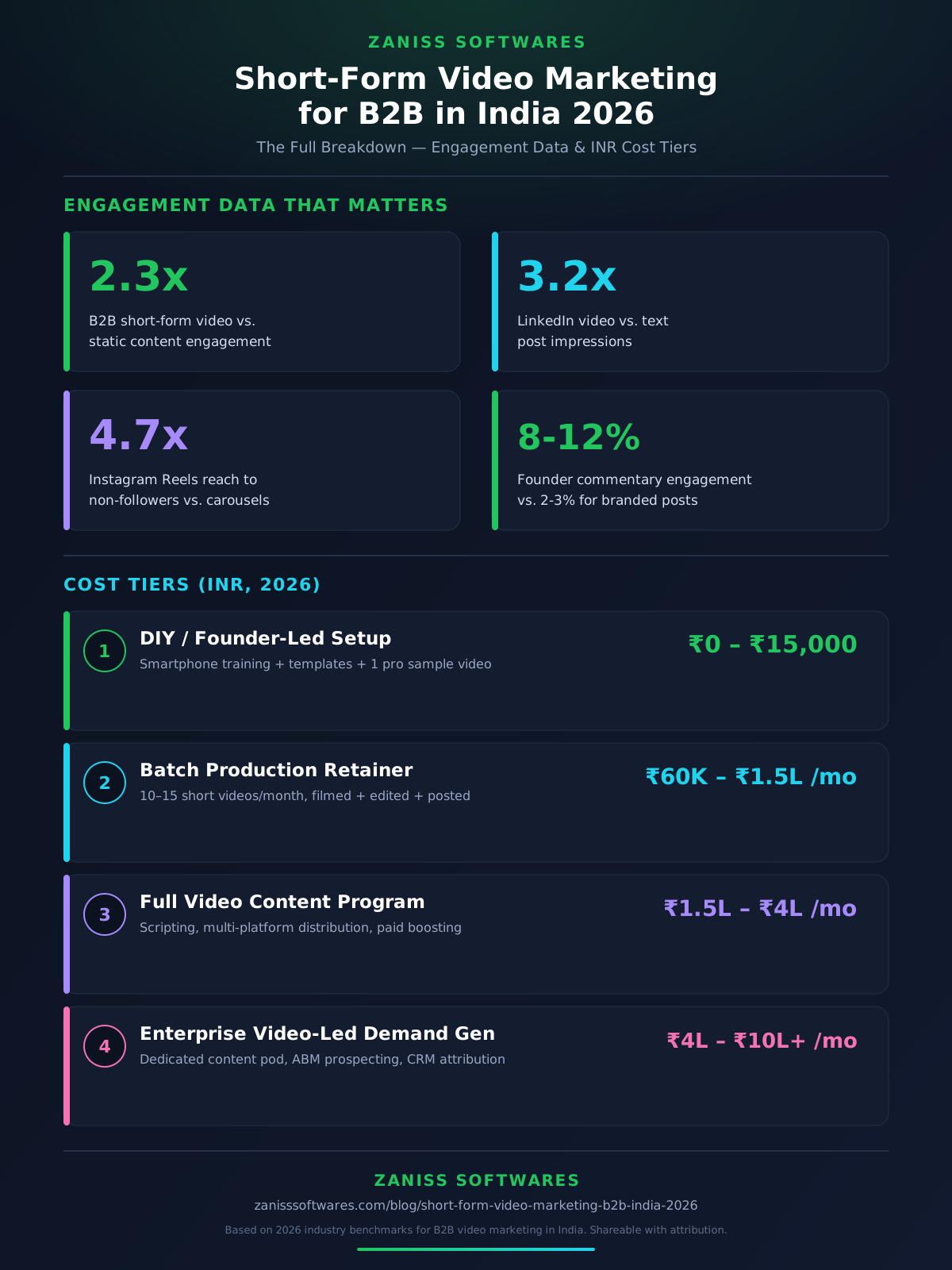
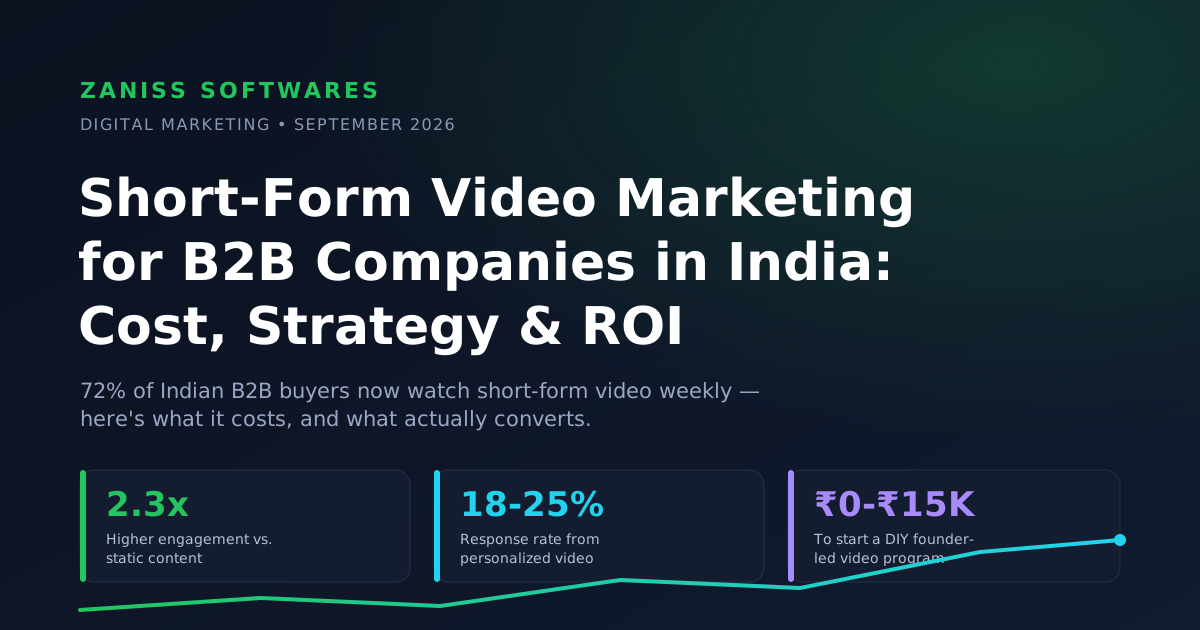
- 1Short-form video has quietly stopped being a B2C-only channel. In India, 72% of B2B decision-makers between 28 and 50 now watch Reels, Shorts, or LinkedIn video weekly, and B2B brands using short-form video see roughly 2.3x the engagement of brands relying on static posts.
- 2The real conversion story isn't views — it's that personalized video outreach gets 18–25% response rates against 5–8% for cold text emails, and video follow-ups close deals up to 35% faster.
- 3This article breaks down what short-form video marketing actually costs to run properly in India in 2026, what genuinely converts for B2B versus what's just noise, and a framework for deciding whether your business should invest now.
Why B2B Companies in India Are Suddenly Taking Reels and Shorts Seriously
For most of the last decade, short-form video was filed under "B2C marketing" in the minds of Indian B2B founders and marketing heads — something for D2C skincare brands and food delivery apps, not for a SaaS company selling to procurement teams or a manufacturer selling to distributors. That line has effectively disappeared in 2026, and the reason isn't a trend piece — it's where buyers are actually spending their attention.
Indian B2B decision-makers are, first, human beings who scroll Instagram Reels and YouTube Shorts before they are procurement officers reading a PDF. Roughly 72% of Indian B2B decision-makers aged 28–50 now consume short-form video content on a weekly basis, and platforms have quietly become discovery engines for vendors, not just entertainment feeds. LinkedIn's own algorithm has shifted hard toward native video, delivering roughly 3.2x more impressions than an equivalent text post, and Instagram Reels reach about 4.7x more non-followers than a carousel post covering the same topic. YouTube Shorts follows the same pattern — around 60% of Shorts views come from people who don't already subscribe to the channel, meaning it functions as a genuine top-of-funnel discovery channel rather than a retention tool for an existing audience.
None of this means B2B buyers are being sold to like consumers. It means the format buyers are willing to spend attention on has changed, and businesses that keep publishing only long-form whitepapers and static LinkedIn posts are increasingly invisible to a growing share of their own market, particularly younger decision-makers who are now approving six- and seven-figure INR budgets.
The Data Behind the Shift
It's worth being precise about what's actually improving, because "video gets more engagement" undersells what's happening. B2B companies publishing consistent short-form video report roughly 2.3x higher engagement than companies relying on static content alone — that's a baseline lift before any strategy is even applied well.
Format matters enormously within that baseline. Founder-led "hot take" videos — a recognizable person on camera sharing an opinion or an insight, not a polished brand film — average an 8–12% engagement rate on LinkedIn, compared with 2–3% for typical branded content posted from a company page. Myth-busting videos, where a business corrects a common misconception in its industry, see a 3.2% share rate against roughly 0.8% for standard posts, which matters because shares are the mechanism that gets a video in front of people who don't already follow the account.
The sharpest numbers, though, sit lower in the funnel, where most companies aren't even looking yet. Personalized video prospecting — a short, specific video sent to one named prospect instead of a templated email — gets an 18–25% response rate, compared with 5–8% for a standard cold text email. Sales teams using short video follow-ups after a first call report deals closing up to 35% faster, and proposal walkthroughs recorded as video cut back-and-forth clarification emails by roughly 50%. Put together, this is the part of the story that actually shows up in revenue, not just impressions: video isn't only a top-of-funnel awareness tool for B2B, it's increasingly a sales-enablement tool that shortens cycles.
What Actually Works: Formats That Convert for B2B in India
Not every short-form format performs equally, and Indian B2B teams that treat video marketing as "make something and post it" tend to burn budget without result. Five formats consistently outperform generic brand content:
- Founder or subject-matter-expert commentary — a recognizable person speaking directly to camera about an industry trend, a hot take, or a client mistake they see often — reliably outperforms polished, scripted brand videos, because it reads as a person with expertise rather than a marketing department with a message to push.
- Myth-busting and misconception-correction content works because it gives viewers a reason to share it with a colleague who holds the same misconception — this is the mechanic behind the higher share rate noted above, not luck.
- Behind-the-scenes and process content — a 30-second look at how a project is actually delivered, a client onboarding call excerpt, a whiteboard session — builds the kind of trust that a case study PDF takes far longer to establish, because buyers are watching the work rather than reading a claim about the work.
- Client-result snippets, ideally 15–45 seconds and specific ("we cut this client's cloud bill by 31% in six weeks" rather than "we help clients save money"), function as social proof in a format people will actually finish watching.
- Sales-enablement video — personalized prospecting clips, proposal walkthroughs, and post-call follow-ups — is the least "marketing-shaped" use of short video and the one with the clearest revenue attribution, per the response-rate and deal-velocity numbers above.
What consistently underperforms: generic product-feature videos with no human presence, stock-footage-driven brand films repurposed into vertical crops, and anything that reads as an ad rather than as a person sharing something useful. Indian B2B buyers, like most buyers globally in 2026, can tell the difference within the first two seconds, and a short-form platform's algorithm can tell within the first few hundred views — low completion rates on inauthentic content suppress reach quickly, so the cost of getting the format wrong compounds rather than staying flat.
Choosing the Right Platform Mix for an Indian B2B Audience
Not every platform earns the same role in a B2B video strategy, and Indian teams often default to "post everywhere" rather than matching the platform to the buying stage. LinkedIn remains the strongest fit for decision-maker-facing content precisely because the audience is pre-filtered by job title and industry — a founder's hot take or a client-result clip reaches people already professionally relevant, which is why its 3.2x impression lift over text posts translates so directly into pipeline-adjacent engagement rather than just vanity reach.
YouTube Shorts sits in between — with 60% of views coming from non-subscribers, it functions as a search-adjacent discovery surface, and Indian buyers researching a specific problem ("how to reduce cloud costs," "ERP vs custom software") increasingly land on a Short before they land on a website, making it a strong channel for problem-aware, educational content specifically.
A sensible default for most Indian B2B companies starting out is to produce once and distribute across all three with platform-native editing (captions, aspect ratio, and hook timing adjusted per platform) rather than treating each platform as requiring entirely separate content — the underlying clip can be the same, but the first two seconds and the caption strategy should not be identical across LinkedIn, Instagram, and YouTube.
Planning a Website? Don't Overpay or Underbuild
Most businesses overspend on features they don't need — or underspend and rebuild within a year. We help you scope it right from day one.
What Short-Form Video Marketing Costs in India in 2026
Cost depends heavily on how much of the work is DIY versus outsourced, and whether you're paying for one-off production or an ongoing content engine. These are realistic, INR-denominated ranges for the Indian market in 2026, scoped specifically to short-form/social video rather than TVC-grade brand films:
| Tier | Scope | Typical Cadence | Investment (INR) |
|---|---|---|---|
| Tier 1 — DIY / Founder-Led Setup | Smartphone filming training, hook/script templates, one professionally edited sample video | One-time, 1–2 weeks | ₹0 – ₹15,000 |
| Tier 2 — Batch Production Retainer | Filming day + editing + captions + scheduling for 10–15 short videos | Monthly, ongoing | ₹60,000 – ₹1,50,000 / month |
| Tier 3 — Full Video Content Program | Scripting, filming, editing, multi-platform distribution (LinkedIn, Instagram, YouTube Shorts), light paid boosting, monthly reporting | Monthly, ongoing | ₹1,50,000 – ₹4,00,000 / month |
| Tier 4 — Enterprise Video-Led Demand Gen | Dedicated content pod, executive/founder on-camera coaching, ABM-personalized prospecting video, motion graphics/animation, CRM-integrated attribution | Monthly, ongoing | ₹4,00,000 – ₹10,00,000+ / month |
A few cost mechanics worth knowing before budgeting: individual video production, outside a retainer, runs from effectively ₹0 for a founder filming on a smartphone up to roughly ₹15,000 for a single professionally shot and edited video, and drops to ₹1,500–₹3,000 per video once you're producing in batches during one filming day. Explainer-style 2D animation, where relevant for a product-led piece, typically runs ₹25,000–₹75,000 per finished minute. Most mid-sized Indian B2B companies land in Tier 2 or the lower end of Tier 3 for a first six-month program, then move up as they build an internal library of what actually converts and can justify a larger retainer against measured pipeline impact.
Where the ROI Really Comes From
The mistake most companies make when evaluating short-form video is measuring it like a brand-awareness channel — views, likes, follower growth — and then concluding it "doesn't move the needle" for B2B. That's measuring the wrong layer.
The stronger ROI signal is cost-per-qualified-lead: organic short-form video content, once a format is working, typically produces a cost-per-qualified-lead 65–80% lower than paid LinkedIn advertising for an equivalent audience, because the content keeps working (and getting found via search and recommendation feeds) long after a paid campaign budget runs out. Layered on top of that is the sales-cycle effect described earlier — personalized video prospecting and video follow-ups aren't a top-of-funnel metric at all, they're a mid-to-late-funnel one, and the 18–25% response rate and 35% faster deal closure numbers are the actual business case, not the view count on a Reel.
The honest caveat: none of this shows up in month one. Short-form video, like SEO, compounds — a library of 60–100 videos built over two to three quarters starts getting discovered through platform search and recommendation well after the original posting date, which is exactly why treating it as a one-off "let's try a few videos" experiment tends to produce disappointing results regardless of production quality.
Common Mistakes Indian B2B Teams Make
The most common failure is treating short-form video as a design or production problem rather than a consistency problem — companies spend heavily on one polished launch video, publish it once, and stop, when the data above is consistently about accounts that post 3–5 times a week at minimum (5–7 times a week for the strongest results). A single great video and forty mediocre-but-consistent ones will usually outperform each other in the opposite direction than most teams expect.
A second common mistake is putting a hired presenter or a generic marketing voice on camera instead of an actual founder, engineer, or subject-matter expert — the engagement data above is specifically stronger for recognizable, credible people, not polish. A third is skipping platform-native formatting: a video cropped from a widescreen brand film into a vertical frame, with no captions and no hook in the first two seconds, underperforms a rougher video that was actually shot vertically and edited for how people watch on a phone with the sound off. And a fourth, specific to B2B: treating video purely as a marketing-department deliverable and never handing clips to the sales team for prospecting and follow-up — which, per the numbers above, is where a meaningful share of the actual ROI sits.
Decision Framework: Should You Invest in Short-Form Video Now?
Ask four questions before committing budget:
- Do you have at least one person internally — founder, senior engineer, or subject-matter expert — willing to appear on camera regularly? Video without a credible human presence underperforms significantly; if the honest answer is no one wants to do this, fix that first or start with Tier 1 training rather than jumping to a retainer.
- Is your sales cycle long enough that a faster-moving deal or a higher response rate would matter? If your sales cycle is already short and largely transactional, the awareness-layer benefits may matter more than the sales-enablement benefits, which should shape which tier you start in.
- Can you commit to a 3–5x/week minimum posting cadence for at least two to three quarters? The compounding effect described above requires consistency; a six-week trial is not long enough to judge this channel fairly.
- Do you have (or can you afford to build) a system for turning video into pipeline — tracking which prospects were sent personalized video, which clips sales reps are using, and what's converting — rather than just publishing and hoping?
If you answered yes to three or more, a Tier 2 or Tier 3 program is a reasonable starting point. If the honest answer to question 1 is no, start smaller — a Tier 1 setup that gets one internal champion comfortable on camera before scaling spend.
Related Articles
- CRO CRO in India 2026: Framework, Cost & Strategy
- SEO Long-Tail Keywords That Convert for B2B SaaS
- Digital Marketing Why Digital Marketing is Important in 2026
- SEO SEO Tips for Small Businesses in 2026: 12 Tactics That Actually Work
Companion infographic: Short-Form Video Marketing for B2B in India 2026 — The Full Breakdown →
Working With Us
Building a short-form video engine that actually produces pipeline — not just views — means pairing content production with the distribution, reporting, and lead-tracking discipline of a real marketing program. That's exactly what our Digital Marketing team builds for Indian B2B companies.
Pro Insight
Planning a cloud-native platform? Let's review your architecture for free.
At ZANISS SOFTWARES, we don't just build websites — we build growth systems.
- ✓SEO-first architecture
- ✓Conversion-focused design
- ✓High-speed performance
- ✓Scalable, future-proof code
📩 Response within 24 hours
Frequently Asked Questions
Is short-form video actually effective for B2B companies, or is it mainly a B2C tactic?
It's genuinely effective for B2B in 2026 — 72% of Indian B2B decision-makers consume short-form video weekly, and B2B accounts using it see roughly 2.3x higher engagement than static-content-only accounts. The formats that work differ from B2C (founder commentary and sales-enablement clips outperform polished brand films), but the channel itself is not B2C-exclusive anymore.
How much does short-form video marketing cost in India in 2026?
Realistic ranges run from effectively free for a DIY founder-led setup up to ₹15,000 for a single professionally produced video, with ongoing monthly programs typically landing between ₹60,000 and ₹4,00,000 depending on volume, platforms, and whether paid boosting and sales-enablement video are included.
What's the single biggest driver of ROI from short-form video for B2B?
Not view count — cost-per-qualified-lead and sales-cycle impact. Organic short-form video typically produces a cost-per-qualified-lead 65–80% lower than paid LinkedIn ads over time, and personalized video prospecting/follow-ups measurably shorten deal cycles.
How often do we need to post for this to work?
The data points to a 3–5x/week minimum, with 5–7x/week performing best. Short-form video compounds over two to three quarters rather than producing results in the first few weeks, so cadence and patience matter more than any single video's production quality.
Do we need a professional video team, or can this be done in-house?
Many of the highest-performing formats — founder commentary, behind-the-scenes clips, personalized prospecting video — are specifically built around authenticity over polish, and can start as a DIY, smartphone-shot effort (Tier 1). A production partner becomes valuable for consistency, multi-platform distribution, and scaling once the format is proven, rather than as a prerequisite to start.