Quick Summary
- 1About 97–98 out of every 100 website visitors leave without converting — CRO is how you change that number without buying more traffic.
- 2A 2% → 3% conversion lift on the same ad spend cuts cost per lead by roughly a third, and the improvement compounds across every future channel.
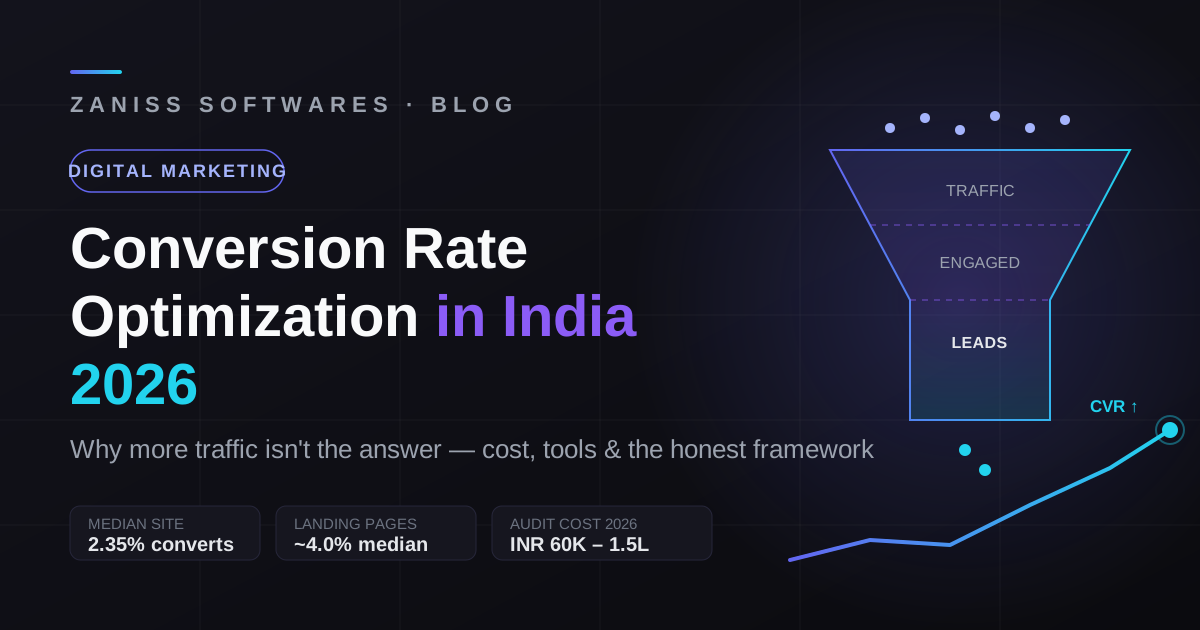
- 3Global median conversion is ~2.35% for websites and ~4% for dedicated landing pages; benchmarks vary more by traffic source than by industry.
- 4Below ~200 conversions/month, skip A/B testing — do a heuristic audit and ship fixes directly; testing programmes earn their keep past ~1,000/month.
- 5Indian CRO pricing in 2026: audits ₹60K–₹1.5L, retainers ₹75K–₹3L/mo, or bundled inside a performance-marketing engagement.
Every month we meet a founder whose ad budget has doubled in a year while lead volume has barely moved. The instinct is always the same: more traffic. More keywords, more campaigns, a bigger Meta budget. Almost nobody asks the other question — what happens to the traffic we already pay for once it lands?
The answer, for the median website, is that about 97 to 98 visitors out of 100 leave without doing anything you can bill against. Conversion rate optimization (CRO) is the discipline of shrinking that number, and in our experience it is the single most under-bought service in Indian digital marketing — partly because it's invisible, and partly because the industry has oversold A/B testing to businesses that don't have the traffic to run it. This guide is our attempt at the honest version: what CRO actually is, what it costs in India in 2026, which tools are worth paying for, and when it's the wrong thing to spend money on.
The maths your ad budget is ignoring
Say you spend ₹1,00,000 a month on Google Ads, average ₹50 a click, and your site converts at 2%. That's 2,000 visits, 40 leads, and a ₹2,500 cost per lead. Now suppose a CRO programme lifts conversion to 3% — an entirely realistic first-quarter outcome when a site has never been optimized. Same spend, same traffic: 60 leads at ₹1,667 each. You just cut CPL by a third without touching a single campaign setting.
Here's the part that makes CRO compound: that improvement applies to every channel simultaneously — organic, paid, email, referral, the WhatsApp link on your Instagram bio. Traffic you buy expires when you stop paying. A conversion improvement keeps paying out on all future traffic, which is why we treat CRO as infrastructure, not a campaign. We wrote about the acquisition side of this equation in our our full performance marketing service; CRO is the multiplier that sits under it.
What should your conversion rate be?
Benchmarks vary wildly by industry and by what counts as a "conversion", so treat published numbers as orientation, not targets. The 2026 picture across the studies we track:
| Segment | Median conversion rate (2026) | Notes |
|---|---|---|
| All websites (global median) | ~2.35% | Any primary goal — form, call, purchase |
| Dedicated landing pages (all industries) | ~4.0% | Nearly double site-wide pages; top quartile exceeds 11% |
| SaaS / technology | ~3.8% | Longer sales cycles suppress the number |
| E-commerce | ~4.3% | Add-to-cart much higher; this is completed purchase |
| Healthcare | 3.0–4.2% | Trust and compliance friction |
| Legal / professional services | ~7.4% | High intent, short decision cycles |
| Financial services | ~8.4% | Comparison-driven, urgent need |
Two honest caveats. First, traffic source moves conversion more than industry does — visitors from an email list convert dramatically better than cold paid social, so a "low" rate may be a targeting problem, not a page problem. Second, Indian B2B sites that add a WhatsApp or call option routinely beat form-only benchmarks, because a large share of Indian buyers simply will not fill a six-field form.
Where Indian websites actually leak
After auditing sites across healthcare, manufacturing, real estate and SaaS, the same five leaks account for most lost conversions:
- Speed on mid-range Android. Most Indian traffic arrives on a ₹12–20K phone over 4G. A page that feels fine on your office Wi-Fi can take 6+ seconds there, and every extra second costs conversions. This is a Core Web Vitals problem before it is a design problem — the same discipline we bake into our web development builds.
- Forms designed for the seller, not the buyer. Six required fields, no phone-first option, OTP walls before value is shown. Cutting a form from six fields to three is the single most reliable win we ship.
- No low-commitment path. Indian buyers often want to talk before they submit. Sites with only a "Request a demo" form leave money on the table versus adding a WhatsApp click-to-chat or a visible phone number.
- Trust deficit. No client logos, no real address, stock-photo teams, no case numbers. In a market wary of fly-by-night vendors, credibility elements are conversion elements.
- Thumb-hostile mobile layouts. Primary CTAs parked in the hardest-to-reach corner of the screen. We covered the mechanics in our thumb-zone design guide — over 70% of Indian mobile users browse one-handed.
The CRO process we actually run
CRO is not "make the button orange". A real programme is a research loop with four stages:
- 1. Research. GA4 funnel analysis to find where users drop; heatmaps and session recordings to see why; on-site polls or five quick user interviews to hear the objection in the buyer's own words. A week of Microsoft Clarity recordings usually surfaces more than a month of debate.
- 2. Hypothesis backlog. Every observed leak becomes a testable statement — "moving proof above the fold will lift demo requests because recordings show users bounce before scrolling" — scored on impact, confidence and effort (ICE) so the roadmap is ranked, not random.
- 3. Test or ship. High-traffic pages get A/B tests. Low-traffic pages get the fix shipped directly with before/after measurement — more on this distinction below, because it's where most CRO engagements quietly go wrong.
- 4. Measure and re-enter the loop. Wins get rolled out everywhere they apply; losses get documented (a disproved hypothesis is cheap market research). The backlog is re-scored monthly.
What CRO costs in India in 2026
| Engagement | Price Range | Best For |
|---|---|---|
| DIY (founder + Clarity) | ₹0 + your time | Watch 50 recordings, fix the obvious. Surprisingly effective once. |
| One-time CRO audit | ₹60K – ₹1.5L | Full-funnel analytics review, heatmap/recording analysis, prioritized fix list with mockups. Large agencies quote ₹1.5L+. |
| Monthly CRO retainer (standalone) | ₹75K – ₹3L/mo | Research loop, test design and execution, monthly experiment roadmap. Premium Indian agencies ₹1.5L–₹3L. |
| CRO inside a performance retainer | Bundled | How ZANISS runs it: weekly CRO and landing-page testing inside Performance Marketing ($2.5K–6K/mo + ad spend). |
Planning a Website? Don't Overpay or Underbuild
Most businesses overspend on features they don't need — or underspend and rebuild within a year. We help you scope it right from day one.
The A/B testing honesty section
Here is the thing most CRO vendors in India will not tell you: classic A/B testing has a traffic floor, and the majority of Indian SME websites are below it. A split test needs enough conversions — as a working rule, several hundred per variant — to separate a real improvement from noise. If your site does 40 leads a month, a two-variant test needs many months to conclude, by which point seasonality has polluted the result. Running "tests" anyway produces confident-sounding reports built on statistical sand.
Our rule of thumb:
| Your monthly conversions | What CRO should look like |
|---|---|
| Under ~200 | No A/B tests. Heuristic audit + session recordings + direct fixes, measured before/after. Fix speed, forms, trust, clarity. |
| 200–1,000 | Occasional high-impact tests on your highest-traffic page only; everything else ships directly. |
| 1,000+ | A proper experimentation programme — parallel tests, a managed backlog, and a testing tool earn their keep here. |
This is why we bundle CRO into performance marketing rather than selling test volume: the deliverable is lift, not a count of experiments.
Tools: what's free, what's worth paying for
| Tool | 2026 pricing | Where it fits |
|---|---|---|
| Microsoft Clarity | Free, unlimited sessions | Heatmaps, recordings, dead-click and rage-click detection, AI session summaries. Our default first install; ~30-day retention is the trade-off. |
| GA4 + Tag Manager | Free | Funnel and drop-off analysis, conversion events. Non-negotiable foundation. |
| Hotjar | Free tier; paid from ~$32–49/mo | Adds surveys, feedback widgets and 365-day retention on top of heatmaps. |
| VWO | Free under 10K monthly users; Growth from ~$314/mo | The mainstream A/B testing choice after Google Optimize's shutdown; has merged with AB Tasty. |
| Convert | Mid-market paid plans | Privacy-focused testing (GDPR/DPDP-friendly), solid for EU-facing businesses. |
| AB Tasty / Optimizely | Enterprise, ~$20K+/yr | Personalization and feature experimentation at scale; overkill below ~1M visits/mo. |
An SME can run a legitimate first year of CRO on ₹0 of tooling — Clarity plus GA4 covers research and measurement. Pay for a testing platform only once you clear the traffic floor above.
What CRO costs in India in 2026
See the pricing table above for the by-engagement breakdown. The bundled model exists for a reason: when one vendor owns ads and another owns the landing page, every weak month becomes a blame exchange. When the same pod owns cost per lead end to end, CRO stops being a report and starts being a number someone is accountable for.
When CRO is the wrong purchase
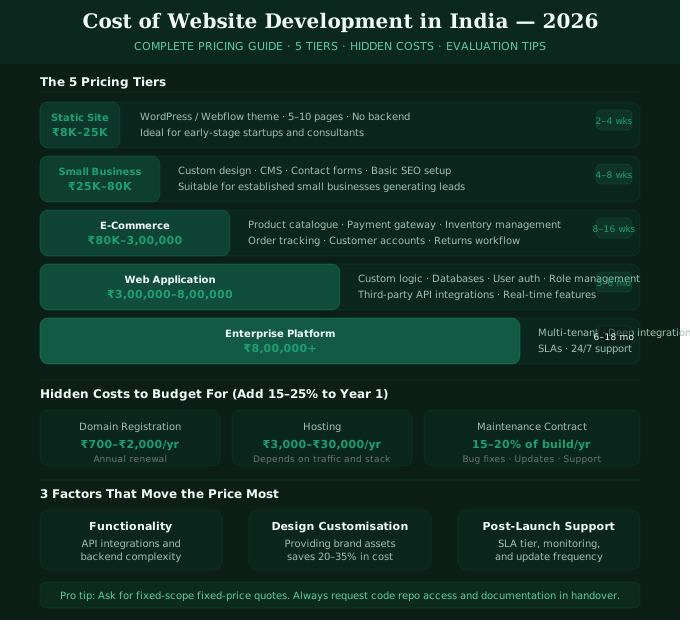
We turn down CRO engagements in three situations. If a site gets under roughly 3,000–5,000 visits a month, the constraint is acquisition, not conversion — do a one-time heuristic cleanup, then spend on SEO and ads first. If the offer itself isn't landing — visitors read the page, understand it, and still don't want it — that's positioning work, and no amount of button testing fixes it. And if the site is a five-year-old template that fails Core Web Vitals structurally, a rebuild is often cheaper than optimizing rubble; our website cost guide covers what that actually runs. CRO multiplies a working system. It cannot resurrect a broken one.
Working with us
ZANISS SOFTWARES runs CRO the way it should be run — inside the same team that manages your traffic, so one pod owns your cost per lead end to end. Our digital marketing engagements include weekly CRO and landing-page testing as standard, reported against leads and revenue rather than vanity metrics, and because we're a software company first, the fixes actually get built — fast pages, clean forms, tracked funnels. If your traffic is growing faster than your lead count, book a free consultation and we'll show you where your funnel leaks before you spend another rupee on ads.
Pro Insight
Working with us
ZANISS runs CRO inside the same team that manages your traffic, so one pod owns your cost per lead end to end. Weekly CRO and landing-page testing come standard with our digital marketing engagements — and because we're a software company first, the fixes actually get built.
- ✓SEO-first architecture
- ✓Conversion-focused design
- ✓High-speed performance
- ✓Scalable, future-proof code
📩 Response within 24 hours