In this article
Quick Summary
- 1AI Overviews now appear on roughly 48% of Google searches, and when one shows up, the #1 organic result loses up to 58% of its clicks.
- 2Google AI Mode has crossed 100 million monthly users across the US and India, and Perplexity grew about 640% year-on-year in India.
- 3The new visibility metric is not your rank — it is whether AI engines cite you.
- 4GEO in India costs ₹35K–₹1.5L one-time for audit-and-fix and ₹25K–₹90K/month ongoing — with clear cases where it is not yet worth your money.
For fifteen years, the deal with Google was simple: rank on page one, get the click, win the lead. In 2026 that deal is quietly being rewritten. Nearly half of Google searches now show an AI Overview above the organic results, ChatGPT and Gemini answer buying-intent questions directly, and a growing share of your prospects never visit a search results page at all — they ask an assistant and act on the answer.
We run SEO and content programs for clients across Gujarat and beyond, and over the past year the pattern in analytics has been consistent: impressions up, rankings stable, clicks down. That is not a penalty. It is the new physics of search. This article is our working playbook for it — what actually changed, how AI engines decide whom to cite, what we do about it, and what it costs in honest INR figures.
The click era is ending — here is the data
A few numbers frame the problem better than any hot take:
- AI Overviews appear on ~48% of Google searches as of early 2026 (BrightEdge), and the feature has crossed 2.5 billion monthly users across 200+ countries.
- When an AI Overview is present, the top-ranking page loses up to 58% of its clicks (December 2025 measurements, up from ~35% in April 2025). Seer Interactive measured a ~61% organic CTR decline on informational queries.
- Roughly 60% of Google searches now end without any click. The user reads the AI answer and leaves.
- Google AI Mode passed 100 million monthly active users across the US and India — and India is one of its two launch-scale markets.
- Perplexity grew ~640% year-on-year in India, and ChatGPT is now the second most used platform among Indian professionals.
- The consolation prize is real: traffic that does arrive from AI assistants converts at ~7.1% — nearly as well as paid search — because the assistant has pre-qualified the visitor. And brands cited inside an AI Overview see ~35% higher organic CTR on those queries.
So the game is not "traffic is dead." The game is: fewer clicks, but warmer ones — and the brands that get cited inside the answer collect a disproportionate share of both the clicks and the trust.
GEO vs SEO: what actually changes
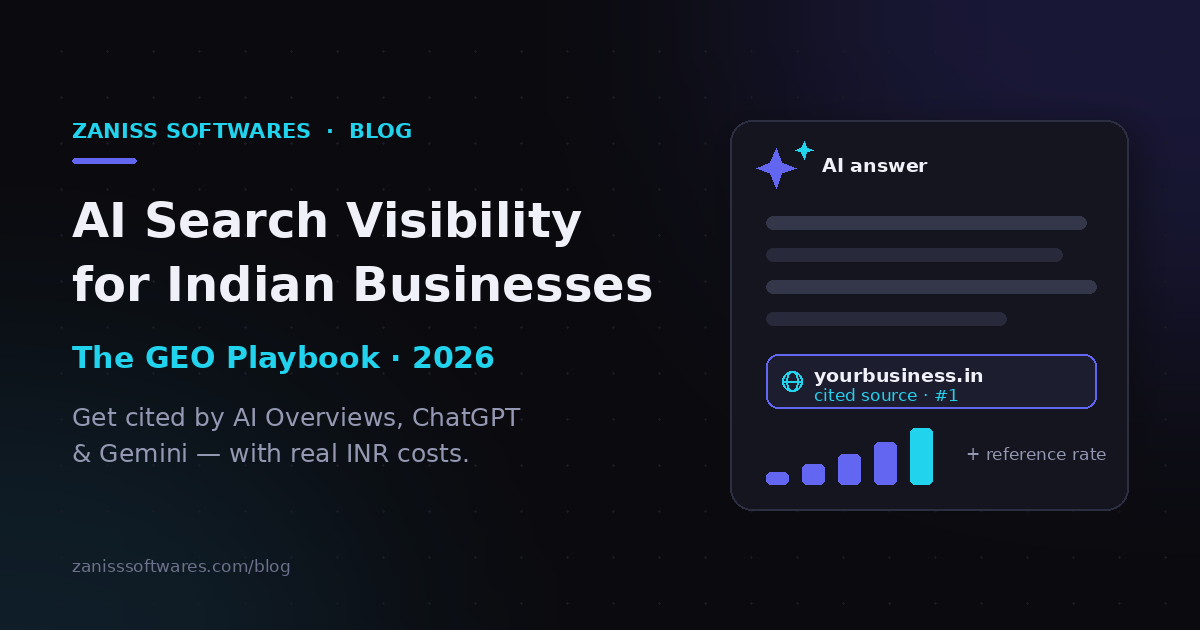
Generative Engine Optimization (GEO) is the practice of structuring your content so AI engines — Google AI Overviews and AI Mode, ChatGPT, Gemini, Perplexity, Copilot — retrieve it, trust it, and cite it in their answers. If that sounds like SEO with a new hat, it half is. Everything foundational carries over: crawlability, site speed, HTTPS, clean information architecture, genuine expertise. AI engines mostly retrieve from the same indexes classic search uses.
What changes is the unit of consumption. A search engine ranks pages; a language model retrieves passages. An LLM does not reward a 3,000-word page that buries its answer in paragraph fourteen. It rewards the page whose paragraph three states the answer in one declarative sentence, backs it with a number, and sits under a heading that matches the question. The metric shifts too: from click-through rate to reference rate — how often you are cited when AI answers questions in your category.
How AI engines decide who gets cited
From published research and our own testing across client sites, five factors keep showing up:
- Extractable structure. Question-shaped headings with direct, self-contained answers in the first sentence beneath them. Clean tables. Lists. Passages that make sense out of context.
- Freshness. About 85% of AI Overview citations come from content published or updated within the last two years, and recently updated content appears ~4.3× more often in AI answers. A dated, refreshed page beats an old evergreen one.
- Specific numbers and named sources. Princeton's original GEO research found that adding statistics, quotations and citations lifted content visibility in generative engines by 30–40%. Vague content does not get quoted; concrete content does.
- Schema and machine readability. FAQ, Organization, LocalBusiness and Article schema help engines map your content to entities. Structured data matters more to LLM pipelines than it ever did to classic crawlers.
- Third-party corroboration. Wikipedia (~6.2%) and Reddit (~5.2%) are the most-cited domains in AI answers. Engines trust brands that other sources talk about — directories, review sites, forums, industry press — not just the brand's own website.
The GEO playbook we run (seven steps)
1. Baseline your AI visibility. Before changing anything, ask ChatGPT, Gemini and Perplexity the 15–20 questions your buyers actually ask ("best ERP development company in Ahmedabad", "how much does a custom CRM cost in India"). Record who gets cited. This is your competitive map, and it is free.
2. Restructure money pages for extraction. Convert key sections to question-format H2/H3s with a one-sentence direct answer up top, then the detail. Add a summary box with the key numbers at the top of long guides — exactly the pattern this article uses.
3. Publish real numbers. Pricing ranges, timelines, benchmarks from your own work. This is the single highest-leverage GEO move and the one most Indian firms refuse to make. We publish our cost tables precisely because engines (and buyers) reward it — our cost guides are our most-cited pages.
4. Implement schema properly. Organization + LocalBusiness sitewide; Article + FAQ on content; Service and aggregate-rating markup where legitimate. One-time engineering work, compounding returns.
5. Refresh on a calendar. Given the 4.3× freshness multiplier, a quarterly refresh cycle on your top 20 pages — updated figures, updated dates, a new section — outperforms publishing 20 new thin posts.
6. Earn third-party mentions. Get listed where engines look: Google Business Profile, JustDial/Sulekha for local, Clutch/GoodFirms for IT services, genuine participation in Reddit and Quora threads your buyers read. This is classic digital PR wearing a new jersey.
7. Track reference rate monthly. Re-run your question set, log citations, watch AI-source sessions in GA4 (ChatGPT, Perplexity and Gemini referrals are separable with a custom channel group). Optionally add a dedicated tracker — pricing below.
What GEO costs in India in 2026
| Line item | Price Range | Best For |
|---|---|---|
| GEO + AI visibility audit (one-time) | ₹35,000 – ₹1,50,000 | Question-set baseline, content-structure audit, schema gap report, competitor citation map |
| Schema implementation (one-time) | ₹15,000 – ₹60,000 | Depends on CMS; headless/custom sites sit at the top of the range |
| Money-page restructuring (one-time) | ₹4,000 – ₹12,000 / page | Rewrite for extraction: Q&A headings, summary boxes, tables |
| Ongoing GEO retainer (monthly) | ₹25,000 – ₹90,000 | Refresh calendar, new cited-content, mention building, monthly reference-rate report |
| AI visibility tracking tool (monthly) | ₹0 – ₹25,000 | Manual tracking is free; tools like Otterly.AI start ~€89 (~₹9,000)/mo; enterprise platforms cost more |
Planning a Website? Don't Overpay or Underbuild
Most businesses overspend on features they don't need — or underspend and rebuild within a year. We help you scope it right from day one.
What GEO costs in India in 2026
Honest figures, based on what this work takes when done properly. As always: the wide ranges reflect scope, not mystery. See the cost table above.
For most SMEs, a sensible first engagement is the audit plus restructuring of 8–12 money pages: ₹70,000 – ₹2,00,000 all-in, before committing to a retainer. If an agency quotes you a "GEO package" without showing you a baseline citation map first, that is a red flag — the same one we described in our guide to choosing a software development company.
How to measure whether it is working
Three numbers, reviewed monthly. Reference rate: of your tracked buyer questions, what share of AI answers cite you (expect movement in 8–12 weeks, not 2). AI-assisted sessions: GA4 sessions referred from ChatGPT, Perplexity, Gemini, Copilot — small in volume, high in conversion, growing every month. Branded search volume: buyers who see you cited in an AI answer often search your name later; a rising branded curve is GEO working even when referrals are not tagged.
What to stop worshipping: average position and raw organic sessions. Both can decline while leads improve — we have watched it happen on our own site, where cost-guide pages lose informational clicks to AI Overviews but consultation requests keep climbing.
The India-specific opportunities most guides miss
Vernacular content is nearly uncontested. Over half of searches from Tier 2/3 cities are voice queries in Hindi, Tamil, Telugu or Bengali, and AI engines have very few citable business sources in those languages. A services firm publishing genuinely useful Hindi or Gujarati content today is competing for citations against almost nobody.
Local entity signals punch above their weight. For "near me" and city-qualified questions, AI Mode leans heavily on Google Business Profile data, reviews and local directories. A complete, actively-reviewed profile is GEO — no content required.
India is a launch market, not a laggard. AI Mode scaled in India alongside the US. The window where your competitors have not adjusted is open now; on current adoption curves, it will not stay open through 2027.
When GEO is not worth your money yet
We would rather talk you out of a retainer than sign a disappointed client. Skip dedicated GEO spend for now if: your website has under ~20 pages of substantive content (fix the foundation first — see our website cost guide); your sales are overwhelmingly walk-in, referral or marketplace-driven; or your basic SEO hygiene is broken, because GEO inherits SEO's plumbing. In those cases the classic fundamentals in our SEO tips for small businesses deliver more per rupee.
If, on the other hand, you already publish expertise and your buyers research before they call — GEO is the highest-leverage marketing adjustment available to you in 2026, and most of it is one-time structural work, not a forever-fee.
Working with us
ZANISS SOFTWARES runs integrated digital marketing engagements from Ahmedabad — SEO, GEO, paid and content under one roof, with the engineering team next door to implement schema, speed and structural fixes the same week they are recommended. If you want to know where your business stands in AI answers today, we will run the baseline citation map as part of a free consultation — no retainer required to see the numbers.
Pro Insight
Working with us
ZANISS SOFTWARES runs integrated digital marketing engagements from Ahmedabad — SEO, GEO, paid and content under one roof, with the engineering team next door to implement schema, speed and structural fixes the same week they are recommended.
- ✓SEO-first architecture
- ✓Conversion-focused design
- ✓High-speed performance
- ✓Scalable, future-proof code
📩 Response within 24 hours
Frequently Asked Questions
What is generative engine optimization (GEO)?
GEO is the practice of structuring website content so AI engines — Google AI Overviews, ChatGPT, Gemini, Perplexity — retrieve it and cite it as a source in their generated answers. It extends SEO: instead of only ranking pages for clicks, you optimize passages for citation.
Is SEO dead in 2026?
No. AI engines retrieve from search indexes, so crawlability, authority and quality content still decide who is eligible to be cited. What is fading is the informational click: ~60% of Google searches now end without one. SEO fundamentals remain the entry ticket; GEO decides who gets quoted.
How much does GEO cost in India?
A proper audit runs ₹35,000–₹1.5 lakh one-time; restructuring money pages costs ₹4,000–₹12,000 per page; ongoing retainers run ₹25,000–₹90,000 per month. A sensible SME starting point — audit plus 8–12 restructured pages — lands between ₹70,000 and ₹2 lakh.
How long does GEO take to show results?
Expect first citation movement in 8–12 weeks. Freshness signals respond fastest — updated pages appear roughly 4.3× more often in AI answers — while entity authority and third-party mentions compound over 6–12 months.
How do I check if AI engines cite my business?
Ask ChatGPT, Gemini and Perplexity the 15–20 questions your buyers ask and record which businesses are cited. Repeat monthly. In GA4, build a channel group separating referrals from chatgpt.com, perplexity.ai and gemini.google.com to track AI-sourced sessions.
Does GEO work for local businesses in Ahmedabad?
Yes — often faster than for national brands. City-qualified AI answers lean on Google Business Profile data, reviews and local directories, which small businesses can improve in weeks. Vernacular content adds a further advantage because Indian-language sources face almost no citation competition.