In this article
Quick Summary
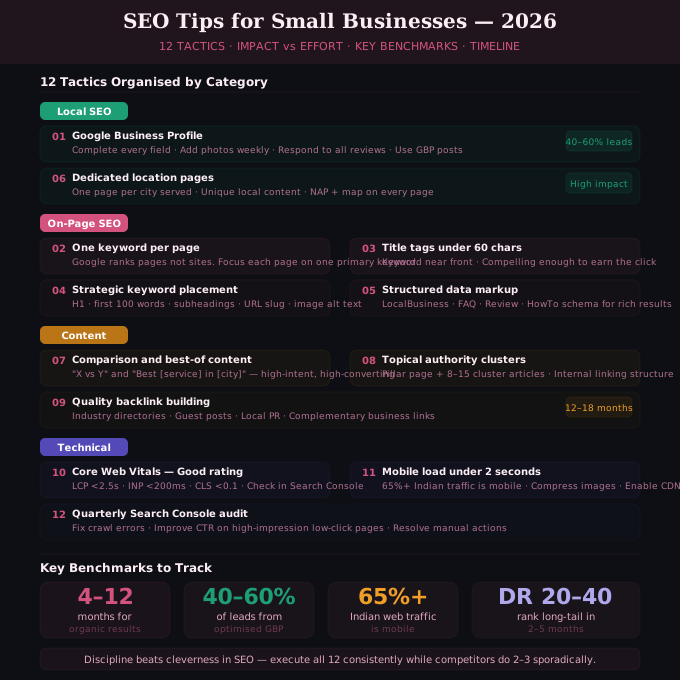
- 1AI search (Google AI Overviews, ChatGPT) only quotes authoritative content — high-quality SEO matters more, not less.
- 2Local SEO + Google Business Profile generates 40–60% of leads for service businesses.
- 31 strong backlink beats 100 weak ones. Quality always outranks quantity in 2026.
- 4SEO is a 6–12 month asset — most businesses fail because they quit at month 3.
Most small businesses fall into one of two SEO ruts: they ignore it entirely, or they hire someone for three months, see no movement, and conclude SEO is dead. Both reactions miss the actual mechanic. SEO in 2026 isn't a campaign — it's a compounding asset, like a fixed deposit that pays in qualified leads instead of interest.
The smaller you are, the more this works in your favour. A focused 6-person business can move on a content opportunity in a week; a national chain takes a quarter to get the same brief through legal.
Has AI killed SEO? (Short answer: no, the opposite)
The "SEO is dead" headline reappears every time Google updates anything. The 2026 version blames AI Overviews and ChatGPT. In practice, both of those tools need a source for every answer they give — and the sources they pick are the same authoritative pages that already rank well organically. The losers in this transition are thin "10 tips for X" listicles. The winners are pages with a clear point of view, named authors, and specific data.
If you've watched your zero-click impressions go up while traffic stayed flat, that's not failure — that's brand exposure you used to pay for. The trick is making sure your name is the one in the answer box.
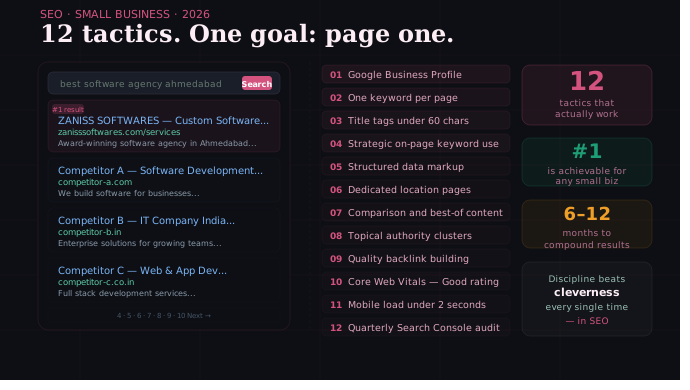
12 tactics that actually move rankings for small businesses
1. Earn the answer box, not just the blue link
Structure pages so the first 60–80 words directly answer the search query. Add a short FAQ block with proper schema. We routinely see featured-snippet wins triple click-through on commercial-intent queries — and they're disproportionately likely to get cited by AI Overviews too.
2. Local SEO first — it has the best ROI of anything you'll do
For service businesses, a fully filled Google Business Profile, weekly photo posts, a documented review-collection process after every job, and a Q&A section that pre-empts common objections will typically deliver 40–60% of total enquiries within 90 days. The compounding part: once you have 80+ recent 5-star reviews, displacing you in the local pack becomes genuinely hard.
3. One page, one primary intent
The most common technical mistake we see on small-business sites is one "services" page trying to rank for nine different queries. Split them. A page targeting "ERP implementation Ahmedabad" should not also be the page about "custom CRM in India" — Google can't tell which to rank, and ranks neither.
4. Write for the actual question, not the keyword
"Best CRM in India" looks like an informational query. Look at the SERP and you'll see it's dominated by comparison roundups, not vendor pages. Match the page format to what's already winning. Trying to rank a vendor pitch on a comparison query is a slow way to lose to capterra.com.
5. Page speed is now a conversion lever, not just a ranking signal
Aim for LCP under 2.5s, INP under 200ms, and CLS under 0.1 — measured on a mid-range Android over 4G, not your office wifi. The 2025 INP rollout punished sites that felt slow on interaction even when they "loaded fast." If this is unfamiliar territory, our web development team handles it as part of every build.
6. Write like a person who knows the topic
Google's helpful content system and AI Overviews both downrank content that sounds generated. The signals: predictable transitions ("In today's fast-paced world..."), no specific numbers, no first-person experience, no opinion. Add a real byline, link to LinkedIn, mention what you actually saw on a project. The same content with one paragraph of lived experience will outperform the polished generic version.
7. Backlinks: 5 great ones beat 500 mediocre
One contextual link from a publication your customers actually read is worth more than a hundred from PBNs or directory spam. Realistic ways small businesses earn them in 2026: original survey data, contributing to industry reports, podcast appearances, and being the unique source for a journalist on a deadline. Stop buying packages.
8. Internal linking with intent
Map your blog posts to the service page they should funnel to. Use descriptive anchor text — "custom ERP development for manufacturers" instead of "click here." A good rule: every blog post should link to at least one service page and one related blog post within the first half of the article.
9. Conversational queries deserve conversational answers
Voice search and AI chat both ask longer, fuller questions. Build out FAQ sections that mirror those phrasings — and let yourself sound like a person, not a brochure.
10. Refresh top pages on a calendar, not a whim
Pick your top 10 traffic-driving pages. Audit them every quarter for stale data, broken links, and missing 2026 context. Updating an existing ranking page is almost always faster than ranking a new one — and Google rewards demonstrable freshness on commercial pages.
11. HTTPS, headers, and the boring technical baseline
SSL is a baseline, not a differentiator. While you're at it: a clean robots.txt, an actually-correct sitemap, canonical tags on duplicate pages, hreflang for multi-region sites, and security headers (HSTS, CSP). Most "I can't rank anything" calls we take end up being a botched migration that broke half these.
12. Image SEO is the most under-used 10-minute win
Descriptive filenames (not "IMG_4532.jpg"), accurate alt text, modern formats (WebP/AVIF), and a width/height attribute to prevent CLS. Image search drives more traffic than most small businesses realise — especially in product, real-estate, and food verticals.
Treat SEO as a system, not a checklist
Three layers, all of which have to be working at once:
- Content — pages mapped to real buyer intent, by stage of journey.
- Technical — Core Web Vitals, schema, crawlability, internationalisation.
- Authority — backlinks, brand mentions, reviews, named expertise.
Most small businesses over-invest in one layer and ignore the other two. Beautifully written content on a slow site with no backlinks won't rank. Fast site with no content won't rank either. The leverage is in keeping all three moving at the same time, even slowly.
Planning a Website? Don't Overpay or Underbuild
Most businesses overspend on features they don't need — or underspend and rebuild within a year. We help you scope it right from day one.
Realistic timeline (and where most teams quit)
- Month 1–3 — technical fixes land, first long-tail rankings appear, you'll feel like nothing is happening.
- Month 4–6 — meaningful organic traffic starts compounding, GBP-driven leads pick up first.
- Month 7–12 — defensible rankings on commercial queries, attribution from organic shows up clearly in your CRM.
The businesses that win at SEO aren't smarter — they just outlast the ones that quit at month three. The ones that quit are usually working off a flat retainer with no quarterly review of what shipped, which is the structural fix.
What good year-one SEO looks like in your dashboard
- 20–40% of total leads attributed to organic and direct channels
- Top 5 commercial keywords ranking on page 1 (or in the local pack for geo-queries)
- Cost per lead from SEO at less than half your blended paid CPL
- 30+ recent 5-star reviews on Google with sub-24h reply rate from your team
Related reading
For the broader picture: why your business needs digital marketing in 2026, benefits of digital marketing in India, and the India website cost guide.
Want a candid SEO audit?
If you're spending on SEO and not sure whether it's working, contact us for a free audit. We'll point at the three highest-leverage fixes — whether or not you ever work with our digital marketing team.
Pro Insight
Planning a cloud-native platform? Let's review your architecture for free.
At ZANISS SOFTWARES, we don't just build websites — we build growth systems.
- ✓SEO-first architecture
- ✓Conversion-focused design
- ✓High-speed performance
- ✓Scalable, future-proof code
📩 Response within 24 hours
Frequently Asked Questions
Is SEO still effective in 2026?
Yes, SEO is more effective than ever as AI search engines rely on high-quality content from authoritative websites.
How long does SEO take to work?
SEO typically takes 3–6 months to show results and up to 12 months for strong rankings.