In this article
Quick Summary
- 1India is already digital — affordable data, UPI, and Tier 2/3 growth let small businesses outcompete big brands.
- 2Local SEO + Google Business Profile alone can drive 40–60% of leads for service businesses.
- 3Digital channels are 3–10x cheaper per lead than newspaper, radio, or hoardings — with full attribution.
- 4WhatsApp is India's highest-converting channel (90%+ open rates) — pair it with SEO + ads for full funnel.
I'll skip the "India is going digital" speech — you've heard it. The more honest framing in 2026 is this: digital marketing in India has matured to the point where the businesses doing it badly are now actively losing customers to the ones doing it slightly better.
That's a different conversation than "should I be online?" The real question is where to put your next ₹50,000, and what you should reasonably expect back.
Why the math changed for Indian SMEs
A few quiet shifts changed the unit economics:
- Mobile data is essentially free, and it reaches Tier 2/3 cities now — not just metros.
- UPI killed friction at checkout, so a click can convert to revenue in 30 seconds.
- Google Business Profile and WhatsApp Business APIs grew up — small operators can now do what only enterprises could three years ago.
- AI-driven search (Google AI Overviews, ChatGPT, Perplexity) reads structured, trustworthy content and ignores thin pages.
The practical takeaway: a 12-person clinic in Navrangpura can absolutely outrank a multi-city chain — if its content, schema, and reviews are sharper.
The benefits that actually move the needle
1. Hyper-local intent ("near me" is your unfair advantage)
"Software company in Ahmedabad", "best dentist near me", "kurta supplier Surat" — these searches have buying intent baked in. A well-optimised Google Business Profile plus 4–5 location-specific landing pages routinely drives 40–60% of total leads for service businesses we work with. It's the cheapest channel to set up and the slowest one for competitors to copy.
2. The cost-per-lead reality
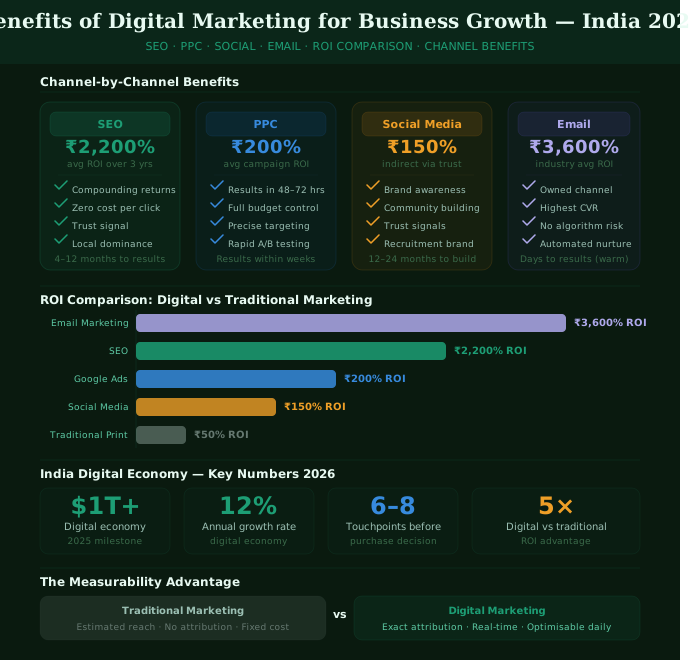
Compare honestly. A half-page newspaper insert in a Gujarati daily runs ₹40,000–₹80,000 with no tracking. A focused Google Search Ads campaign for the same budget, targeting buyers actively typing your service, will usually deliver 80–150 qualified leads at a measurable cost-per-lead. We've seen CPLs drop from ₹900 to ₹220 within 60 days just by tightening match types and landing-page intent.
3. Trust at scale through reviews and case studies
Indian buyers still want social proof — they just look for it on Google reviews, Justdial, and Instagram now instead of asking neighbours. Forty genuine 5-star reviews on your GBP listing is worth more than any award badge on your website.
4. WhatsApp is your highest-converting channel (it's not close)
Open rates of 90%+ and response times in minutes. We typically see WhatsApp lead-to-meeting conversion at 3–5x what email delivers in the same funnel. The trick is to treat it as a sales channel with proper templates, not a spam blaster.
5. SEO compounds — ads don't
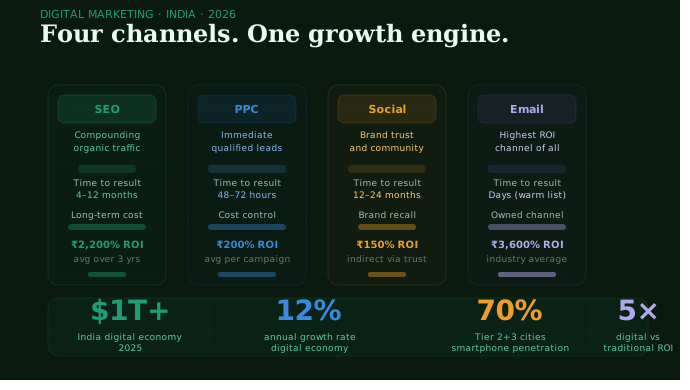
The day you stop paying Google Ads, the leads stop. SEO is the opposite: a single well-researched article we wrote for a client in 2023 is still bringing in 40+ qualified visits a month with zero ongoing spend. The catch is that it usually takes 4–6 months to see meaningful traction, which is why most businesses give up too early.
6. PPC for speed, SEO for compounding
You don't pick one. The pattern that works for almost every Indian SME we onboard: ads to fill the pipeline this month, SEO to make next year's pipeline cheaper. Anyone selling you "only ads" or "only SEO" is selling their own service mix, not your growth.
7. Social media — useful, but rarely a primary lead source
Instagram and LinkedIn build recall and warm up cold buyers. They are not, for most service businesses, the channel that closes deals. Set realistic expectations and don't let anyone bill you ₹40,000/month for "engagement" with no attached pipeline.
8. Email and retargeting — the quietly profitable layer
Most businesses ignore the visitors who didn't convert. A simple retargeting layer plus a 4-email nurture sequence routinely lifts overall site conversion by 15–25% at almost no incremental ad spend.
Digital vs traditional — the honest comparison
| Factor | Traditional | Digital |
|---|---|---|
| Targeting | Broad, region-level | Pincode, intent, device, behaviour |
| Entry budget | ₹40,000+ minimum | ₹500/day, scale up when it works |
| Attribution | "Did anyone call from the hoarding?" | Per-rupee tracking via GA4 + CRM |
| Iteration speed | Weeks per change | Same-day creative swaps |
| Compounding | None — spend stops, leads stop | SEO + content keep producing for years |
Planning a Website? Don't Overpay or Underbuild
Most businesses overspend on features they don't need — or underspend and rebuild within a year. We help you scope it right from day one.
A real example from our pipeline
An ENT clinic in west Ahmedabad came to us spending ₹65,000/month on hoardings and getting maybe 12 attributable enquiries. We moved the same budget into a tightly geo-fenced Google Ads campaign, rebuilt their GBP with weekly photo posts, and added 8 SEO landing pages around procedures. Inside 90 days: 147 enquiries/month, a 38% drop in cost per booking, and they no longer need to renew the hoarding contract.
Nothing exotic — just the basics done in the right order.
Where to actually start (in this order)
Step 1: Own your local presence
Claim and finish your Google Business Profile properly. Add real photos, services, FAQs, weekly posts, and a process for collecting reviews after every job. This alone often beats the first ₹30,000 of paid ads.
Step 2: Add intent-driven content
Pick five questions your customers ask before buying. Write a clear, opinionated 800-word article for each. Add proper schema. That's a quarter's worth of content work and the foundation of long-term SEO.
Step 3: Layer paid ads on top
Once landing pages convert organically, send paid traffic to the same pages. Conversion rates are usually 2–3x higher than ads pointing at a generic homepage.
Resist the urge to start everything at once. Focus is the only marketing channel that's actually free.
What "good" results look like in year one
- Local pack visibility for your top 5 service+location queries
- Cost per qualified lead trending down month over month, not just CTR
- 30%+ of leads attributed to organic and direct (not just paid)
- A repeatable WhatsApp + email follow-up flow with measurable conversion
Related reading
For the full strategy picture, also read: Why digital marketing matters in 2026, SEO tips for small businesses, and our website cost guide for India.
Want a second opinion on your current spend?
We run digital marketing for businesses across India and we're happy to look at your numbers and tell you honestly where the leaks are. contact us for a no-obligation audit — usually 45 minutes, sometimes uncomfortable, always useful.
Pro Insight
Planning a cloud-native platform? Let's review your architecture for free.
At ZANISS SOFTWARES, we don't just build websites — we build growth systems.
- ✓SEO-first architecture
- ✓Conversion-focused design
- ✓High-speed performance
- ✓Scalable, future-proof code
📩 Response within 24 hours
Frequently Asked Questions
Is digital marketing effective for small businesses in India?
Yes, digital marketing allows small businesses to target specific audiences, generate leads, and compete with larger brands at a lower cost.
Which digital marketing channel works best in India?
Google Search Ads and Local SEO are the most effective for high-intent lead generation in India.