Quick Summary
- 1Growth fails at the handoffs between marketing, product and sales — not inside any one channel.
- 2Awareness compounds with long-tail organic search; consideration converts with comparison + proof.
- 3Decision-stage friction is the most addressable leak — direct booking beats 'contact us' forms.
- 4Expansion revenue is the cheapest revenue you'll ever acquire; build a QBR cadence to unlock it.
Why B2B growth pipelines break at the handoffs
The most expensive failure point in B2B growth isn't any individual channel — it's the gap between channels. Marketing generates leads that sales can't convert because the ICP is wrong. Product ships features that marketing doesn't know about. Sales gets questions from prospects that content hasn't answered. Each team optimises for its own metrics and the pipeline leaks at every handoff.
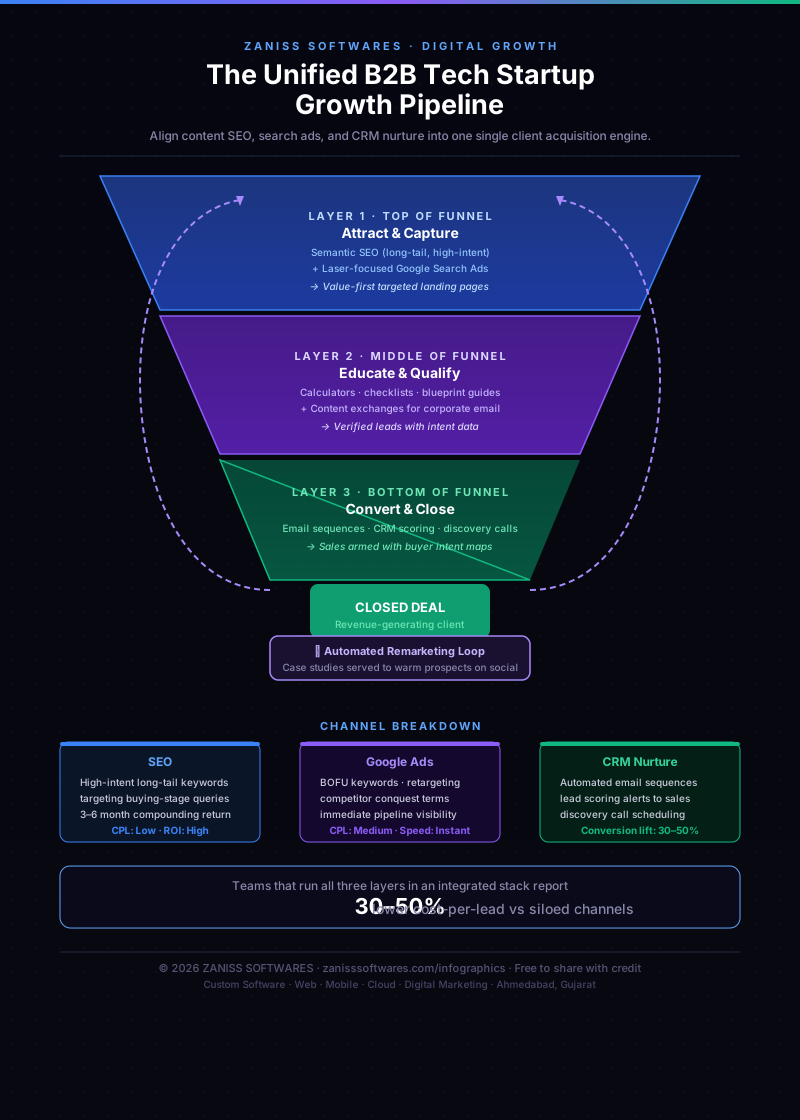
The unified growth pipeline we've seen work for Indian B2B SaaS companies in 2026 treats all three functions as inputs to a single system, with shared metrics (pipeline velocity, qualified opportunity rate, CAC by channel) rather than separated KPIs (marketing: leads; sales: deals; product: DAU).
Stage 1 — Awareness: getting found by the right people
For B2B software companies, the most durable awareness channel in 2026 is organic search — specifically, long-tail, high-intent search queries from buyers in the research phase. A CFO searching "custom ERP software Ahmedabad SME" is much closer to a buying conversation than one searching "ERP software" — the specificity signals real intent and a real budget.
The content strategy that supports this: one in-depth, genuinely useful article per target keyword cluster, with internal linking to related content and service pages. Not 200 thin articles, 20 deep ones. See our long-tail keywords guide for the keyword research process.
Planning a Website? Don't Overpay or Underbuild
Most businesses overspend on features they don't need — or underspend and rebuild within a year. We help you scope it right from day one.
Stage 2 — Consideration: converting the curious into the convinced
Visitors in the consideration stage are evaluating you against 2–3 alternatives. The content that converts at this stage isn't more awareness content — it's comparison content (us vs. competitors, custom vs. SaaS), ROI calculators, case studies with specific numbers, and proof of domain expertise in the buyer's specific industry.
For a software development company, this might be: a case study with a healthcare client showing exactly what was built and what the outcome was, a comparison of custom CRM versus Salesforce for companies under 50 seats, or a transparent pricing guide that gives ranges rather than "contact us." Browse our portfolio for the format we use.
Stage 3 — Decision: the consultation to the contract
Most B2B software contracts begin with a conversation, not a form submission. The decision stage is about making that conversation easy to initiate, giving prospects confidence before they book, and delivering a discovery call that proves competence within the first 15 minutes.
The two things that matter most here: a frictionless booking process (a direct calendar link, not a "we'll get back to you" form), and a structured discovery call that leads with understanding the prospect's problem before pitching a solution.
Stage 4 — Retention and expansion: the stage most companies under-invest in
For B2B SaaS and software services, the cheapest revenue to acquire is expansion revenue from existing clients. A customer who has shipped one successful product with you is dramatically easier to sell the next phase to than a new prospect. The pipeline for expansion revenue is: regular check-ins, proactive roadmap suggestions, and a structured QBR (quarterly business review) process that brings new ideas before the client goes looking for them.
Connecting the pipeline: shared metrics that matter
The metric that connects all four stages is pipeline velocity — how fast does a qualified prospect move from first contact to signed contract, and where does it slow down? Tracking stage duration for every deal immediately reveals where the pipeline leaks: if prospects consistently stall between consultation and proposal, the problem is in the proposal process; if they stall between proposal and contract, the problem is in commercial terms or decision-maker access. We build the underlying tooling as part of digital marketing.
Want a growth strategy built on this pipeline framework for your software product? contact us for a free consultation.
Pro Insight
Planning a cloud-native platform? Let's review your architecture for free.
At ZANISS SOFTWARES, we don't just build websites — we build growth systems.
- ✓SEO-first architecture
- ✓Conversion-focused design
- ✓High-speed performance
- ✓Scalable, future-proof code
📩 Response within 24 hours
Frequently Asked Questions
How long does it take this pipeline to start producing pipeline?
Paid search and consideration-stage content produce inbound within 30–60 days. Organic search compounds over 6–9 months. Expansion revenue starts in quarter two of the first client relationship.
Do we need separate teams for each stage?
Not at early scale. One growth-minded operator can run the full pipeline up to ~₹5 Cr ARR. After that, specialise — but keep shared metrics so the teams don't drift back into silos.
What's the single biggest mistake B2B SaaS teams make?
Spending on top-of-funnel awareness before fixing decision-stage friction. Fix the booking process and discovery call first; you'll convert more of the traffic you already have before scaling acquisition.