In this article
Quick Summary
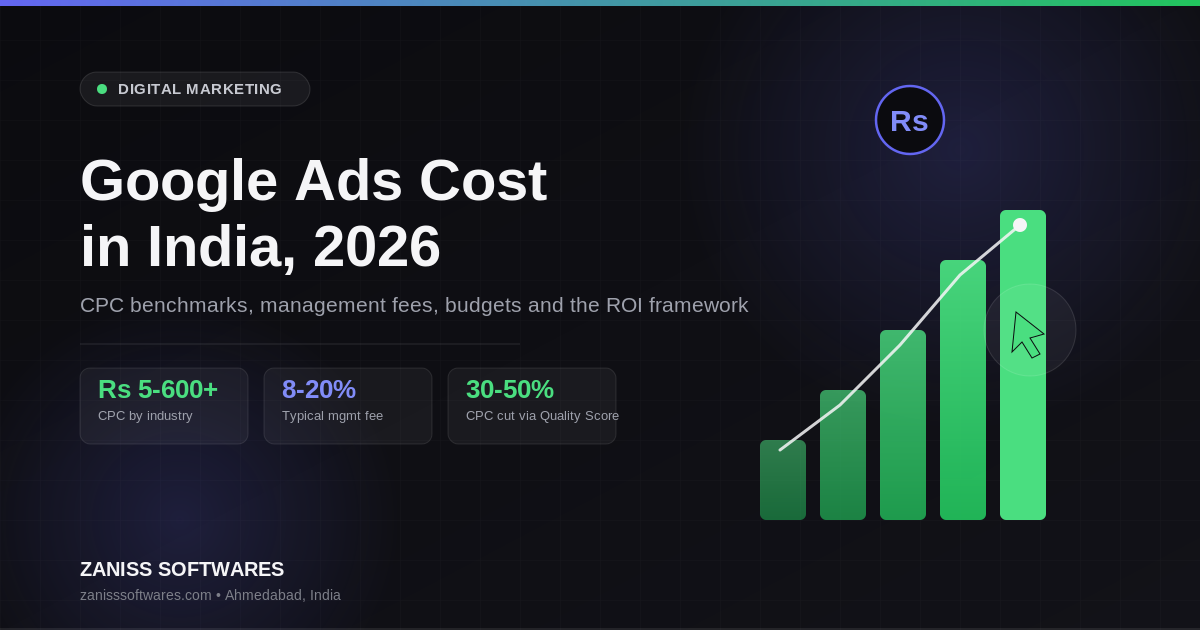
- 1Google Ads in India costs two separate things: media spend (₹5 to ₹600+ per click depending on industry) and a management fee (₹20,000–₹3,00,000/month, or 8–20% of ad spend).
- 2Most businesses need at least ₹25,000–₹40,000/month in combined spend before there's enough conversion data to optimise anything meaningfully.
- 3Quality Score is the single biggest cost lever most founders ignore — moving a keyword from Quality Score 5 to 8+ can cut CPC by 30–50% without raising a single bid.
- 4This guide breaks down real 2026 CPC benchmarks by industry, what a management fee should actually include, the minimum viable budget by business type, and the decision framework we use before we ever propose a number to a client.
Estimated read time: 9 minutes (~2,100 words)
Why "how much does Google Ads cost" is the wrong first question
Ask five agencies "how much does Google Ads cost in India" and you'll get five different numbers, because the question conflates two completely separate expenses. The first is media spend — the money Google actually keeps when someone clicks your ad. The second is the management fee — what you pay a person or agency to build, run, and optimise the campaign. Founders who budget for only one of these are the ones who call us six months later asking why their "₹30,000 Google Ads budget" produced almost no leads. It produced no leads because ₹30,000 was the media spend, the account had no dedicated landing pages, and nobody was watching Quality Score. The honest starting point isn't a single number — it's separating the two costs, then sizing each one to your industry and your goal.
The two costs nobody separates: media spend vs. management fee
Media spend goes directly to Google, auction by auction, click by click. You set a daily or monthly cap; Google spends up to that cap on the keywords and audiences you've targeted, at whatever cost-per-click the auction produces that day. Nobody — not us, not Google, not any tool — can quote you a fixed CPC in advance; it moves with competition, seasonality, and your own Quality Score.
Management fee is what you pay for the human work: keyword research, ad copy, landing page alignment, negative keyword lists, bid strategy, conversion tracking, and the monthly reporting that tells you which campaigns are actually producing revenue versus just clicks. In India in 2026, that fee runs ₹20,000 to ₹3,00,000 a month, or 8–20% of ad spend, depending on account complexity and whether you're managing search only or search plus shopping plus display plus remarketing.
Treat these as two line items in your budget, not one. A ₹50,000/month "Google Ads budget" that's actually ₹35,000 media plus ₹15,000 management behaves very differently from ₹45,000 media plus a ₹5,000 flat fee from someone who barely touches the account after setup.
CPC benchmarks by industry in India, 2026
| Industry / vertical | Typical CPC range | Notes |
|---|---|---|
| Local services, travel, low-competition | ₹5 – ₹15 | Lowest competition, hyperlocal intent |
| E-commerce (Search) | ₹15 – ₹40 | Google Shopping CPC often ₹5–15 |
| Retail / D2C brands | ₹15 – ₹40 | Similar demand curve to e-commerce |
| B2B SaaS / software | ₹40 – ₹150 | High customer value drives up bids |
| Real estate | ₹40 – ₹120 | Most competitive consumer vertical |
| Finance, insurance, legal | ₹100 – ₹600+ | Highest-intent, highest-value clicks |
| Overall India average (blended) | ₹25 – ₹60 | Blended figure — industry drives the real number |
The blended average CPC across Indian industries sits around ₹25–₹60, but that number is close to useless for planning — it hides a 100x spread between a local service business and a B2B SaaS company bidding on finance-adjacent keywords. Use the industry row closest to your business, not the blended average, when you build a budget.
Geography moves the number too. Delhi NCR and Mumbai routinely run 30–50% higher CPCs than Tier 2 cities for identical keywords, because that's where advertiser competition and buyer income concentrate. If your business serves all of India, you can often lower blended CPC materially by adjusting bid modifiers down in Tier 1 metros and up in Tier 2/3 cities where your competitors haven't bothered to compete.
What a management fee actually buys you
| Fee model | Typical range | Best for |
|---|---|---|
| Percentage of ad spend | 8–20% of monthly spend | Budgets that will scale over time |
| Flat monthly retainer | ₹20,000 – ₹3,00,000/month | Predictable budgets, small-to-mid spend |
| Hybrid (base fee + %) | ₹15,000–₹30,000 base + 5–10% | Larger accounts wanting cost control at scale |
| Small budget management (<₹1L ad spend) | ₹30,000 – ₹50,000/month | Startups and SMEs testing the channel |
A fee below ₹20,000/month on a real search account usually means templated ad copy, no dedicated landing pages, and monthly reporting that shows clicks and impressions instead of leads and revenue. That's not necessarily fraud — it's just a scope that doesn't include the work that actually moves cost per lead. Before you sign anything, ask what's included: is there a dedicated landing page per campaign theme, is conversion tracking wired to your CRM, and does the monthly report show cost per qualified lead, not just cost per click.
Planning a Website? Don't Overpay or Underbuild
Most businesses overspend on features they don't need — or underspend and rebuild within a year. We help you scope it right from day one.
The minimum viable budget — and why less than this wastes money
| Business type | Media spend / month | Combined incl. management |
|---|---|---|
| Local shop / single-location service | ₹5,000 – ₹15,000 | ₹15,000 – ₹25,000 (often self-managed) |
| Growing SME / regional business | ₹15,000 – ₹50,000 | ₹35,000 – ₹70,000 |
| B2B SaaS / startup (national) | ₹50,000 – ₹2,00,000 | ₹80,000 – ₹2,40,000 |
| Enterprise / competitive vertical | ₹2,00,000+ | ₹2,50,000+ |
Google's own algorithms need roughly 30 conversions a month per campaign to exit the "learning phase" and start optimising delivery properly. Below that volume, Smart Bidding strategies are effectively guessing. That's the real argument for a ₹25,000–₹40,000/month floor on combined spend for most businesses outside hyperlocal, low-CPC categories — not because Google requires it, but because anything less rarely generates enough data to tell you what's working.
If your total marketing budget genuinely can't support that floor yet, the honest advice — the advice we give even when it costs us the engagement — is to put that budget into SEO and conversion rate work first, and revisit paid search once the website itself converts well enough to make the spend worth accelerating.
Quality Score: the cost lever almost nobody manages properly
Quality Score is a 1–10 rating Google assigns to every keyword in your account, built from three inputs: expected click-through rate (about 40% of the score), ad relevance (about 30%), and landing page experience (about 30%). It isn't cosmetic — it feeds directly into Ad Rank, which determines both your position and what you pay for it. Two advertisers bidding on the exact same keyword can pay wildly different prices for the exact same ad position, because the auction rewards relevance over raw bid size.
The numbers are worth internalising: moving a keyword's Quality Score from the industry-average 5 up to 8 or higher typically cuts CPC by 30–50% at the same ad position. In a legal-services account we've reviewed, keywords at Quality Score 9–10 were paying roughly 45–50% less per click than the same keyword and position at Quality Score 4–5 — nearly double, for the identical auction.
The fastest lever is usually the landing page. A generic ad group sending traffic to a general services page almost always scores "below average" on landing page experience. Building one dedicated landing page per keyword theme — matching the ad copy's language to the page's headline and content — typically moves that page from "below average" to "average" or "above average" within three to four weeks, and the CPC reduction from that single change often pays for the landing page build within the first month of lower media spend. This is exactly the kind of work that sits between our web development and digital marketing teams, and it's why we build landing pages and run the ads together rather than handing you a spreadsheet of keywords to bid on alone.
Common budget mistakes we see before clients come to us
- Judging performance in the first 2–3 weeks, while the account is still in Smart Bidding's learning phase
- Sending all ad groups to one generic page instead of a dedicated page per keyword theme
- No negative keyword list, so budget leaks to irrelevant searches within days
- Tracking clicks and impressions instead of cost per qualified lead or cost per sale
- Running Google Ads in isolation from SEO and site CRO, so every lead costs full price forever instead of organic search sharing the load over time
The decision framework: Google Ads first, SEO first, or both together
Google Ads earns its budget fastest when you already have (or are simultaneously building) a landing page that converts, a way to track a lead all the way to a qualified sale, and a business that can absorb leads without a slow sales process eating the margin paid search bought you. If none of those are true yet, SEO and CRO work usually produces a better first-90-days return, because it fixes the thing that would otherwise waste every paid click.
That's the reasoning behind running SEO, Google Ads, and CRO as one coordinated engagement instead of three separate vendors. SEO builds the compounding, no-cost-per-click traffic base. Google Ads fills the gap while SEO matures and targets high-intent terms organic search hasn't reached yet. CRO makes every visitor from either channel worth more. Clients who run all three together typically see a 25–60% reduction in cost per lead within 6–12 months — because the three channels are reducing each other's cost instead of competing for the same budget line.
How we scope and report on Google Ads engagements
Every Google Ads engagement we run starts with a free scoping conversation, not a media-spend number pulled from a rate card. We look at your current site's conversion readiness, your sales process, and your competitive CPC range before recommending a combined budget — media plus management — as a fixed, written proposal. Work runs in the same two-week sprint cadence as our development projects: landing pages get built or refined every sprint, not once at kickoff and never again. Monthly reporting shows cost per lead and, wherever tracking allows, cost per sale — not just clicks, because clicks don't pay your team's salaries.
If you're deciding between fixing a website that doesn't convert or turning on paid traffic that will just leak through that same weak page, read our piece on lowering cost per lead with SEO and Google Ads working together — it's the more detailed version of the framework above. For the organic side of the equation, our SEO tips for small businesses covers the tactics that pair best with paid search, and if you're also thinking about visibility inside AI-powered search results, our honest GEO playbook walks through what actually moves the needle in 2026. And if the real underlying problem is inconsistent lead generation rather than one channel, our Digital Marketing service page walks through how we run SEO, Ads, and CRO as one accountable engagement.
Working With Us
If inconsistent lead generation is the bottleneck holding your growth back, this is exactly the kind of problem our digital marketing team solves every week — running SEO, Google Ads, and conversion rate optimisation as one coordinated engagement, reported on leads and revenue rather than vanity metrics. Visit our Digital Marketing service page to see how we structure engagements, or book a free 30-minute consultation and we'll give you an honest read on whether Google Ads, SEO, or both make sense for your budget right now — no obligation, no sales pitch.
Pro Insight
Planning a cloud-native platform? Let's review your architecture for free.
At ZANISS SOFTWARES, we don't just build websites — we build growth systems.
- ✓SEO-first architecture
- ✓Conversion-focused design
- ✓High-speed performance
- ✓Scalable, future-proof code
📩 Response within 24 hours
Frequently Asked Questions
What is the minimum Google Ads budget for a small business in India in 2026?
There's no official minimum, but the practical floor for meaningful results is ₹25,000–₹40,000 a month in combined media spend and management. Below that, most campaigns never gather the roughly 30 monthly conversions Google's Smart Bidding needs to optimise properly. Hyperlocal businesses with a handful of highly specific keywords can sometimes run on ₹5,000–₹15,000/month, but expect a longer runway before results stabilise.
How much does Google Ads management cost in India?
Agencies typically charge either a flat monthly retainer of ₹20,000–₹3,00,000, or 8–20% of ad spend, depending on account complexity. Small-budget accounts (under ₹1,00,000 in monthly ad spend) commonly pay ₹30,000–₹50,000/month for proper management, separate from the media spend itself, which goes directly to Google.
Why is my Google Ads CPC so much higher than the numbers I've read online?
Published averages are blended across every industry and city in India. Your real CPC depends on your specific industry (₹5 for low-competition local services versus ₹600+ for finance, insurance, or legal), your city (Tier 1 metros run 30–50% higher than Tier 2), and your Quality Score, which alone can swing cost per click by 30–50% for the identical keyword and position.
Does a higher Google Ads budget guarantee more leads?
No. Budget determines how many auctions you can enter, not how efficiently you win them. A well-optimised ₹50,000/month account with strong Quality Scores and dedicated landing pages regularly outperforms a poorly optimised ₹1,50,000/month account on cost per lead. Fix Quality Score and landing page relevance before increasing spend.
Should I invest in SEO or Google Ads first?
If your website already converts well and you need leads immediately, Google Ads is the faster lever. If your site doesn't convert yet, or your budget can't sustain the ₹25,000+/month floor for meaningful paid data, SEO and conversion rate work typically deliver a better first-year return, because they fix the thing that would otherwise waste every paid click.
How long before Google Ads starts producing consistent leads?
Expect 2–4 weeks for the account to exit Google's learning phase, assuming you're hitting roughly 30 conversions a month. Meaningful optimisation and stable cost per lead typically show up by month two to three, and the biggest efficiency gains — from Quality Score and landing page improvements — usually compound between months three and six.