In this article
Quick Summary
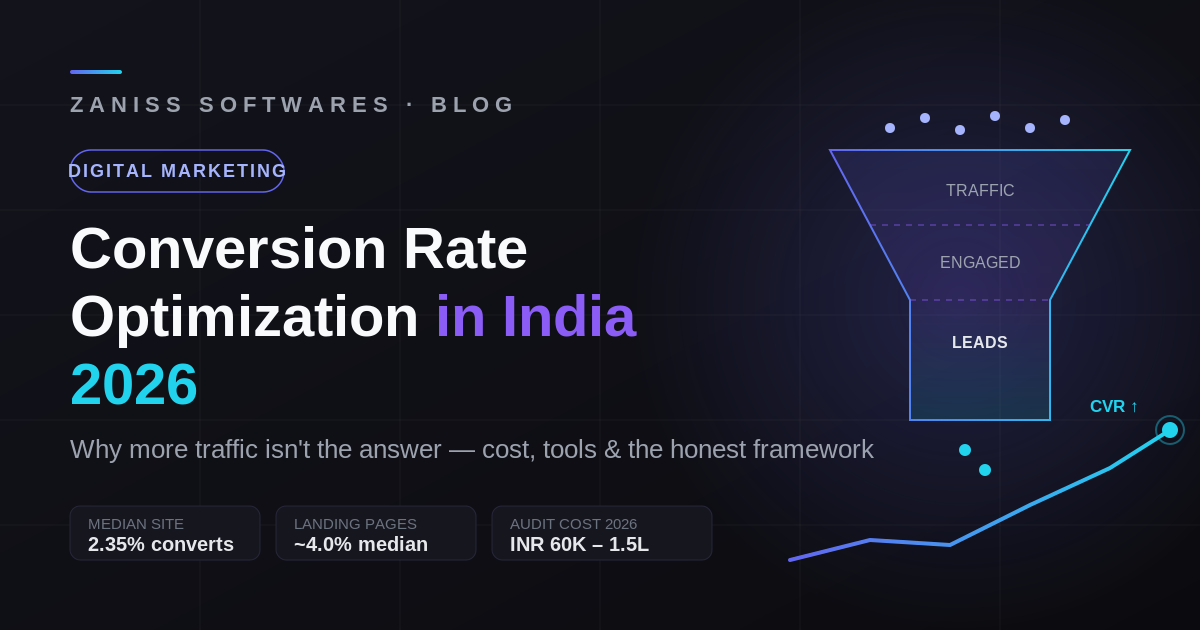
- 1The average website converts at 2.35% of visitors into leads or sales — but the top 10% convert at 11.45% or higher, nearly 5x the average. That gap comes from a disciplined testing process, not a bigger budget or a redesign.
- 2A structured CRO program in India typically runs ₹40,000–₹1.8L/month for SMEs (roughly $480–$2,160), scaling to ₹5L+/month for high-traffic sites — 40–60% below equivalent US/UK agency pricing for the same senior-level process.
- 3Businesses that run structured A/B testing grow revenue 1.5–2x faster than those that don't, and CRO programs return 223% ROI on average.
- 4This guide is the audit-hypothesize-test-ship framework we run with clients in 2026, real tool pricing, and a clear decision framework for CRO vs. a full redesign.
Why Traffic Keeps Going Up and Revenue Doesn't
We run SEO and Google Ads for clients across India, the US, the UK and the UAE, and the same pattern shows up on almost every account review: organic traffic is up 40%, ad spend is flat, and revenue moved maybe 8%. The channel isn't underperforming — the website is. A visitor who lands on a slow page, can't tell what you do in five seconds, or hits a form with eleven required fields doesn't convert no matter how well-targeted the click was. That's conversion rate optimization's job: fixing the last mile between traffic and revenue, not generating more traffic.
The average website converts at 2.35% of visitors into leads or sales. The top 25% convert at 5.31% or higher, and the top 10% clear 11.45% — nearly five times the average. That gap isn't luck or a bigger budget. It's a small number of businesses running a disciplined testing process while everyone else redesigns once every three years and hopes.
What CRO Actually Is (and Isn't)
CRO is the practice of increasing the percentage of visitors who complete a target action — purchase, form fill, demo booking, app download — through structured, evidence-based changes to a page or flow. It is not a redesign. It is not "make the button bigger and see what happens." A real CRO program has three things a redesign usually doesn't: a hypothesis for every change, a way to measure whether that change actually worked, and a queue of the next five things to test regardless of whether the last one won.
It's also not free. Testing takes traffic — enough visitors to reach statistical confidence in a reasonable time — and it takes someone accountable for running the process every two weeks, not once a quarter when someone remembers.
The Bottleneck Behind the Bottleneck
We see four things wreck conversion rate on almost every Indian business site we audit, in order of frequency:
- Load time. Every additional second above 2 seconds on mobile costs measurable conversion — and most Indian SME sites we audit load in 4–7 seconds on a mid-range Android device on 4G, not the fibre connection the site was tested on.
- Form friction. Long forms up front, no progress indicator, and asking for information (like a full address) that isn't needed until step three.
- Unclear above-the-fold value proposition. Visitors decide whether to keep reading in under five seconds. A stock photo and a vague tagline loses a chunk of them before they scroll.
- No path for the "not ready yet" visitor. Most B2B visitors aren't ready to fill a contact form on visit one — if the only conversion path is "talk to sales," you're throwing away everyone who needed to see one more thing first.
The Framework We Run: Audit → Hypothesize → Test → Ship
We run CRO in the same two-week sprint cadence we use for every engagement, because testing without a cadence turns into testing never.
Step 1 — Audit (Week 1). Quantitative: GA4 funnel analysis, Microsoft Clarity or Hotjar session recordings, scroll-depth and rage-click data. Qualitative: five-second tests on the homepage, and — if traffic allows — user interviews. We're looking for where people drop off, not just that they drop off.
Step 2 — Hypothesize and Prioritize. Every proposed test gets written as: "We believe [change] will cause [effect] because [evidence]. We'll know this is true when [metric] moves by [amount]." Then we score the backlog so we're not testing the loudest opinion in the room first.
Step 3 — Test. Run the test with a big enough sample to trust the result. On lower-traffic B2B sites (under 5,000 monthly visitors to the page in question), a true A/B test can take 6–10 weeks to reach significance — for those sites we often run sequential before/after tests with a longer observation window instead of splitting already-thin traffic in half.
Step 4 — Ship and Document. Winning changes go live. Losing tests get documented too — a test that disproves your best idea isn't wasted, it's the fastest way to stop wasting budget on it. Everything feeds the next sprint's backlog.
Prioritizing What to Test First: The ICE Framework
We score every idea on Impact, Confidence and Ease (1–10 each), then test the highest average score first — not the idea from the loudest stakeholder meeting.
| Test idea | Impact | Confidence | Ease | ICE score |
|---|---|---|---|---|
| Simplify checkout form (12 fields → 5) | 9 | 8 | 6 | 7.7 |
| Rewrite hero headline to lead with outcome | 7 | 6 | 9 | 7.3 |
| Add exit-intent offer popup | 5 | 5 | 8 | 6.0 |
| Full homepage redesign | 8 | 4 | 2 | 4.7 |
The redesign scores lowest — not because it wouldn't help, but because it's expensive, slow, and you won't know which part of it worked.
Planning a Website? Don't Overpay or Underbuild
Most businesses overspend on features they don't need — or underspend and rebuild within a year. We help you scope it right from day one.
What CRO Actually Costs in India (2026)
Real numbers, not "it depends." Costs below are for an ongoing monthly program — audit, 2–4 tests running at any time, reporting — not a one-off redesign.
| Engagement tier | Typical scope | Monthly cost (INR) | Monthly cost (USD) |
|---|---|---|---|
| Starter | 1 landing page, 2 tests/month, monthly report | ₹40,000 – ₹80,000 | $480 – $960 |
| Growth | Full site, 3–4 concurrent tests, session recordings, biweekly reporting | ₹90,000 – ₹1.8L | $1,080 – $2,160 |
| Scale | Multi-funnel (site + app + ad landing pages), dedicated CRO lead, weekly reporting | ₹2L – ₹4.5L | $2,400 – $5,400 |
| Enterprise / high-traffic SaaS | Full experimentation platform, engineering-embedded testing, personalization | ₹5L+ | $6,000+ |
For comparison, agencies in the US and UK typically quote $1,500–$15,000/month for materially the same scope — India pricing runs 40–60% lower for the same senior-level process, the same value gap we see across our other service lines.
Tooling adds ₹0–₹1.5L/month depending on traffic tier — see below.
Tools We Actually Use (and What They Cost)
| Tool | Use | Approx. monthly cost |
|---|---|---|
| Microsoft Clarity | Session recordings, heatmaps | Free |
| Google Analytics 4 | Funnel and drop-off analysis | Free |
| Hotjar | Heatmaps, surveys, feedback widgets | Free tier; ₹0 – ₹6,500 (paid) |
| VWO / AB Tasty | A/B and multivariate testing | ₹15,000 – ₹80,000+ (by traffic) |
| GrowthBook / PostHog | Open-source / self-hosted experimentation | Free – ₹25,000 (hosted) |
| Unbounce / Instapage | Landing page building for fast test variants | ₹6,000 – ₹20,000 |
We default to free tools (Clarity, GA4) for the audit phase on every engagement, and only add a paid testing platform once there's enough traffic to make split-testing worthwhile — no reason to pay for VWO on a page that gets 800 visits a month.
CRO vs. Redesign: How to Decide
Choose CRO when: your current design converts, just not well enough; you have steady traffic to test against; you need results in weeks, not months. Choose a redesign when: the information architecture doesn't match how customers actually buy; the brand or product has fundamentally changed; or the codebase itself is the constraint (unmaintainable, insecure, can't ship changes without a six-week release cycle).
See our website development cost guide for what a redesign actually costs before committing to one.
In practice, we run CRO first even when a redesign is likely — a 4–6 week testing sprint tells you which parts of the current site are actually broken, so the redesign brief is evidence-based instead of a guess dressed up as a brand refresh.
Common Mistakes We See
- Testing too many things at once, so a lift can't be attributed to any single change.
- Stopping a test the moment it looks like it's winning, before reaching statistical significance — the single biggest cause of "wins" that don't hold up next quarter.
- Optimizing for the metric that's easiest to measure (clicks) instead of the one that matters (paid signups, qualified leads).
- Treating CRO as a one-time project instead of an ongoing sprint cadence — a site that tested once in 2024 isn't meaningfully different from one that never tested.
Where CRO Fits With SEO and Ads
CRO is the third leg of the stool we run for digital marketing clients, alongside SEO and Google Ads — see our guide on lowering cost per lead by running SEO and Ads together. Traffic without conversion is wasted spend; conversion without traffic has nothing to work on. The businesses getting the best ROI in 2026 run all three in the same reporting cycle, not three separate vendors emailing three separate reports.
Working With Us
If your traffic looks healthy but revenue isn't following, that's usually a conversion problem, not a marketing problem. Our Digital Marketing team runs CRO the same way we run every engagement — two-week sprints, a documented test backlog, and reporting on leads and revenue, not vanity metrics. Book a free 30-minute consultation and we'll audit your funnel and tell you honestly whether CRO, a redesign, or neither is the right next step.
Pro Insight
Planning a cloud-native platform? Let's review your architecture for free.
At ZANISS SOFTWARES, we don't just build websites — we build growth systems.
- ✓SEO-first architecture
- ✓Conversion-focused design
- ✓High-speed performance
- ✓Scalable, future-proof code
📩 Response within 24 hours
Frequently Asked Questions
What is a good conversion rate for a website in India?
It depends heavily on industry and traffic source, but as a benchmark: the global average sits at 2.35%, professional services and B2B lead-gen sites that are performing well land between 3–5%, and e-commerce sites in the 2–5% range are healthy. Below 2% on a site with decent traffic quality is usually a sign of friction worth auditing.
How much does CRO cost in India in 2026?
A structured monthly program typically runs ₹40,000–₹1.8L/month for small to mid-sized businesses (roughly $480–$2,160), scaling to ₹2L–₹5L+ for high-traffic or multi-funnel sites — about 40–60% below equivalent US/UK agency pricing for the same senior-level process.
How long before CRO shows measurable results?
A single test typically needs 2–6 weeks to reach statistical confidence depending on traffic volume. Most clients see their first meaningful, validated lift within one full sprint cycle (4–6 weeks), with compounding gains as the backlog works through higher-impact items.
Should I run CRO or just redesign my website?
Run CRO first if your traffic is steady and the core layout roughly works — it's faster, cheaper, and tells you exactly what's broken before you commit budget to a rebuild. Redesign first only if the information architecture doesn't match how customers buy, the brand has changed fundamentally, or the codebase itself blocks fast iteration.
What's the difference between CRO and SEO?
SEO gets more of the right visitors to your site. CRO gets more of those visitors to convert once they arrive. They compound each other — improving conversion rate makes every SEO and ad dollar worth more, without spending anything extra on traffic.
Is CRO worth it for a small business with limited traffic?
Below a few thousand monthly visitors to the page you want to test, formal split-testing takes too long to reach significance to be practical. In that range we recommend a structured audit and sequential (before/after) testing instead of true A/B tests — you still fix the friction, just measured differently. The 223% average ROI case holds regardless of traffic size; only the testing method changes.