Quick Summary
- 1India has 535 million WhatsApp users and 15 million+ businesses already on WhatsApp Business — but the free app stops at one shared inbox with no automation.
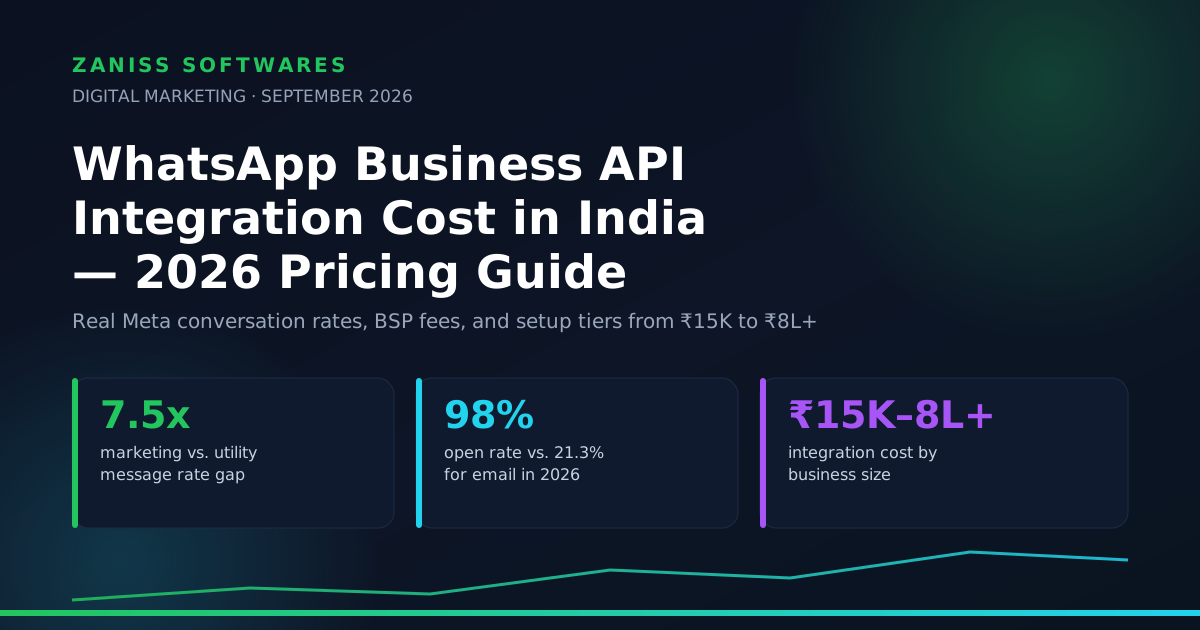
- 2Meta's official 2026 conversation rates: ₹0.8631 for marketing messages, ₹0.115 for utility, authentication and (from October 1, 2026) service messages — a 7.5x gap between marketing and everything else.
- 3A real integration costs ₹15,000–₹40,000 to start, ₹60,000–₹1,50,000 for a CRM-connected setup, and ₹2,00,000–₹8,00,000+ for enterprise commerce and ERP integration — on top of a monthly BSP platform fee and per-conversation charges.
- 4WhatsApp's 98% open rate and 7–12% conversion rate (vs. 21.3% and 2–4% for email) is why the higher per-message cost still produces a lower cost per acquisition for most Indian businesses.
India now has more WhatsApp users than any other country on earth — 535 million and climbing — and more than 15 million Indian businesses have already set up a WhatsApp Business presence. For most of them, that's where it stops: the free WhatsApp Business app gives you one shared inbox, one device, and zero automation. The WhatsApp Business API is what turns that inbox into a channel that can confirm an order at 2 a.m., answer a product question through your CRM, and re-market to yesterday's cart abandoners — at a 98% open rate that email and SMS simply can't touch.
The problem is that "API pricing" gets quoted in half a dozen incompatible ways: per-conversation, per-message, per-seat, monthly platform fee, one-time integration cost, sometimes all in the same sales call. This guide breaks down exactly what Indian businesses pay in 2026 — Meta's official conversation rates, what Business Solution Providers (BSPs) add on top, and what a real end-to-end integration costs by business size — so you can budget accurately before you sign anything.
What the WhatsApp Business API Actually Is (And Isn't)
The free WhatsApp Business app — the green-icon app most kirana stores and boutique founders already use — is built for one person on one phone. It has no API access, no automation, and no way to plug into a CRM, helpdesk, or e-commerce backend. The WhatsApp Business API (technically the "Cloud API," now Meta's default hosting model) is a separate product entirely: it requires a verified Meta Business account, is accessed through an approved Business Solution Provider such as AiSensy, Interakt, Gupshup, Twilio, or Meta directly, and supports multiple agents, chatbots, message templates, and integration with the systems you already run your business on. It's also the only path to the official green verification badge that signals a business is who it claims to be.
Businesses evaluating the API for the first time are usually really evaluating three separate things at once — Meta's usage-based conversation pricing, a BSP's monthly platform fee, and a one-time integration cost for whatever they want the API to actually do. Conflating the three is the single most common reason budgets go wrong.
It's also worth knowing that Meta itself doesn't sell direct access to most small and mid-size businesses — you go through an approved BSP by default, which is why "WhatsApp API pricing" is really two vendors' pricing stacked on top of each other rather than one number from Meta.
Choosing a BSP: What Actually Differs Between Providers
Not all BSPs compete on the same axis, and picking on price alone usually means missing the difference that matters for your use case. Some — AiSensy and Interakt, for instance — lean into no-code flow builders and are a strong fit if you want a marketing/support bot without writing integration code. Others, like Gupshup and Twilio, expose a more developer-first API surface and are the better fit once you're building a custom CRM or ERP connection rather than using a pre-built dashboard. A few differentiators worth asking about directly: how many free template submissions are included before resubmission fees kick in, whether multi-agent seats are capped or unlimited on your plan, how quickly their support responds when Meta flags your account for review, and whether your chatbot flows and contact data export cleanly if you switch providers later. None of these show up on a pricing page, and all of them affect your real cost of ownership more than the headline monthly fee does.
Meta's Official 2026 Per-Conversation Pricing
Since Meta moved to conversation-based pricing, every message you send or receive falls into one of four categories, each billed per 24-hour conversation window rather than per individual message:
| Conversation Category | Rate (INR) | Typical Use |
|---|---|---|
| Marketing | ₹0.8631 | Promotional campaigns, offers, broadcasts, click-to-WhatsApp ad follow-ups |
| Utility | ₹0.115 | Order confirmations, shipping updates, payment and appointment reminders |
| Authentication | ₹0.115 | OTPs and identity verification codes |
| Service | ₹0 (free until Sep 30, 2026); ₹0.115 from Oct 1, 2026 | Any reply you send within the 24-hour customer-service window a customer opens |
The gap that trips up most first-time budgets: marketing conversations cost roughly 7.5 times more than utility, authentication, or (soon) service conversations. A business that runs its entire customer communication — order updates, OTPs, and support — through the "marketing" template category by mistake will pay several times what it should. Getting your message templates categorized correctly is one of the highest-leverage five-minute conversations you can have with your integration partner.
What You Actually Pay Every Month — BSP Fees + Message Volume
Meta's rates are only one line item. You also pay your BSP a monthly platform/subscription fee for the dashboard, template management, and support — typically ₹999 to ₹9,999 a month depending on features and seats, with common published plans around ₹1,999 (small business), ₹3,999 (growing business), and ₹7,999 (larger teams). Some BSPs skip the flat fee and instead mark up Meta's per-conversation rate by ₹0.10–₹0.30 per message — worth asking about directly, since it changes your total cost curve as volume grows.
Combining platform fees, conversation charges, and 18% GST, realistic all-in monthly costs in 2026 look like this: a business sending around 5,000 conversations a month lands near ₹5,685; 25,000 conversations a month comes to roughly ₹21,353; and 100,000 conversations a month runs about ₹75,975. Notice these figures don't scale linearly — the platform fee is a smaller share of the total as volume grows, which is exactly why larger senders push BSPs hard on per-message markups rather than the subscription tier.
One-Time Integration Cost by Business Size
The conversation and platform fees above are ongoing. What most businesses actually want to budget for first is the one-time cost of building something useful on top of the API — and that's driven far more by integration depth than by message volume.
| Tier | Best For | One-Time Setup | Monthly Cost (Platform + Messages, incl. GST) | What's Included |
|---|---|---|---|---|
| Starter | Solo founders, small D2C or retail sellers | ₹15,000 – ₹40,000 | ≈ ₹5,700 (~5,000 conversations/mo) | Meta verification, BSP onboarding, 3–5 automated flows, product catalog |
| Growing | SMEs and service businesses scaling support/sales | ₹60,000 – ₹1,50,000 | ≈ ₹21,000 (~25,000 conversations/mo) | CRM/helpdesk integration, abandoned-cart flows, multi-agent shared inbox, drip campaigns |
| Enterprise | Larger D2C brands, BFSI, multi-location chains | ₹2,00,000 – ₹8,00,000+ | ≈ ₹76,000+ (~1,00,000 conversations/mo) | Custom CRM/ERP integration, AI/NLP chatbot, in-chat checkout, multi-department routing |
Businesses moving toward full commerce inside WhatsApp — product discovery, cart, and checkout without leaving the chat — sit above even the Enterprise tier here and start to overlap with what we cover in our Agentic Commerce Readiness guide, where platform builds run ₹15,000 for an initial audit up to ₹18,00,000+ for a full agent-ready commerce stack.
A Worked Example: 90-Day Budget for a Mid-Size D2C Brand
To make this concrete: a mid-size D2C brand doing roughly 8,000 orders a month, wanting order confirmations, shipping updates, cart-recovery messages, and a support inbox connected to its helpdesk, typically lands in the Growing tier. Budget for the first 90 days looks like: ₹90,000 one-time integration (CRM connection, cart-recovery automation, catalog setup), ₹3,999/month BSP platform fee (₹11,997 across the quarter), and roughly ₹18,000–₹22,000/month in conversation charges once utility and service messages are properly categorized (₹54,000–₹66,000 across the quarter). All-in, that's approximately ₹1,55,000–₹1,68,000 for the first quarter, dropping to the ongoing ₹20,000–₹26,000/month run rate from month four onward — a number worth pinning down with a vendor before signing, since it's the figure most quotes quietly leave until "usage-based billing, details TBD."
Where the ROI Actually Comes From
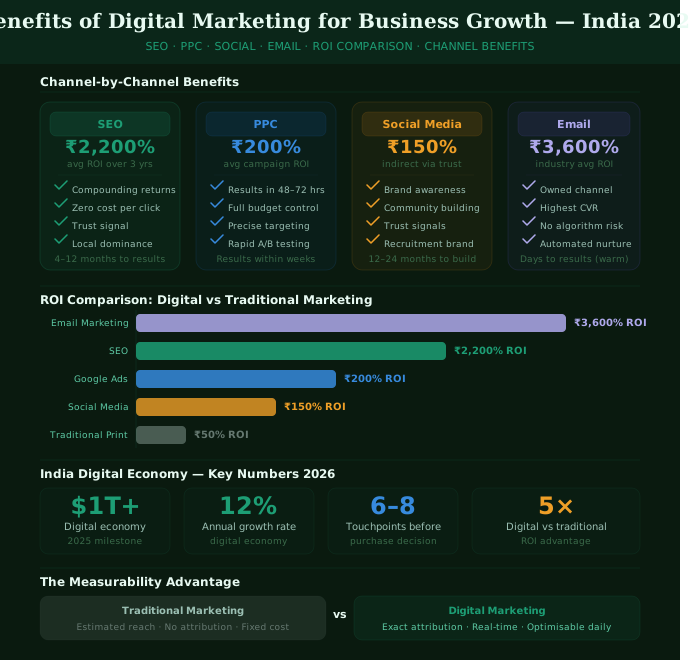
The per-message cost only makes sense next to what it replaces. WhatsApp Business messages see a 98% open rate with a 45–60% click-through rate, against email's 21.3% open rate and 2.6% click-through rate — and 78% of recipients open a WhatsApp message within five minutes, compared with 9% for email. Conversion rates follow the same pattern: WhatsApp converts at roughly 7–12%, against 2–4% for email, a gap researchers describe as roughly 3x higher conversion than email despite the higher line-item cost per message. Broadcast response rates average around 35%, and businesses that reply within five minutes convert as much as 21x better than those that don't — which is the real argument for automation rather than a human checking a shared inbox once an hour. Separately, 78% of Indian WhatsApp users report having purchased something through the platform, which is the underlying reason WhatsApp increasingly functions as a storefront rather than just a support channel.
Three Integration Patterns We See Most Often
Broadcast + FAQ bot — the entry point for most retail and D2C brands: automated replies to common questions, a broadcast list for offers and restocks, and a human handoff for anything the bot can't resolve. This sits comfortably in the Starter-to-Growing range and is usually delivered as part of a Digital Marketing engagement.
CRM-integrated support and sales — for B2B and service businesses where a WhatsApp conversation needs to show up against the same customer record your sales and support teams already use, with routing rules and SLAs attached. This is where a Custom Software Development partner earns their fee: the API itself is straightforward, the CRM/ERP integration work is not.
Full commerce inside WhatsApp — product catalog, cart, and checkout without a customer ever leaving the chat, increasingly connected to agent-based shopping protocols. This is the frontier we cover in depth in our agentic commerce guide, and it's the pattern most likely to need custom backend work rather than an off-the-shelf BSP dashboard.
In practice, most Indian businesses start at the first pattern and grow into the second within 6–12 months once the chatbot proves out — which is worth planning for at the outset, since a CRM-ready architecture from day one is cheaper than retrofitting one onto a standalone bot later.
A Decision Framework: How to Evaluate a WhatsApp API Quote
Five questions separate a quote that holds up from one that doesn't:
- Conversation category mix. Does the quote assume you'll run everything through cheaper utility/service categories, or does it quietly plan for marketing-rate broadcasts you didn't ask for?
- BSP markup transparency. Is the per-message markup above Meta's base rate disclosed as a number, or buried in "usage billed separately"?
- Template approval support. Meta rejects a meaningful share of first-submission templates — does your partner handle resubmission, or is that on you?
- Integration depth. Does this touch your actual CRM/ERP and customer data, or does it sit standalone with data you'll have to reconcile manually?
- Ownership and portability. Do you own the chatbot flows, templates, and conversation data if you switch BSPs later, or are they locked into one vendor's dashboard?
A quote that wins on the headline setup number but loses on three of these five almost always costs more in year two once template rework, data reconciliation, and vendor lock-in are added up.
Hidden Costs to Ask About Upfront
Several costs show up after the contract is signed rather than in it: template rejection and resubmission cycles that stall a campaign for days; ongoing catalog and product-feed maintenance for commerce use cases; number porting fees if you're migrating an existing business number; WhatsApp Commerce Policy compliance work for D2C sellers (product categories, pricing display rules); agent-seat limits that force a plan upgrade sooner than expected; and Meta's periodic rate changes, including the service-message change already scheduled for October 2026. Asking a vendor to walk through each of these before signing is a fair and normal request.
There's also a data-handling angle Indian businesses can't skip: any customer data flowing through a WhatsApp integration — phone numbers, order history, payment status — falls under the same obligations as the rest of your customer data stack under India's DPDP Act. If your BSP or integration partner can't tell you where conversation data is stored, how long it's retained, and how a deletion request gets fulfilled, that's a compliance gap worth closing before go-live, not after.
Related Articles
- Short-Form Video Marketing for B2B Companies in India
- SEO Services Cost in India in 2026
- CRO in India 2026: Framework, Cost & Strategy
- Agentic Commerce Readiness 2026: AI Shopping Agents
Companion infographic: WhatsApp Business API Cost in India 2026 →
Working With Us
Whether you need a simple broadcast-and-FAQ bot or a fully CRM-integrated WhatsApp commerce build, our Digital Marketing and Custom Software Development teams can scope it against your actual numbers, not a generic package. Book a free consultation and we'll tell you honestly which tier you actually need.
Planning a Website? Don't Overpay or Underbuild
Most businesses overspend on features they don't need — or underspend and rebuild within a year. We help you scope it right from day one.
Pro Insight
Working With Us
Whether you need a simple broadcast-and-FAQ bot or a fully CRM-integrated WhatsApp commerce build, our Digital Marketing and Custom Software Development teams can scope it against your actual numbers, not a generic package. Book a free consultation and we'll tell you honestly which tier you actually need.
- ✓SEO-first architecture
- ✓Conversion-focused design
- ✓High-speed performance
- ✓Scalable, future-proof code
📩 Response within 24 hours