Quick Summary
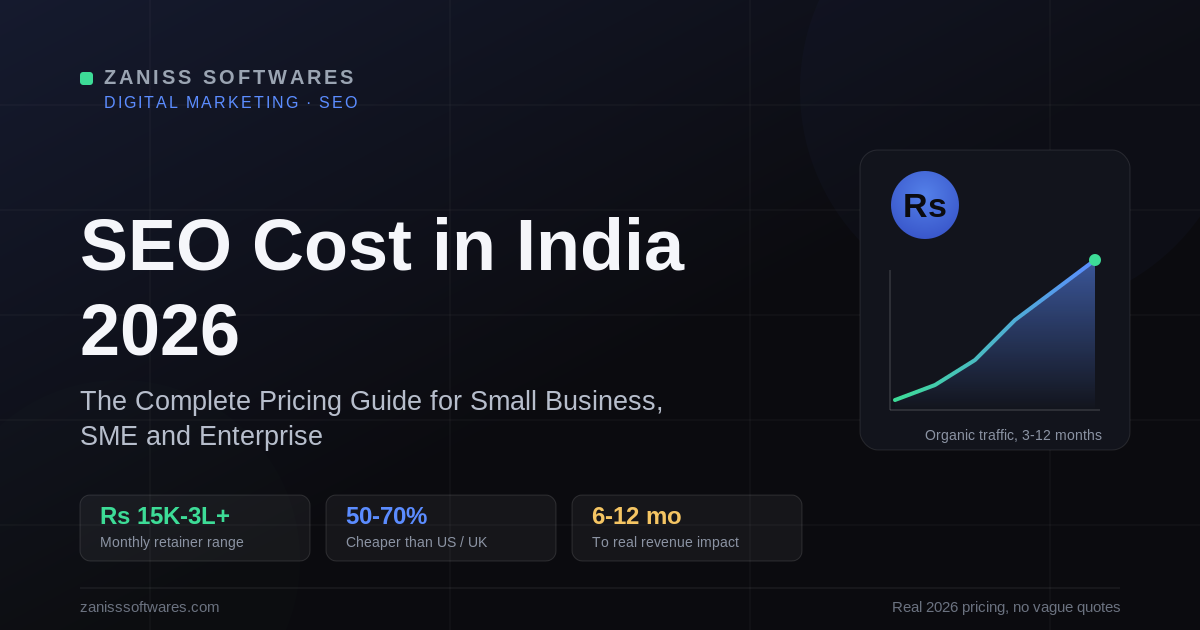
- 1SEO in India in 2026 typically costs ₹15,000–₹40,000/month for small businesses, ₹40,000–₹1,00,000/month for growing SMEs, and ₹1,00,000–₹3,00,000+/month for competitive B2B, ecommerce or enterprise programs — roughly a third to a half of what the same scope costs in the US or UK.
- 2The single biggest budget-killer isn't the sticker price, it's the “strategy included, execution billed separately” clause that quietly adds ₹40,000–₹60,000 a month in content and outreach costs nobody quoted upfront.
- 3Meaningful ranking movement takes 3–6 months and real revenue impact takes 6–12 months regardless of budget — anyone promising page-one rankings in 30 days is selling short-term tactics that get penalized later.
- 4This guide breaks down real 2026 pricing by business stage, what should (and shouldn't) be bundled into a retainer, and the decision framework we walk clients through before we quote a number.
Why SEO pricing in India is such a mess in 2026
We get asked "how much does SEO cost?" more than almost any other question, and the honest answer is that the range is enormous on purpose. In the same week last month we saw three quotes for what looked like the same brief: ₹12,000, ₹65,000 and ₹2,40,000 a month. All three were legitimate — they just weren't quoting the same scope of work. "SEO" bundles technical audits, content production, link building, local optimization and reporting in wildly different ratios depending on who's selling it, and until you separate those line items, comparing two quotes is close to meaningless.
This guide is the pricing breakdown we wish existed before we started doing this ourselves: real 2026 numbers by business stage, what's usually bundled into a retainer versus billed as an extra, and the framework we walk clients through before we put a number on paper.
What actually moves the price
Five variables explain almost all of the spread between a ₹15,000 retainer and a ₹2,00,000 one:
- Competition in your keyword space. Ranking a local clinic for "dentist in Satellite, Ahmedabad" costs a fraction of ranking a SaaS company for "CRM software" against competitors with seven-figure content budgets — see our long-tail keyword framework for how we map keywords to buying intent instead of volume.
- Content volume and quality required. Two generalist blog posts a month costs a different amount than eight posts from a subject-matter specialist backed by original data.
- Technical debt on the existing site. A clean, modern build needs light technical work. A site on an old CMS with duplicate content, broken redirects and no structured data needs weeks of remediation before content work even starts.
- Link building and digital PR intensity. Earning links through outreach and digital PR is the most labour-intensive — and most expensive — part of SEO, and the part most low-cost packages quietly skip.
- Reporting and strategy depth. A ₹15,000 package usually means an automated monthly report. A ₹1,50,000 package usually means a dedicated strategist, competitor tracking and a monthly call through the numbers.
2026 SEO pricing in India, by business stage
| Business Stage | Monthly Retainer (INR) | USD Equivalent | What It Typically Covers |
|---|---|---|---|
| Local / small business | ₹15,000 – ₹40,000 | $180 – $480 | On-page fixes, Google Business Profile, 2–4 posts/mo, local citations |
| Growing SME | ₹40,000 – ₹1,00,000 | $480 – $1,200 | Technical SEO, content calendar (4–8 posts/mo), on-page + off-page, reporting |
| E-commerce | ₹50,000 – ₹1,50,000+ | $600 – $1,800+ | Category/product page SEO, structured data, content at scale, CRO overlap |
| Competitive B2B / SaaS | ₹75,000 – ₹2,00,000+ | $900 – $2,400+ | Bottom-of-funnel content, technical SEO, digital PR, AI-search (GEO) visibility |
| Enterprise | ₹1,50,000 – ₹3,00,000+ | $1,800 – $3,600+ | Multi-market strategy, dedicated team, advanced technical SEO, exec reporting |
These ranges hold whether you're paying in INR from Ahmedabad or in USD/GBP from London — the scope described is what determines the price, not the currency.
What's usually included vs. billed as an extra
| Line Item | Usually in the Base Retainer | Often Billed Separately |
|---|---|---|
| Technical SEO audit | Yes, one-time in month 1 | — |
| On-page optimization | Yes | — |
| Content strategy & calendar | Yes | — |
| Content writing | Sometimes | ₹2,500–₹8,000 per article |
| Link building / digital PR | Rarely at lower tiers | ₹15,000–₹50,000/mo add-on |
| Paid tools (Ahrefs, SEMrush, Screaming Frog) | Sometimes | ₹8,000–₹25,000/mo |
| Technical/dev fixes (speed, migrations) | No | Developer hours or a web dev retainer |
| Monthly reporting dashboard | Yes | — |
The line that catches people out most often is content writing. If your agency's ₹40,000 retainer covers "content strategy" but not "content writing," and you need six articles a month at ₹4,000–₹8,000 each, your real monthly spend is closer to ₹65,000–₹90,000. Ask for this breakdown before you sign, not after the first invoice.
Three real quotes, explained
To make this concrete, here's roughly what we'd propose for three different businesses that came to us this year all asking for "SEO" — and why the number differs by more than 6x between them.
- A single-location physiotherapy clinic in Ahmedabad, competing for "physiotherapist near me" and neighbourhood-level terms. Low technical debt, no e-commerce, five visible local competitors. Quote: ₹22,000/month — on-page fixes, Google Business Profile optimisation, 3 blog posts/month, quarterly citation cleanup.
- A B2B logistics-software SME selling to fleet operators across three states, competing against category leaders with large content teams. Moderate technical debt, needs bottom-of-funnel content and targeted trade-press links. Quote: ₹85,000/month — technical SEO, 6 posts/month, outreach, monthly reporting call.
- A D2C skincare brand shipping to the UK and UAE as well as India, on a headless e-commerce build with 8,000+ product and category URLs. Real crawl-budget and structured-data work required, plus content at scale and ongoing digital PR. Quote: ₹1,40,000/month — crawl audit, structured data, content calendar, link building, CRO handoff once traffic lands.
The pattern holds across almost every quote we write: the number tracks the size and complexity of the actual problem, not a fixed "SEO package" tier. If a vendor quotes you a flat number before seeing your site and your competitors, that number is a guess.
Retainer, project, or hourly — which model fits
Monthly retainers are the standard for a reason: SEO compounds, and a retainer buys ongoing technical maintenance, content and link building rather than a one-off spike that decays within a quarter. Project pricing makes sense for bounded scope — a technical audit, a migration SEO plan, a one-time content sprint — where there's a clear deliverable and end date. Hourly consulting fits best when you already have an internal team and need senior strategic input rather than execution hours. We'd avoid hourly billing for execution work; it rewards slow output, not results.
Planning a Website? Don't Overpay or Underbuild
Most businesses overspend on features they don't need — or underspend and rebuild within a year. We help you scope it right from day one.
The hidden costs that blow up a budget
- Tools. A serious SEO program needs Ahrefs, SEMrush or Screaming Frog plus rank tracking. If these aren't bundled into your retainer, budget ₹8,000–₹25,000 a month on top.
- Developer time. Recommendations that touch site architecture, page speed or Core Web Vitals need a developer to implement. If your SEO vendor doesn't also build, you're paying two invoices to fix one problem — which is exactly why we run SEO and web development under one roof.
- Content that needs a rewrite in six months. Cheap, generic content ranks briefly and fades once competitors publish something more substantial. The all-in cost of "cheap" content is often higher once you count the rewrite.
Traffic without conversion is also a hidden cost — pairing SEO with conversion optimisation matters as soon as the new traffic starts arriving; see our breakdown of the CRO framework, tools and real cost we run with clients.
Where SEO budgets get wasted
Three patterns account for most of the money we see wasted on SEO in India in 2026, independent of which tier a business is paying for:
- Paying for volume over relevance. Ten mediocre blog posts a month collectively rank worse than three well-researched ones that actually answer a buyer's question. Volume-based pricing models quietly incentivise this.
- Chasing vanity keywords. Ranking #1 for a broad term with no commercial intent looks good in a report and moves no revenue. We price and report against qualified traffic and leads, not raw ranking counts.
- Switching vendors every 4–6 months. SEO compounds; restarting the technical and content foundation with a new agency every two quarters resets the clock without multiplying results. The 3–6 month runway before results show up applies again every time you switch.
Why SEO from India runs 50–70% cheaper than the US or UK
US and UK SEO retainers typically start around $2,000/month, with $1,500–$5,000/month covering the bulk of the market and senior specialists billing $100–$250/hour. The same scope delivered from India typically starts closer to $500/month, with senior talent billing $25–$55/hour — a gap driven by cost of living and exchange rates, not a difference in method or tooling. For the US, UK, UAE and Australian clients we work with, that usually means the same monthly budget buys two to three times the execution hours: more content, more technical work, more link building for the same spend. If you're also weighing paid search, our Google Ads cost guide breaks down how those budgets compare.
Does SEO still matter now that AI Overviews answer half of Google searches?
Yes — arguably more than before, because visibility inside AI Overviews and chatbot answers is built on the same technical and content foundations as traditional SEO, with an added structured-data and citation-worthiness layer. We cover the mechanics in our GEO playbook; for pricing purposes, the practical takeaway is that a 2026 SEO retainer that doesn't account for AI-search visibility is already behind. Budget for it inside your existing content and technical line items rather than as a separate expense — it's an extension of core SEO, not a new discipline.
How long until SEO pays for itself
SEO isn't a paid-media substitute — there's no toggle that stops it working the moment you stop paying, but there's also no real shortcut on the front end. Realistic expectations for 2026: early ranking movement in 30–90 days, compounding traffic and lead gains at 3–6 months, and measurable revenue impact at 6–12 months. Competitive B2B and SaaS keywords sit at the long end of that range; local and long-tail terms move faster. If anyone promises page-one rankings inside a month, they're either quoting branded, zero-competition terms or using tactics — link farms, AI-generated content at scale, keyword stuffing — that get penalised within a year and cost more to undo than they saved.
DIY, freelancer, agency or in-house — a decision framework
- DIY makes sense below roughly ₹20L in annual revenue, for a single local location, if someone on the team can commit 5–8 hours a week consistently. Start with our 12 SEO tactics that actually work.
- A freelancer fits a narrow, well-defined scope — a technical audit or a content sprint — where you already have in-house strategy.
- An agency fits when SEO needs to run in coordination with paid ads, CRO and web development rather than in isolation, and when keyword competition justifies specialist time across technical, content and outreach.
- In-house makes sense once your SEO spend consistently crosses roughly ₹1,50,000–₹2,00,000/month — at that point, a senior in-house hire plus a smaller specialist retainer is often more cost-effective than a full external team.
How we price SEO at ZANISS
We don't sell SEO as an isolated line item, because it rarely performs as one. Every engagement starts with a free technical and competitive audit so the number we quote maps to your actual gap — not a generic package. We run SEO in coordination with Google Ads and conversion rate optimisation under the same digital marketing team, and when a technical fix needs a developer, it's the same engineers who built your site, not a third invoice.
Working With Us
If you want an honest read on what your SEO program should actually cost before you sign anything with anyone — us included — start with our Digital Marketing team. We'll run a free technical and competitive audit, map it against the pricing tiers in this guide, and tell you the real number, even if it's smaller than what you expected to pay. Book a free consultation to get started.
Pro Insight
Get an honest number for your SEO program
We'll run a free technical and competitive audit, map it against the pricing tiers in this guide, and tell you the real number — even if it's smaller than what you expected to pay.
- ✓SEO-first architecture
- ✓Conversion-focused design
- ✓High-speed performance
- ✓Scalable, future-proof code
📩 Response within 24 hours