In this article
Quick Summary
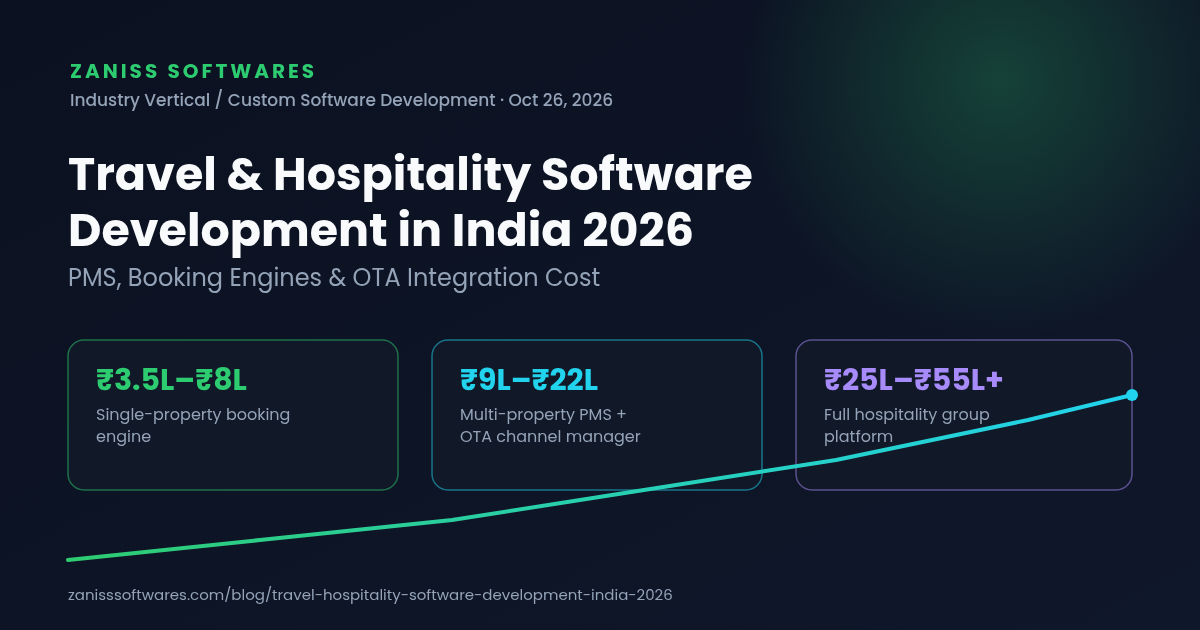
- 1Travel and hospitality businesses in India pay anywhere from ₹3.5 lakh for a single-property direct booking engine to ₹55 lakh+ for a multi-property chain platform with OTA sync, loyalty and guest apps. Ready-made SaaS PMS tools (Hotelogix, eZee, Opera) launch faster but cap out on customization and lock you into recurring monthly or per-booking fees. This guide breaks down real 2026 INR cost tiers, how OTA and GDS integration actually works, and the build-vs-buy decision framework we walk clients through before any contract is signed.
Why Travel & Hospitality Software Is Different From a Standard Booking Website
Most websites just need to display information correctly. A hotel or travel booking system has to do something much harder: it has to agree with itself, in real time, across every channel a room or seat is sold through. Sell a room on MakeMyTrip at 8:03pm and someone books the same room directly on the hotel's own website at 8:03:04pm, and you have an overbooking — a guest with a confirmed reservation and no room waiting for them. For a 20-room boutique property, that is not a minor bug; it is a guest-experience disaster and, often, a refund and a bad review.
This is why travel and hospitality platforms are usually scoped, priced, and built differently from a typical business website or e-commerce store. The core engineering problem isn't the booking form guests see — it's the inventory logic underneath it that has to stay correct whether a booking comes through a walk-in front desk, a travel agent's GDS terminal, or any of four to six connected OTAs running at once, especially during a festival-weekend demand spike when a dozen bookings can land within the same ninety seconds.
The Three Layers Every Hospitality Platform Needs
Whether you buy an off-the-shelf PMS or commission a custom build, every functioning travel and hospitality system is really three layers stacked on top of each other.
The property management system (PMS) layer is the operational core: the room or seat inventory, rates, reservations, housekeeping status, GST-compliant billing, and front-desk operations. This is the single source of truth everything else reads from.
The channel manager layer sits between the PMS and the outside world. It pushes availability and pricing out to each connected OTA (MakeMyTrip, Booking.com, Goibibo, Agoda) and, for travel agencies, into a Global Distribution System (GDS) for flight inventory — and pulls bookings back in, decrementing inventory everywhere else the instant a room or seat is sold anywhere.
The guest experience layer is everything a traveler actually touches: the direct booking engine on the hotel's own site, a guest mobile app for digital check-in and room service requests, WhatsApp-based booking confirmations and reminders, and loyalty or rewards programs for repeat guests. This layer is where off-the-shelf PMS tools tend to be weakest, because it's the least standardized across different hospitality businesses — and the layer where a custom build earns back the most in direct bookings and repeat revenue.
What It Actually Costs to Build Travel & Hospitality Software in India (2026)
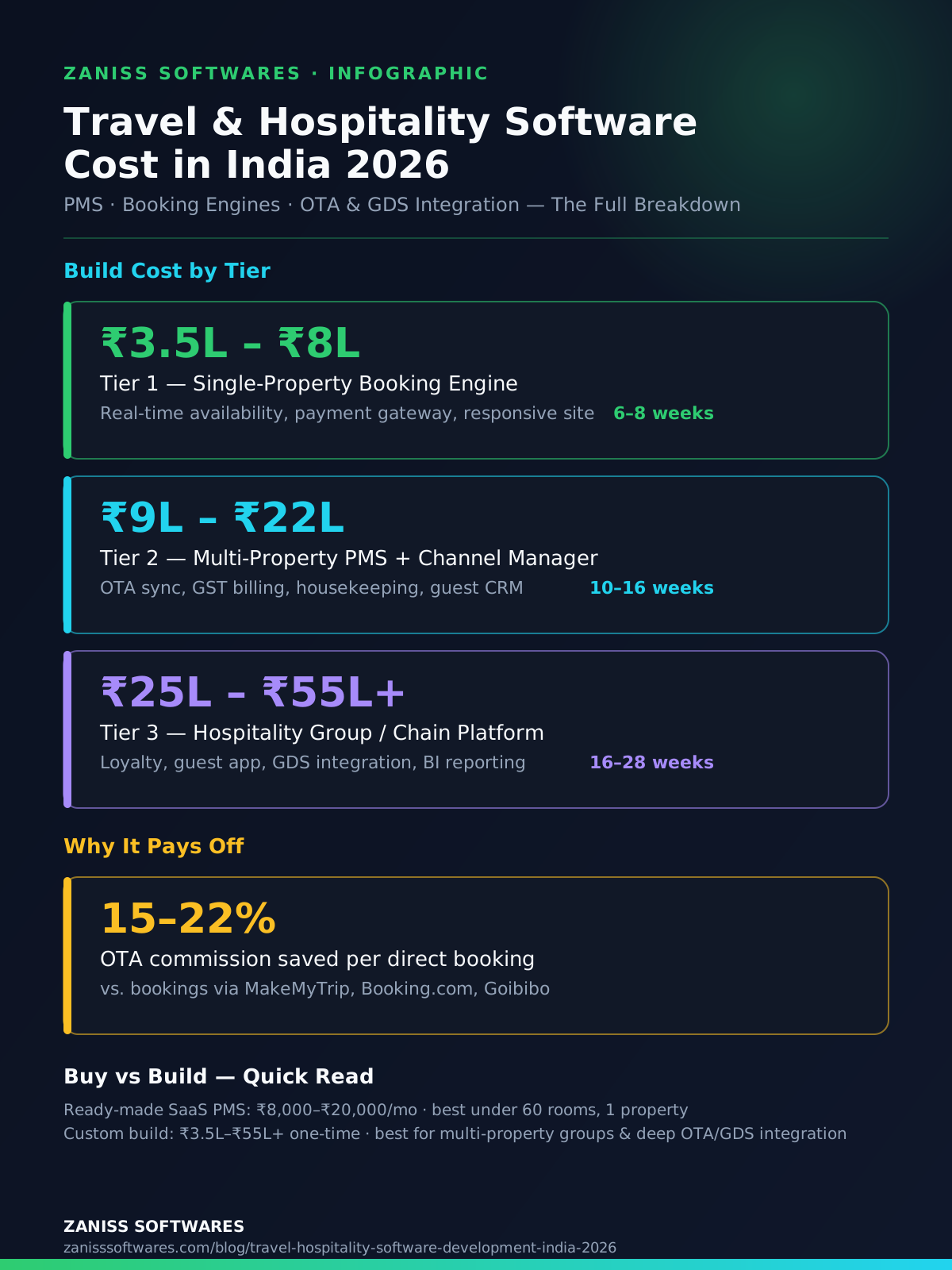
Pricing for hospitality software in India depends almost entirely on how many of the three layers above you need, and how many properties and OTA/GDS connections the system has to support on day one. The table below reflects real 2026 build costs for custom development — not the monthly subscription pricing of an off-the-shelf PMS, which is compared separately in the next section.
| Build Tier | What's Included | Cost (INR) | Timeline |
|---|---|---|---|
| Build TierTier 1 — Single-Property Booking Engine | What's IncludedDirect booking engine, real-time availability, dynamic pricing basics, payment gateway, mobile-responsive site | Cost (INR)₹3,50,000 – ₹8,00,000 | Timeline6–8 weeks |
| Build TierTier 2 — Multi-Property PMS + Channel Manager | What's IncludedFull PMS, OTA channel manager (MakeMyTrip, Booking.com, Goibibo), GST billing, housekeeping, guest CRM, WhatsApp alerts | Cost (INR)₹9,00,000 – ₹22,00,000 | Timeline10–16 weeks |
| Build TierTier 3 — Hospitality Group / Chain Platform | What's IncludedMulti-property dashboard, loyalty & rewards, guest experience app, GDS/flight integration, BI reporting (RevPAR, ADR, occupancy) | Cost (INR)₹25,00,000 – ₹55,00,000+ | Timeline16–28 weeks |
| Build TierAdd-on — Guest Mobile App (iOS + Android) | What's IncludedDigital check-in, room service, concierge requests, loyalty wallet | Cost (INR)₹6,00,000 – ₹15,00,000 | Timeline8–12 weeks |
| Build TierAdd-on — GDS / Flight Booking Integration | What's IncludedFor travel agencies and tour operators needing airline inventory | Cost (INR)₹5,00,000 – ₹12,00,000 | Timeline6–10 weeks |
| Build TierAdd-on — Additional OTA Channel | What's IncludedPer extra OTA connected to the channel manager after the first two | Cost (INR)₹40,000 – ₹1,20,000 | Timeline1–2 weeks |
A few things move these numbers in practice. Every additional OTA connected beyond the first two adds engineering time for that OTA's specific API quirks and certification process — MakeMyTrip, Booking.com and Goibibo each have different webhook reliability and rate-limiting behavior, which is why channel manager work is priced per connection rather than as a flat fee. GDS integration for travel agencies is priced separately from OTA sync because GDS systems use a fundamentally different, stateful session protocol (PNR creation and ticketing time limits) rather than a simple webhook relationship — conflating the two in a single budget line is a common and costly scoping mistake.
Off-the-Shelf PMS vs Custom Build: What Changes at Scale
The honest starting point for most single-property hotels is a ready-made SaaS PMS, not a custom build. Tools like Hotelogix and eZee Absolute are genuinely well-built for standardized, single-property operations, and they get a 20–40 room property live in days, not months. The decision gets more complicated once a business grows past one property, or needs guest-facing features a generic PMS wasn't built for.
| Option | Typical Cost | Best Fit | Trade-off |
|---|---|---|---|
| OptionReady-made SaaS PMS (Hotelogix, eZee Absolute) | Typical Cost₹8,000 – ₹20,000/mo + setup | Best FitSingle property, under 60 rooms, fast launch | Trade-offLimited customization, recurring fees scale with bookings |
| OptionEnterprise PMS (Opera, IDS Next FX Suite) | Typical Cost₹5,00,000 – ₹15,00,000+ one-time/custom | Best FitLarge chains, luxury brands, complex F&B/banquet ops | Trade-offExpensive to customize further; vendor lock-in |
| OptionCustom-built platform (ZANISS SOFTWARES) | Typical Cost₹3,50,000 – ₹55,00,000+ depending on tier | Best FitMulti-property groups, travel agencies, unique workflows, API-heavy integrations | Trade-offHigher upfront cost; you own the roadmap and the data |
The number that tends to tip the decision is the three-year total cost of ownership, not the headline monthly price. A ₹15,000-per-month enterprise SaaS tier across three properties already exceeds ₹16 lakh over three years — before per-booking fees that many SaaS PMS contracts add on top — and at the end of three years the business still doesn't own the platform, the data model, or the roadmap. A custom multi-property build in a comparable cost range is a one-time investment the business owns outright, with no ceiling on how deeply it integrates with existing CRM, accounting, or ERP systems.
OTA & Channel Manager Integration: How It Works and What It Costs
A channel manager's job sounds simple — keep inventory in sync across every OTA — but the implementation detail that actually matters is how fast and how reliably that sync happens under load. The naive approach polls each OTA's API on a timer and reconciles periodically; it mostly works until two bookings land on two different channels within the same few seconds, at which point a race condition can double-sell a room. A production-grade channel manager instead treats the property's inventory ledger as the single source of truth and pushes availability changes outward the instant they happen, with retry logic and a dead-letter queue for any sync that fails and needs human review.
Industry data on OTA market share in India gives a sense of how many connections typically matter: MakeMyTrip holds roughly 32% share, Booking.com around 24%, Agoda about 14%, Goibibo near 10%, and Yatra, Cleartrip and EaseMyTrip combined around 12%, with direct hotel websites accounting for the remaining share. In practice, most properties connect their top two to four OTAs by booking volume rather than every OTA that exists — the first two connections are typically scoped into the Tier 2 build above, with each additional connection priced separately because of the integration and certification work specific to that OTA's API.
The payoff for getting this right is direct, measurable revenue: every booking that moves from an OTA to the hotel's own direct booking engine saves 15–22% in commission that would otherwise go to the OTA. For a mid-sized property doing even a modest volume of monthly bookings, shifting a meaningful share of OTA traffic to direct bookings — which a well-built, fast-loading booking engine makes realistic — is often the single highest-ROI feature in the entire platform.
GDS Integration for Travel Agencies and Tour Operators
Travel agencies and tour operators that need to sell flight inventory alongside hotel rooms face a different integration problem than hotels do. A Global Distribution System (GDS) connection isn't a simple API call — it's a stateful session protocol with its own booking-hold rules, including PNR (Passenger Name Record) creation and strict ticketing time limits that, if missed, release the held fare back into inventory. Because GDS sessions and hotel inventory ledgers have fundamentally different consistency models, the systems that hold up best in production isolate GDS integration behind its own service boundary rather than letting GDS session state leak into the core PMS. This is typically scoped and priced separately from OTA channel manager work for exactly that reason.
Guest Experience: WhatsApp, Loyalty Programs and Mobile Apps
The guest-facing layer is where a custom build most clearly earns back its cost over a generic SaaS PMS. WhatsApp Business API integration for booking confirmations, check-in reminders and post-stay feedback is now close to a baseline expectation among Indian travelers rather than a differentiator — and it's a relatively low-cost addition on top of an existing PMS, typically a few lakh rupees in setup plus a small per-conversation fee. A loyalty and rewards program for repeat guests and a branded guest mobile app for digital check-in, room service and concierge requests cost more to build but compound in value the longer a hospitality business operates, since they reduce dependency on OTA discovery for repeat bookings over time.
What a Realistic Build Timeline Looks Like
Builds are almost always phased, with the PMS and channel manager going live first since every other layer depends on having a correct, synced inventory core. A single-property booking engine typically ships in 6–8 weeks. A multi-property PMS with channel manager integration across two to three OTAs runs 10–16 weeks. A full hospitality group platform — multi-property dashboard, loyalty, a guest app and GDS integration for an in-house travel desk — typically takes 16–28 weeks, usually released in stages so the business starts capturing direct bookings and OTA sync accuracy well before the guest app or loyalty program ships.
The Decision Framework: Buy, Customize, or Build From Scratch
Before recommending either path to a client, we work through the same five questions on every hospitality software engagement:
- Property count and growth plan: a single 15-room boutique property rarely needs custom software — but a group planning to add 3 more properties in 18 months will outgrow a SaaS PMS fast.
- OTA and GDS dependency: if more than 40% of bookings come through 3+ OTAs plus a GDS for travel agents, inventory sync accuracy becomes the single biggest driver of lost revenue — and the strongest case for a custom channel manager layer.
- Guest experience ambitions: digital check-in, a loyalty wallet, or a branded guest app are rarely available in off-the-shelf PMS tools without paying for a higher tier or a separate vendor.
- Existing systems to integrate: if the business already runs a CRM, accounting software, or an ERP, a custom build avoids duplicate data entry across disconnected tools.
- Budget horizon: compare the 3-year total cost of a ₹15,000/month SaaS subscription (~₹5.4 lakh over 3 years, before per-booking fees) against a one-time custom build in the same cost range that the business then owns outright.
Frequently Asked Questions
How much does it cost to build hotel or travel booking software in India in 2026?
A single-property direct booking engine starts around ₹3.5 lakh. A multi-property PMS with OTA channel manager integration typically runs ₹9 lakh to ₹22 lakh. A full hospitality group platform with loyalty, guest apps and GDS integration can run ₹25 lakh to ₹55 lakh or more, depending on the number of properties and integrations.
Should I buy a ready-made PMS or build custom software?
Buy a ready-made SaaS PMS like Hotelogix or eZee if you run one property under 60 rooms and need to launch within weeks. Build custom if you manage multiple properties, need deep OTA/GDS integration, want a branded guest app, or are already paying recurring per-booking fees that would be cheaper to own outright at your current volume.
How does OTA channel manager integration actually work, and what does it cost?
A channel manager sits between your property's inventory and each OTA's API (MakeMyTrip, Booking.com, Goibibo, Agoda), pushing real-time availability and pricing updates both ways so a room sold on one channel is automatically blocked everywhere else. Building this as part of a custom PMS typically costs ₹40,000–₹1,20,000 per additional OTA connection beyond the first two, which are usually included in the Tier 2 build.
How long does it take to build a custom PMS or booking engine?
A single-property booking engine typically takes 6–8 weeks. A multi-property PMS with channel manager integration takes 10–16 weeks. A full hospitality group platform with guest apps, loyalty and GDS integration takes 16–28 weeks, usually phased so the core PMS and channel manager go live first.
What technology stack is best for travel and hospitality software in India?
Most Indian hospitality platforms are built on PostgreSQL or SQL Server for the database, Node.js or .NET for the backend, and React or Next.js for the frontend, with GST-compliant billing, WhatsApp Business API for guest messaging, and cloud hosting on AWS, Azure or GCP for multi-region resilience during seasonal demand spikes.
Related Articles
- Logistics & Supply Chain Software Development in India 2026
- Custom ERP Software Development in India 2026: Cost, Modules & Timeline
- WhatsApp Business API Integration Cost for Indian Businesses in 2026
- System Integration Services in India 2026: Connecting CRM, ERP & Disconnected Tools
Companion infographic: Travel & Hospitality Software Cost in India 2026 — The Full Breakdown →
Working With Us
Planning a booking engine, PMS or OTA integration build? Explore our Custom Software Development services or get a free consultation to scope your project.
📩 Response within 24 hours