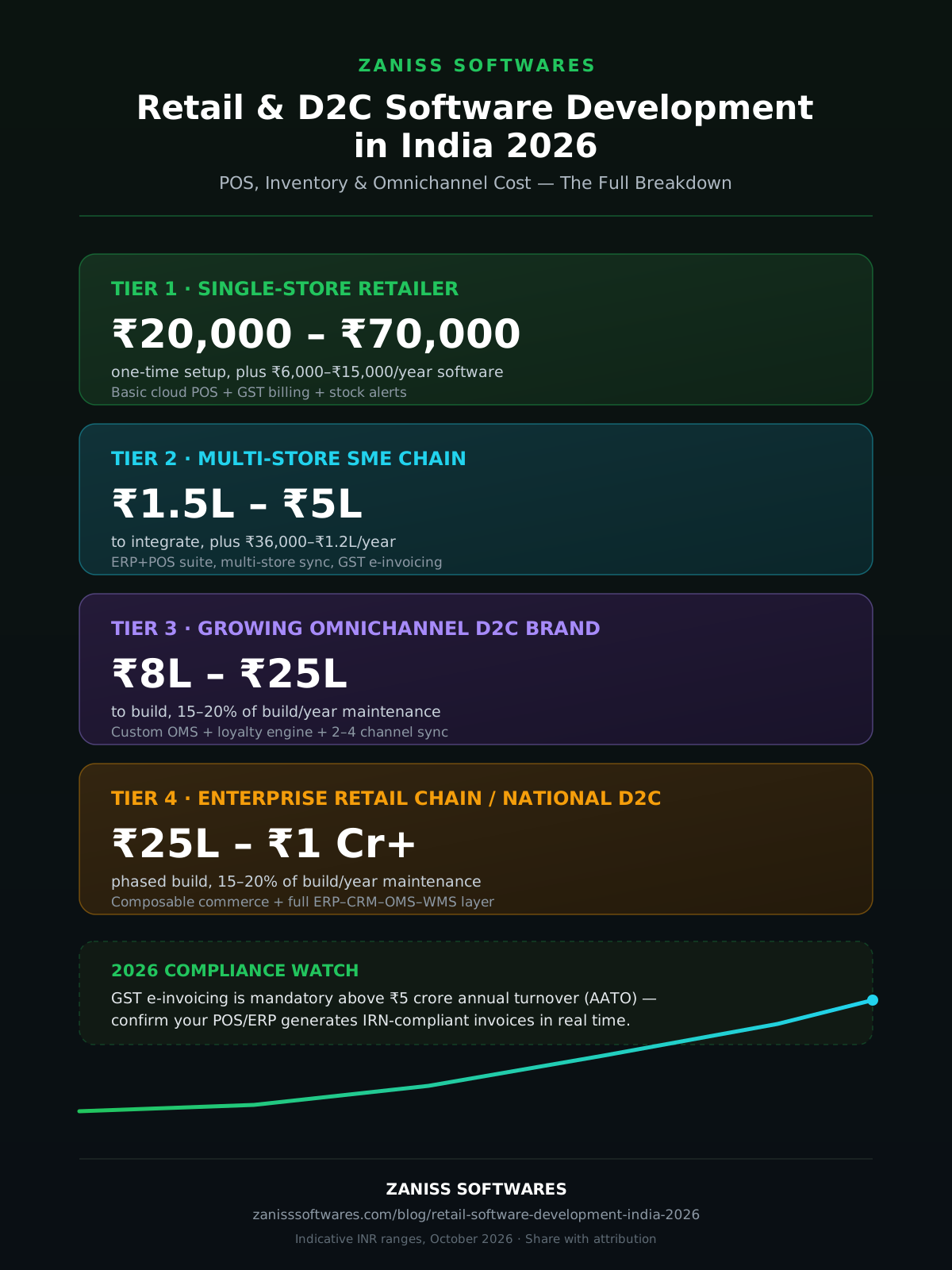
Breakdown: The Four Cost Tiers
Single-store retailer — ₹20,000 – ₹70,000 one-time · ₹6,000 – ₹15,000/year ongoing
Multi-store SME chain — ₹1.5L – ₹5L one-time · ₹36,000 – ₹1.2L/year ongoing
Omnichannel D2C brand — ₹8L – ₹25L one-time · 15–20% of build/year ongoing
Enterprise retail chain — ₹25L – ₹1 Cr+ one-time · 15–20% of build/year ongoing
What Drives the Jump Between Tiers
Store count and channel count matter more than revenue. A single ₹50L-revenue boutique brand selling only on its own website stays in Tier 1–2 territory, while a ₹5 Cr-revenue brand live on four marketplaces and two stores is already deep in Tier 3 — because the integration surface area, not the revenue, is what drives the engineering cost.
How to Decide Which Tier You're In
Staff manually reconciling stock between locations or channels → you're past Tier 1.
Approaching or above ₹5 Cr AATO → confirm GST e-invoicing (IRN) support now.
Overselling across 3+ channels → you need a real OMS (Tier 3).
No single system shows total stock + orders + customer history across channels → that's usually the highest-ROI next build.
Frequently asked questions
- What does retail POS software cost in India in 2026?
- ₹500–₹1,200/month in software for a single store, plus ₹10,000–₹40,000 one-time for hardware. Multi-store ERP+POS suites with sync run ₹3,000–₹10,000+/month.
- Is GST e-invoicing mandatory for my retail business?
- Yes, for businesses with aggregate annual turnover above ₹5 crore as of 2026 — invoices must be registered on the government's IRP in real time.
- Do I need a custom OMS, or can I use an off-the-shelf platform?
- Off-the-shelf works for standard fulfillment flows. Build custom once your loyalty rules, catalogue structure or fulfillment logic stop fitting the platform's model.