In this article
Quick Summary
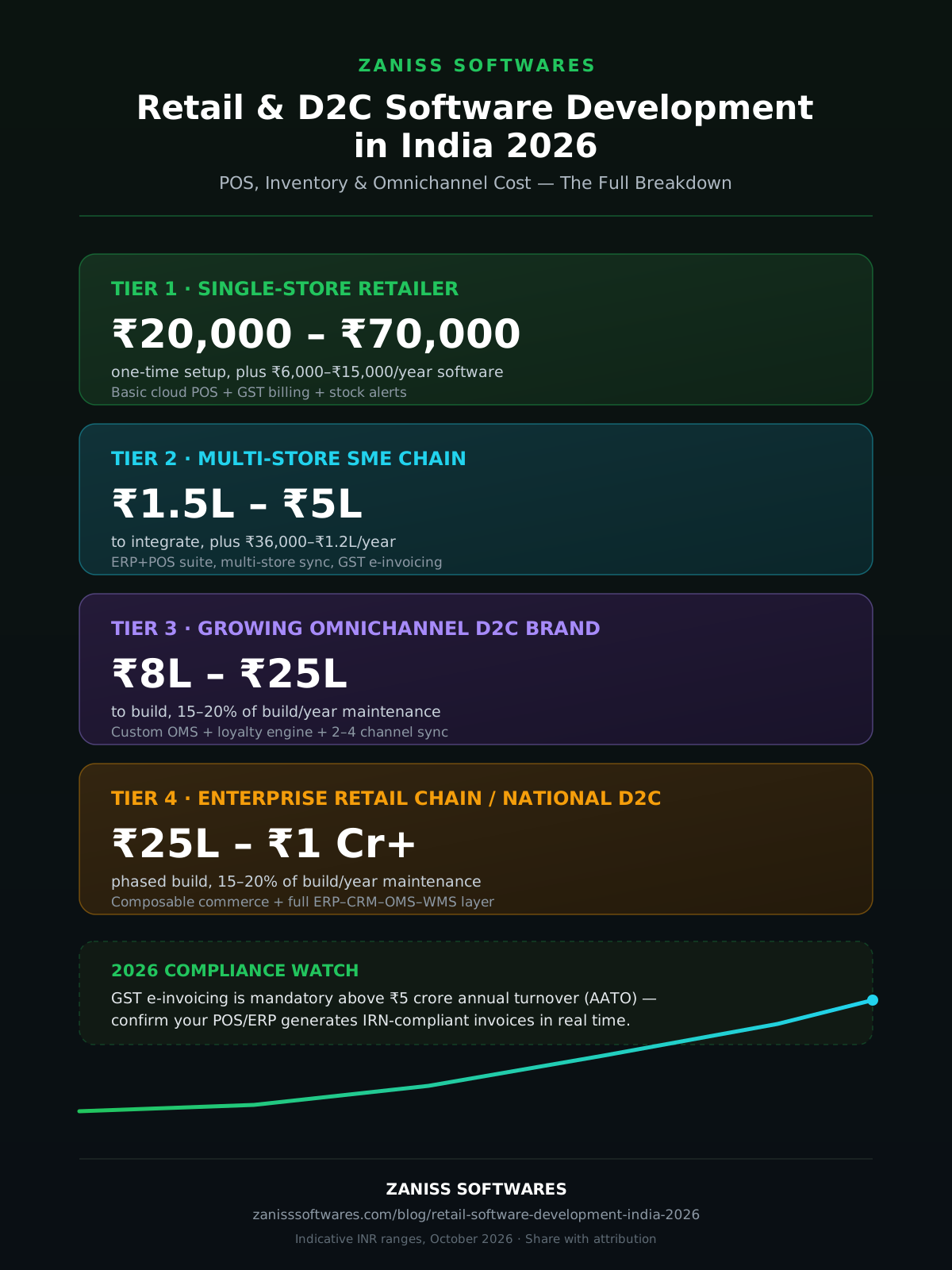
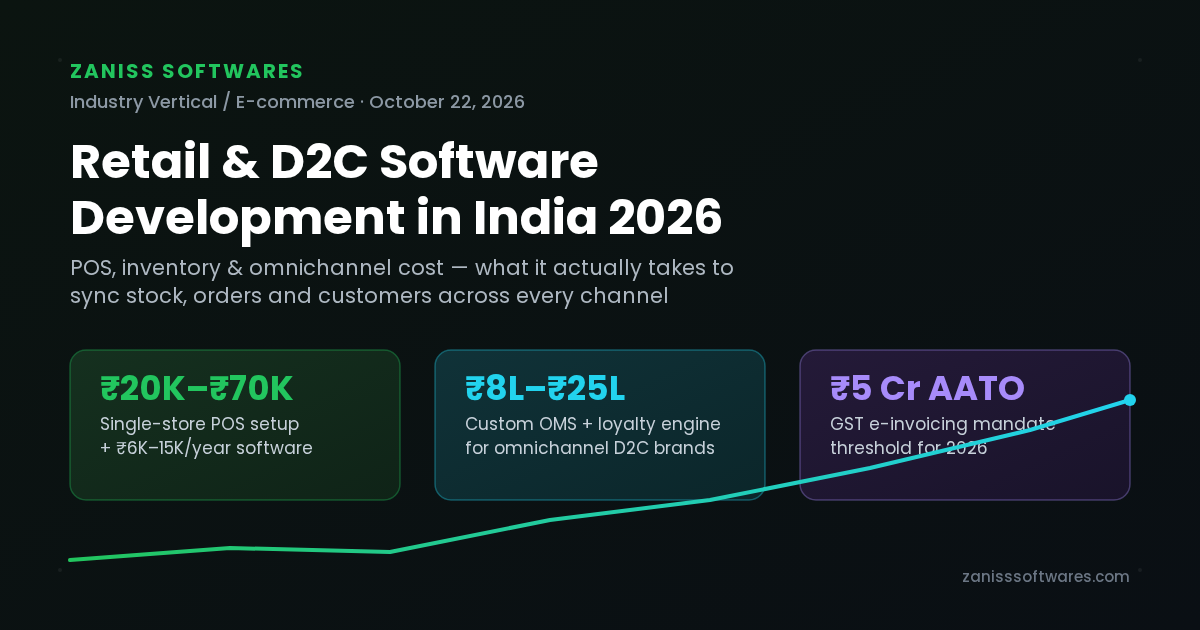
- 1Retail and D2C software in India in 2026 spans four tiers: a single-store cloud POS setup for ₹20,000–₹70,000 one-time plus ₹6,000–₹15,000 a year; a multi-store SME chain with an ERP+POS suite and GST e-invoicing for ₹1.5L–₹5L to integrate plus ₹36,000–₹1.2L a year; a growing omnichannel D2C brand needing a custom order management system (OMS), loyalty engine and marketplace sync for ₹8L–₹25L; and an enterprise retail chain or national D2C brand running composable commerce and a full integration layer for ₹25L–₹1 Cr+. The right tier depends on store count, SKU complexity, and how many sales channels you're reconciling by hand today — not on what a competitor bought.
Why "retail software" means something different in 2026
Five years ago, "retail software" meant a billing machine at the counter. In 2026, an Indian retailer or D2C brand is usually running some combination of a physical POS, a Shopify or custom storefront, listings on Amazon, Flipkart and Myntra, a warehouse or two, and a WhatsApp or Instagram DM channel that somehow also needs to know what's in stock. The actual software problem for most retail and D2C businesses today isn't "do we have a billing system" — almost everyone does. It's "do all these systems agree with each other," and increasingly, "can a customer buy online and return in-store without someone manually fixing the ledger afterward."
That reconciliation problem is where real budget goes in 2026, and it's also where ZANISS SOFTWARES' Custom Software Development practice spends the most time with retail clients — building the eCommerce & retail solutions, order management systems (OMS), loyalty engines, and catalogue sync layers that keep stock, orders and customer data consistent across channels, which is explicitly one of the industries we build for under our Custom Software Development service.
This guide breaks down what POS, inventory, and omnichannel retail software actually costs in India in 2026, across four realistic tiers, plus the compliance deadline (GST e-invoicing) that's pushing even small retailers to modernize their billing stack this year.
Tier 1: The single-store retailer — get billing and basic stock right
For a single store — a boutique, a pharmacy, a textile shop, a small electronics outlet — the job is billing accuracy, GST-compliant invoices, and knowing what's on the shelf without a physical count every week.
At this tier, off-the-shelf cloud POS software (Petpooja, Vyapar, Zoho Inventory and similar tools are common in the Indian market) typically runs ₹500–₹1,200 a month for a basic plan covering GST billing, barcode-based stock tracking and simple sales reports. Hardware is the bigger line item: a tablet-based setup with a barcode scanner and receipt printer runs ₹10,000–₹25,000 one-time, or a full desktop terminal with a cash drawer runs ₹25,000–₹40,000+. Many retailers now rent hardware instead, at ₹400–₹1,200 a month, to avoid the upfront spend.
Total realistic first-year cost: ₹20,000–₹70,000 including hardware, setup and software, then ₹6,000–₹15,000 a year in software subscription after that. This tier rarely needs custom development — the gap is choosing the right off-the-shelf product and configuring GST and stock rules correctly, which is more of a consulting and setup exercise than a build.
Tier 2: The multi-store SME chain — sync inventory, add GST e-invoicing
The moment a retailer opens a second or third location, the single-store tools start breaking down. Stock counts stop matching across stores, "sold out at Store A, available at Store B" becomes invisible to staff, and GST compliance gets more demanding.
This is also where a real 2026 deadline bites: the government's e-invoicing mandate now applies to any business with an aggregate annual turnover (AATO) above ₹5 crore, requiring invoices to be registered on the Invoice Registration Portal (IRP) in real time rather than generated offline. A multi-store chain crossing that threshold needs its POS or ERP to generate IRN-compliant e-invoices automatically — retrofitting this into a legacy billing system is a common, avoidable cost spike we see clients hit mid-year.
At this tier, businesses typically move to an advanced ERP+POS suite with multi-store inventory sync, centralized CRM and e-invoicing support, running ₹3,000–₹10,000+ a month in software. Getting multiple stores, a basic e-commerce listing, and accounting software (commonly Tally) talking to each other reliably is a system-integration job, not a software-licensing one: a multi-system inventory and order sync across 4–5 tools typically costs ₹1.5L–₹5L to build (see our detailed System Integration cost breakdown for the scope-by-scope numbers), plus 15–20% of that per year in maintenance.
Total realistic cost: ₹1.5L–₹5L one-time integration and customization, plus ₹36,000–₹1,20,000 a year in software and sync maintenance.
Tier 3: The growing omnichannel D2C brand — OMS, loyalty, and marketplace sync
This is the tier where most of our retail and D2C clients actually sit, and it's the one with the least "buy a product" shortcut. A D2C brand doing ₹2–20 crore in annual GMV across its own website, 2–4 marketplaces, and maybe one or two physical stores or kiosks needs a real order management system (OMS) — software that knows total available stock across every channel, routes each order to the right fulfillment point, and prevents overselling when the same 40 units of a SKU are listed in five places at once.
Platforms like Unicommerce and similar omnichannel retail management systems exist specifically for this problem, connecting marketplaces, a D2C storefront, POS and ERP systems into what's effectively a single inventory ledger, supporting ship-from-store, store-to-store transfers, and unified returns across channels. Where an off-the-shelf OMS doesn't fit the brand's specific fulfillment logic, loyalty structure, or catalogue complexity, a custom build is usually the better long-term bet, because the alternative is layering workarounds on a rigid third-party platform as the brand scales.
At this tier, a custom OMS plus a loyalty engine and 2–4 channel sync (marketplaces, storefront, stores, warehouse) typically runs ₹8L–₹25L to build, depending on channel count and catalogue size, roughly in line with what a headless commerce build costs on its own (our E-commerce Development guide puts headless storefronts at ₹22L–₹75L for performance-led D2C brands, before the OMS and sync layer is added). Many brands at this stage also rebuild or extend their CRM to unify customer history across channels — see our CRM Software Development cost guide for that breakdown, since a custom CRM MVP (₹12L–₹35L) often runs in parallel with the OMS build.
Tier 4: The enterprise retail chain or national D2C brand
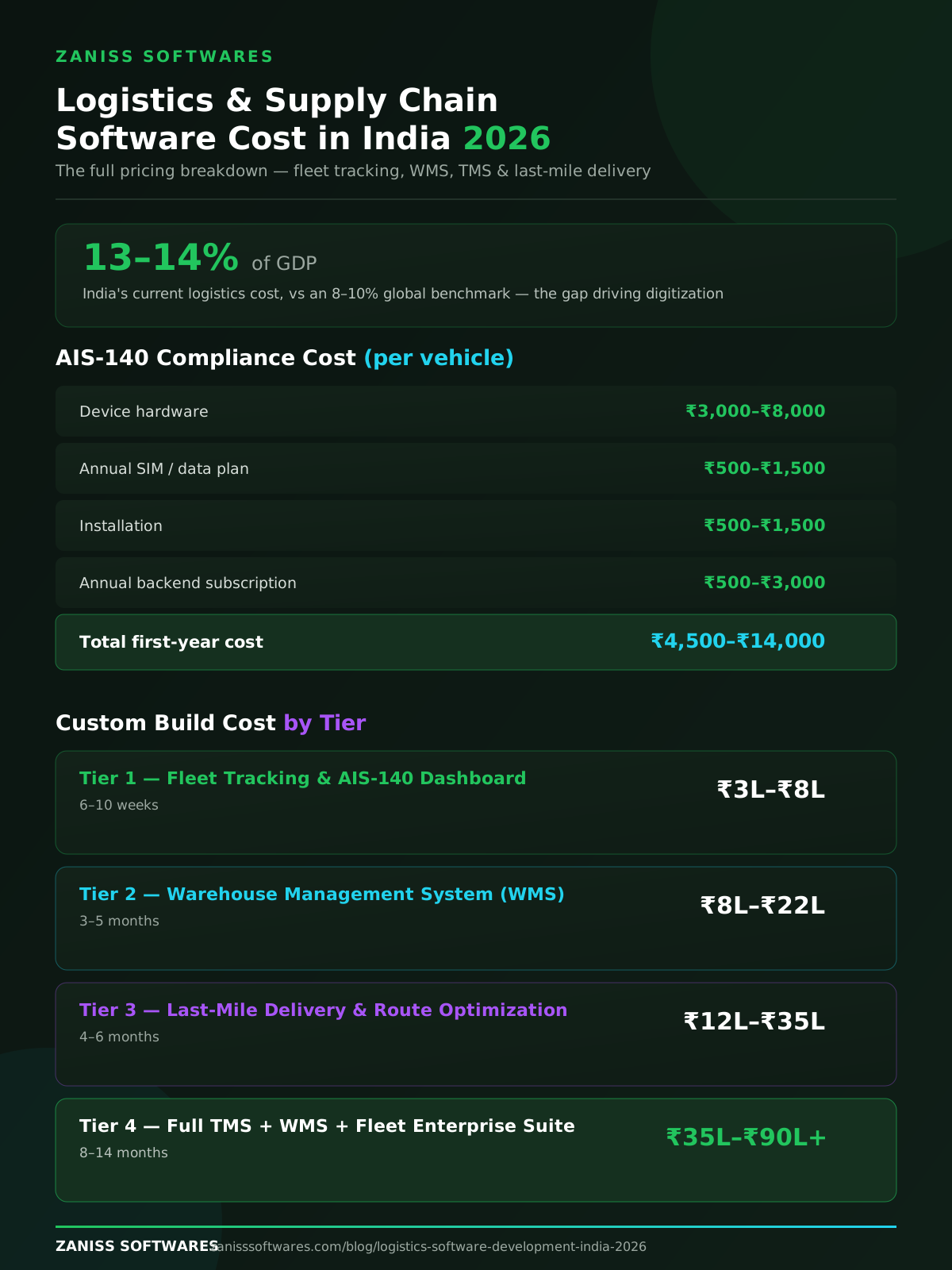
At scale — a retail chain with dozens of stores, or a D2C brand doing ₹50 crore+ in GMV — the requirements shift again: composable or fully custom commerce architecture, an enterprise-grade integration layer connecting ERP, CRM, OMS, WMS and finance systems, AI-driven personalization and demand forecasting, and multi-warehouse logistics coordination (our Logistics & Supply Chain Software guide covers the WMS and fleet-tracking side of this in more detail for brands running their own fulfillment).
This tier typically costs ₹25L–₹1 Cr+ depending on store count, SKU complexity, and how many legacy systems need to be unified, with an enterprise CRM–ERP integration layer alone sometimes running ₹20L–₹80L+. These are multi-quarter engagements, usually phased so the retailer gets working improvements every sprint rather than a single large launch at the end.
INR Cost Summary Table
| Tier | Who it's for | One-time cost | Ongoing cost |
|---|---|---|---|
| Tier1. Single-store retailer | Who it's forOne shop, basic billing & stock | One-time cost₹20,000 – ₹70,000 | Ongoing cost₹6,000 – ₹15,000/year |
| Tier2. Multi-store SME chain | Who it's for2–10 stores, GST e-invoicing, sync | One-time cost₹1.5L – ₹5L | Ongoing cost₹36,000 – ₹1.2L/year |
| Tier3. Growing omnichannel D2C brand | Who it's for₹2–20 Cr GMV, OMS, loyalty, 2–4 channels | One-time cost₹8L – ₹25L | Ongoing cost15–20% of build/year |
| Tier4. Enterprise retail chain / national D2C | Who it's for₹50 Cr+ GMV, composable commerce, full integration | One-time cost₹25L – ₹1 Cr+ | Ongoing cost15–20% of build/year |
Ranges are indicative, based on current Indian market pricing for POS/ERP software, published integration and commerce-build costs, and ZANISS SOFTWARES project data. Actual cost depends on store count, SKU count, channel count, and existing system quality.
Decision Framework: Which tier are you actually in?
Don't size your build by what stage you'd like to be at — size it by what's breaking today.
- If staff are manually checking stock between locations or channels, you're past Tier 1 regardless of revenue — inventory sync is the first fix, not a nice-to-have.
- If you're approaching or above ₹5 crore AATO, confirm your billing system supports GST e-invoicing (IRN generation) now, not when the deadline forces it — retrofitting mid-year is more expensive than planning for it.
- If overselling or double-fulfillment happens across more than two sales channels, you need a real OMS (Tier 3), not another spreadsheet or a patched-together Zapier workflow.
- If no single system shows you total stock, total orders, and total customer history across every channel, that unification gap — not a new storefront — is almost always the highest-ROI next build.
- If you're evaluating a platform like Unicommerce versus a custom OMS, the honest test is whether your fulfillment logic, loyalty rules, or catalogue structure are standard enough to fit the platform's model — if you're already planning workarounds before go-live, build custom.
Frequently Asked Questions
What does retail POS software cost in India in 2026?
A basic cloud POS for a single store costs ₹500–₹1,200 a month in software, plus ₹10,000–₹40,000 one-time for hardware (tablet-based setups are cheaper than full desktop terminals). Multi-store ERP+POS suites with inventory sync and e-invoicing run ₹3,000–₹10,000+ a month.
Do I need a custom order management system, or can I use Shopify/Unicommerce out of the box?
Off-the-shelf OMS platforms work well for standard fulfillment flows across common marketplaces. A custom build makes sense once your loyalty rules, catalogue structure, or fulfillment logic (e.g., store-specific promotions, complex bundling, B2B pricing) don't fit the platform's assumptions — at that point you're paying for workarounds instead of a system that fits.
Is GST e-invoicing mandatory for my retail business?
As of 2026, e-invoicing is mandatory for businesses with aggregate annual turnover (AATO) above ₹5 crore, requiring real-time invoice registration on the government's IRP. If you're near that threshold, confirm your POS or ERP supports IRN generation before it becomes urgent.
How much does omnichannel inventory sync cost for a D2C brand selling on 3–4 marketplaces?
A multi-system inventory and order sync across 4–5 tools (storefront, 2–3 marketplaces, accounting) typically costs ₹1.5L–₹5L to build, scaling to ₹8L–₹25L when it includes a full custom OMS and loyalty engine rather than point-to-point integrations.
What's the real difference between omnichannel and unified commerce for an Indian retailer?
Omnichannel means your channels are connected and share data (stock, orders, customer profile). Unified commerce goes further — one single system of record drives every channel in real time, rather than several systems kept in sync. Most Indian retail and D2C brands are realistically building toward omnichannel first (Tier 2–3 above) before unified commerce becomes worth the investment (Tier 4).
Companion infographic
Retail & D2C Software Development in India 2026 — The Full Cost Breakdown →
Related Articles
Working With Us
If stock, orders and customer data don't agree across your channels yet, that's exactly what we build. Explore our Custom Software Development services, or get a free consultation to scope your retail or D2C integration.
📩 Response within 24 hours