In this article
Quick Summary
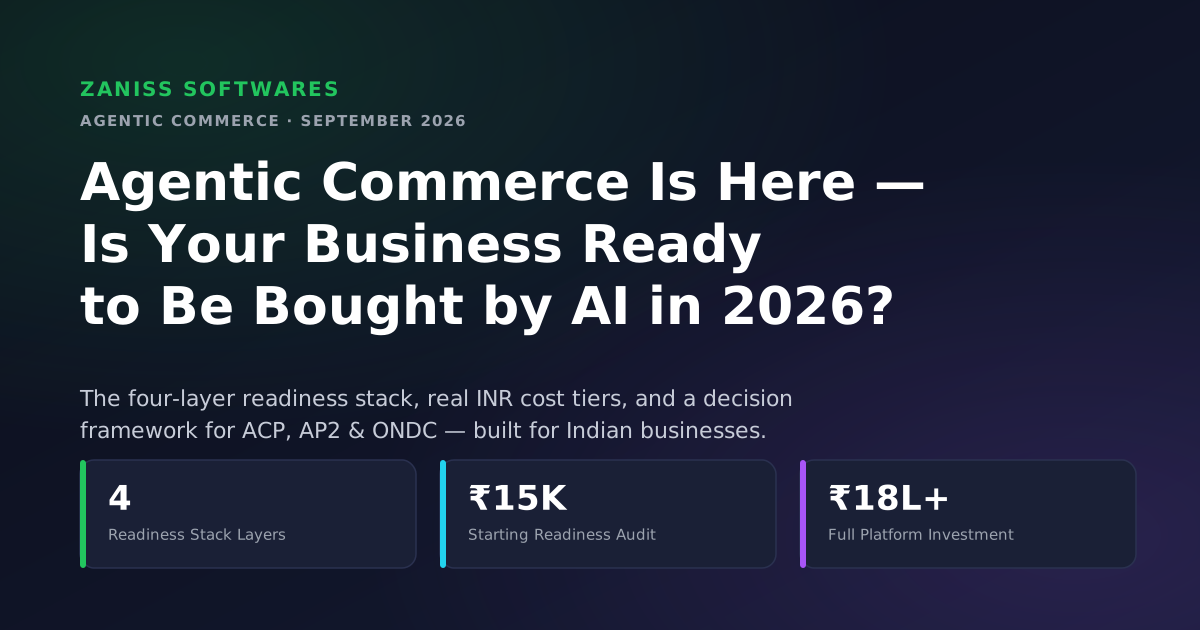
- 1AI agents inside ChatGPT, Gemini, and Perplexity can now browse, compare, and complete a purchase without a human ever loading a website. This is “agentic commerce,” and it runs on new rails — OpenAI's Agentic Commerce Protocol (built with Stripe), Google's Agent Payments Protocol (AP2), and in India, the ONDC network.
- 2If your product data, checkout, and structured markup aren't built for machine buyers as well as human ones, you become invisible to a fast-growing slice of demand.
- 3This article breaks down what's actually changed, what it costs in INR to get agent-ready, and how to decide if your business needs this now or can wait a cycle.
What "Agentic Commerce" Actually Means in 2026
For twenty years, "online sales" meant a person typing into a search box, clicking a blue link, landing on a website, and filling out a checkout form. That chain still exists, but it now has a parallel track: a person tells an AI assistant what they want, and the assistant does the searching, comparing, and — increasingly — the buying, without the human ever seeing your website.
This is what the industry has settled on calling agentic commerce: transactions initiated, negotiated, or completed by an AI agent acting on a person's behalf, rather than by the person directly clicking through your site. The agent reads your product data the way a browser reads HTML — except it isn't rendering a page for a human, it's parsing structured facts (price, availability, specs, reviews, return policy) to make a decision and, in a growing number of cases, execute a purchase.
For a software or e-commerce business in India, this isn't a five-years-away trend. It's already live in the tools your customers use daily, and it changes what "being found online" requires.
Think about the difference between a search engine result and an agent's answer. A search result is a list of links a human still has to click, read, and judge. An agent's answer is a decision already half-made — it has read your price, your delivery window, your return policy, and your stock status, and it is presenting (or acting on) a recommendation. If your data wasn't structured well enough for the agent to read confidently, you were never in that shortlist to begin with, and no amount of persuasive homepage copy fixes that after the fact.
Why This Is Happening Now
Three separate pieces of infrastructure came together in 2025–2026 to make this practical rather than theoretical.
OpenAI shipped Instant Checkout inside ChatGPT, built on the Agentic Commerce Protocol (ACP), co-developed with Stripe. It defines a standard way for a merchant's catalog and checkout to talk to an AI agent — product feed in, payment token out — without the merchant having to build a custom integration for every AI platform that might send it traffic.
Google, separately, published the Agent Payments Protocol (AP2) — an open standard for how an AI agent proves it has a real user's authorization to spend real money, using cryptographically signed "mandates" rather than a saved card number handed to a chatbot. Payment providers including Stripe and consumer fintechs like Klarna have already signaled support.
Perplexity, Amazon's Rufus, and Google's own AI Mode are running parallel, less standardized versions of the same idea: an assistant that shops for you inside the conversation.
None of these protocols compete with your website. They sit in front of it, deciding whether your business is even a candidate to be shown to the person who's shopping.
It's worth being precise about what's genuinely new here versus what's just louder. Product feeds, structured data, and API-based ordering have existed for years — Google Shopping feeds and marketplace APIs are not new inventions. What's new is that a general-purpose AI assistant, not a dedicated shopping app, is now the thing reading that data and closing the loop on payment. That collapses several previously separate journeys — search, comparison, and checkout — into a single conversational interaction the merchant doesn't fully see or control. It's a meaningful shift in who your "customer" technically is at the moment of discovery: increasingly, it's software acting for a person, not the person directly.
What Changes for Indian Businesses Specifically
Two things happen at once, and most businesses are only paying attention to one of them.
First, discoverability shifts from keywords to structured facts. An AI agent comparing five vendors doesn't skim your homepage copy — it reads your schema markup, your product feed, your pricing table, and your return policy as machine-readable fields. If those fields are missing, inconsistent, or buried in a PDF, the agent either skips you or, worse, guesses and gets it wrong in front of the customer.
Second, the checkout itself becomes a technical integration, not just a UX flow. If a customer's agent wants to complete a purchase without leaving its own interface, your store needs an API-level way to receive that order — a webhook or endpoint speaking ACP, AP2, or (for Indian sellers) the ONDC protocol, rather than a "Buy Now" button meant for a mouse click.
Neither of these is exotic engineering. Both require a business to treat its product catalog and checkout as a system with a machine-facing contract, not just a page a human reads.
This applies well beyond retail, too. A B2B software company doesn't get "checked out" by an agent the way a t-shirt does, but it absolutely gets shortlisted, compared, and sometimes eliminated by one. A founder asking an AI assistant to compare custom software vendors, or a procurement team asking it to summarize vendor pricing pages, is running the exact same discoverability test — can the agent extract accurate, structured facts about your offering — even though nothing is added to a cart. Treating this as purely an e-commerce concern misses half the businesses that are already affected.
The Agentic Commerce Readiness Stack
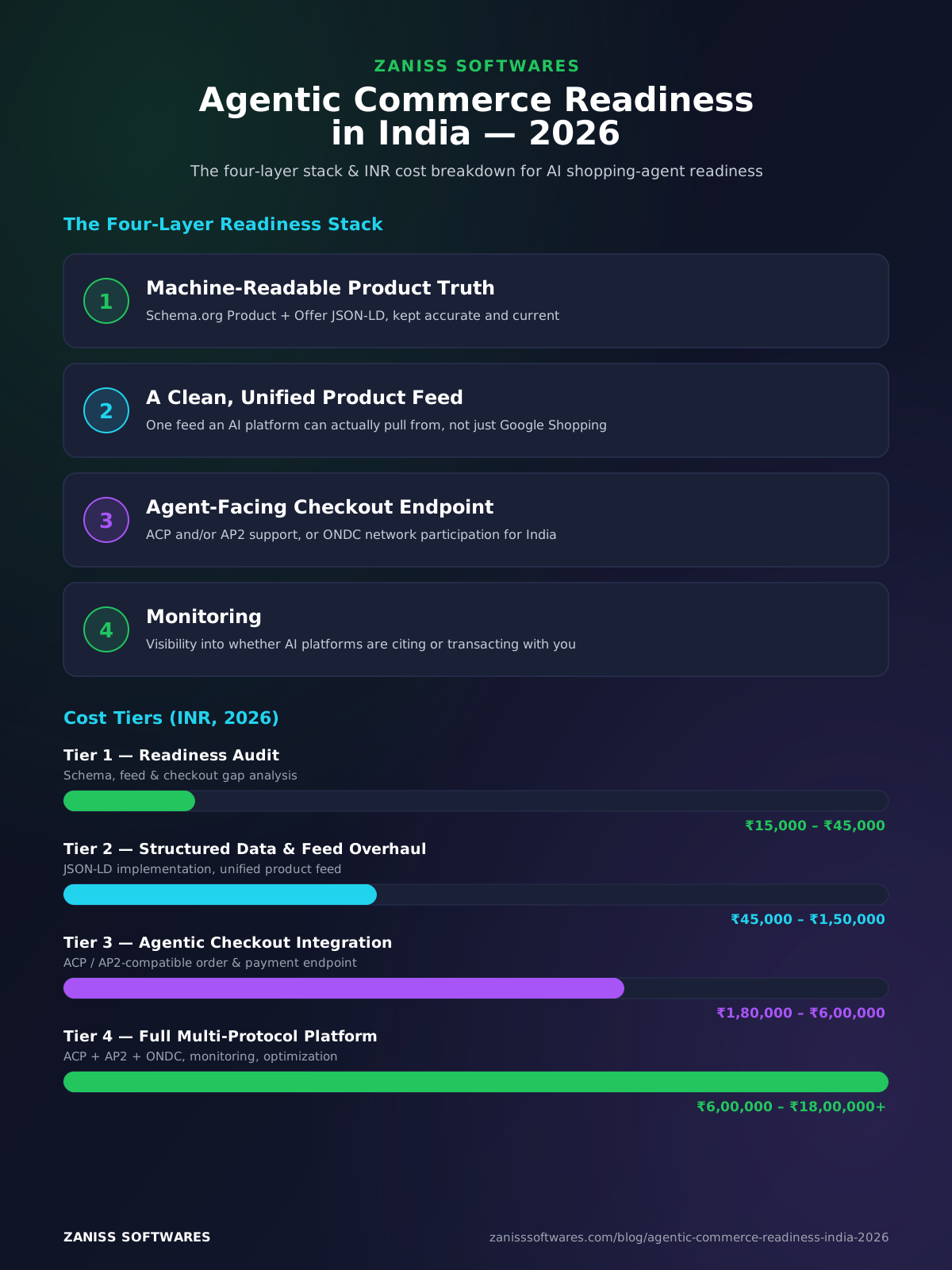
We think about readiness in four layers, and most businesses are missing at least two of them:
Layer 1 — Machine-readable product truth. Complete, accurate schema.org/Product and Offer JSON-LD on every product page: price, currency, GTIN/SKU, availability, shipping, and return terms, kept in sync with what's actually true (agents penalize stale data harder than humans do, because they act on it directly).
Layer 2 — A clean, current product feed. A single feed (Merchant Center-style or a direct API) that an AI platform can pull from, rather than one built for Google Shopping alone and never touched again.
Layer 3 — An agent-facing checkout endpoint. ACP and/or AP2 support (or, for India-first sellers, ONDC network participation) so an order initiated by an agent can actually complete, with your existing payment gateway and inventory system underneath it.
Layer 4 — Monitoring. Visibility into whether AI platforms are actually citing, comparing, or transacting with you — this is new territory and mostly means log analysis and periodic prompt testing today, not a mature analytics dashboard.
Planning a Website? Don't Overpay or Underbuild
Most businesses overspend on features they don't need — or underspend and rebuild within a year. We help you scope it right from day one.
What It Costs to Get Agent-Ready in India (2026)
Pricing depends heavily on catalog size, how messy your existing product data is, and whether you need one checkout protocol or several. These are realistic 2026 ranges for the Indian market:
| Tier | Scope | Typical Timeline | Investment (INR) |
|---|---|---|---|
| Tier 1 — Readiness Audit | Schema, feed, and checkout gap analysis against ACP/AP2/ONDC requirements | 1–2 weeks | ₹15,000 – ₹45,000 |
| Tier 2 — Structured Data & Feed Overhaul | JSON-LD implementation, GTIN/MPN cleanup, unified product feed | 2–4 weeks | ₹45,000 – ₹1,50,000 |
| Tier 3 — Agentic Checkout Integration | ACP or AP2-compatible order/payment endpoint, sandbox + production rollout | 4–8 weeks | ₹1,80,000 – ₹6,00,000 |
| Tier 4 — Full Agentic Commerce Platform | Multi-protocol support (ACP + AP2 + ONDC), monitoring, ongoing optimization | 8–16 weeks | ₹6,00,000 – ₹18,00,000+ |
Most mid-size Indian D2C and B2B catalogs land in Tier 2 or the lower end of Tier 3 for an initial rollout, then expand coverage as agent-driven traffic proves out. As with most infrastructure investments, the audit is the cheap, low-risk step — it tells you precisely which of the four layers are already partially built (most businesses have some schema markup or a Merchant Center feed already) versus which need to be built from scratch, so the Tier 2–4 spend is scoped against reality rather than a generic checklist.
ONDC and the India-Specific Angle
India already has government-backed rails for exactly this problem. The Open Network for Digital Commerce (ONDC) decouples buyer-side apps from seller-side catalogs using an open protocol — conceptually the same "any agent, any seller" idea that ACP and AP2 are now building for the rest of the world. A business that's already ONDC-integrated has a head start: much of the machine-readable catalog and order-API work is shared groundwork between ONDC compliance and global agentic-commerce readiness. For sellers who haven't looked at ONDC yet, agentic commerce readiness is a good forcing function to do both at once rather than twice — the catalog cleanup, the order-status API, and the return-policy structuring are largely shared work, so sequencing them together is meaningfully cheaper than treating ONDC and global agentic-commerce readiness as two separate projects a year apart.
Common Mistakes Businesses Make
The most common failure isn't lack of budget — it's sequencing. Businesses jump to Tier 3 checkout integration before Tier 1–2 data hygiene is done, and the agent either can't find the product or cites wrong pricing, which is worse than not being cited at all. A close second: treating this as a one-time project instead of a maintained feed — schema and product data drift out of sync with the live site within weeks if nobody owns it. And a third: assuming this only matters for large e-commerce catalogs. B2B software and service businesses are already being compared and shortlisted by AI agents doing vendor research, even when nothing is "checked out" — the discoverability layer (Layer 1 and 2 above) matters just as much for a services business as for a retailer.
A fourth, quieter mistake: outsourcing this entirely to a marketing team without involving engineering. Schema markup and product feeds live in code and content-management templates, and keeping them accurate as inventory, pricing, and policies change is an engineering-maintained pipeline, not a one-off content task. The businesses that get the most value tend to be the ones where a developer owns the feed and a marketer owns what goes into it — not one team trying to do both.
Decision Framework: Do You Need This Now, or Can It Wait?
Ask four questions:
- Do you sell a defined product or service catalog (not a purely custom-quote business) where a buyer could plausibly compare you against competitors using structured facts?
- Is your organic or paid customer acquisition cost already climbing — a sign that traditional discovery channels are getting more expensive and a new channel is worth testing early?
- Are your direct competitors already schema-clean or ONDC/marketplace-integrated? If they are, you're already invisible to agents by comparison, even if nothing looks broken on your own site.
- Do you have the internal ownership to keep product data current once it's built, or would this become another unmaintained project?
If you answered yes to two or more, start with a Tier 1 readiness audit now — it's low-cost and tells you exactly where you stand. If your business is pre-catalog, pre-PMF, or entirely custom-quote, this can reasonably wait a cycle while the protocols mature further.
Related Articles
- AI Search AI Search Visibility for Indian Businesses in 2026: The Honest GEO Playbook
- E-commerce E-commerce Development in India 2026: Shopify vs Custom vs Headless
- API Development API Development Services in India 2026: REST, GraphQL and gRPC Done Right
- AI Integration AI Integration Services in India 2026: Where AI Actually Pays Back
Companion infographic: Agentic Commerce Readiness in India 2026 — The Full Breakdown →
Working With Us
Getting agent-ready isn't a single checkbox — it's structured data, a clean feed, and a checkout integration that has to keep working as the protocols evolve. That's exactly the kind of system work our Custom Software Development team handles for Indian businesses every day.
Pro Insight
Planning a cloud-native platform? Let's review your architecture for free.
At ZANISS SOFTWARES, we don't just build websites — we build growth systems.
- ✓SEO-first architecture
- ✓Conversion-focused design
- ✓High-speed performance
- ✓Scalable, future-proof code
📩 Response within 24 hours
Frequently Asked Questions
What is agentic commerce and why does it matter for Indian businesses in 2026?
Agentic commerce is the growing category of purchases where an AI assistant — not a human clicking through a website — does the comparing and buying on a customer's behalf. It matters because discovery and checkout increasingly happen inside that AI layer, outside your own site's analytics and outside traditional SEO.
How is this different from traditional SEO or Google Shopping ads?
Traditional SEO optimizes for a human reading a results page. Agentic commerce optimizes for a machine parsing structured data and executing an action. The two overlap (clean product data helps both) but agentic readiness adds a checkout-level technical layer that SEO never required.
What are AP2 and ACP, and do I need to support both?
The Agentic Commerce Protocol (ACP), from OpenAI and Stripe, powers Instant Checkout in ChatGPT. Google's Agent Payments Protocol (AP2) is a broader open standard for authorizing agent-initiated payments across platforms. Most businesses starting out pick one based on where their customers already are, then expand — few need full multi-protocol coverage on day one.
How much does it cost to make an Indian e-commerce or B2B catalog agent-ready?
A realistic starting range is ₹45,000–₹1,50,000 for structured data and feed cleanup (Tier 2), with full checkout-level integration typically landing between ₹1,80,000 and ₹6,00,000 depending on catalog complexity and how many protocols you support.
Where does ONDC fit into this for Indian sellers?
ONDC is India's own open-network answer to the same problem agentic commerce solves globally — separating buyer apps from seller catalogs via a shared protocol. ONDC integration and global agentic-commerce readiness share a lot of underlying groundwork, so Indian sellers evaluating one should evaluate both together.