Quick Summary
- 1The EU's European Accessibility Act became enforceable on June 28, 2025, and US ADA website lawsuits rose 27% in 2025 to over 5,100 filings — 68% of H1 2026 filings targeted businesses under $50M in revenue, with no small-business exemption.
- 2WCAG 2.2 AA is now the practical baseline for any business selling into the US, UK, EU, or Australia.
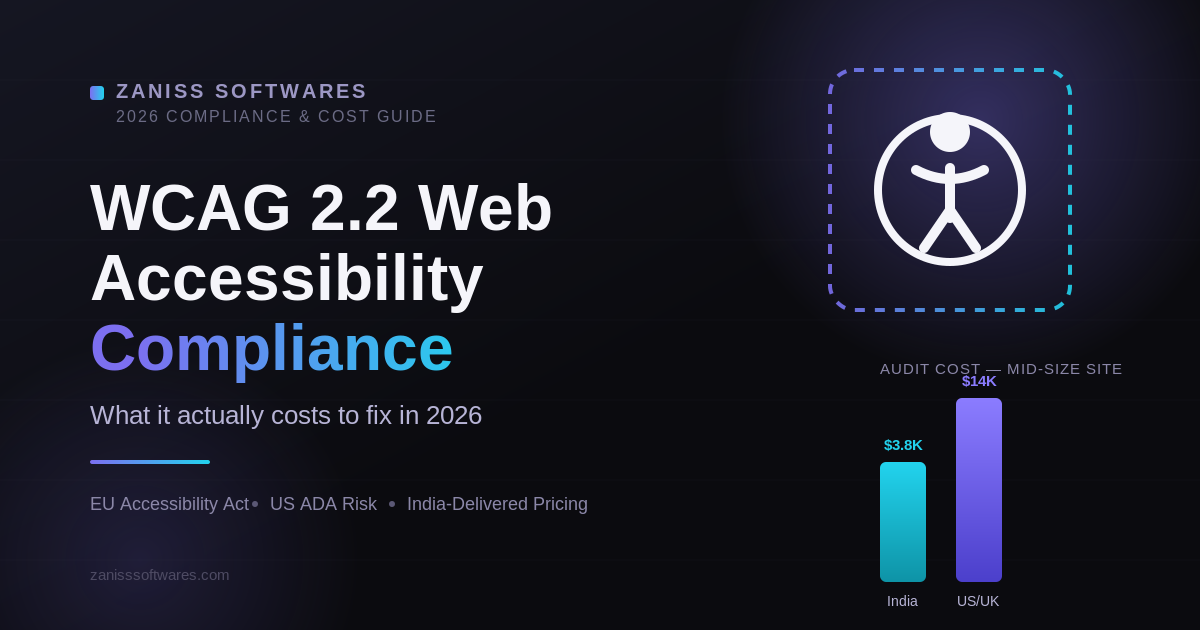
- 3A professional manual audit for a small-to-mid site delivered from India runs ₹1.5L–₹4L (roughly $1,800–$4,800), against $3,000–$20,000 for the same scope from a US or UK agency.
- 4Remediation typically adds ₹2L–₹8L depending on real issue volume, found only after a proper audit — not a scanner report. This guide breaks down what WCAG 2.2 actually requires, real 2026 audit and remediation pricing, and the decision framework we use with clients before we quote a number.
Why accessibility just became a business risk, not a nice-to-have
For years we treated web accessibility as a compliance checkbox mostly relevant to government portals and large enterprises with legal departments. That changed in 2025. Two things happened in the same twelve months that moved WCAG 2.2 from "good practice" to "check before you sign the next enterprise deal or run another ad campaign into the EU or US."
First, the European Accessibility Act (EAA) became enforceable on June 28, 2025. It applies EN 301 549 — which incorporates WCAG 2.1 AA as its floor — across all 27 EU member states, covering e-commerce, banking, transport, and any digital product or service sold to EU consumers, regardless of where the company is headquartered. If you sell into the EU from Ahmedabad, London, or Austin, the EAA applies to you the same way GDPR did. Post-deadline reporting obligations kicked in on October 15, 2025: critical accessibility issues must be disclosed within one week, moderate issues within one month.
Second, ADA Title III website lawsuits in the US kept climbing instead of leveling off. 5,114 ADA lawsuits were filed in 2025, with roughly 3,117 of those specifically about website accessibility — a 27% jump over 2024. The part that should worry small and mid-size businesses specifically: 68% of H1 2026 filings targeted companies with under $50M in annual revenue, and there's no small-business exemption under Title III. On top of the lawsuits themselves, an estimated 35,000–50,000 demand letters went out in 2025 — most of which never make headlines because they get settled quietly.
We're not writing this to sell fear. We're writing it because we've had client conversations that started with "we got a letter" or "our EU distributor is asking about EN 301 549," and in every case the fix was smaller and cheaper than the client expected — once we scoped it properly instead of guessing.
What WCAG 2.2 actually asks for
WCAG 2.2 became the current W3C recommendation in October 2023 and is now the de facto standard referenced by the EAA, most US settlement agreements, and UK public sector requirements. It's additive — anything that meets WCAG 2.2 also meets WCAG 2.1, so there's no reason to build new work against the older version.
It has 86 success criteria across three conformance levels (A, AA, AAA). Almost every business target is Level AA — that's what EN 301 549 references and what most US settlements specify. WCAG 2.2 added nine new success criteria on top of 2.1, and dropped one (4.1.1 Parsing, which stopped mattering once modern browsers stopped choking on malformed HTML).
The nine new checks are worth knowing by name, because they're the ones existing WCAG 2.1-compliant sites usually fail first:
| Criterion | What it actually means | Where sites usually fail it |
|---|---|---|
| Focus Not Obscured | A sticky header or chat widget can't fully hide the element that currently has keyboard focus | Sticky nav bars covering focused form fields |
| Focus Appearance | Focus indicators need a minimum size and contrast, not a faint 1px outline | Custom buttons that removed the browser's default focus ring |
| Dragging Movements | Anything done by drag needs a non-drag alternative | Kanban boards, image reordering, sliders |
| Target Size (Minimum) | Clickable targets need to be at least 24×24 CSS px, or have adequate spacing | Icon-only buttons in dense mobile nav bars |
| Consistent Help | A help link or chat icon repeated across pages must stay in the same relative place | Help widgets that move or vanish on template variants |
| Redundant Entry | Don't make users re-enter information already given in the same process | Multi-step checkout and onboarding forms |
| Accessible Authentication (Min.) | Login can't rely solely on a cognitive test (puzzle, memorised pattern) with no alternative | CAPTCHA-only login with no audio or alternative option |
We keep this list short because five of these nine criteria are UI/UX decisions, not backend engineering fixes — which is exactly why we run accessibility work as a joint web development and design workstream, not a bolt-on audit report nobody implements.
Who's actually exposed
| Market | What applies | Practical deadline |
|---|---|---|
| European Union | EAA (EN 301 549 / WCAG 2.1 AA floor) | Enforceable since Jun 28, 2025; full retrofit by Jun 28, 2030 |
| United States | ADA Title III (case law references WCAG 2.1/2.2 AA) | No statutory deadline — enforced via lawsuits and demand letters |
| United Kingdom | Equality Act 2010; public sector must meet WCAG 2.2 AA (PSBAR) | Public sector mandatory now; private sector risk-based |
| Australia | Disability Discrimination Act 1992; WCAG 2.2 AA as AHRC best practice | No hard deadline — complaint-driven |
| India | No EAA/ADA-equivalent private mandate yet; RPwD Act 2016 covers govt platforms | Relevant mainly if selling into the markets above |
If you sell only within India and never touch EU, US, UK, or Australian customers, the pressure is lower today — though enterprise RFPs increasingly ask for a WCAG statement regardless of geography, because procurement teams have started copying US vendor-risk checklists wholesale.
What it costs to get this wrong
Numbers, not scare talk: even an ADA lawsuit that results in zero damages typically costs $5,000–$125,000 in legal fees to defend, before any settlement or remediation. Demand letters usually push for a faster, cheaper settlement — but the remediation clause in most settlements requires exactly the same WCAG 2.2 AA work you'd have done proactively, just on a court-imposed timeline with a lawyer's invoice attached.
The EAA works differently — enforcement is regulatory, through national market surveillance authorities, with reporting obligations for unresolved complaints starting at one week for critical issues. There's no US-style litigation ecosystem around it yet, but the underlying technical obligation (WCAG 2.1 AA minimum) is the same.
What a real WCAG 2.2 AA engagement costs
This is the part vendors are usually vague about, so here's what we've seen scoping these engagements in 2026 — both the India-delivered rate and what the same audit costs from a US or UK agency, so you can see the gap.
Audit cost by site size (professional manual audit, not an automated scanner report):
| Site size | India-delivered (₹) | India-delivered (approx. USD) | Typical US/UK agency (USD) |
|---|---|---|---|
| Small site (<15 pages/screens) | ₹1,50,000 – ₹2,50,000 | $1,800 – $3,000 | $3,000 – $8,000 |
| Mid-size site or web app (15–50) | ₹2,50,000 – ₹4,00,000 | $3,000 – $4,800 | $8,000 – $20,000 |
| Enterprise platform / SaaS | ₹5,00,000 – ₹10,00,000 | $6,000 – $12,000 | $20,000 – $50,000+ |
Remediation cost by site size:
| Site size | India-delivered (₹) | India-delivered (approx. USD) | Typical US/UK agency (USD) |
|---|---|---|---|
| Small site, mostly compliant already | ₹80,000 – ₹2,00,000 | $960 – $2,400 | $1,000 – $5,000 |
| Mid-size site, real issue volume | ₹2,00,000 – ₹5,00,000 | $2,400 – $6,000 | $5,000 – $15,000 |
| Large or complex platform | ₹5,00,000 – ₹8,00,000+ | $6,000 – $9,600+ | $15,000 – $50,000+ |
Two honest caveats we give every client before quoting a number: first, WCAG 2.2 AA audits cost roughly 10% more than a WCAG 2.1 AA audit because of the nine additional criteria, so if a vendor quotes you a flat "2.1 rate" for 2.2 work, ask why. Second, nobody should quote firm remediation pricing before seeing the audit findings — issue volume varies enormously between two sites of the same size, and remediation on a template-driven CMS site is a different job than remediation on a custom React application with its own component library.
Ongoing monitoring and annual re-audits — worth budgeting for if you operate in the EU given the EAA's post-deadline reporting obligations — typically run ₹1,50,000–₹4,00,000 a year for a mid-size site.
Planning a Website? Don't Overpay or Underbuild
Most businesses overspend on features they don't need — or underspend and rebuild within a year. We help you scope it right from day one.
The decision framework we use before quoting a number
We ask clients three questions before recommending audit-only, audit-plus-remediation, or a monitoring retainer:
- Do you sell into the EU, or does an EU distributor or partner need an EN 301 549 statement? If yes, this isn't optional — plan for full remediation on a defined timeline, not just an audit.
- Have you received a demand letter or lawsuit already? If yes, remediation needs to start immediately and the audit needs to specifically address the claims in the letter — a generic audit report doesn't satisfy opposing counsel.
- Is this proactive risk management with no immediate trigger? If yes, start with an audit. It tells you whether you're closer to minor cleanup or structural rebuild before you commit to a remediation budget — and it becomes your documented good-faith defense if a claim ever does arrive.
What we actually find in most audits
Roughly 60–70% of the issues we find in a typical mid-size site audit are quick wins: missing or wrong alt text, form fields without associated labels, colour contrast just under the 4.5:1 threshold on secondary text, focus indicators removed by a CSS reset, and heading structures that skip levels for visual reasons. These are usually a few days of focused developer time.
The remaining 30–40% is where the WCAG 2.2-specific criteria live — target size on mobile nav, drag interactions without keyboard alternatives, multi-step forms making users re-enter data, and authentication flows relying purely on a CAPTCHA. These take longer because they're component-level design and engineering decisions, not attribute fixes.
How we run accessibility engagements
We treat accessibility the same way we treat every other engagement: fixed scope, two-week sprints, and a written report before any remediation work starts — not a scanner PDF, but a manually tested findings document mapped to specific WCAG 2.2 success criteria with screenshots and priority ranking. Remediation runs in the same two-week sprint cadence as our web development work, with a working, re-tested build at the end of every sprint. If you're already a ZANISS client on a maintenance retainer, accessibility remediation folds into your existing plan instead of becoming a separate vendor relationship.
A realistic timeline
- Audit: 1–2 weeks for a small-to-mid site, 3–4 weeks for an enterprise platform, including manual screen-reader testing — automated scanning alone catches only 30–40% of real issues.
- Remediation: 2–6 weeks for a mid-size site depending on issue volume, run in the same sprint structure as any other development engagement.
- Re-audit and sign-off: 3–5 business days once remediation is complete.
Working With Us
Accessibility remediation is a web development and UI/UX design problem before it's a legal one — which is exactly the combination ZANISS SOFTWARES was built around. If you need a WCAG 2.2 AA audit, a fixed-scope remediation sprint, or an ongoing monitoring retainer, see how we approach Web Development and UI/UX Design, and book a free 30-minute consultation — we'll tell you honestly whether you're looking at a two-week cleanup or a structural rebuild before you commit to a number.
Related Articles
- UI/UX Design ROI in 2026: What Good Design Is Actually Worth — Design
- The Mobile UX Thumb-Zone Heatmap: Designing for How People Actually Hold Their Phones — Design
- Cost of Website Development in India in 2026: A Complete Pricing Guide — Web Development
- Conversion Rate Optimization (CRO) for Indian Business Websites in 2026 — Digital Marketing
Pro Insight
Need a WCAG 2.2 AA audit scoped properly?
We'll tell you honestly whether you're looking at a two-week cleanup or a structural rebuild before you commit to a number.
- ✓SEO-first architecture
- ✓Conversion-focused design
- ✓High-speed performance
- ✓Scalable, future-proof code
📩 Response within 24 hours
Frequently Asked Questions
Do I legally need to be WCAG 2.2 compliant if my business is based in India?
Only indirectly — India doesn't yet have an EAA- or ADA-equivalent private-sector mandate. But if you sell into the EU, US, UK, or Australia, or serve enterprise clients in those markets, their compliance obligations flow through to you contractually even though the underlying law doesn't apply to an Indian entity directly.
What's the difference between WCAG 2.1 AA and WCAG 2.2 AA in practice?
WCAG 2.2 AA includes everything in 2.1 AA plus nine additional success criteria covering focus visibility, target size, drag alternatives, consistent help placement, avoiding redundant data entry, and accessible authentication. If you're building or auditing anything new in 2026, target 2.2 AA directly — there's no reason to build to the older standard.
Can an automated accessibility scanner tell me if I'm compliant?
No. Automated tools like axe or WAVE catch roughly 30–40% of real WCAG issues — mostly missing alt text, contrast ratios, and markup errors. The rest — logical focus order, meaningful vs decorative alt text, keyboard operability of custom components — requires manual testing with a screen reader. A scanner report is a starting point, not a compliance statement.
How much does a WCAG 2.2 AA audit cost for a typical small business website?
For a site under roughly 15 pages, expect ₹1.5L–₹2.5L (about $1,800–$3,000) delivered from India for a proper manual audit, versus $3,000–$8,000 from a US or UK agency for the same scope. Remediation is a separate line item, usually quoted after the audit identifies real issue volume.
We already got a demand letter — what should we do first?
Don't remediate blind and don't ignore it. Get a WCAG 2.2 AA audit that specifically maps findings to the claims in the letter, share it with counsel, and start remediation on the highest-severity items immediately. Courts and opposing counsel respond very differently to “we’re already fixing this, here’s the documented plan” than to silence.
Does fixing accessibility issues actually improve conversion, or is it purely a compliance cost?
Both. Larger touch targets, clearer focus states, simpler forms, and better contrast are also core conversion-rate-optimisation principles — WCAG 2.2 and good CRO overlap on roughly a third of what they each recommend. Sites we've remediated for accessibility have also seen measurable drops in form abandonment, mostly from fixing exactly what WCAG 2.2 flags: unclear labels, redundant re-entry, and unreliable focus states on mobile.