In this article
Quick Summary
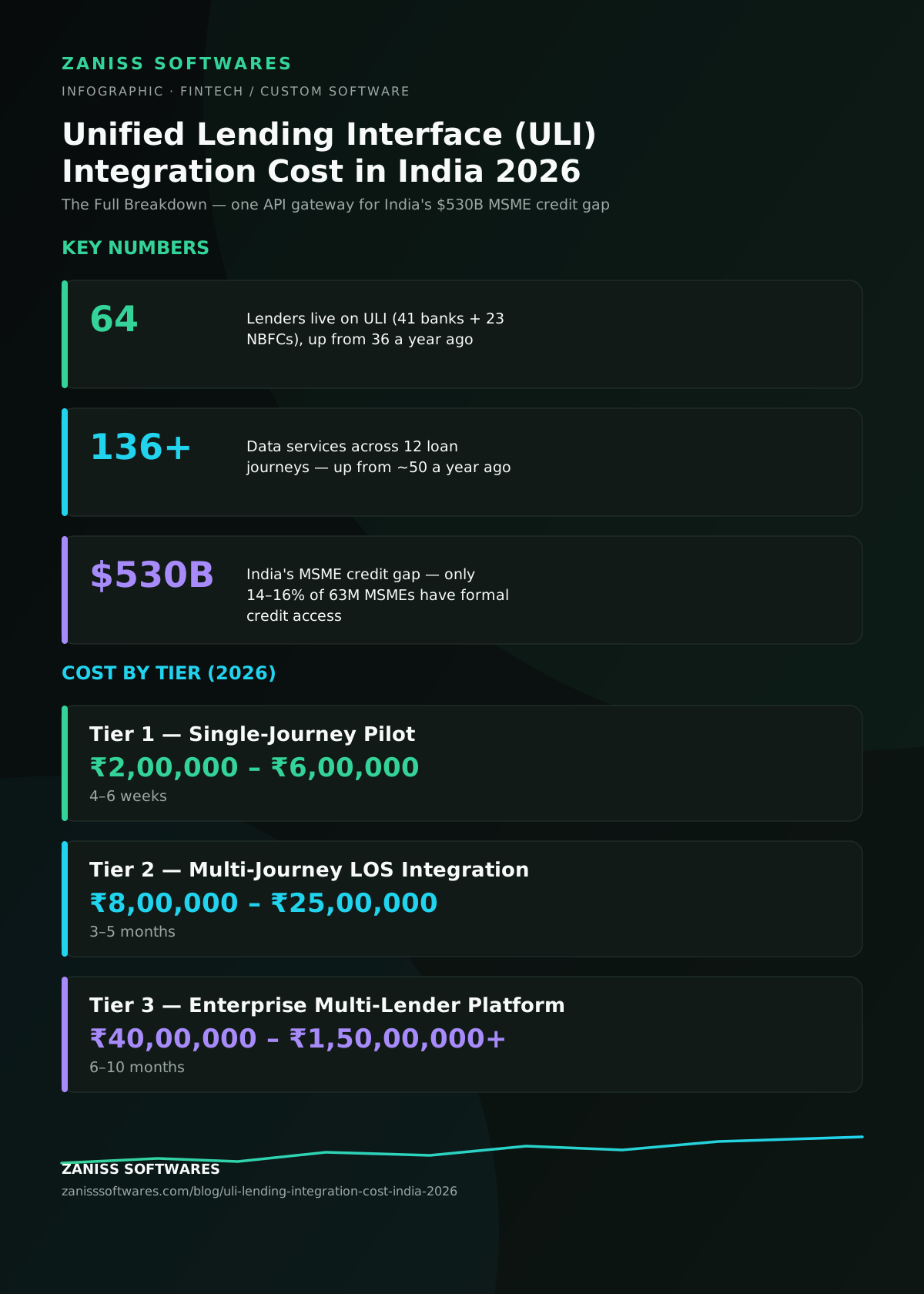
- 164 lenders — 41 banks and 23 NBFCs — are live on ULI as of December 2025, up from just 36 a year earlier; RBI now calls it "no longer a pilot."
- 2ULI replaces one-to-one bilateral integrations between lenders and data providers with a single standardised API gateway spanning 136+ data services across 12 loan journeys.
- 32026 integration cost tiers: ₹2,00,000–₹6,00,000 for a single-journey pilot, ₹8,00,000–₹25,00,000 for a multi-journey LOS integration, ₹40,00,000–₹1,50,00,000+ for an enterprise multi-lender platform.
- 4India's MSME credit gap is roughly USD 530 billion — ULI is RBI's infrastructure bet to close it, and lenders who integrate now get a head start on a 12-journey data pipeline most competitors haven't touched yet.
What Is the Unified Lending Interface, and Why It's Not "Just Another UPI"
If you build or run lending software in India, you've probably heard "ULI" mentioned in the same breath as UPI — and assumed it's a payments rail with a new acronym. It isn't. The Unified Lending Interface (ULI) is RBI's digital public infrastructure (DPI) for the data side of lending: a single API gateway that connects lenders to the dozens of data sources a credit decision actually depends on — identity verification, state land records, GST filings, satellite imagery, dairy cooperative data, credit guarantee schemes — without each lender building a separate bilateral integration to every one of them.
The idea isn't new. It traces back to a 2022 pilot that digitised Kisan Credit Card (KCC) loans under ₹1.6 lakh, which RBI formalised in 2023 as the Public Tech Platform for Frictionless Credit (PTPFC) — later rebranded as ULI. Today the platform is owned and hosted by the Reserve Bank Innovation Hub (RBIH), though RBI has signalled that a separate entity may eventually take over running it at scale.
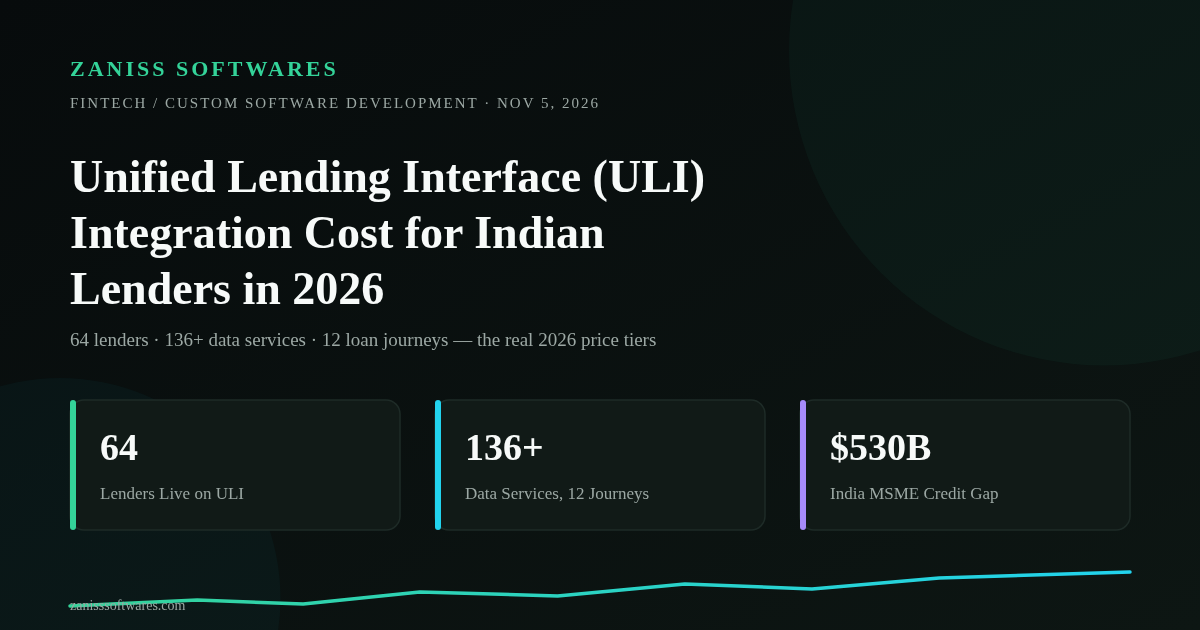
What makes ULI genuinely different from UPI is the problem it solves. UPI moves money between accounts in seconds. ULI moves the information a lender needs to decide whether to lend at all — and it's doing that at a scale RBI itself now calls "no longer a pilot": 64 lenders, spanning 41 banks and 23 NBFCs, were live on the platform as of December 2025, up from just 36 a year earlier. If your institution originates loans — retail, MSME, agri or dairy — ULI is quickly becoming infrastructure you can't ignore, the same way UPI became infrastructure no payments app could skip.
Inside ULI: How the API Gateway Actually Works
RBI describes ULI as a universal API gateway covering the entire loan lifecycle — from identity verification and eligibility checks through application processing to disbursement. The design principle is "plug-and-play": a lender integrates once with the ULI gateway and reaches dozens of data providers through that single connection, instead of negotiating and maintaining a separate technical integration with each one.
The data flow is straightforward on paper and non-trivial to build well. A borrower submits a loan request to a lender. The lender sends a data request to the ULI central system. ULI fetches the relevant records from the appropriate data sources in real time. Those records come back as a standardised data response. The lender's underwriting logic then turns that response into a loan decision. The standardisation is the real engineering win: schemas for KYC, property search, land records and credit guarantee data are consistent across providers, so a lender's integration code doesn't need a special case for every state government's land records system or every dairy cooperative's data feed.
On the data side, ULI already pulls from a wide range of custodians: UIDAI (Aadhaar-based identity), digitised land records from eight states, satellite and geospatial data, PAN and tax records, GST filings, Registrar of Companies data, AgriStack, DigiLocker documents, dairy-cooperative insights, and credit guarantee scheme information. Distribution has reached beyond large banks, too — through NABARD's e-Kisan Credit Card (e-KCC) platform, ULI now reaches district central cooperative banks and regional rural banks that would never have built their own API integrations.
One governance detail matters enormously for your architecture: RBI has stated that ULI itself does not store customer data or borrower consent. Consent management and grievance redress stay with the individual lender. That means your DPDP Act 2023 compliance work — consent capture, audit logging, data retention, breach response — doesn't move to RBIH just because you're integrating with a government-backed gateway. It stays squarely your problem, built on top of encrypted, secure API calls to ULI.
The 12 Loan Journeys and 136+ Data Services Live Today
ULI's growth over the past year has been fast by DPI standards. Data services rose from roughly 50 to more than 136, now supporting 12 distinct loan journeys. Lender participation nearly doubled, from 36 to 64 in twelve months. For a platform RBI was still calling a pilot in 2024, that's a meaningful signal that ULI is being treated as core infrastructure rather than a side experiment.
The 12 loan journeys lean heavily toward the segments India's formal credit system has historically underserved: Kisan Credit Card and other agri loans, dairy-sector lending backed by cooperative data, property-backed MSME loans using digitised land records, and working-capital products that can now pull GST and tax data directly instead of asking the borrower for photocopies. That underserved-segment focus isn't incidental — it's the point. PwC's 2024 analysis of ULI put India's MSME credit gap at roughly USD 530 billion, with only 14–16% of the country's 63 million MSMEs having access to formal credit. ULI is RBI's structural bet that standardised data access, not just more capital, is what closes that gap.
For a lending platform or fintech deciding whether to build on ULI now, the practical read is this: the data-service catalogue is wide enough to support real products today, but it's still growing fast enough that your integration architecture should assume more journeys and more data providers will be added — not just the ones you need for launch.
ULI, Account Aggregator, and ONDC: How the Three DPIs Fit Together
If you've already worked with Account Aggregator (AA) integrations — through providers like Setu, FinBox, Perfios or Decentro — or read our earlier breakdown of ONDC integration, you're already one DPI away from understanding ULI. All three are part of the same India Stack philosophy: standardise an interface once, let every participant plug in, and stop forcing n-to-n bilateral integrations.
The distinction that matters for architecture: AA is a consent-based framework for a customer to share their own financial data (bank statements, investment holdings, insurance records) with a lender who requests it, mediated by regulated Financial Information Providers and Users. ULI is broader and lender-facing — it's not limited to customer-consented financial data; it spans identity, land, agri, tax and guarantee-scheme data across the full loan lifecycle. RBI's own documentation frames the two as complementary rather than competing: AAs can feed consolidated financial data into a ULI-based underwriting flow, and the platform is explicitly meant to interoperate with AA, OCEN (the Open Credit Enablement Network) and ONDC rather than replace any of them.
In practice, most serious 2026 lending builds end up touching at least two of these three DPIs — ULI for loan-lifecycle and alternate data, AA for consent-based financial data — and the integration cost tiers below assume that reality rather than a ULI-only build in isolation.
ULI Integration Cost in India (2026): Complete Pricing Breakdown
Figures below are ZANISS SOFTWARES' indicative 2026 engagement ranges for ULI integration work, inclusive of engineering time, RBIH sandbox-to-production onboarding support, and testing. As of November 2026, neither RBI nor RBIH has published a per-call or per-transaction fee schedule for ULI itself (unlike UPI's MDR), so these figures reflect build cost, not platform usage fees — budget for a usage-fee line once RBIH finalises one.
| Tier | What's Included | Typical Cost (INR) | Timeline |
|---|---|---|---|
| TierTier 1 — Single-Journey Pilot | What's IncludedOne ULI loan journey (e.g. KCC/agri or basic MSME working-capital), one to two data services (Aadhaar-based KYC plus land records or credit bureau), RBIH sandbox onboarding, basic rules-based underwriting | Typical Cost (INR)₹2,00,000 – ₹6,00,000 | Timeline4–6 weeks |
| TierTier 2 — Multi-Journey LOS Integration | What's IncludedLoan origination system (LOS) integrated with ULI across 3–5 loan journeys, Account Aggregator consent flow layered on top, GST/PAN/credit-bureau data services, DPDP-compliant audit logging, reconciliation dashboard, RBIH production onboarding | Typical Cost (INR)₹8,00,000 – ₹25,00,000 | Timeline3–5 months |
| TierTier 3 — Enterprise Multi-Lender / TSP Platform | What's IncludedTechnology-service-provider-grade platform serving multiple NBFCs/banks on ULI, 24x7 BCP/DR, custom underwriting and scoring engine, AA + OCEN + ONDC interoperability, high-availability architecture, RBIH certification support, dedicated compliance and security review | Typical Cost (INR)₹40,00,000 – ₹1,50,00,000+ | Timeline6–10 months |
What Actually Drives the Cost Up or Down
The number of loan journeys you target is the single biggest cost lever — each additional journey means new data services, new schema handling, and new underwriting rules to validate. Beyond that, five factors move a quote the most: how many data services you consume per journey; whether your existing LOS or core banking system is API-first or legacy and screen-scraped; whether you build a custom underwriting/scoring engine or lean on bureau scores and ULI data directly; how deep your compliance and audit requirements run as a regulated entity versus a TSP serving regulated entities; and whether you need full 24x7 BCP/DR, which RBI's own ULI design principles explicitly call for at scale.
Teams that scope a single pilot journey first and expand consistently land near the bottom of each tier. Teams that try to build the Tier 3 platform on day one — before validating demand with real borrowers on even one journey — routinely spend Tier 3 money to discover they needed a Tier 1 answer.
A Decision Framework: Which Integration Path Is Right for You
Ask three questions before scoping a build:
- Are you a single regulated entity testing one loan product, or a platform serving many lenders? A bank or NBFC piloting one journey for its own book belongs in Tier 1 or 2. A fintech building a TSP-style platform that onboards multiple lenders onto ULI needs Tier 3's compliance and BCP/DR depth from day one — retrofitting that later is expensive and slow.
- Do you already have a modern, API-first LOS or core banking stack, or are you integrating from a legacy system? Legacy cores without clean APIs add real integration effort before ULI work even starts — budget that as a separate line, not inside the ULI tier.
- Do you need just ULI, or are you also layering Account Aggregator consent and OCEN-style co-lending on top? Most production-grade 2026 builds touch at least two DPIs. If AA or OCEN is on your roadmap within 12 months, design the consent and data layer for all of them now — it's materially cheaper than bolting AA on after a ULI-only build ships.
Quick gut check: if you can name the one loan journey you'd launch first and the one data service you can't ship without, you're ready to scope Tier 1 or 2 this quarter. If you're still debating which journeys to prioritise, that conversation — not a build — is the next step.
Common Mistakes Lenders and Fintechs Make
- Treating ULI like a payment rail. ULI is a data-decisioning gateway, not a money-movement API. Teams that staff the project like a UPI integration under-scope the underwriting, compliance and audit work ULI data actually demands.
- Skipping RBIH sandbox testing. Going straight to production onboarding to save a few weeks routinely costs more time later when schema edge cases surface against real data providers instead of test fixtures.
- Not budgeting for DPDP Act consent and audit logging from day one. Because ULI doesn't store consent or customer data, that liability — and its engineering cost — sits entirely with you.
- Assuming ULI's roadmap is fixed. With data services growing from 50 to 136+ in a year, an architecture that hardcodes today's journey list instead of treating journeys as configurable will need a rebuild, not an update, within 12 months.
- Building a custom underwriting engine before validating one journey end-to-end. Validate with a pilot and bureau-standard scoring first; invest in a bespoke scoring model once real loan performance data justifies it.
Frequently Asked Questions
What exactly is the Unified Lending Interface (ULI), and is integrating with it mandatory?
ULI is RBI's digital public infrastructure for lending data — a single API gateway connecting lenders to identity, land, tax, agri and credit-guarantee data sources across the loan lifecycle. It isn't legally mandatory the way some compliance regimes are, but with 64 lenders already live and growing fast, it's rapidly becoming the default way regulated entities access this data at scale rather than a niche option.
How is ULI different from Account Aggregator (AA) and UPI?
UPI moves money. AA shares a customer's own consented financial data between regulated parties. ULI is broader and lender-facing: it spans identity, land records, agri data, tax filings and credit-guarantee information across the entire loan lifecycle, and is designed to interoperate with both AA and UPI rather than replace either.
Which lenders and fintechs actually need to integrate with ULI in 2026?
Banks and NBFCs originating retail, MSME, agri or dairy loans are the core audience, along with fintechs building loan origination platforms or TSP-style infrastructure that serves multiple lenders. If your loan book touches any of the 12 live journeys — or the underserved-segment lending ULI targets — it's worth scoping now rather than waiting.
How long does a realistic ULI integration take, start to production?
A focused single-journey pilot can reach production in 4–6 weeks. A multi-journey loan origination system integration typically runs 3–5 months. A full multi-lender platform with enterprise compliance and BCP/DR requirements runs 6–10 months.
Do we need RBIH's approval before going live on ULI?
Yes — onboarding runs through RBIH, which currently owns and hosts the ULI platform. Any regulated entity that wants to onboard can apply directly to RBIH; budget time for sandbox testing before production go-live, which most teams underestimate.
Related Articles
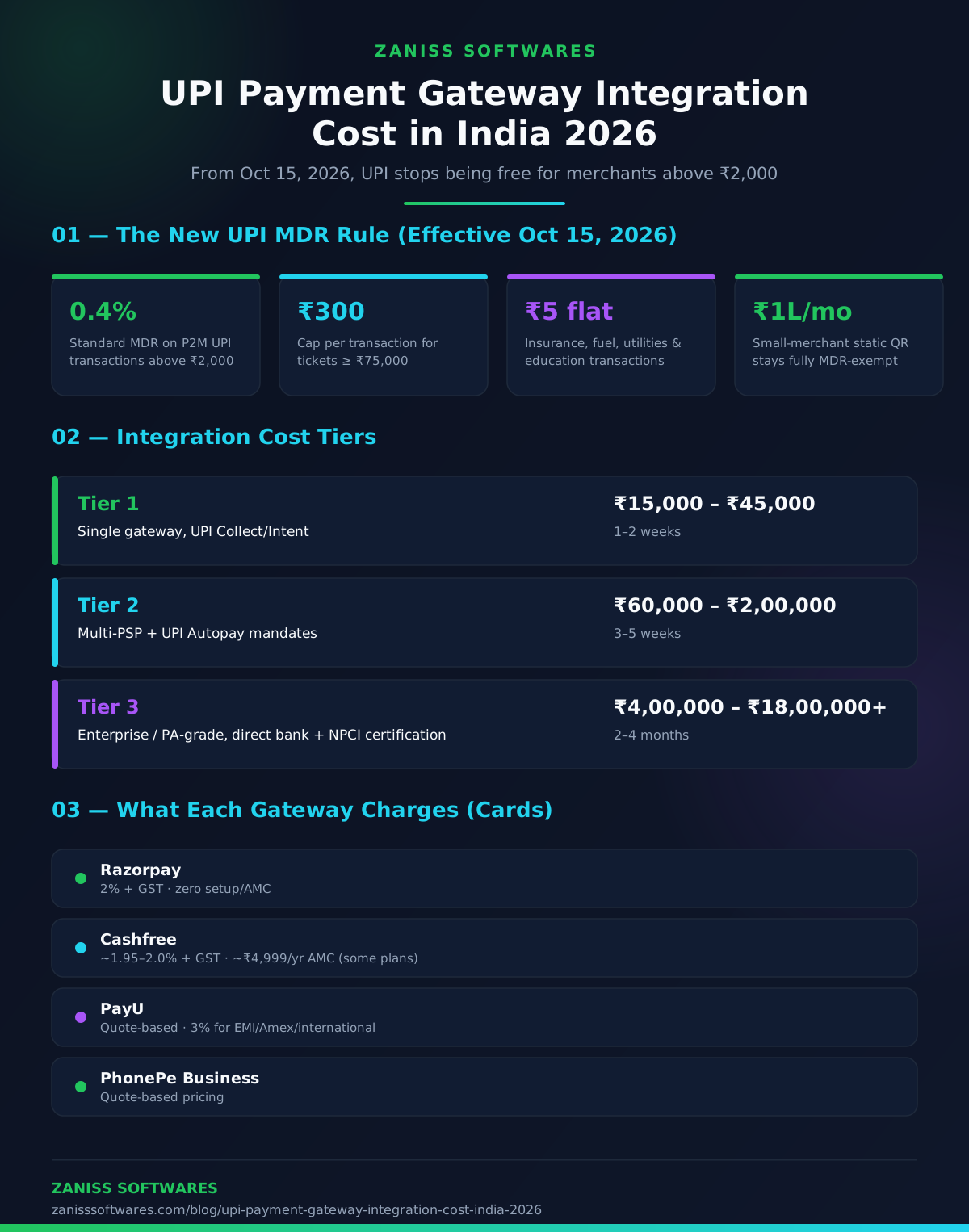
- UPI Payment Gateway Integration Cost for Indian Apps in 2026
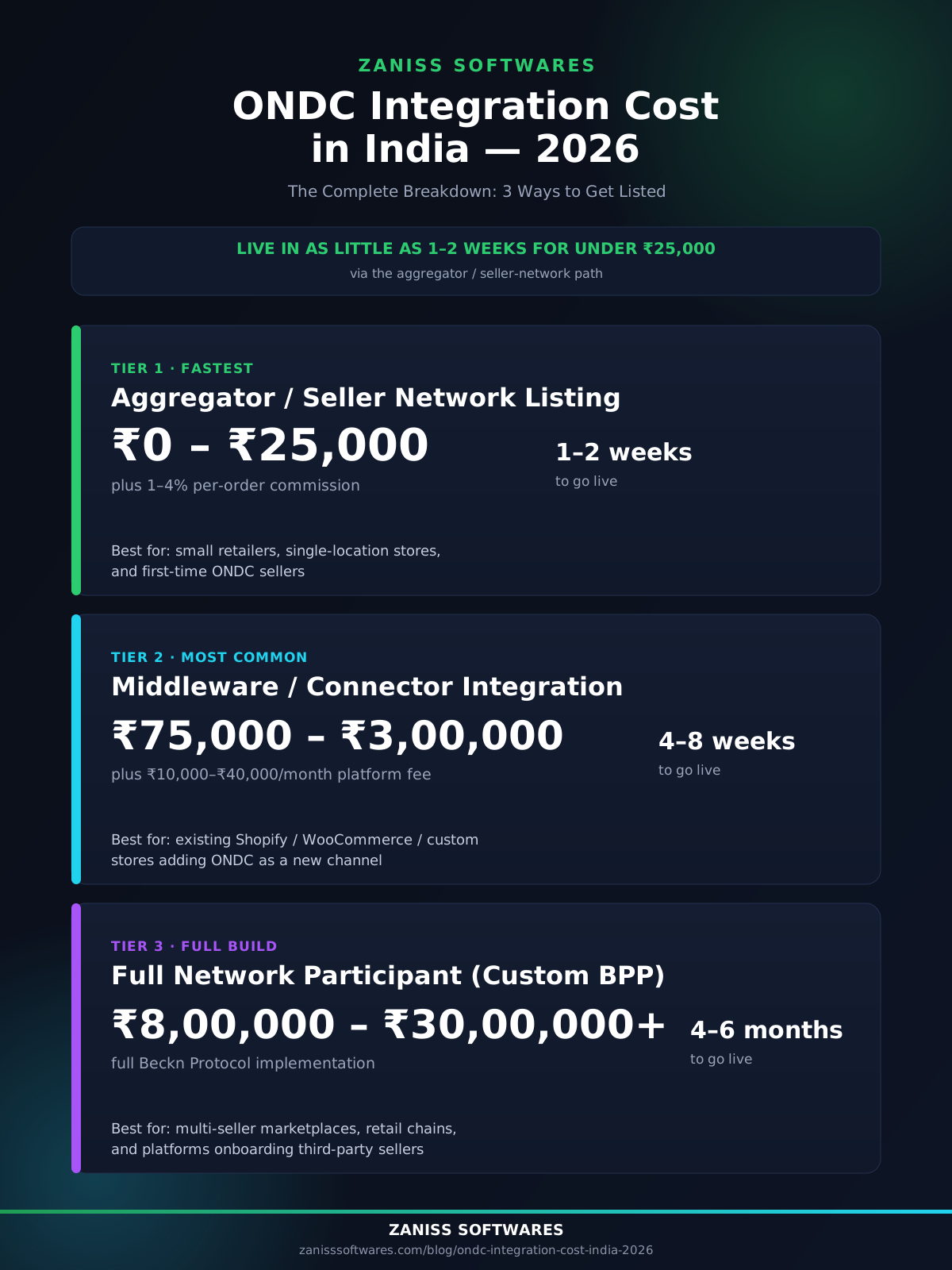
- ONDC Integration for Indian Businesses in 2026: Cost, Architecture, and How to Get Listed on the Network
- Fintech Software Development in India 2026: Compliance, Cost and Architecture
- DPDP Act Compliance for Indian SaaS: What Engineering Teams Must Build in 2026
- System Integration Services in India 2026: Connecting CRM, ERP & Disconnected Tools
Working With Us
Scoping a ULI integration — whether it's a single pilot loan journey or a multi-lender platform with full AA and OCEN interoperability — is exactly the kind of regulated, data-heavy engineering work our Custom Software Development team handles for Indian lenders and fintechs. If you want a straight answer on which tier your build actually needs and a realistic quote before you apply to RBIH, book a free 30-minute consultation — no obligation, written recap within one business day.
📩 Response within 24 hours