Quick Summary
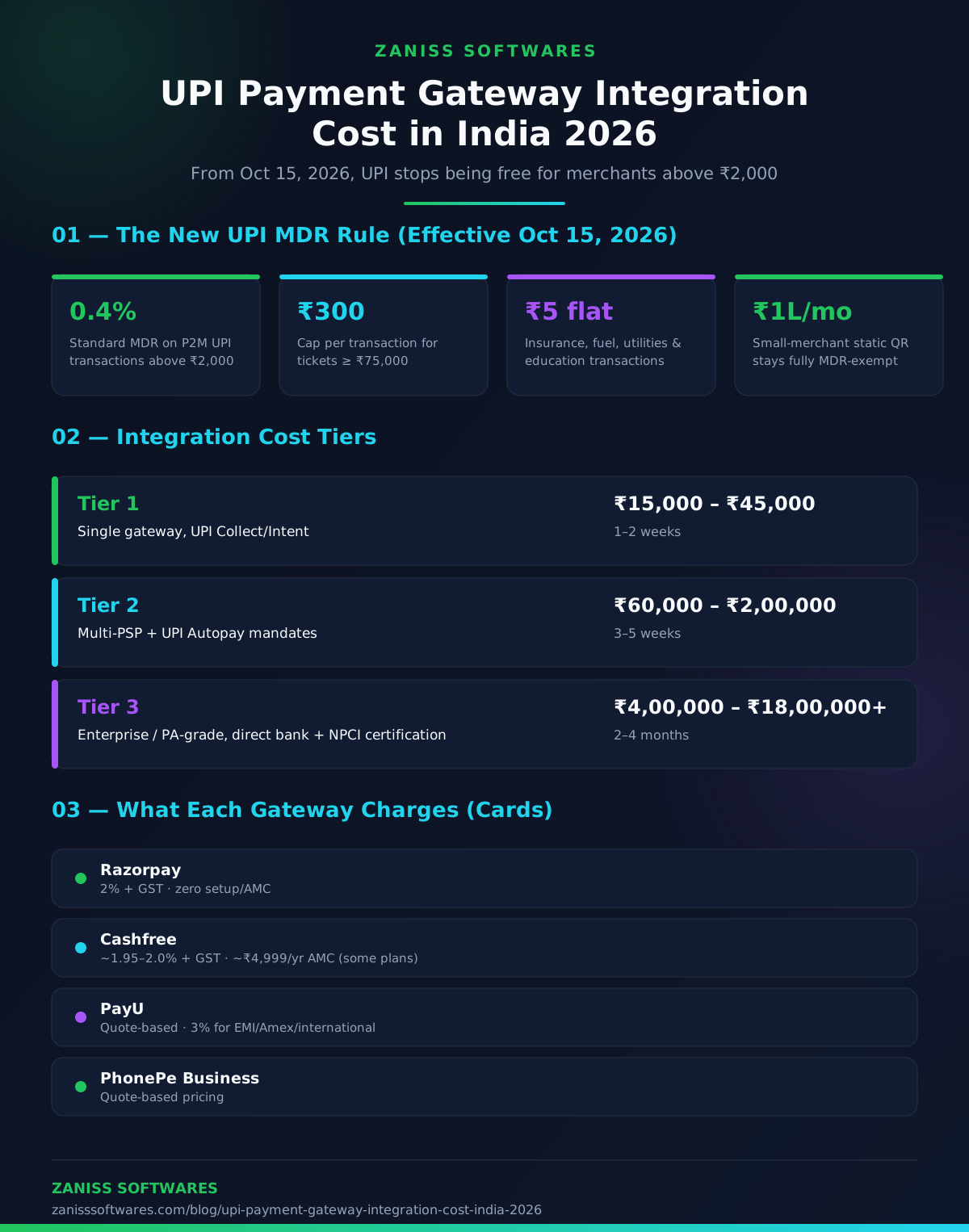
- 1Cards and wallets still cost ~2% + GST on every gateway (Razorpay, PayU, Cashfree); UPI itself has been zero-MDR for merchants since 2020 — but that changes from October 15, 2026.
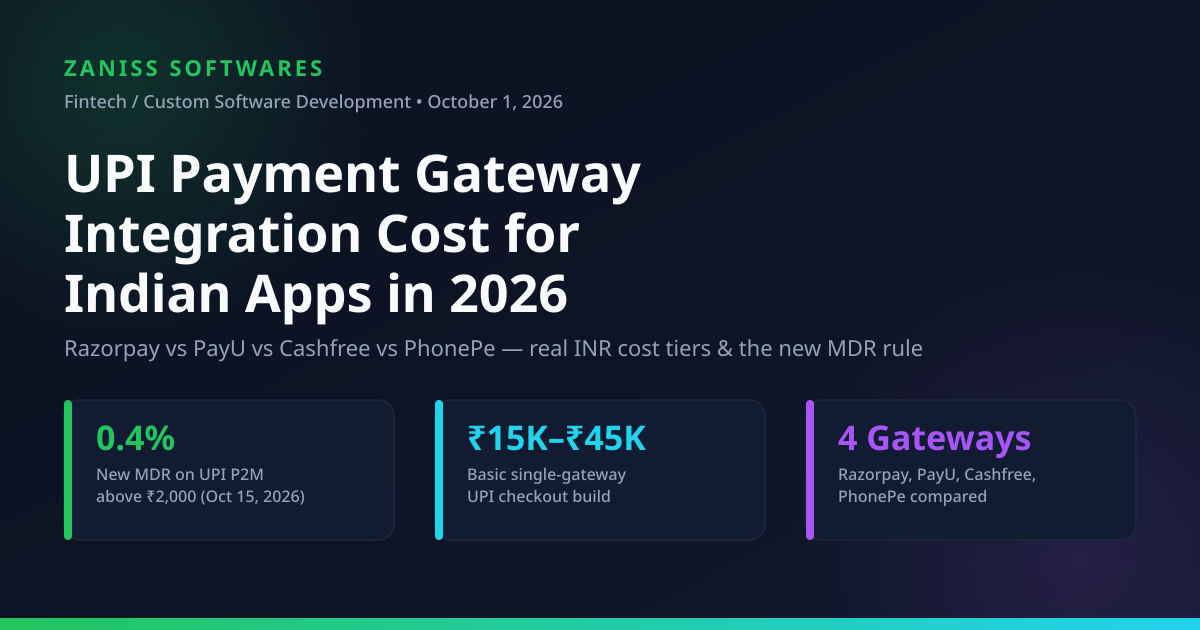
- 2NPCI's new rule adds a 0.4% MDR on person-to-merchant UPI transactions above ₹2,000 (capped at ₹300 on tickets ≥ ₹75,000); small merchants collecting under ₹1 lakh/month via static QR stay exempt.
- 3A basic single-gateway UPI checkout for an app typically runs ₹15,000–₹45,000; add UPI Autopay mandates and multi-PSP redundancy and it's ₹60,000–₹2,00,000; enterprise/PA-grade builds with direct bank tie-ups run ₹4,00,000–₹18,00,000+.
- 4If your app bills recurring subscriptions, budget UPI Autopay (commonly still called "UPI 2.0") as its own line item — mandate creation and execution carry separate, smaller per-transaction fees on top of the gateway's base pricing.
Why UPI integration cost varies so much in 2026
Every founder who asks "what does it cost to add UPI to my app?" gets a different answer depending on who's quoting, because "UPI integration" means at least three very different engineering jobs. Dropping a Razorpay or Cashfree checkout widget into a React Native app is an afternoon's work for a competent engineer. Building a resilient, multi-PSP payment layer with automatic failover, UPI Autopay mandates for subscriptions, reconciliation against bank settlement files, and dispute/chargeback workflows is a multi-week systems project. Becoming a Payment Aggregator yourself, with direct NPCI and bank certification, is a different order of magnitude entirely — closer to building fintech infrastructure than "adding a payment button."
The honest starting point is this: UPI is deceptively simple from the consumer side — scan, approve, done — and deceptively complex from the merchant integration side, because you're not integrating with one rail. You're integrating with a payment gateway's abstraction over NPCI's UPI switch, over your customer's bank, over the gateway's settlement and reconciliation systems, and (increasingly in 2026) over a new regulatory layer that changes what you can charge and what gets deducted before money reaches your account.
This guide breaks down what Razorpay, PayU, Cashfree and PhonePe's Business API actually charge in 2026, what the new UPI Merchant Discount Rate (MDR) rule effective October 15, 2026 means for your revenue model, and what a realistic INR budget looks like depending on which of the three integration tiers your app actually needs.
Razorpay vs PayU vs Cashfree vs PhonePe: what each actually charges
All four platforms publish broadly similar headline pricing, and the real differences show up in the fine print and in what you negotiate once your volume justifies a sales conversation.
Razorpay advertises a standard 2% + GST per successful domestic transaction (cards, netbanking, wallets), zero setup fee and zero Annual Maintenance Charge. UPI transactions carry zero MDR under the government's long-standing mandate, though Razorpay's dashboard and infrastructure sit on the same "platform fee" logic as its card pricing once a merchant moves off any promotional tier. New merchants frequently get a 0% platform fee window on their first ₹5 lakh of cumulative volume for the first 90 days, with a one-time KYC processing fee of roughly ₹199 plus tax. Instant settlement (money in your account same-day rather than T+1) costs an additional 0.20–0.30% per transaction. International cards and EMI-based methods sit at 3% and above. Above ₹5 lakh in monthly volume, Razorpay moves you to negotiated enterprise pricing.
Cashfree Payments mirrors this closely: zero setup fee, but a published Annual Maintenance Contract of roughly ₹4,999/year on some plans (waived or negotiated at volume), domestic cards around 1.95–2.0% depending on promotional cycles, and UPI priced "as per applicable law" — i.e., zero MDR until the regulatory change below. Where Cashfree gets specific is recurring payments: UPI Autopay mandate creation runs about ₹7.50 per mandate, with execution fees of roughly ₹5 per presentation under ₹1,000 and ₹15 at or above ₹1,000. If your app is a subscription product, those per-cycle numbers matter more than the headline MDR.
PayU publishes the least granular pricing of the four — card rates vary by business category and volume and generally require a quote, though EMI, Amex, Diners and international cards sit at 3% in line with the rest of the market. PayU advertises no setup or maintenance fees. For a founder comparing gateways, PayU is usually the one you shortlist once you already have volume to negotiate with, not the one you pick for a quick MVP integration, simply because its public documentation assumes a sales conversation.
PhonePe's Payment Gateway / UPI Payment Gateway (its merchant-facing API product, distinct from the consumer app) also requires a quote for most pricing, but it carries one practical advantage for UPI-heavy Indian consumer apps: PhonePe's own enormous UPI handle base means a meaningful share of your customers' UPI apps already default to PhonePe, which can translate into marginally better success rates on PhonePe-initiated intent flows. It's worth a comparative pilot if your user base skews toward PhonePe over Google Pay or Paytm, but you will need to talk to their business team for real numbers rather than relying on a published rate card.
The practical takeaway: treat the published 2% as a worst-case anchor, not a quote. Every one of these four platforms negotiates once you can show ₹5–10 lakh+ in projected monthly volume, and UPI-specific rates — at least until October 2026 — have effectively been zero MDR across the board because the government mandated it, not because any one gateway is more generous than another.
The UPI Autopay layer: mandates, recurring billing, and why it changes your build
What most teams still informally call "UPI 2.0" is UPI Autopay — NPCI's e-mandate framework that lets a customer authorize recurring debits (subscriptions, EMIs, SIPs) through UPI rather than a saved card. If your app bills anything on a recurring basis — SaaS subscriptions, OTT content, insurance premiums, loan EMIs, membership fees — Autopay isn't optional polish, it's core infrastructure, because UPI has overtaken cards as the preferred recurring-payment rail for a large share of Indian consumers who don't carry a credit card at all.
Integrating Autopay is meaningfully more work than integrating one-time UPI Collect or Intent flows. You need to build and test the mandate creation flow (customer authorizes a recurring debit up to a cap amount), the mandate execution flow (the actual recurring charge, which runs silently once authorized, subject to a mandatory pre-debit notification), mandate pause/revoke handling, and failure/retry logic when an execution fails due to insufficient balance or a revoked mandate. Gateways price mandate creation and execution separately from one-time transactions — Cashfree's ₹7.50 mandate-creation and ₹5–15 per-execution figures above are typical of the market — and those costs scale with your subscriber count in a way that one-time MDR percentages don't.
For any app with a subscription or EMI billing model, budget Autopay as its own integration line item, separate from your core checkout, and expect it to add roughly 30–40% to your base UPI integration timeline.
The new NPCI MDR rule (effective October 15, 2026) and what it means for your P&L
This is the single biggest UPI-economics change Indian app builders need to plan around in 2026. NPCI, backed by the RBI, has introduced a Merchant Discount Rate on select Person-to-Merchant (P2M) UPI transactions, effective October 15, 2026, after years of UPI being mandated zero-MDR for merchants:
- Standard rate: 0.4% on P2M UPI transactions above ₹2,000.
- High-value cap: Capped at ₹300 per transaction for amounts of ₹75,000 and above, so the fee doesn't scale unbounded on large tickets.
- Sector-specific flat fees: Insurance, fuel, utilities and education transactions attract a flat ₹5 per transaction rather than the percentage rate. Capital market transactions carry a separate 0.02% rate (also capped at ₹300).
- Small-merchant exemption: Merchants operating under the P2PM (person-to-small-merchant) framework who collect up to ₹1 lakh per month through static UPI QR codes continue at zero MDR — no changes required to existing QR infrastructure.
- Who pays: The merchant absorbs this fee. The rule explicitly bars passing it on to the customer — "consumers pay only the posted price."
Transactions below ₹2,000 remain exempt from the new MDR across every merchant category.
For an app-based business, the practical implication is that your average order value determines whether this matters at all. A food-delivery or micro-transaction app where most orders sit under ₹2,000 sees close to zero impact. A B2B SaaS platform, an EMI-based lending app, or an e-commerce storefront where typical transactions clear ₹2,000 regularly needs to model a 0.4% hit into unit economics for the first time since UPI launched — and needs a payment gateway integration that can correctly flag, calculate and reconcile which transactions the new MDR applies to, because the threshold and sector exceptions aren't something you can leave to the gateway's default dashboard without checking.
This is also precisely why "integration cost" now includes compliance logic that didn't exist a year ago: your backend needs to know a transaction's category (standard P2M, insurance/fuel/utilities/education flat-fee, capital markets, or small-merchant-exempt) before it can correctly predict net settlement, not just gross transaction value.
Real integration cost tiers for Indian apps in 2026
Based on current implementation work ZANISS SOFTWARES scopes for Indian app teams, here's what a realistic INR budget looks like by integration depth, inclusive of engineering time, gateway onboarding support, and testing — not inclusive of the gateway's own transaction-time MDR/platform fees described above, which are ongoing operating costs rather than one-time build costs.
| Tier | What's included | Typical cost (INR) | Timeline |
|---|---|---|---|
| Tier 1 — Single gateway, UPI Collect/Intent | One PSP (e.g. Razorpay or Cashfree), standard checkout UI, UPI Intent + Collect flows, basic webhook/status handling, sandbox-to-production go-live | ₹15,000 – ₹45,000 | 1–2 weeks |
| Tier 2 — Multi-PSP + UPI Autopay | Two PSPs for failover/redundancy, UPI Autopay mandate creation & execution for subscriptions, reconciliation dashboard against settlement files, retry logic, MDR-category tagging per transaction | ₹60,000 – ₹2,00,000 | 3–5 weeks |
| Tier 3 — Enterprise / PA-grade build | Direct bank tie-ups, support through NPCI/Payment Aggregator certification, multi-bank UPI switch failover, custom mandate & dispute/chargeback workflows, DPDP-compliant audit logging and data residency | ₹4,00,000 – ₹18,00,000+ | 2–4 months |
Most apps — single-vendor SaaS tools, D2C storefronts, service-booking apps — belong in Tier 1 or Tier 2. Tier 3 is for platforms that are themselves becoming payment infrastructure (marketplaces settling to thousands of sub-merchants, lending platforms, or anyone the RBI would classify as needing their own PA licence).
Decision framework: which integration path fits your app
Ask three questions before scoping a build:
- Do you bill recurring payments? If yes, Tier 1 is almost never sufficient — you need Autopay mandates from day one, which pushes you to Tier 2 at minimum.
- What's your typical transaction size? Comfortably under ₹2,000 per order, the new MDR rule barely touches you and a single well-chosen gateway (Tier 1/2) is fine. Regularly above ₹2,000, you need MDR-category logic built in from the start, not bolted on later.
- Are you a platform settling money to other merchants, or a single business collecting your own revenue? The moment you're splitting settlement across sub-merchants (a marketplace, a franchise network, a multi-vendor platform), you're in Tier 3 territory regardless of transaction size, because NPCI/RBI treat that as aggregation, not simple collection.
A quick gut check: if you can describe your payment flow in one sentence — "customer pays us, once or on a schedule" — you're Tier 1 or 2. If the sentence needs a second clause — "...and we then split or forward part of that to someone else" — budget for Tier 3 from the outset rather than discovering the compliance requirement mid-build.
Common hidden costs teams miss
Three costs consistently get left out of first-pass budgets. First, reconciliation tooling — matching what your app's database says a customer paid against what actually settled into your bank account, after MDR deductions, refunds and chargebacks, is its own small project if you want it automated rather than a monthly spreadsheet exercise. Second, failure-state UX — a UPI payment can fail, time out, or show as pending for minutes while the actual debit succeeds on the bank's side; building a status-polling and reconciliation flow that doesn't double-charge or silently drop a successful payment is where most "quick" integrations actually spend their time. Third, sandbox-to-production friction — every gateway's test environment behaves subtly differently from production (especially around Autopay mandate timing and pre-debit notifications), so budget real QA time against live bank accounts in a staging-equivalent flow before go-live, not just sandbox credentials.
Companion infographic: UPI Payment Gateway Integration Cost in India 2026 — The Full Breakdown →
Related Articles
- Fintech Software Development in India 2026 (Cost & Compliance)
- SaaS MVP Cost & Timeline 2026 — Founder Guide
- DPDP Act Compliance for Indian SaaS: What Engineering Teams Must Build in 2026
- ONDC Integration for Indian Businesses in 2026: Cost, Architecture, and How to Get Listed on the Network
Companion infographic: UPI Payment Gateway Integration Cost in India 2026 — The Full Breakdown →
Planning a Website? Don't Overpay or Underbuild
Most businesses overspend on features they don't need — or underspend and rebuild within a year. We help you scope it right from day one.
Pro Insight
Working With Us
Building or re-architecting UPI payments into your app — whether it's a quick single-gateway checkout or a full PA-grade, multi-bank build — is exactly the kind of scoped engineering work our Custom Software Development team handles week to week for Indian product teams. If you want a straight answer on which tier your app actually needs and a realistic quote before you commit to a vendor, book a free 30-minute consultation — no obligation, written recap within one business day.
- ✓SEO-first architecture
- ✓Conversion-focused design
- ✓High-speed performance
- ✓Scalable, future-proof code
📩 Response within 24 hours
Frequently Asked Questions
Is UPI really free for merchants in India in 2026?
Mostly, yes — but not entirely as of October 15, 2026. UPI remains zero-MDR for person-to-merchant transactions under ₹2,000 and for small merchants collecting under ₹1 lakh/month via static QR. Above that, NPCI's new rule applies a 0.4% MDR (capped at ₹300 on large tickets, or a flat ₹5 for insurance/fuel/utilities/education transactions).
What is UPI Autopay / "UPI 2.0" and do I need it?
UPI Autopay is NPCI's e-mandate framework for recurring UPI debits — subscriptions, EMIs, memberships. If your app bills anything on a schedule, you need it; it's a separate integration from one-time UPI Collect/Intent payments and carries its own, smaller per-mandate and per-execution fees.
Which gateway is cheapest — Razorpay, PayU, Cashfree, or PhonePe?
All four publish broadly similar headline rates (~2% + GST on cards, historically zero MDR on UPI), and real pricing is negotiated once you have meaningful volume. Pick based on documentation quality, settlement speed, and Autopay support rather than headline rate alone, then negotiate.
How does the new 0.4% MDR rule affect my app's revenue model?
It depends entirely on your average transaction size. Apps with typical orders under ₹2,000 see almost no impact. Apps with larger average tickets (SaaS invoices, EMI collections, bigger e-commerce carts) need to model roughly 0.4% of UPI revenue above that threshold as a new cost from October 15, 2026 onward, and need integration logic that correctly tags which transactions qualify for exemptions.
How long does UPI payment gateway integration actually take?
A basic single-gateway UPI checkout: 1–2 weeks. Add Autopay mandates and a second gateway for redundancy: 3–5 weeks. A full Payment Aggregator-grade build with direct bank certification: 2–4 months. The honest range depends far more on your recurring-billing and multi-merchant-settlement needs than on the UPI piece alone.