Quick Summary
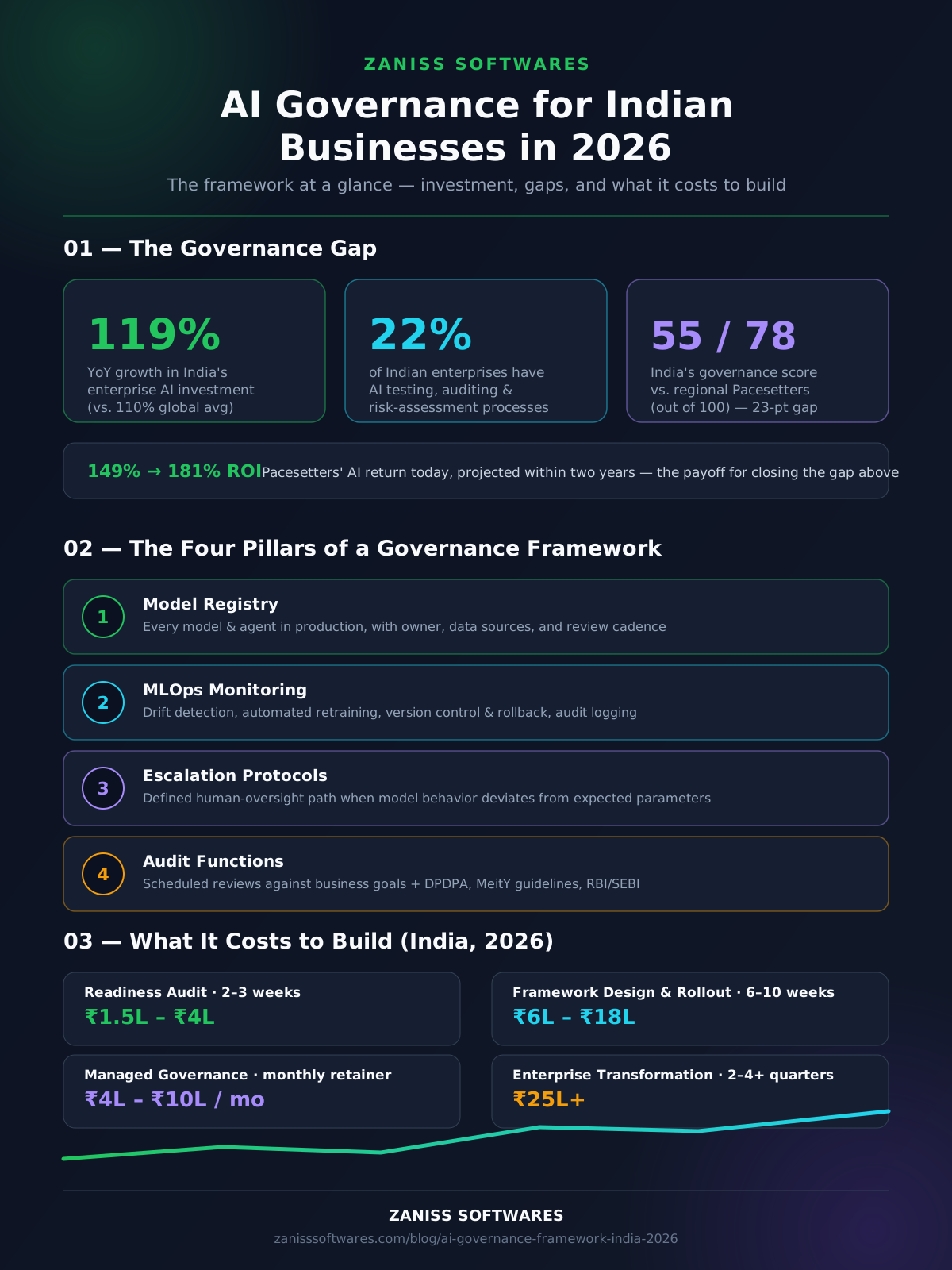
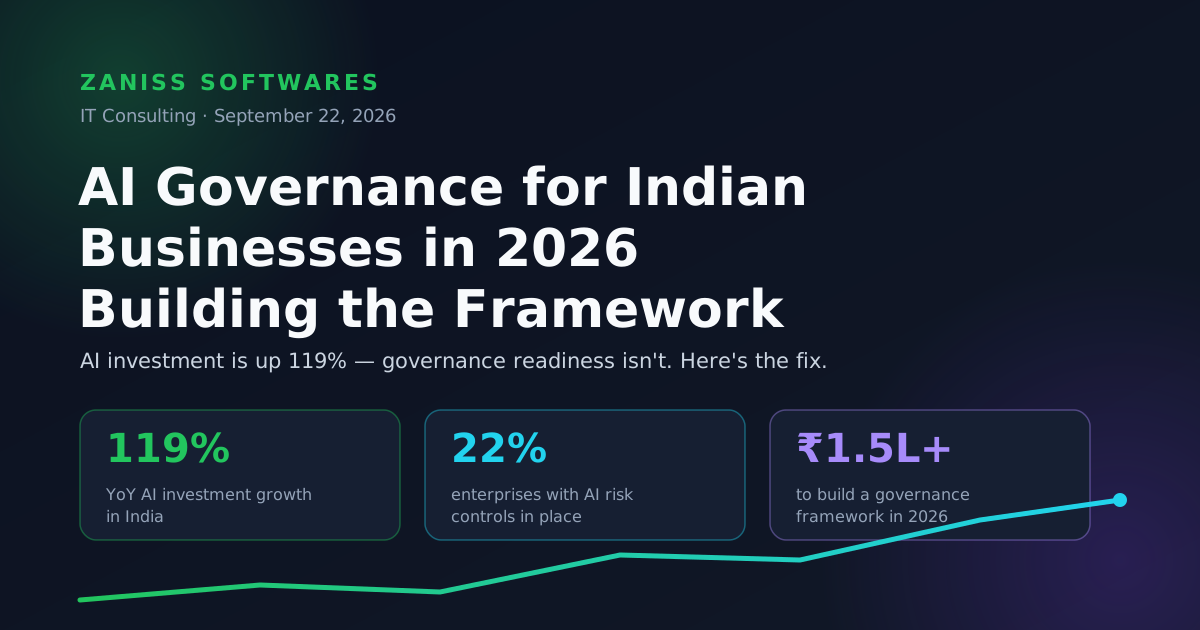
- 1Indian enterprises increased AI investment by 119% in the past year, well ahead of the global average, but a recent ServiceNow-backed study found only 22% have the testing, auditing, and risk-assessment processes to govern what they're deploying.
- 2MeitY's November 2025 India AI Governance Guidelines and the Digital Personal Data Protection Act have turned "we'll figure out governance later" into a real business risk.
- 3An AI governance framework in India in 2026 costs ₹1.5L–₹4L for a readiness audit, ₹6L–₹18L for a full framework build, and ₹4L–₹10L/month for managed oversight.
- 4A working framework has four pillars: a model registry, MLOps monitoring, escalation protocols with human oversight, and regular audits against DPDPA and sector rules.
For most of 2024 and 2025, Indian businesses treated AI governance as a slide in a strategy deck — something to revisit once the pilot proved itself. That window has closed. A 2026 study backed by ServiceNow found enterprise AI investment in India grew 119% year over year, ahead of the 110% global average, with AI now consuming 16.6% of the average IT budget and projected to reach 21.3% by 2027. Investment isn't the problem. Oversight is.
The same research found that only 22% of Indian enterprises have AI testing, auditing, and risk-assessment processes in place, and the country's overall AI governance maturity score sits at 55 out of 100, a 23-point gap behind the region's "Pacesetter" organizations, which average 78. That gap shows up in the numbers that matter to a board: Pacesetters report 149% ROI on AI investment, projected to climb to 181% within two years, while organizations without governance structures spend disproportionately more cleaning up after AI incidents, according to Gartner research on enterprise AI risk.
There's also a regulatory trigger. On November 5, 2025, the Ministry of Electronics and Information Technology (MeitY) published India's AI Governance Guidelines, a voluntary but increasingly referenced framework meant to balance innovation with responsible AI deployment in the Indian context. It arrives on top of obligations Indian companies already carry under the Digital Personal Data Protection Act (DPDPA), and sector-specific overlays from the RBI for financial services AI and SEBI for capital-markets applications. None of these force a company to stop using AI. All of them make "we don't have a governance process" a much harder answer to give a regulator, an auditor, or an enterprise customer's procurement team.
What "AI Governance" Actually Means for an Indian Business
The phrase gets used loosely, so it's worth being precise. AI governance is not the same thing as DPDPA compliance, and it's not the same thing as picking a "responsible AI" vendor and moving on. It's the operating system that sits on top of every model, agent, and AI-powered workflow a company runs: who owns each one, what data it touches, how its output is checked, and what happens when it gets something wrong.
Concretely, that means a company can answer four questions on demand: which AI systems are currently in production, who is accountable for each one, how their outputs are monitored and reviewed, and what the escalation path looks like when something goes wrong. Most Indian businesses we talk to can answer the first question loosely and none of the other three with confidence. That's the gap the 22% governance-readiness statistic is describing.
It also isn't just a defensive exercise. McKinsey's research on enterprise AI adoption found that companies with mature governance practices report meaningfully higher rates of realized AI value — not despite the governance overhead, but partly because of it. Clear ownership and monitoring make teams more willing to expand AI into higher-stakes workflows, because they can catch problems before they become incidents.
The Four Pillars of a Working AI Governance Framework
Strip away the consulting jargon and a governance framework that actually holds up in an audit has four components.
A model registry. A documented, living inventory of every AI model and agent in production, with defined ownership, the data sources it touches, and a review cadence. If a model isn't in the registry, it isn't governed — no matter how good the underlying policy document sounds.
MLOps monitoring infrastructure. Continuous monitoring for model drift, automated retraining pipelines where appropriate, version control with rollback capability, and centralized audit logging. This is the technical backbone that makes the other three pillars enforceable rather than aspirational.
Escalation protocols with human oversight. A defined path for what happens when a model's behavior deviates from expected parameters — especially in high-stakes decisions like credit approvals, hiring shortlists, or medical triage support.
Regular audit functions. Scheduled internal or third-party audits that measure model outputs against both business objectives and regulatory requirements — DPDPA, the MeitY guidelines, and any sector-specific rules (RBI, SEBI, or industry-specific bodies) that apply.
None of these four pillars is exotic engineering. Most mid-sized Indian companies already have pieces of this — a spreadsheet tracking vendor tools, a security team that reviews new integrations, a compliance officer who reads regulatory updates. The work is less about inventing new capability and more about connecting what already exists into a single, auditable system.
Where Indian Regulation Is Actually Heading
It helps to separate what's mandatory from what's precautionary. The DPDPA is law, and it already shapes how any AI system touching personal data must handle consent, data residency, and audit trails — a company running an AI-powered recommendation engine or support chatbot on customer data has DPDPA obligations regardless of whether "AI governance" is a formal program. The MeitY AI Governance Guidelines, by contrast, are currently voluntary, positioned as a framework for responsible adoption rather than a binding statute — but voluntary frameworks from regulators have a way of becoming procurement requirements and audit checklists within a couple of budget cycles, and enterprise customers are already starting to ask vendors for evidence of AI governance maturity during due diligence.
For regulated sectors, the picture is sharper. Financial services companies deploying AI in lending, fraud detection, or advisory workflows sit under RBI guidance on top of DPDPA. Capital markets platforms using AI for trading signals, research, or client communication have SEBI's requirements layered on as well. In both cases, the four-pillar framework above isn't optional groundwork — it's close to the minimum an auditor will expect to see documented.
What an AI Governance Framework Costs to Build in India (2026)
Pricing depends heavily on how many AI systems are already in production and how regulated the industry is. The ranges below reflect what this typically looks like across ZANISS SOFTWARES' IT Consulting engagements in 2026, from a scoped audit through an ongoing managed program.
| Engagement Tier | What's Included | Timeline | Investment (INR) |
|---|---|---|---|
| AI Governance Readiness Audit | Model & tool inventory, risk scoring against MeitY guidelines and DPDPA, gap report, board-ready summary | 2–3 weeks | ₹1.5L – ₹4L |
| Governance Framework Design & Rollout | Policy documentation, model registry setup, escalation protocols, human-oversight workflows, staff training | 6–10 weeks | ₹6L – ₹18L |
| Managed AI Governance / Fractional AI Risk Advisory | Ongoing audits, MLOps monitoring oversight, vendor AI risk reviews, quarterly board reporting | Monthly retainer | ₹4L – ₹10L / month |
| Enterprise-Wide Transformation Programme | Governance embedded across business units, automated compliance tooling, multi-quarter advisory | 2–4+ quarters | ₹25L+ |
A useful sanity check before committing budget: the 60% of enterprises citing transparency and misinformation concerns, the 55% flagging regulatory complexity, and the 50% pointing to data privacy and security in recent industry surveys are almost always describing gaps that a readiness audit alone would surface within three weeks — it's worth starting there rather than jumping straight to a full framework build.
Decision Framework: Audit, Framework Build, or Managed Program?
Three questions determine which tier fits.
How many AI systems are actually in production right now? One or two pilot tools — a support chatbot, an internal drafting assistant — usually justify a readiness audit first. Beyond five or six systems touching real customer or financial data, skip straight to a framework build; the audit alone will just confirm what's already obvious.
Does the business operate in a regulated sector? Financial services, healthcare, and any company handling sensitive personal data at scale should treat RBI, SEBI, or DPDPA exposure as the forcing function, not AI ambition. Regulated companies rarely have the luxury of an audit-only phase — the framework build tends to be the realistic starting point.
Is there internal capacity to run governance day to day? A framework is only as good as who maintains it. Companies without a compliance or platform team to own the model registry and audits should budget for the managed retainer from the start, rather than building a framework that quietly goes stale within two quarters.
Common Mistakes Indian Businesses Make with AI Governance
The most frequent misstep is treating governance as a document rather than a system — a policy PDF gets written, circulated, and never connected to an actual model registry or monitoring pipeline. The second is assuming DPDPA compliance already covers AI governance; it covers the personal-data slice, not model drift, escalation, or output auditing. The third is waiting for a mandate. With only 18% of Indian enterprises having replaced fragmented legacy systems with integrated platforms and just 11% moving AI agents into full autonomous workflows, most companies still have a narrow window to build governance proactively before AI adoption outpaces the ability to control it.
Related Articles
- DPDP Act Compliance for Indian SaaS: What Engineering Teams Must Build in 2026
- Fractional CTO Services in India 2026: When You Need One (and When You Don't)
- AI Integration Services in India 2026: Where AI Actually Pays Back
- Cybersecurity Services for SaaS Companies in 2026: A Practical Buyer's Guide
Companion infographic: AI Governance for Indian Businesses in 2026 — The Framework at a Glance →
Working With Us
Scaling AI without a governance framework is how a promising pilot turns into next quarter's incident report. ZANISS SOFTWARES' IT Consulting practice runs AI governance readiness audits, framework builds, and managed advisory retainers for Indian businesses navigating DPDPA, the MeitY guidelines, and sector-specific rules from the RBI and SEBI.
Explore IT Consulting services →
Book a free 30-minute strategy call →
Planning a Website? Don't Overpay or Underbuild
Most businesses overspend on features they don't need — or underspend and rebuild within a year. We help you scope it right from day one.
Pro Insight
Working With Us
Scaling AI without a governance framework is how a promising pilot turns into next quarter's incident report. ZANISS SOFTWARES' IT Consulting practice runs AI governance readiness audits, framework builds, and managed advisory retainers for Indian businesses navigating DPDPA, the MeitY guidelines, and sector-specific rules from the RBI and SEBI.
- ✓SEO-first architecture
- ✓Conversion-focused design
- ✓High-speed performance
- ✓Scalable, future-proof code
📩 Response within 24 hours