In this article
Quick Summary
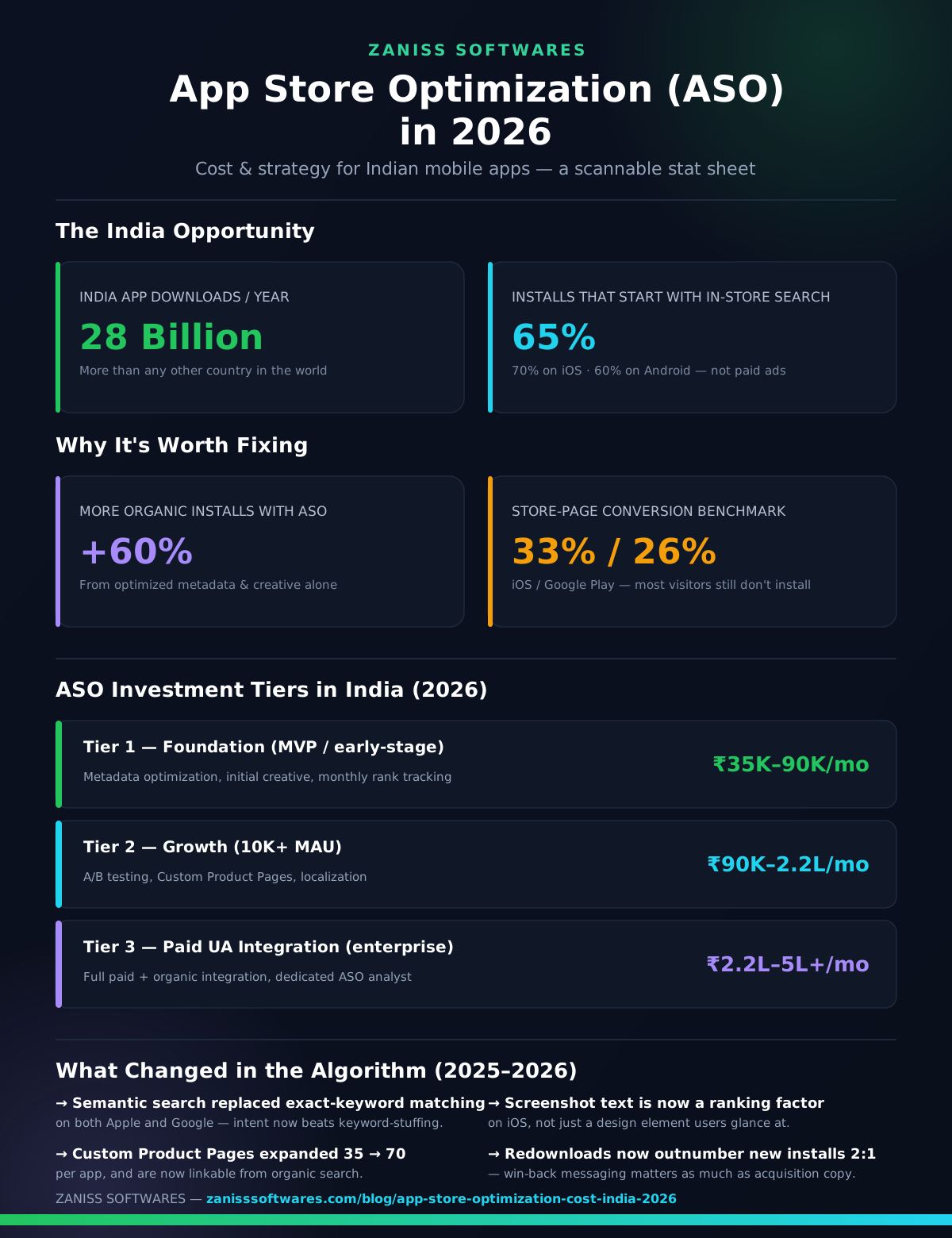
- 1India generates more app downloads than any country in the world — roughly 28 billion a year — yet most Indian businesses still treat their app store listing as an afterthought once the app itself ships.
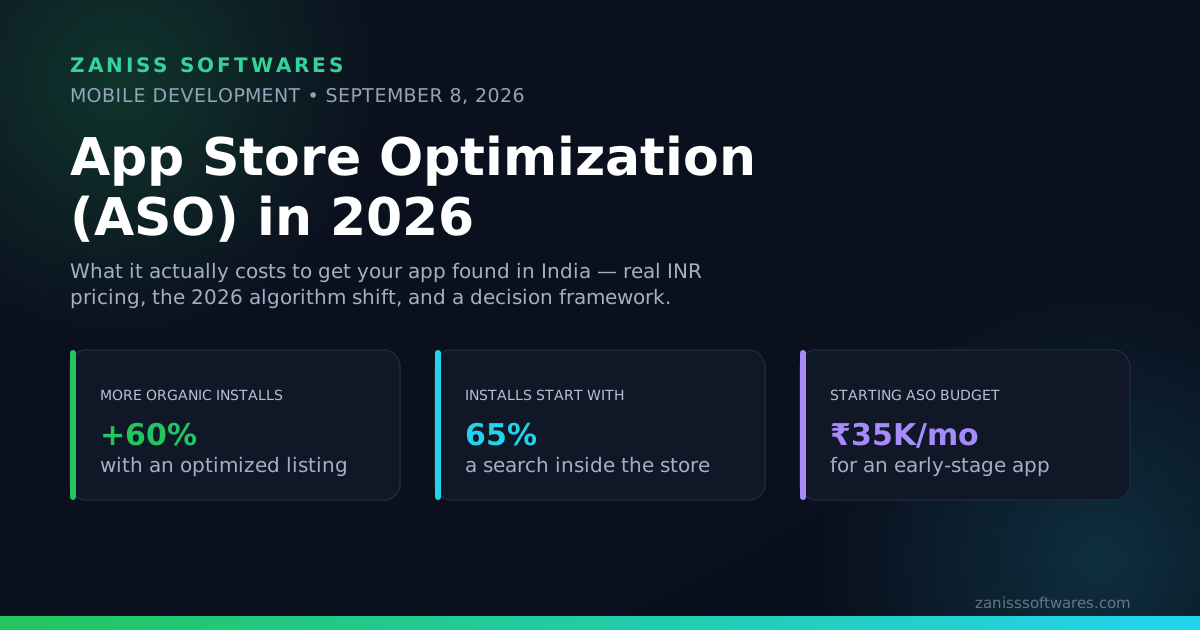
- 265% of all app installs start with a search inside the App Store or Play Store (70% on iOS, 60% on Android), and a properly optimized listing delivers roughly 60% more organic installs without spending an extra rupee on ads.
- 3Apple and Google both moved to AI-driven "semantic" search in 2025–2026, so stuffing exact keywords into a title no longer works the way it used to — intent-matching and screenshot text now materially affect ranking.
- 4A realistic ASO program in India in 2026 costs ₹35,000–₹90,000/month for an early-stage app, scaling to ₹2,20,000–₹5,00,000+/month once integrated with paid user acquisition — this article breaks down exactly what each tier buys and how to decide if now is the right time.
Why App Store Optimization Finally Matters for Indian Businesses in 2026
For years, most Indian founders and marketing heads treated the app store listing as a formality — upload the icon, write a description nobody reads, submit, done. The real marketing budget went to Instagram ads, Google Ads, and influencer partnerships that pointed people to a website or a WhatsApp number. The app store itself was just where the app "lived," not a channel you actively optimized.
That assumption is expensive in 2026. India now generates more app downloads than any other country on earth — an estimated 28 billion a year — and a large majority of those downloads start with someone typing a search directly into the App Store or Google Play, not clicking a paid ad or a social post. Roughly 65% of all installs originate from in-store search (about 70% on iOS, 60% on Android). If your listing doesn't show up in that search, or shows up but doesn't convert once a person taps in, you're invisible to the single largest source of app discovery that exists — regardless of how much you spend on Meta or Google Ads pointing traffic elsewhere.
This matters even more for the businesses we build mobile apps for at ZANISS SOFTWARES: healthcare booking apps, logistics and fleet tools, D2C and retail apps, fintech and real estate platforms. These are categories where a prospective user, having heard about your app from a friend or an ad, still goes to the app store to check ratings, screenshots, and legitimacy before installing. That moment — the store listing itself — is where a meaningful share of installs are won or lost, and it is almost entirely within your control to optimize.
What ASO Actually Means in 2026 (It's Not Just Keywords Anymore)
App Store Optimization is the practice of improving an app's visibility and conversion rate inside the App Store and Google Play — the mobile equivalent of SEO, but for a search engine that ranks apps instead of web pages. Historically, that meant stuffing the title and keyword field with high-volume search terms and hoping the algorithm rewarded exact matches.
That approach is now outdated. Apple's major search algorithm update (rolled out through mid-2025 and matured through 2026) shifted ranking toward intent-driven, semantic matching — the store now tries to understand what a searcher actually wants, not just which words appear in your metadata. Google Play has moved the same direction with its Guided Search feature, which organizes results by user intent rather than keyword frequency alone. In practice, this means an app titled and described for humans — with clear, benefit-led language — now outperforms one stuffed with disconnected keywords.
The other major shift is that visual assets are no longer decoration — they're ranking signals. Since Apple's 2025 algorithm change, screenshot text is read and factored into search relevance, not just displayed to the user. Google Play now weighs post-install engagement and retention data into how an app ranks, meaning ASO in 2026 is inseparable from product quality: an app people install and immediately delete actively hurts your ranking, not just your reviews.
The Data: What's Actually Changed in the App Store and Play Store in 2025–2026
A few concrete shifts are worth understanding before spending a single rupee on ASO. First, Apple expanded Custom Product Pages from 35 to 70 per app, and those variant pages now surface inside organic search results through keyword linking — not just paid campaign links, as before. That means a single app can now legitimately run dozens of tailored listings (one for "fleet tracking," one for "driver app," one for "dispatch software," for example) and have each one found organically for the right search.
Second, portrait-format preview video has quietly become the highest-converting creative asset: early 2026 data shows portrait video delivering roughly 7% higher watch time and about 5% better conversion than landscape video or static screenshots alone — a meaningful gap when a 1-point conversion improvement compounds across every future install.
Third, and easy to miss: redownloads now outnumber first-time downloads by roughly 2:1 globally (Apple has reported figures like 839 million weekly first-time downloads against 1.9 billion weekly redownloads). That reframes ASO priorities — win-back messaging, update notes, and re-engagement creative inside the store listing matter almost as much as first-time acquisition copy, because a huge share of your "new" installs are actually people who deleted the app once and are giving it a second look.
What It Costs to Do ASO Properly in India in 2026
ASO pricing in India scales with how competitive your category is and how much of it you want to run in-house versus with a partner. The table below reflects what a realistic, properly resourced ASO program costs as a monthly retainer in 2026 — the tiers ZANISS runs for mobile app development clients, and broadly consistent with market rates we see quoted by comparable Indian digital agencies.
Two things worth flagging before you pick a tier. First, ASO is not a one-time project — rankings and conversion rates decay as competitors update their own listings and as the algorithm itself shifts, which is why every credible program is structured as an ongoing retainer, not a single deliverable. Second, the return shows up as a lower blended cost per install: a store listing converting at 26% instead of 15% makes every rupee you already spend on paid UA, influencer marketing, or PR go further, because more of the people who arrive actually install.
ASO vs Paid User Acquisition: Why the Best Programs Use Both
A common and costly misconception is treating ASO and paid user acquisition (Apple Search Ads, Google UAC, Meta app-install campaigns) as competing budget lines. They're not — they compound. Average cost-per-install for paid app campaigns runs around $2.24 on iOS and $1.12 on Android globally, and that cost is calculated against your store listing's conversion rate. If your listing converts at the current benchmark average — 33% on iOS, 26% on Google Play — you're paying for roughly 3 to 4 clicks per install. Improve that conversion rate through better screenshots, video, and metadata, and your effective cost per install drops proportionally, even though you didn't change your ad spend or targeting at all.
This is the argument we make most often to clients who are already running paid app-install campaigns without a parallel ASO effort: you are, in effect, paying an increasing premium for traffic that a weak store listing is failing to convert. Fixing the listing first, then scaling paid spend into it, is almost always the cheaper sequence.
There's a second, less obvious benefit: Apple Search Ads and Google UAC both use the organic store listing's own metadata and creative as inputs into ad relevance scoring in many placements. A stronger organic listing doesn't just convert better on its own — it can also lower your effective cost-per-click in paid placements, because the platform's own quality signals improve alongside it. Treating ASO as the foundation paid spend sits on top of, rather than a separate line item competing for the same budget, is the mental model that tends to produce the best blended results.
ASO Investment Tiers in India (2026)
| Tier | Price Range | Best For |
|---|---|---|
| One-Time ASO Audit & Setup | ₹40,000 – ₹1,50,000 (one-time) | Full listing audit, competitor benchmarking, keyword research, and metadata rewrite before any monthly retainer begins. |
| Tier 1 — ASO Foundation (MVP / early-stage apps) | ₹35,000 – ₹90,000 / month | Keyword research and metadata optimization (title, subtitle, description), initial screenshot and preview-video design, monthly rank and conversion tracking, one competitor benchmark report per quarter. |
| Tier 2 — ASO Growth (scaling apps, 10K+ MAU) | ₹90,000 – ₹2,20,000 / month | Everything in Foundation, plus A/B testing of icons and screenshots (Play Store Experiments and Apple Product Page Optimization), Custom Product Pages for different audiences, localization into 2–3 Indian languages, quarterly full ASO audit. |
| Tier 3 — ASO + Paid UA Integration (enterprise / high-growth apps) | ₹2,20,000 – ₹5,00,000+ / month | Everything in Growth, plus integrated Apple Search Ads and Google UAC management, a continuous creative-testing pipeline, retention and win-back campaigns, and a dedicated ASO analyst with a monthly strategy call. |
Planning a Website? Don't Overpay or Underbuild
Most businesses overspend on features they don't need — or underspend and rebuild within a year. We help you scope it right from day one.
A Decision Framework: Should You Invest in ASO Now, or Wait?
Not every app needs a dedicated ASO program on day one. We use five questions with clients to decide whether now is the right time:
- Has your app been live for at least 60 days with measurable organic traffic to analyze? (Pre-launch and week-one apps don't have enough data yet — build and stabilize first.)
- Is app store search plausibly a top-3 acquisition channel for your category (as it is for most utility, healthcare, finance, retail, and logistics apps)?
- Are you already spending on Apple Search Ads or Google UAC without having touched your store listing's metadata or creative in the last 6 months?
- Has your app's icon, screenshots, or description gone unchanged for two or more quarters while competitors have visibly updated theirs?
- Are you preparing for a fundraise, board update, or expansion where organic growth efficiency (not just total downloads) will be scrutinized?
If two or more of these apply, a dedicated ASO program is worth starting now — typically at the Foundation tier, with a review after 90 days to decide whether to scale. If none apply — you're pre-launch or in your first two months live — the better use of budget is finishing the product and gathering enough install and retention data for ASO decisions to be evidence-based rather than guesswork.
What a Real ASO Program Looks Like Month to Month
A properly run ASO retainer isn't a set-and-forget metadata change — it's a recurring cycle. In a typical month, that looks like: reviewing the previous month's keyword rankings and conversion-rate data; running or analyzing at least one live A/B test on an icon, screenshot set, or preview video; checking competitor listings for changes worth responding to; updating Custom Product Pages for any new audience segment or campaign; and producing a short report tied to installs and conversion rate — not vanity metrics like impressions alone.
This is also where ASO and app development stay connected in practice. Post-install engagement and retention now feed directly into how both Apple and Google rank an app, which means the people managing your store listing need visibility into crash rates, onboarding drop-off, and update cadence — not just design and copywriting skills. It's part of why we run ASO as an extension of the mobile app development relationship rather than as a fully separate marketing engagement.
What ASO Looks Like Differently Across App Categories in India
ASO isn't one playbook applied uniformly — the categories we build for most often at ZANISS SOFTWARES each have their own conversion drivers. For healthcare and fintech apps, trust signals dominate: screenshots that show verified credentials, security badges, or compliance callouts (HIPAA, PCI-DSS, RBI guidelines) convert measurably better than generic feature screenshots, because the install decision is really a trust decision. For logistics and fleet-management apps, the searcher is usually a business decision-maker rather than a consumer, so keyword strategy leans toward operational terms — "fleet tracking," "driver app," "dispatch software" — rather than consumer-facing language, and Custom Product Pages let a single app run separate optimized listings for each of those searches.
Retail and D2C apps see the opposite pattern: visual merchandising in the screenshots (real product imagery, offers, ratings count) outperforms feature lists, and portrait preview video showing the actual shopping flow consistently beats a narrated explainer. Localization matters more here too — a store listing translated into Hindi, Tamil, or Bengali (not just transliterated) measurably improves conversion in tier-2 and tier-3 city markets, which is where a large share of India's next wave of app growth is coming from.
The practical takeaway is that a generic ASO checklist applied without category context underperforms. This is one reason the audit step at the start of any engagement matters as much as the ongoing optimization work — it's where category-specific conversion drivers get identified before a single screenshot is redesigned.
Common ASO Mistakes We See Indian Businesses Make
The most frequent mistake is treating the app store listing as static — written once at launch and never revisited, even as the app itself goes through several major versions. A close second is optimizing purely for downloads without looking at post-install retention, which — given how heavily both stores now weight engagement in ranking — can actively suppress future visibility even as raw install numbers look fine for a month or two.
The third common mistake is running paid UA and ASO through two completely disconnected teams or vendors, so the creative that wins in paid tests never gets tested organically, and vice versa. The businesses that get the most out of ASO in 2026 treat it as one connected system: product, creative, and paid acquisition all reading from the same install and retention data.
A fourth, quieter mistake is ignoring the review and ratings loop. Both stores weight recent rating velocity and review sentiment into ranking, not just the lifetime average score. An app with a strong 4.6 average but no reviews in the last 90 days can rank behind a newer competitor with a 4.3 average and a steady stream of recent, responded-to reviews. Prompting for reviews at the right moment in the user journey — after a completed booking or successful transaction, never immediately on first open — is a small, frequently skipped step with an outsized effect on ranking.
Related Articles
- How Much Does Mobile App Development Cost in 2026? Complete Breakdown
- Native vs cross-platform apps in 2026: an honest comparison
- The Mobile UX Thumb-Zone Heatmap: Designing for How People Actually Hold Their Phones
- Progressive Web Apps in India 2026: When PWAs Beat Native (and When They Don't)
- Companion infographic: App Store Optimization (ASO) in 2026 →
Working With Us
Considering an ASO program, or building the app itself first? Either way, our mobile app development team can help you scope it — from a first MVP through app store submission, and the ongoing optimization that keeps it discoverable.
→ Explore our Mobile App Development services
→ Book a free consultation
Pro Insight
Planning a cloud-native platform? Let's review your architecture for free.
At ZANISS SOFTWARES, we don't just build websites — we build growth systems.
- ✓SEO-first architecture
- ✓Conversion-focused design
- ✓High-speed performance
- ✓Scalable, future-proof code
📩 Response within 24 hours
Frequently Asked Questions
What exactly is App Store Optimization (ASO), and how is it different from SEO?
ASO is the practice of improving how an app ranks and converts inside the App Store and Google Play search results — optimizing the title, keywords, description, icon, screenshots, and preview video so the app both appears for relevant searches and convinces people who find it to actually install. SEO does the same job for web pages inside Google Search. The disciplines share a research methodology (keyword and competitor research, iterative testing) but the ranking factors are different — ASO weighs visual creative, ratings, and post-install engagement far more heavily than traditional web SEO does.
How much does ASO cost for a business in India in 2026?
A realistic program starts at ₹35,000–₹90,000 per month for an early-stage app (Foundation tier), scaling to ₹90,000–₹2,20,000/month once you're running structured creative testing and localization (Growth tier), and ₹2,20,000–₹5,00,000+/month for a program fully integrated with paid Apple Search Ads and Google UAC management (enterprise tier). Most businesses also pay a one-time audit and setup fee of ₹40,000–₹1,50,000 before the monthly retainer begins.
How long does it take to see results from ASO?
Metadata and creative changes typically show measurable ranking movement within 2–4 weeks, since both app stores re-index listings on a rolling basis. Meaningful, statistically confident conversion-rate improvements from A/B testing screenshots or preview video usually take 60–90 days, because you need enough store-page visits to reach significance. We set client expectations around a 90-day first review, not a 30-day one.
I'm already running paid app-install campaigns — do I still need ASO?
Almost always, yes. Your paid campaigns' cost-per-install is directly determined by your store listing's conversion rate — average benchmarks sit around 33% on iOS and 26% on Google Play. If your listing under-converts relative to that benchmark, you are effectively paying a premium on every paid install to compensate for a listing that isn't doing its job. Fixing the listing first typically lowers blended acquisition cost across both paid and organic channels.
Can I do ASO myself, or does it require an agency or development partner?
Basic metadata optimization (title, keywords, description) can be done in-house with a few hours of research using free tools from both app stores. Where it gets harder to DIY is structured A/B testing of creative assets, Custom Product Page strategy, and connecting store-listing data with actual product engagement and retention metrics — that combination usually benefits from a partner who can see both the app's backend data and the store listing's performance data together, which is one reason we run ASO alongside the mobile app development work itself rather than as an isolated marketing add-on.