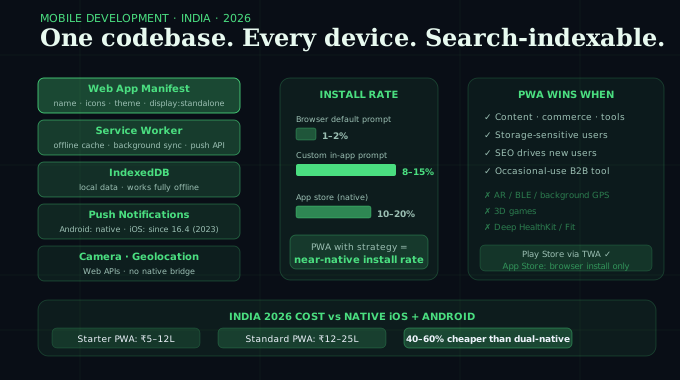
Quick Summary
- 1PWAs are installable websites that work offline, send push notifications, and live on the home screen.
- 2Right for content, commerce, and tools where reach matters more than deep device integration.
- 3Wrong for games, AR, BLE-heavy apps, or anything needing background location.
- 4India 2026 build cost: INR 5 L–35 L — typically 40–60% cheaper than building native iOS + Android.
Five years ago, "should we build a PWA or a native app?" was usually answered with "native, obviously". In 2026, with iOS PWA support now mature, Android push notifications standardised, and the cost of dual-platform native apps still climbing, the calculus has flipped for a lot of use cases. Here's the honest 2026 view from our mobile development practice.
What a PWA is in 2026
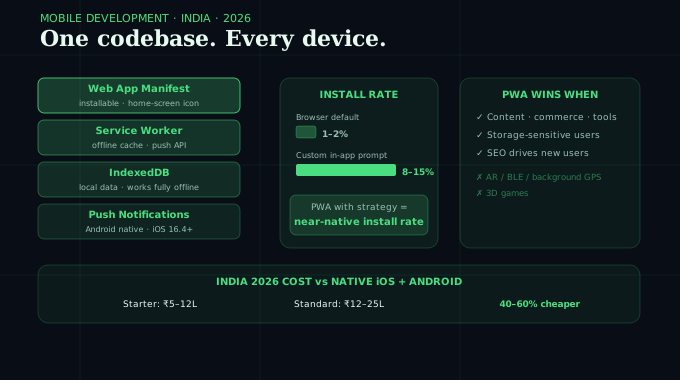
A Progressive Web App is a website that uses modern web capabilities (service workers, web app manifest, push API, IndexedDB) to behave like a native app: it can be installed to the home screen, run offline, send push notifications, access the camera, and look identical to a native app once launched. Crucially, it's still a single codebase served from a URL — no app store, no separate iOS and Android builds, no review delays.
When a PWA is the right answer
- Content and commerce. News, e-commerce, recipes, courses — anything where reach matters and discovery happens through search.
- Tools your users open occasionally. A B2B dashboard your customers check once a week doesn't justify the native install friction.
- Markets with storage constraints. India is the canonical example: many users hesitate to install a 60 MB app for occasional use. A 200 KB PWA shell is invisible to their storage.
- MVPs where speed-to-market trumps everything. A PWA ships in weeks instead of months and skips app-store review entirely.
When a PWA is the wrong answer
Native still wins decisively for: 3D games, AR/VR, BLE accessory control, continuous background location, deep HealthKit/Google Fit integration, and apps where users expect zero perceptible difference from first-party iOS apps. If your app's value is in deep device integration, build native. If your app's value is in the content and workflows on the screen, a PWA is probably enough.
The install-rate truth nobody publishes
PWAs have a credibility problem: install rates are lower than native app store installs because there's no familiar "Install" button. Default browser install prompts are easy to miss. The fix is design, not technology: a custom in-app prompt that fires at the right moment (after a user has had a clear value moment — added an item to cart, completed a workflow, saved an article) with copy that explains the benefit ("Install for offline access" beats "Add to home screen"). Teams that do this see install rates of 8–15%; teams that rely on the browser default see 1–2%.
Indicative PWA build cost (India, 2026)
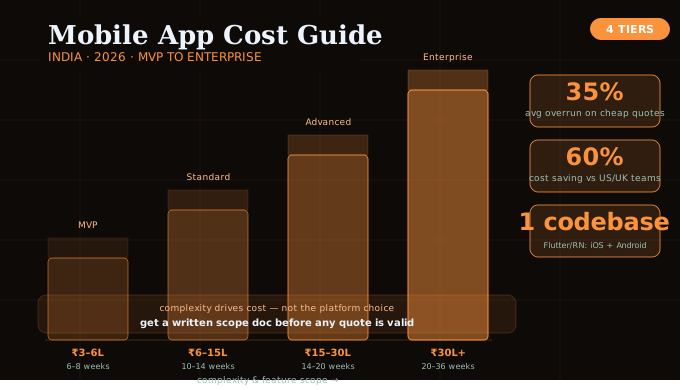
| Build Scope | Price Range | Best For |
|---|---|---|
| Starter PWA — responsive web app + offline shell + installable | INR 5–12 L | Content sites, simple tools, MVPs |
| Standard PWA — offline data sync, push notifications, auth | INR 12–25 L | E-commerce, SaaS, productivity apps |
| Advanced PWA — background sync, payments, deep integration | INR 25–35 L+ | Fintech-lite, booking platforms, field-ops tools |
Planning a Website? Don't Overpay or Underbuild
Most businesses overspend on features they don't need — or underspend and rebuild within a year. We help you scope it right from day one.
Offline that actually works
"Works offline" is the PWA's superpower and the place most builds cut corners. Real offline support means: cached app shell that loads instantly, IndexedDB for user data, a sync queue for actions taken offline that replay when connectivity returns, and clear UI signalling whether the user is online or offline. Done well, the experience matches a native app. Done poorly, the user sees a broken state and concludes "PWAs don't work" — and they're right about your PWA.
What the build actually costs in India 2026
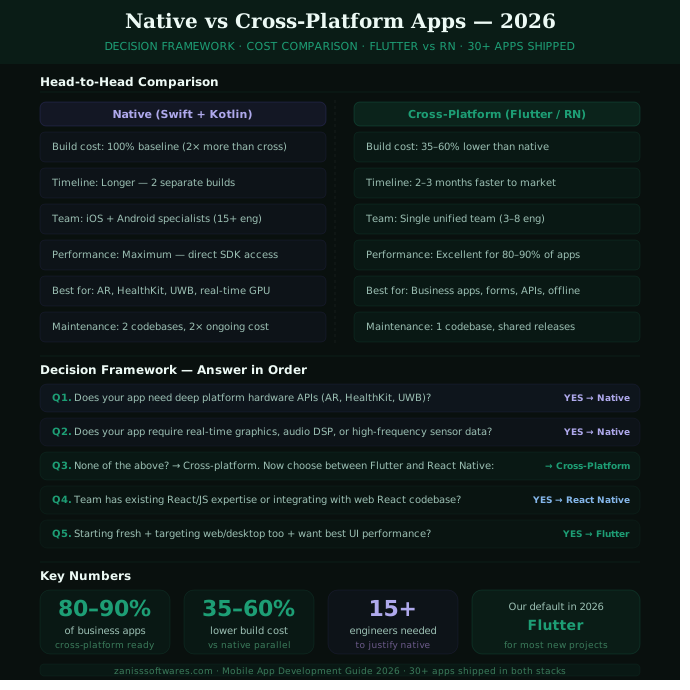
A PWA usually saves 40–60% over building separate iOS and Android apps with the same functionality, because there's one codebase, one deployment pipeline, and no app-store overhead. The savings shrink if you need the advanced features (background sync, complex push, deep integrations) that require platform-specific code. See the pricing table above for indicative ranges, and pair this with our native vs cross-platform comparison for the wider mobile-stack decision.
iOS, finally
For years, Safari's lagging PWA support was the deal-breaker — no push notifications, limited storage, quirky install flow. iOS 16.4 (2023) added Web Push, and by 2026 the gap between iOS and Android PWA capabilities is small enough to ignore for most use cases. The main remaining limitations on iOS: no Web Bluetooth, no background sync, and the install prompt is still a multi-tap journey through the share sheet. Design around these rather than fighting them.
SEO is the unfair advantage
Native apps don't rank in Google. PWAs do. For any business where new-user acquisition happens through search — most content sites, most e-commerce — this is a structural advantage native apps cannot match. Combine a PWA with the SEO playbook from our digital marketing practice and a single asset can serve both your installed users and your search-driven new traffic.
How we engage
PWA projects start with a one-week feasibility review: we audit your use case, run a Lighthouse PWA audit on any existing site, and produce a yes/no/build-native recommendation. From there, build is 4–12 weeks depending on scope. contact us when you're ready to scope one.
Pro Insight
Considering a PWA instead of a native app? Let's run the numbers.
We'll honestly tell you whether a PWA serves your users better than native — and what it actually costs to build it right.
- ✓PWA vs native decision matrix
- ✓Offline-first architecture plan
- ✓Install-rate strategy
- ✓Lighthouse PWA audit included
📩 Response within 24 hours
Frequently Asked Questions
Can a PWA replace our native app entirely?
For many use cases in 2026, yes — particularly content, e-commerce, tools, and B2B dashboards. Where native still wins: 3D games, AR/VR, BLE accessory control, continuous background location, and apps where users expect zero difference from a first-party iOS experience. If your app's value is in content and workflows rather than deep device integration, a PWA is likely sufficient and significantly cheaper to build and maintain.
Do PWAs work on iPhones in 2026?
Yes, with minor caveats. Since iOS 16.4 (2023), Safari supports Web Push, making PWAs viable on iPhone for the first time without workarounds. Remaining limitations: no Web Bluetooth, no background sync, and the install flow requires tapping the share sheet then "Add to Home Screen" — there's no native browser install prompt like Chrome on Android. Design a custom in-app prompt that guides users through it. For the vast majority of content, commerce, and tool use cases, iPhone PWA support in 2026 is good enough.
Can a PWA be listed on the Google Play Store?
Yes — through Trusted Web Activity (TWA), a PWA can be wrapped and published on the Google Play Store as a native-looking app. This is a legitimate path for businesses that need Play Store presence for trust or discovery reasons while keeping a single web codebase. The TWA wrapper is a thin shell; the actual app is still your PWA served from a URL. Apple's App Store does not support TWA — iOS users must install via the browser share sheet flow.