Infographic 63 · ZANISS SOFTWARES

Cloud Security Posture Management in India 2026 — Cost & Risk at a Glance

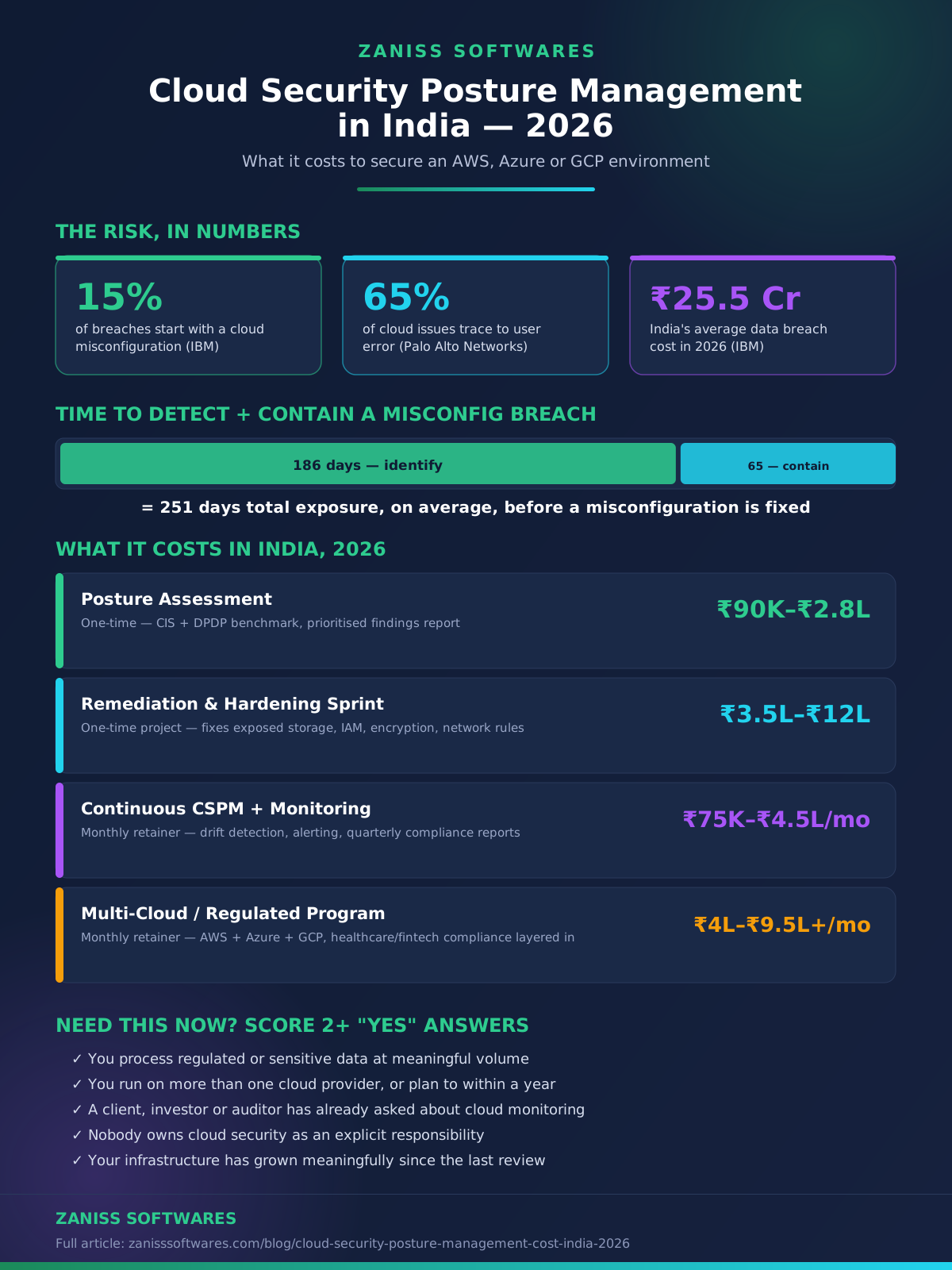
Cloud misconfiguration is the 3rd most common breach entry point — and it takes 251 days on average to catch. Here's what it costs to fix that in India in 2026, where the average data breach now runs ₹25.5 crore (IBM).

Cloud Security Posture Management cost and risk infographic for Indian businesses 2026 — assessment, remediation and monitoring pricing tiers, ZANISS SOFTWARES
Cloud Security Posture Management in India 2026 — Cost & Risk at a Glance · Source: ZANISS SOFTWARES — free to share with credit and a link back to this page.

Key takeaways

  • Cloud misconfiguration causes roughly 15% of data breaches — more often than sophisticated hacking, and mostly from human error (65%, per Palo Alto Networks).
  • Misconfiguration breaches take an average of 251 days to identify and contain, versus much faster detection for other breach types — that's 251 days of live, unmonitored exposure.
  • A realistic CSPM program in India in 2026 ranges from ₹90,000 for a one-time assessment to ₹4,50,000+/month for continuous multi-cloud monitoring, scaled to your footprint.
  • India's DPDP Act expects "reasonable security safeguards" for personal data — regulators and enterprise auditors increasingly treat continuous cloud monitoring as the evidence of that, not a launch-day checklist.

The Pricing Tiers

Three stages, priced by scope: a one-time Posture Assessment (₹90,000–₹2,80,000) benchmarks your environment against CIS Controls and DPDP requirements. A Remediation & Hardening Sprint (₹3,50,000–₹12,00,000) fixes what the assessment finds — exposed storage, over-permissioned IAM roles, unencrypted data, open network rules. Continuous CSPM + Managed Monitoring (₹75,000–₹4,50,000/month) keeps it that way with ongoing drift detection and quarterly compliance reporting. Multi-cloud or regulated-industry programs (healthcare, fintech) run ₹4,00,000–₹9,50,000+/month.

Why the Risk Is Bigger Than It Looks

15% of breaches start with a misconfiguration — the 3rd most common initial attack vector (IBM). 65% of cloud security issues trace to user error, not attacker sophistication (Palo Alto Networks). Gartner projected that through 2025, 99% of cloud security failures would be the customer's fault, not the cloud provider's — a reminder that AWS, Azure and GCP secure the infrastructure, but everything configured on top is on you.

What Actually Drives the Cost Up or Down

Three variables move the price within each tier: how many cloud accounts and services are in scope, whether the environment is single-cloud or multi-cloud, and whether a named compliance framework (DPDP, SOC 2, ISO 27001, healthcare-specific rules) needs to be mapped against findings rather than a generic best-practices pass. A single-account startup sits at the low end of every tier; a multi-cloud, regulated-data business sits at the top for genuine scope reasons, not markup.

How to Decide If You Need This Now

Score two or more "yes" answers below and a one-time assessment is overdue: (1) You process regulated or sensitive data at meaningful volume. (2) You run on more than one cloud provider, or plan to within a year. (3) A client, investor or auditor has already asked about your cloud security monitoring. (4) Nobody owns cloud security as an explicit responsibility. (5) Your infrastructure has grown meaningfully since it was last reviewed. A regulated-data, multi-cloud business should plan straight for continuous monitoring, not just the assessment.
Frequently asked questions

What's the difference between CSPM and a firewall?
A firewall controls traffic at a network boundary. CSPM continuously scans your entire cloud configuration — storage permissions, IAM roles, encryption — against security benchmarks and flags drift as it happens.
Do we need CSPM on a single cloud provider like AWS?
Yes — single-cloud environments still drift constantly as services and team access grow. Multi-cloud simply compounds the same risk faster.
Is this required for DPDP Act compliance?
The Act doesn't name CSPM specifically, but its "reasonable security safeguards" requirement is increasingly interpreted to mean documented, continuous cloud monitoring — treat it as a practical necessity for any business handling real personal data.

Want this applied to your business?

Book a free consultation and we'll map this framework to your project — no fluff, no sales pressure.